“Do you understand, my darling, that you are mine, to do with as I please? That you are my slave, to be used for my pleasure, and to be punished for my displeasure?”
— Prince Laurent speaking to Beauty after she is taken to his castle.

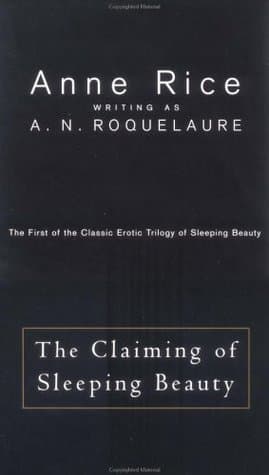
A.N. Roquelaure (1983)
Genre
Fantasy / Romance
Reading Time
253 min
Key Themes
See below
Sign in to track this book
In a daring reimagining of the classic fairy tale, a prince's kiss is replaced by a sensual awakening, binding Sleeping Beauty to a century of erotic enslavement rather than a simple happily-ever-after.
Prince Tristan, having heard the legend of the sleeping kingdom, ventures through the thorny hedge and finds the castle frozen in time. He discovers Princess Beauty, radiant and untouched by the century of slumber. He awakens her with a kiss, fulfilling the prophecy, but immediately makes it clear that this act of salvation comes with a price: her absolute submission to him. He informs her that she is now his property, and her only purpose is to serve his pleasure. Beauty, bewildered and disoriented from her long sleep, is too dazed to resist or fully comprehend the implications of his declaration, accepting her new reality with a mix of fear and strange fascination.
Tristan brings Beauty back to his kingdom, where she is introduced to his royal court and the established customs of his realm. She quickly learns that in this society, all women of royal lineage, once claimed, are considered slaves, subject to the will of their masters. Beauty is placed under the tutelage of the Queen, Tristan's mother, and a stern mistress named Lady Juliana, who begin her rigorous training in obedience and servitude. This initial period is marked by strict lessons, physical punishments for perceived transgressions, and a constant emphasis on her new role as a submissive pleasure slave. She is dressed in simple tunics, her hair is shorn, and she is expected to perform various tasks for the court.
Beauty's training culminates in a public display designed to break her spirit and fully integrate her into her new role. She is brought before the assembled court, stripped, and subjected to a series of spankings and other forms of corporal punishment administered by Lady Juliana and even Prince Tristan himself. This event is not merely punitive but ritualistic, intended to publicly mark her as a royal slave and demonstrate the absolute power of her master. Beauty experiences a profound sense of shame and degradation, yet also a strange, burgeoning awareness of her own body and the power dynamics at play. This public humiliation solidifies her understanding of her new existence.
As the days turn into weeks, Beauty's initial resistance and confusion slowly give way to a grudging, then a more profound, acceptance of her role. The constant discipline, while often painful, also begins to awaken dormant sensations within her. She discovers a peculiar pleasure in obeying, in being controlled, and in the physical sensations of her punishments. Her body, once dormant, responds to the touch and the discipline, and she finds herself anticipating the moments when she will be called upon to serve. This shift marks a significant turning point, as Beauty starts to internalize her new identity and find a sense of purpose, albeit a submissive one, in her existence.
Prince Tristan introduces Beauty to his two younger brothers, Prince Laurent and Prince Thorne, who are also masters in their own right. They are intrigued by Beauty and immediately begin to participate in her training and discipline. Laurent is depicted as more overtly cruel and demanding, while Thorne is somewhat more reserved but equally firm in his expectations of her submission. Beauty finds herself navigating the different personalities and desires of the three princes, each of whom claims a share of her time and attention. Her world expands to include their commands and their various forms of discipline, further entrenching her in the life of a royal pleasure slave.
A grand royal tournament is held, drawing knights and nobles from across the land. During this event, Beauty is expected to serve the princes and their guests, often in a state of partial undress or with specific markings indicating her slave status. She is paraded before the court, used as a human footstool, and subjected to public spankings and other forms of discipline as a demonstration of her masters' power and her own obedience. This public exposure further reinforces her identity as a pleasure slave and allows her to experience the full extent of the court's customs and the expectations placed upon her. She becomes a living symbol of the princes' authority.
Despite her increasing acceptance, Beauty still experiences moments of internal conflict. She occasionally recalls fragments of her former life as a princess, a life of freedom and agency, which clashes with her current reality. However, these memories are increasingly overshadowed by her growing desire for the discipline and the profound sense of release and pleasure she finds in her submission. She actively seeks out the princes' attention, craving their touch, their commands, and the punishments they inflict. This internal struggle highlights the psychological transformation she is undergoing, as her former self slowly erodes, replaced by a new identity shaped by her experiences.
Beauty is subjected to a ceremonial bridling, a symbolic act that further cements her status as a pleasure slave. This ritual involves being fitted with a decorative bridle, often with a bit, symbolizing her complete control and ownership by the princes. The ceremony is a public affirmation of her status, reinforcing the idea that she is an animal to be trained and ridden. While initially daunting, Beauty finds herself submitting to the ritual with a mix of trepidation and a strange, almost eager, anticipation. This event marks another significant step in her transformation, as she embraces the symbolic and literal aspects of her enslavement.
As Beauty's training progresses and her obedience becomes absolute, she is granted access to the more private and intimate chambers of the princes. Here, she learns the full spectrum of her duties as a pleasure slave, engaging in various erotic acts and forms of servitude that are reserved for the most compliant and highly trained. These private sessions are intense and demanding, pushing the boundaries of her physical and emotional endurance, yet Beauty finds herself increasingly responsive and even eager to please her masters. She experiences a deepening of her pleasure in submission, finding profound satisfaction in fulfilling their every command.
Towards the latter part of her training, Beauty is subtly, and sometimes overtly, tested on her loyalty and whether she harbors any lingering desire for freedom. She is presented with opportunities or scenarios that might allow her to escape or assert independence, but each time, she chooses to remain in her state of enslavement. This choice is not made out of fear alone, but from a genuine, deeply ingrained desire to serve her masters and the profound pleasure she now derives from her submission. She has fully embraced her role, finding her identity and purpose within the confines of her servitude, demonstrating her complete transformation.
The story culminates in a grand ball, where Beauty's transformation is fully revealed to the assembled court. She is paraded as the epitome of a perfectly trained royal pleasure slave, adorned in a manner that highlights her submission and her beauty. She performs various acts of service and obedience, publicly demonstrating her mastery and her willingness to please. This final display signifies her complete psychological and physical enslavement, where her will is entirely subsumed by that of her masters. Beauty has not only accepted her fate but has come to find profound fulfillment and identity in her role as a willing and eager servant.
The Protagonist
Beauty transforms from an innocent, bewildered princess into a fully compliant and eager pleasure slave, finding her identity and satisfaction in submission.
The Antagonist/Master
Tristan remains consistently dominant, his character serving as the unwavering force that shapes Beauty's transformation.
The Supporting/Master
Laurent remains a consistent figure of demanding authority, his role to further test Beauty's limits and obedience.
The Supporting/Master
Thorne maintains his reserved yet firm demeanor, contributing to Beauty's multifaceted training.
The Supporting/Trainer
Juliana consistently embodies the strict enforcer, her role to guide Beauty through the initial stages of her training.
The Supporting/Mentor
The Queen remains a figure of established authority, upholding the traditions of the court.
The novel meticulously details Beauty's profound transformation from an independent princess to a willing pleasure slave. Her identity is systematically stripped away and rebuilt, not through force alone, but through a process that awakens dormant desires within her. This theme explores how environment and persistent conditioning can reshape an individual's sense of self and purpose. For instance, Beauty's initial confusion and resistance slowly give way to a profound acceptance and even eagerness for her new role, as seen when she begins to anticipate the princes' commands and finds pleasure in the discipline, effectively forging a new identity rooted in submission.
“She was no longer a princess, but a creature of her master's pleasure, and in that realization, she found a strange, unsettling peace.”
The narrative is fundamentally about power dynamics, specifically the absolute power held by the princes over Beauty. This power is not merely political but extends to complete control over her body, mind, and will. The story explores how power is asserted, maintained, and internalized, with Beauty's submission becoming a testament to the princes' authority. Scenes of public humiliation, such as the initial spankings and her role in the royal tournament, vividly illustrate this theme, demonstrating the princes' ability to dictate every aspect of her existence and the public acknowledgement of their dominion.
“Her will was no longer her own; it was a delicate instrument tuned to the desires of her masters.”
A central theme is Beauty's sexual awakening, which is inextricably linked to her enslavement and the experience of pain and discipline. The story posits that her journey into submission unlocks a deep-seated capacity for pleasure derived from being controlled and objectified. This theme challenges conventional notions of sexuality, suggesting that desire can manifest in complex and unconventional ways, particularly within power imbalances. Her growing anticipation of punishments and her eager response to the princes' intimate commands exemplify this awakening, as she discovers a new lexicon of erotic experience.
“The lash on her flesh was a strange, terrible caress, awakening sensations she had never known existed.”
The novel implicitly questions the definition of freedom, particularly as Beauty willingly chooses to remain in servitude despite potential opportunities for escape. It explores whether true freedom lies in autonomy or in finding fulfillment within a chosen, albeit restrictive, role. Beauty's ultimate contentment in her enslavement suggests that for some, submission can be a path to a different kind of liberation – freedom from the burden of choice and responsibility. Her final acceptance, where she finds purpose and satisfaction in serving, highlights this nuanced exploration.
“To serve was not merely to obey, but to exist, fully and completely, for another's pleasure.”
A magical enchantment that freezes time and creates a blank slate for Beauty's transformation.
The century-long sleeping spell serves as a crucial plot device by removing Beauty from her original life and context. It ensures her innocence and ignorance of the outside world, making her a 'blank slate' upon awakening. This allows Prince Tristan to immediately assert his claim and begin her re-education without any prior loyalties, knowledge, or established identity to contend with. The spell effectively erases her past, making her subsequent transformation into a slave more psychologically plausible and profound, as she has no competing memories or societal norms to cling to.
The established social norms and laws regarding royal women and slavery in Tristan's kingdom.
The elaborate and rigid customs of Prince Tristan's kingdom, particularly those pertaining to royal women being considered slaves, function as a powerful plot device. These customs provide the justification and framework for Beauty's enslavement, making it not an arbitrary act of cruelty, but a sanctioned, traditional practice. This societal structure normalizes her treatment, providing a constant external pressure for her to conform. It also dictates the specific rituals, training, and punishments she undergoes, shaping the narrative and her psychological journey within a well-defined, albeit harsh, social order.
The systematic use of physical discipline as a tool for training, control, and erotic awakening.
Corporal punishment, particularly spanking and whipping, is a central plot device used throughout the novel. It serves multiple functions: to enforce obedience, to break Beauty's will, and crucially, to awaken her sexually. The repetitive nature and ritualization of these punishments gradually condition Beauty, transforming pain into a source of pleasure and a pathway to deeper submission. This device directly illustrates the theme of sexual awakening and the psychological shifts occurring within Beauty, as her body learns to respond to and even crave the discipline, driving her transformation.
The use of public displays to cement Beauty's slave status and reinforce power dynamics.
Public humiliation, such as Beauty being displayed in various states of undress or subjected to discipline before the court, is a significant plot device. These events serve to publicly mark Beauty as a slave, stripping her of her former royal dignity and reinforcing her new, subordinate status in the eyes of the entire kingdom. It also acts as a powerful psychological tool, embedding her new identity through shared social experience and the shame associated with it. This device underscores the themes of power and control, demonstrating the princes' absolute dominion and the societal acceptance of Beauty's transformation.
“Do you understand, my darling, that you are mine, to do with as I please? That you are my slave, to be used for my pleasure, and to be punished for my displeasure?”
— Prince Laurent speaking to Beauty after she is taken to his castle.
“She was his creature, and she knew it. She was his plaything, his property, his slave. And the knowledge filled her with a strange, thrilling terror.”
— Beauty's internal thoughts as she adapts to her new life.
“The memory of the Prince's touch, the sting of his paddle, the feel of the ropes binding her, all of it was becoming a part of her, defining her.”
— Beauty reflecting on her experiences and how they are changing her.
“You will serve, and you will obey, and you will learn to find pleasure in your service and obedience.”
— One of the Prince's instructions to Beauty regarding her role.
“There was a certain exquisite torment in waiting, in knowing what was to come, and yet being powerless to stop it.”
— Beauty's feelings of anticipation and helplessness.
“Every lash, every binding, every command was a lesson, teaching her to surrender, to trust, to desire her own subjugation.”
— The narrator describing the effects of the Prince's training on Beauty.
“She had thought she knew herself, but this new world, this new master, was revealing parts of her she never knew existed.”
— Beauty's realization about her own hidden desires and nature.
“The chains were not merely physical; they were also of the mind, binding her to her master with threads of fear and devotion.”
— A description of the psychological impact of Beauty's servitude.
“To be truly claimed was to have every part of one's being, body and soul, submitted to another's will.”
— The overarching theme of the book, explained in a philosophical sense.
“She found herself craving his displeasure as much as his approval, for both were proof of her existence in his world.”
— Beauty's complex emotional response to the Prince's treatment.
“The world outside faded, becoming a distant dream. Only the castle, only the Prince, only her service mattered.”
— Beauty's growing isolation and focus on her new life.
“He was not cruel without purpose, nor kind without expectation. Every act had its meaning, its lesson.”
— The narrator's observation about the Prince's methods.
“Her innocence was a garment she had shed, replaced by a darker, more potent knowledge.”
— Beauty's transformation from naivete to experience.
“There was a profound peace in relinquishing control, in allowing another to guide her every movement, every breath.”
— Beauty finding unexpected solace in her submission.
Ready to see how well you understood this book? Take our interactive quiz with 10 questions.

A.N. Roquelaure is the pseudonym for Anne Rice, a celebrated author known for her evocative and often controversial explorations of fantasy, erotica, and the supernatural. Under this name, Roquelaure penned "The Claiming of Sleeping Beauty," a series that reimagined the classic fairy tale with explicit sensuality and dark themes, becoming a notable work within erotic fantasy literature.







