“Jerry, they can make you do anything they want. It's a free country, but they can still make you do it.”
— Brother Leon's manipulation of Jerry regarding the chocolates.

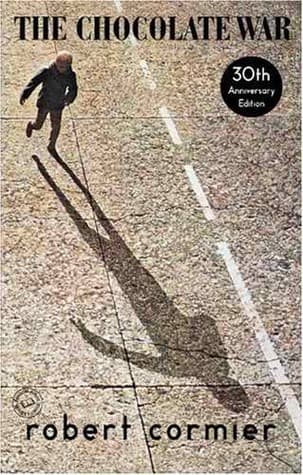
Robert Cormier (1974)
Genre
Young Adult
Reading Time
270 min
Key Themes
See below
Sign in to track this book
At Trinity High, one boy's refusal to sell chocolates sparks a psychological war, forcing him to face a corrupt secret society and the high cost of challenging the system.
Jerry Renault, a Trinity freshman, endures football tryouts, feeling physical and emotional pain under Coach Rollins. He is new, still finding his place, and feels pressure to fit in. In his locker, he finds a poster asking, 'Do I dare disturb the universe?' This question sparks defiance and introspection, setting the stage for his actions. Meanwhile, Archie Costello, The Vigils' Assigner, watches the tryouts, already planning his next assignment, showing his power and manipulative nature within the school's secret society.
Brother Leon, the interim headmaster, announces the annual chocolate sale, an event crucial for school funding and his reputation. He aims to break previous sales records and puts immense pressure on students. At the same time, Archie Costello, The Vigils' cunning and cruel Assigner, gives Jerry Renault his first assignment: refuse to sell chocolates for ten days. Jerry, still thinking about 'disturbing the universe,' accepts, not fully understanding the consequences. This act of defiance, initially a simple Vigils prank, soon becomes far more significant.
Jerry Renault, following The Vigils' assignment, publicly refuses to sell chocolates when Brother Leon calls his name. This shocks Brother Leon and other students, as no one has openly defied the sale before. Brother Leon, enraged but trying to stay calm, singles out Jerry, but Jerry stands firm. The ten days pass, and Jerry continues his silent protest, amusing The Vigils and increasingly frustrating Brother Leon, who sees Jerry's defiance as a personal insult and a threat to his authority and the sale's success.
After ten days, The Vigils, through Obie, tell Jerry his assignment is over and he can start selling chocolates. To everyone's surprise, especially Archie's, Jerry continues to refuse. He has moved past the prank; his refusal is now a personal stand, an answer to the 'disturb the universe' question. This independent defiance angers Archie, who loses control over Jerry, and further fuels Brother Leon's anger. Jerry's continued refusal turns a simple prank into a real rebellion, challenging Trinity's established order.
Brother Leon, desperate for the chocolate sale to succeed and to crush Jerry's rebellion, sees his authority weakening. He implicitly collaborates with Archie Costello, recognizing Archie's power to manipulate the student body. Archie, enjoying the chaos and challenge, begins a campaign of psychological warfare against Jerry. He uses his influence to turn the entire student body against Jerry, making him an outcast. The school environment becomes hostile, with Jerry isolated and facing subtle but constant intimidation and ostracism orchestrated by Archie and The Vigils.
Archie's campaign against Jerry grows. He assigns Vigils members to spread rumors and intimidate students, ensuring no one buys chocolates from Jerry. Students who try to support Jerry or show sympathy are quickly targeted and isolated. The unsold chocolates pile on Jerry's desk, a constant reminder of his failure and isolation. Pressure mounts on Jerry as he faces collective disapproval and hostility from his peers, orchestrated by Archie's cunning and ruthless tactics. The school becomes a hostile environment for Jerry, where conformity is enforced through fear.
Goobers, last year's top chocolate salesman, struggles under Brother Leon's immense pressure to sell his quota. He is physically and emotionally exhausted, his room filled with unsold chocolates. He confides in Jerry, expressing deep resentment and hatred for Brother Leon and the chocolate sale. Goobers' confession highlights the toxic environment created by Brother Leon's obsession and Archie's schemes, showing that Jerry is not the only one suffering, though he is the only one openly resisting. His breakdown foreshadows the potential consequences of defying the system.
As Jerry holds his ground, the harassment orchestrated by Archie becomes more open and cruel. Jerry's locker is vandalized, his schoolwork destroyed, and he endures constant verbal abuse and shoves in hallways. He becomes an outcast, ostracized by almost all classmates, even those who secretly admire his courage. The school, under The Vigils' unspoken rule, ignores the bullying, effectively enabling Archie's reign of terror. Jerry's resolve is tested daily as he endures this escalating torment.
To completely humiliate Jerry and reassert The Vigils' power, Archie proposes a public boxing match between Jerry and Emile Janza, a brutal bully. The event is framed as a school fundraiser for the chocolate sale, drawing a large crowd. Jerry, knowing the odds are against him, accepts the challenge, seeing it as his last stand. Archie designs this public spectacle to be Jerry's ultimate degradation, a final, violent act to break his spirit and ensure no one else dares to 'disturb the universe' at Trinity.
The boxing match occurs in the school gym, a chaotic and violent spectacle orchestrated by Archie. Emile Janza, following Archie's subtle cues, brutally beats Jerry, inflicting severe injuries. The crowd, initially excited, grows uncomfortable with the brutality, but no one intervenes. The fight is rigged, with Archie manipulating the referee and rules to ensure Jerry's defeat. Jerry is left severely injured, his spirit broken, and his defiance crushed. The novel ends with Jerry being taken away in an ambulance, his rebellion extinguished, and the dark forces of conformity and corruption having triumphed at Trinity.
The Protagonist
Jerry transforms from a hesitant freshman into a defiant individual, only to be ultimately crushed by the corrupt system he challenges.
The Antagonist
Archie remains consistently cruel and manipulative, successfully maintaining his power and crushing dissent without facing any consequences.
The Antagonist
Brother Leon's desperation for success and control leads him to embrace increasingly unethical methods, ultimately succeeding in his goals at the expense of student well-being.
The Supporting
Obie's resentment of Archie deepens throughout the novel, but he remains unable to act against him, highlighting the pervasive nature of fear and complicity.
The Supporting
Emile remains a static character, a brutal enforcer whose violence is exploited by Archie without personal growth or change.
The Supporting
Goobers' spirit is broken by the relentless pressure, illustrating the destructive consequences of conformity.
The Mentioned
His absence allows corruption to flourish, but his memory serves as a moral compass for some.
The Supporting
The Vigils maintain their power throughout the novel, demonstrating the difficulty of challenging deeply entrenched systems of control.
The novel shows how power, whether held by adults or students, can corrupt and be abused. Brother Leon's desperate desire for a successful chocolate sale leads him to unethical and cruel tactics. Archie Costello's position as Assigner of The Vigils allows him to manipulate and torment others for his own amusement. The unchecked authority of both characters creates an oppressive environment, demonstrating that absolute power corrupts absolutely. This is clear in Brother Leon's intimidation of students like Goobers and Archie's systematic campaign against Jerry, ending in the rigged boxing match.
“Jerry remembered the poster in his locker: Do I dare disturb the universe? Yes, he thought, I dare.”
This is the novel's central conflict. Jerry Renault's refusal to sell chocolates, initially a Vigils assignment, becomes a personal stand against Trinity's oppressive conformity. The school's system, enforced by Brother Leon and The Vigils, demands absolute adherence to its rules and expectations. Jerry's defiance highlights the immense pressure to conform and the severe consequences of choosing individuality. The tragic outcome of Jerry's rebellion shows the difficulty, and often futility, of an individual challenging a deeply entrenched and corrupt collective, as seen when the entire student body turns against him.
“Nobody had ever said no to Brother Leon before. Or to the Vigils. Or to the school. It was a first.”
The novel examines how authority figures, both adult and peer-based, abuse their positions. Brother Leon, as interim headmaster, uses fear and manipulation to ensure the chocolate sale's success, prioritizing personal ambition over student well-being. Archie Costello, as The Vigils' leader, wields significant power over the student body, using it for cruel pranks and psychological torture. The adults in the school, by ignoring or tacitly allowing The Vigils' activities, are complicit in this abuse. The climax, where Jerry is severely beaten in a 'fight' sanctioned by the school, is the clearest example of this theme.
“He knew that Archie was the one who pulled the strings, the one who manipulated the puppets. And he knew that he, Obie, was one of the puppets.”
Fear is a dominant force at Trinity, used by both Brother Leon and Archie to maintain control. Students fear Brother Leon's wrath if they don't sell chocolates and The Vigils' retribution if they defy Archie. This fear leads to widespread conformity and silence, preventing anyone from supporting Jerry or challenging the status quo. Obie's resentment of Archie is constantly overshadowed by his fear. Even students who initially admire Jerry's courage eventually succumb to the fear of being ostracized or targeted, showing how fear can paralyze collective action.
“Fear was a constant, a dull ache in the belly, a cold hand on the heart.”
The novel follows Jerry Renault's painful journey from an innocent freshman to a disillusioned and broken individual. He enters Trinity with hope and a desire to understand his place, symbolized by the 'disturb the universe' poster. However, his experiences with Brother Leon's corrupt power and Archie's sadistic manipulation strip him of his idealism. The brutal ending, where Jerry is physically and emotionally crushed, signifies a profound loss of innocence, suggesting that in this world, goodness and defiance are often punished, leaving little room for hope.
“He thought of the poster, the question. He had disturbed the universe, all right. But had it been worth it?”
A symbolic question that catalyzes Jerry's rebellion.
This poster, found in Jerry's locker, serves as a powerful symbol and a direct challenge to Jerry. It encapsulates the novel's central theme of conformity versus individuality. For Jerry, it's not just a rhetorical question but a call to action, prompting him to question the established order at Trinity. His decision to continue refusing to sell chocolates, even after The Vigils' assignment ends, is his answer to this question, transforming a prank into a genuine act of rebellion and defining his character arc.
A secret society that acts as a parallel, darker authority within the school.
The Vigils are a crucial plot device, representing the dark, unchecked power that exists among the students, often mirroring and amplifying the abuses of the adult faculty. They serve as Archie Costello's instrument of manipulation and control, allowing him to orchestrate the systematic harassment of Jerry. Their existence highlights the complicity of the adult staff (like Brother Leon) who either ignore or implicitly sanction their activities, revealing the corrupt underbelly of the school's social structure and the pervasive nature of peer pressure.
A seemingly innocuous event that becomes a battleground for power and control.
The annual chocolate sale is initially presented as a standard school fundraiser, but it quickly becomes the central arena for the conflict between Brother Leon's ambition, Archie's manipulation, and Jerry's defiance. It is the catalyst for Jerry's rebellion and the focal point of Brother Leon's desperate need for control. The chocolates themselves become symbols of conformity and the pressure to succeed, and Jerry's refusal to sell them transforms a simple product into a powerful statement against the school's oppressive system.
A psychological tool used by Archie to maintain his power and avoid consequences.
The black box contains marbles, one of which is black. Before assigning a particularly cruel task, Archie is forced to draw from the box. If he draws the black marble, he must perform the assignment himself. This device adds an element of suspense and psychological tension. It demonstrates Archie's cunning, as he rarely draws the black marble, suggesting manipulation or luck. It also highlights his cowardice, as he fears having to personally execute his own cruel assignments, yet it acts as a symbolic check on his power, even if an ineffective one.
An early metaphor for the physical and psychological struggles at Trinity.
The grueling football tryouts that Jerry endures at the beginning of the novel serve as an early metaphor for the larger struggles he will face at Trinity. The physical pain, the pressure to perform, the feeling of being observed and judged, and the hierarchy established by Coach Rollins all parallel the oppressive environment of the school. It introduces the theme of suffering for a cause and foreshadows the physical and emotional toll Jerry's rebellion will take on him, establishing a baseline for the harsh realities of the school.
“Jerry, they can make you do anything they want. It's a free country, but they can still make you do it.”
— Brother Leon's manipulation of Jerry regarding the chocolates.
“Go ahead, refuse. See what happens.”
— Brother Leon challenging Jerry to defy the chocolate sale.
“The world was a conspiracy of the beautiful and the strong, leaving the ugly and the weak to suffer.”
— Jerry's internal reflection on the social hierarchy at Trinity.
“Don't disturb the universe.”
— The phrase Jerry sees on a poster, which later becomes ironic.
“He knew that if he did not sell the chocolates, he would be an outcast, a pariah. But he knew, too, that if he did sell them, he would be a hypocrite.”
— Jerry's internal conflict regarding his refusal to sell chocolates.
“He learned that to be a hero, one must be alone.”
— Jerry's realization about the nature of his stand against the school.
“The world was a series of choices, and sometimes the choices were rotten.”
— Jerry contemplating the difficult decisions he faces.
“Conformity was the only sin.”
— Jerry's internal thought about the importance of individuality.
“He knew what was coming. It was the moment of truth, the moment when he would discover if he was a man or a boy.”
— Jerry preparing for the boxing match against Emile Janza.
“It was not a question of courage. It was a question of survival.”
— Jerry's pragmatic assessment of his situation.
“They had won. He had lost. It was as simple as that.”
— Jerry's reflection after the boxing match and his defeat.
“But it was not courage. It was fear. Fear of being alone, fear of being different.”
— Jerry's internal struggle with the motivations behind his actions.
“You do what you have to do. What else is there?”
— A resigned thought from Jerry about facing his circumstances.
“The universe was not disturbed. It was merely rearranged.”
— A final, cynical reflection on the aftermath of Jerry's stand.
Ready to see how well you understood this book? Take our interactive quiz with 10 questions.
Biography coming soon.