“The past is a ghost, the future a dream, and all we ever have is now.”
— Eddie reflects on the nature of time and memory.

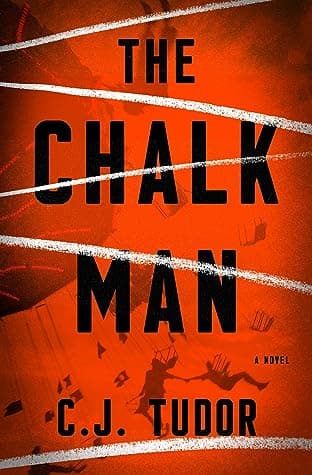
C.J. Tudor (2018)
Genre
Thriller / Mystery
Reading Time
360 min
Key Themes
See below
Sign in to track this book
Thirty years after a game of chalk figures led them to a dismembered body, a new chalk man resurfaces, forcing Eddie and his childhood friends to confront the dark secrets of their past before a killer erases them all.
In the summer of 1986, twelve-year-old Eddie Adams and his friends — Fat Gav, Metal Mickey, Hoppo, and Nicky — live in the quiet English village of Anderbury. They have a secret code using chalk men drawings to leave messages. One day, a mysterious chalk man drawing, different from their own, appears near the fairgrounds. Eddie and his friends follow its directions into the woods. There, they find the dismembered body of Elsie Newton, a local teenager who had gone missing days earlier. This event ends their innocent childhood and starts a dark chapter in their lives, linking them to the tragic death.
After Elsie Newton's body is found, police arrive in Anderbury. Mr. Halloran, a new teacher at their school, is an early suspect because he is secretive and was near the fairgrounds. However, the investigation later focuses on a local fair worker, and the case remains unsolved, leaving the community uneasy. Eddie and his friends struggle with what they saw, having nightmares and feeling uneasy. They keep the detail about the mysterious chalk man drawing that led them to the body a secret, fearing they might be blamed. The incident causes problems in their friendships and creates suspicion among them.
Later that summer, a new girl named Nicola, or 'Nicky', moves to Anderbury and quickly joins Eddie's group of friends. She is confident and adventurous, bringing a new energy to their interactions after the trauma. One evening, while playing 'truth or dare' at the local quarry, a dare goes wrong. Nicky dares Eddie to jump from a dangerous height into the water. He hesitates, but under pressure, he tries the jump. He hits his head on a rock during the fall and nearly drowns. It is revealed that Fat Gav, in a moment of panic, pushed him. The incident leaves Eddie with a severe head injury and a lifelong scar, further straining the group's relationships.
In 2016, Eddie Adams is a forty-two-year-old English teacher, living a quiet life in Anderbury, still affected by the events of 1986. He receives a mysterious package with a single chalk man drawing, identical to the one that led them to Elsie Newton's body decades earlier. This delivery immediately brings back his suppressed memories and anxieties. He soon finds that his childhood friends — Fat Gav, Metal Mickey, and Hoppo — have also received similar chalk man drawings. The reappearance of these symbols suggests that someone from their past is reaching out, or threatening them, forcing Eddie to confront the unresolved trauma and secrets of that summer.
The friends try to treat the chalk men as a joke, dismissing them as a macabre prank. However, their casual attitude quickly turns to fear when Hoppo, one of their childhood friends, is found dead in his home, an apparent suicide. The police call it a suicide, but Eddie and the others are convinced it is connected to the chalk men and the events of 1986. Hoppo's death increases the paranoia within the group, making them realize that the chalk men are not just a reminder but a sinister warning. Eddie begins to suspect that someone is targeting them, making him look deeper into the past to uncover the truth behind Elsie Newton's murder and the quarry accident.
Because of Hoppo's death and the threat, Eddie starts his own investigation, revisiting old acquaintances and places from 1986. He talks with Mrs. Halloran, the widow of Mr. Halloran, the teacher who was briefly suspected in Elsie's murder. He learns more about the fair that was in town, and the people connected to it. He also remembers details about Elsie Newton's life, her reputation, and her interactions with people in the village, including some of the fair workers. Each conversation uncovers fragmented memories and introduces new potential suspects or motives, blurring the lines between past and present and making Eddie question everything he thought he knew.
Eddie confronts Fat Gav about the quarry accident, the long-held secret in their friendship. Gav, visibly shaken, confesses that he did push Eddie, accidentally, out of fear and panic after Eddie hesitated on the ledge. He also reveals his own troubled past, including his abusive father, which explains his often aggressive and insecure behavior as a child. This confession, while painful, gives Eddie a piece of the puzzle, showing the deep guilt and secrets that have affected their group for decades. It also shows the complex dynamics and hidden trauma each friend carried.
Eddie eventually uncovers the truth about Elsie Newton's murder. Mr. Halloran, the art teacher, was involved. Elsie was pregnant, and Mr. Halloran was the father. He had promised to help her get an abortion, but during a confrontation at the fairgrounds, Elsie threatened to expose him, leading to a struggle. Mr. Halloran accidentally pushed Elsie, causing her to fall and hit her head, killing her. He then dismembered her body to conceal her identity and the pregnancy, hoping to avoid scandal and protect his career. This revelation exposes the dark secrets in their quiet village.
Eddie eventually realizes that Nicky drew the chalk men in 2016. Nicky, still alive and seeking revenge, had planned everything. She had led them to Elsie's body in 1986, having seen Mr. Halloran's crime. She also knew about Fat Gav pushing Eddie at the quarry. Nicky, traumatized by these events and feeling abandoned by her friends, had returned to seek retribution for the injustices of the past. She believed her friends had failed to protect her and Elsie, and had allowed the truth to stay hidden for too long. Her chalk men were a symbol of her unresolved pain and her desire for justice.
The story ends with a tense confrontation between Eddie and Nicky, where all the remaining secrets are revealed. Nicky explains her full role in the events of both 1986 and 2016, including her use of the chalk men and her intent to make the others suffer for their past actions. Eddie, now understanding her deep pain and her twisted sense of justice, tries to reason with her. The confrontation forces both of them to face their shared trauma and the consequences of their childhood secrets. The full extent of the emotional damage from the past is revealed, leading to an unsettling resolution that affects Eddie.
The Protagonist
From a traumatized man trying to forget his past, Eddie transforms into an active investigator, bravely confronting his memories and friends to uncover the truth.
The Protagonist
A naive child who loses his innocence after witnessing a horrific crime and experiencing a near-fatal accident.
The Antagonist/Supporting
From a seemingly innocent new girl, Nicky evolves into a vengeful orchestrator, determined to expose the past and seek retribution.
The Supporting
From a troubled, insecure child, Gav grows into a man still haunted by his past actions, eventually confessing his truth.
The Supporting
Mickey remains a steadfast friend, navigating shared trauma with a quieter, more pragmatic approach.
The Supporting
From a fearful child, Hoppo remains haunted by the past, ultimately succumbing to its renewed terror.
The Supporting/Victim
Elsie's story is revealed posthumously, transforming from a mysterious victim to a symbol of hidden secrets and injustice.
The Antagonist
Initially a peripheral figure, he is gradually exposed as the perpetrator of the central crime, embodying hidden depravity.
The Mentioned
Unknowingly reveals critical information that helps unravel the central mystery.
The novel shows how a single traumatic event in childhood can shape and haunt individuals for decades. The discovery of Elsie Newton's body and the quarry accident change the lives of Eddie and his friends. As adults, they are all deeply affected: Eddie is withdrawn, Gav is volatile, Hoppo is afraid, and Nicky wants revenge. The chalk men are a symbol of this unaddressed trauma, forcing the characters to confront the past they've tried to bury, showing how unresolved psychological wounds worsen and eventually demand attention.
“Childhood trauma is like a chalk man. You draw it, you erase it, but the dust always remains. And sometimes, the dust rises again.”
Secrets and lies are important to the story, both in 1986 and 2016. The children's decision to keep the mysterious chalk man a secret, Gav's lie about pushing Eddie, and Mr. Halloran's cover-up of Elsie's murder all show how secrets can damage relationships and lead to bad outcomes. The adult characters carry the guilt of their past actions and inactions, creating distrust and resentment. The novel shows how trying to hide the truth only delays its inevitable return, often with more destructive force.
“Secrets are like chalk. They get on everything. And they don't always wipe away clean.”
The novel deals with the unclear line between justice and revenge. Nicky, driven by her trauma and the perceived injustice of Elsie's unsolved murder and her friends' involvement, takes matters into her own hands. Her plan with the chalk men is an attempt to force a reckoning and deliver her own form of justice. However, her methods are destructive and cause more pain, raising questions about whether her actions are right. The theme explores if true justice can come from revenge, or if it only continues a cycle of suffering.
“Sometimes, justice isn't about what's right. It's about what's owed.”
The Chalk Man clearly contrasts the innocent world of childhood games and friendships with the harsh reality of adult evil. Eddie and his friends' summer is shattered by the discovery of Elsie Newton's body, ending their innocence. Their secret chalk code, initially a symbol of their bond and imagination, becomes a sign of death and fear. The novel shows how easily childhood can be corrupted by trauma, forcing children to face the darkest parts of humanity and taking away their carefree existence, leaving them scarred for life.
“That summer, we learned that monsters weren't just in stories. They were real. And they lived in Anderbury.”
Alternating chapters between 1986 and 2016 to slowly reveal the mystery.
The novel employs a dual timeline structure, switching between Eddie's childhood experiences in 1986 and his adult life in 2016. This device effectively builds suspense by gradually revealing fragments of the past, mirroring Eddie's own fragmented memories and investigation. The alternating perspectives allow the reader to understand the origins of the trauma while simultaneously experiencing its present-day consequences, linking cause and effect across three decades. It also creates dramatic irony as the reader often knows more than the adult Eddie initially, but less than the child Eddie did at the time of certain events.
A recurring symbol representing communication, warning, and trauma.
The chalk men are the central symbolic motif of the novel. In 1986, they are a secret code among friends, representing childhood innocence and communication. However, the appearance of a mysterious chalk man leading them to Elsie Newton's body transforms them into a symbol of dread and foreboding. In 2016, their reappearance signifies the return of the past trauma and serves as a direct threat or warning. They are a powerful visual and narrative device, representing both shared secrets and the lingering, inescapable nature of unresolved events, ultimately becoming a tool for revenge.
The story is told from Eddie's perspective, colored by memory and trauma.
The entire story is narrated from Eddie's first-person perspective, both as a child and an adult. This makes him an inherently unreliable narrator, as his memories are often fragmented, suppressed, or influenced by trauma and the passage of time. The reader experiences the mystery through his subjective lens, piecing together the truth alongside him. This device enhances the suspense and mystery, as the reader must question Eddie's recollections and interpretations, adding layers of psychological depth to the narrative and making the final revelations more impactful.
Misleading clues and characters designed to distract from the true culprit.
The novel skillfully uses red herrings to mislead the reader and build suspense. Initially, Mr. Halloran is presented as a prime suspect due to his secretive nature and the circumstances of Elsie's death. Later, suspicion falls on various fair workers and even among Eddie's own friends regarding different aspects of the past. These misdirections keep the reader guessing and prevent them from identifying the true perpetrator and their complex motivations too early, making the final reveal more surprising and impactful. They highlight the difficulty of discerning truth when obscured by fear and fragmented memories.
“The past is a ghost, the future a dream, and all we ever have is now.”
— Eddie reflects on the nature of time and memory.
“You can't change the past, but you can change the story you tell about it.”
— Eddie contemplates how narratives shape our understanding of events.
“Sometimes the monsters are real, and sometimes they're just people.”
— Eddie realizes the blurred line between human evil and supernatural fear.
“We all have secrets. Some are just buried deeper than others.”
— Eddie acknowledges the hidden truths in his small town.
“The chalk men were our secret code, but secrets have a way of turning deadly.”
— Eddie recalls the childhood game that led to tragedy.
“Friendship is a fragile thing, easily broken by a single lie.”
— Eddie reflects on how deceit shattered his childhood friendships.
“In a small town, everyone knows your business, but no one knows the truth.”
— Eddie describes the paradox of community gossip versus reality.
“Fear is a poison that seeps into your bones and never leaves.”
— Eddie explains how childhood trauma lingers into adulthood.
“The dead don't haunt us; it's the living who won't let go.”
— Eddie muses on how survivors perpetuate cycles of pain.
“We draw our own monsters, then spend our lives running from them.”
— Eddie acknowledges how people create their own fears.
“A single moment can change everything, and you never see it coming.”
— Eddie reflects on the pivotal events that altered his life.
“The truth doesn't set you free; it just shows you the cage you're in.”
— Eddie expresses a cynical view of revelation and freedom.
“Childhood is supposed to be innocent, but ours was stained with blood.”
— Eddie contrasts ideal childhood with his traumatic experiences.
“You can leave a place, but you can't leave the memories behind.”
— Eddie discusses how past events follow him despite physical distance.
Ready to see how well you understood this book? Take our interactive quiz with 10 questions.







