“He would play Albinoni's Adagio. Because it was the most beautiful thing he could think of.”
— The cellist decides what to play after witnessing a mortar attack kill 22 people waiting in line for bread.

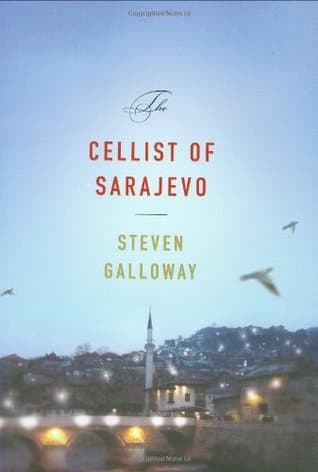
Steven Galloway (2008)
Genre
Literary Fiction / Historical Fiction
Reading Time
240 min
Key Themes
See below
Sign in to track this book
During the Siege of Sarajevo, a cellist plays defiant music, inspiring a sniper, a water-bearer, and a hungry man to reclaim their humanity in a war-torn city.
The novel opens in besieged Sarajevo, where a mortar shell hits a bread line, killing twenty-two people. From his apartment, an unnamed cellist sees the aftermath. Affected by the loss, he vows to sit at the explosion site in Veliki Park for twenty-two days and play Albinoni's Adagio in G Minor once a day, dedicating each performance to one of the victims. This act of defiance becomes a focal point for the city, even as it draws the attention of those who want to stop it.
Kenan, a middle-aged husband and father, faces daily terror as he goes on his weekly search for water. His journey requires him to cross sniper-infested streets to reach the brewery on the other side of the city. He carries several large plastic bottles, and their weight, combined with the constant threat, makes the trip hard and scary. Kenan struggles with the loss of his old life, the loss of trust, and the fear that paralyzes many. He avoids eye contact and conversation, focusing only on survival and providing for his family.
Dragan, an older man whose wife and son have left Sarajevo, tries to navigate the dangerous streets to reach a bakery for food. He struggles with the siege's psychological toll, finding it hard to recognize familiar places or connect with people. The war has taken away his sense of community, leaving him isolated. He avoids the bridges, which are sniper targets, and tries to reconcile the city he knew with the war-torn place it has become. His journey is a quiet battle against despair and the normalization of violence.
Arrow, a young woman who uses a different name to distance herself from her past as a university student, is a skilled sniper for the Bosnian resistance. Her superior, Nermin, assigns her to protect the cellist playing in Veliki Park. Intelligence suggests a sniper in the hills plans to target the cellist. Arrow meticulously scouts the area, identifies enemy positions, and prepares to eliminate the threat, all while dealing with the morality of her role and the constant threat to her own life.
On one of his water runs, Kenan reaches the brewery and sees a woman he knew before the war. They share a brief moment of recognition. As he fills his bottles, a mortar shell lands nearby, shaking the building and causing panic. Kenan and others narrowly escape injury, showing the constant danger. This incident strengthens his fear and his resolve to finish his task, pushing aside the desire for connection in favor of survival.
Dragan, trying to cross an exposed bridge, sees a man shot by a sniper. The man falls, and Dragan, along with others, is paralyzed by fear, unable to help. The man dies on the bridge. This event affects Dragan deeply, forcing him to confront his passivity and the moral decay of the siege. He struggles with the memory of the dead man and the collective failure to help, questioning what remains of their shared humanity. The incident reinforces his isolation and the burden of his fear.
Arrow spends her days on rooftops, observing the hills and buildings around Veliki Park. She identifies the enemy sniper's likely position, a small window in a distant building. She recognizes the enemy's patience and skill. As the cellist plays daily, Arrow maintains her vigil, finger on the trigger, ready to act when the enemy shows himself. She feels responsible for the cellist's life, a symbol of defiance she must protect.
During another water run, Kenan sees an elderly neighbor, Mrs. Ristovski, struggling with her water containers. Initially, his instinct is to avoid getting involved, driven by self-preservation. But he overcomes his fear and offers to help her carry her heavy bottles back to her apartment. This small act of kindness shows a momentary win over the fear and isolation in Sarajevo. It reminds him of the possibility of connection and the human spirit, even if briefly.
Dragan, on his way to the bakery, meets an old friend, Emina, and her family. The meeting is awkward and painful, as they struggle to talk amid their current lives. Emina's daughter asks about Dragan's missing wife, bringing on grief and regret. This encounter forces Dragan to confront the emotional walls he has built and the changes war has made. It is a difficult but important step toward acknowledging the past and the humanity he has tried to suppress.
On the twenty-second day of the cellist's performance, as he begins to play, Arrow sees movement in the enemy's position. A deadly game of cat and mouse begins as both snipers try to gain an advantage. Arrow, using her knowledge of the terrain and her skill, outmaneuvers and eliminates the enemy sniper. The shot is precise and swift, ensuring the cellist's safety on his final day. This act shows Arrow's role as a protector, a necessary force in a world of violence.
With Arrow's successful intervention, the cellist finishes his twenty-second and final performance of Albinoni's Adagio. His act of musical defiance, a constant presence for almost a month, has become a symbol of resilience and hope for the people of Sarajevo. His music has resonated through the shattered streets, offering beauty and remembrance amid the destruction. Although the siege continues, his performance leaves a mark, reminding citizens of their shared humanity and art's power.
After the cellist's final performance, life in Sarajevo continues under siege. Kenan still makes his dangerous water runs, but perhaps with a slightly renewed purpose. Dragan continues to navigate the city, carrying his memories but also with a faint hope for reconnection. Arrow, having done her duty, remains a silent guardian, showing the brutal necessities of war. The novel ends with the understanding that while the cellist's specific act has ended, the struggle for humanity, dignity, and survival in Sarajevo persists, changed by their experiences.
The Supporting
The Cellist's arc is less about personal change and more about his unwavering commitment to his vow, becoming a symbol of hope and defiance for the city.
The Protagonist
Kenan gradually overcomes his paralyzing fear and isolation, performing a small but significant act of kindness for a neighbor, reclaiming a piece of his humanity.
The Protagonist
Dragan moves from profound isolation and numbness to a painful but necessary re-engagement with his past and the possibility of human connection.
The Protagonist
Arrow maintains her identity as a protector, her commitment to justice unwavering, even as she contemplates the cost of her actions on her own humanity.
The Supporting
Nermin's arc is static, serving as a pillar of authority and strategy within the resistance.
The Mentioned
Mrs. Ristovski's arc is not detailed; she serves as a catalyst for Kenan's development.
The Mentioned
Emina's arc is not detailed; she serves as a catalyst for Dragan's development.
This theme is central to the novel, shown through characters' daily struggles and acts of defiance. The Cellist's commitment to playing Albinoni's Adagio for twenty-two days is the most prominent example. It symbolizes art's power to go beyond violence and offer hope. Kenan's decision to help Mrs. Ristovski with her water, overcoming his fear, and Dragan's painful re-engagement with old friends, all show the human capacity for connection even under extreme pressure. The characters, though scarred, find ways to persist and assert their dignity.
“He will not allow them to make him like them. He will not allow them to take away his humanity. He will not allow them to make him afraid.”
The novel shows how war takes away identity, community, and empathy. Dragan's struggle to recognize his city and connect with people, his numbness to suffering, and his initial inability to help the man shot on the bridge, all show this. Kenan's fear, which isolates him and makes him avoid eye contact, shows how self-preservation can erode social bonds. Arrow, while effective, deals with the moral cost of her actions; her adopted name signifies the loss of her former self. The constant threat of death reduces individuals to mere survivors.
“He has learned that the world doesn't end, but that a new world is created in its place. One in which fear and hatred are the only common currency.”
Art, specifically the Cellist's music, counters the violence and destruction. His daily performance of Albinoni's Adagio is an act of remembrance, mourning, and defiance, reminding citizens of their shared culture and the beauty that still exists. The music, despite its tragic origins, offers a message of renewal. Memory, both personal and collective, is also a force, with Dragan dealing with the past and Kenan reflecting on life before the siege, trying to hold onto what defines them beyond the war.
“The music, like the city, was a creation of man, and like the city, it could be destroyed. But it could also be rebuilt.”
Fear is a constant force in the characters' lives. Kenan's every step on his water run is driven by it, and Dragan is often paralyzed by it, leading to inaction. However, the novel also explores different forms of courage. The Cellist's courage is quiet and artistic, a defiant act of peace. Arrow's courage is active and lethal, a necessary violence to protect. Kenan's courage is found in small, personal acts of kindness that push back against his fear, showing that courage is not the absence of fear, but the decision to act despite it.
“He is afraid, but he walks. He is afraid, but he goes on. This is what it means to be alive.”
Narrative shifts between three main characters to offer diverse experiences of the siege.
The novel employs a third-person limited omniscient perspective, primarily focusing on the internal thoughts and experiences of Kenan, Dragan, and Arrow. This allows the reader to deeply understand the individual psychological and physical tolls of the siege from varied viewpoints – a family man, an elderly loner, and a soldier. This structure highlights the universal nature of suffering and resilience while showcasing the different ways people cope with extreme adversity, creating a rich, multifaceted portrait of Sarajevo under siege.
The cellist's daily music acts as a unifying symbol of hope, defiance, and remembrance.
The Cellist's twenty-two-day performance of Albinoni's Adagio serves as the narrative's anchor and a powerful symbol. It represents the enduring human spirit, the power of art to transcend brutality, and a defiant act of remembrance against senseless death. His music is a constant, almost mythic, presence that influences and connects the other characters, even if they never meet him directly. It provides a focal point for the city's collective grief and hope, a beautiful, fragile counterpoint to the surrounding destruction.
Many characters are referred to by roles or aliases, emphasizing the universal experience of war.
The Cellist is never named, and Kenan and Dragan are only given their first names, which could be common. Arrow uses a pseudonym, 'Arrow.' This narrative choice universalizes the characters' experiences, suggesting they represent not just individuals but the countless citizens enduring the siege. It emphasizes that their struggles are shared, making their humanity relatable beyond specific identities. It also highlights the way war can strip away personal identity, reducing people to their roles in survival.
A real musical piece with a history of destruction and reconstruction, mirroring Sarajevo's fate.
Albinoni's Adagio in G Minor is a real musical piece, famously reconstructed from fragments after the Dresden Music Library was firebombed during WWII. This historical context is crucial to the novel. The Adagio's history of destruction and rebirth directly mirrors the destruction of Sarajevo and the hope for its eventual reconstruction. It symbolizes the resilience of culture and humanity, suggesting that even from ruins, something beautiful and meaningful can be rebuilt. The Cellist's choice of this specific piece is therefore deeply symbolic and intentional.
“He would play Albinoni's Adagio. Because it was the most beautiful thing he could think of.”
— The cellist decides what to play after witnessing a mortar attack kill 22 people waiting in line for bread.
“It's not a question of whether you'll die. It's a question of when and how.”
— Kenan reflects on the daily reality of survival during the siege.
“She is Arrow because she has to be. She is Arrow because she chooses to be.”
— Description of the sniper who protects the cellist, embracing her role.
“The men on the hills don't care if you're a good person. They just want you dead.”
— Arrow's thoughts on the impersonal nature of the snipers targeting civilians.
“He will play for twenty-two days, one day for each of the dead.”
— The cellist's vow to honor the victims of the breadline massacre.
“It's not about being brave. It's about not letting them win.”
— Kenan's internal justification for risking his life to fetch water.
“The city is a living thing, and it's dying.”
— Observation of Sarajevo's gradual destruction during the siege.
“She has become what she hates to fight what she hates.”
— Arrow's realization about her transformation into a killer to protect others.
“Hope is a dangerous thing. It makes you forget how to be careful.”
— Dragan's cautionary thought as he navigates the dangerous streets.
“Music is the one thing that can't be taken from you.”
— The cellist's belief in the enduring power of art amidst destruction.
“You don't get to decide what you remember. You only get to decide what you do with it.”
— Arrow reflecting on her past and how it shapes her actions.
“Sometimes the only way to stay human is to do something inhuman.”
— Arrow's justification for her lethal actions as a sniper.
“The water doesn't care who you are. It just flows.”
— Kenan's thought while on his perilous journey to collect water.
“They are trying to erase us, but we are still here.”
— A general sentiment among Sarajevo's citizens resisting annihilation.
“Every day is a choice to live, not just to exist.”
— Dragan's realization about the active decision to maintain one's humanity.
Ready to see how well you understood this book? Take our interactive quiz with 10 questions.

Biography coming soon.







