“I was not a young lady. I was a girl. And a girl could do anything, even if it was considered improper.”
— Enola's internal thoughts on her capabilities and societal expectations.

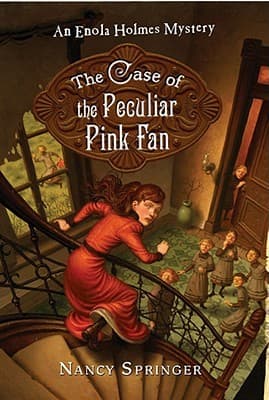
Nancy Springer (2008)
Genre
Children's / Historical Fiction / Mystery / Young Adult
Reading Time
150 min
Key Themes
See below
Sign in to track this book
Enola Holmes, Sherlock's independent sister, reluctantly teams up with him to rescue her friend Lady Cecily from a forced marriage and a sinister orphanage, using clues from a pink fan.
Enola Holmes, working as a 'scientific perditorian' (finder of lost things) under the name Miss Ivy Mesle, visits a flower shop. She sees her childhood friend, Lady Cecily Alistair. Cecily, usually lively, seems quiet and hides her face behind a pink fan. Her behavior is odd, and a strict old woman watches her. Before Enola can speak to her, Cecily is rushed away. This brief, unsettling moment makes Enola suspicious. Cecily's actions and the fan suggest she is in trouble and sending a secret message, leading Enola to investigate.
Lady Cecily's strange behavior and the pink fan worry Enola Holmes. She sketches the fan's design and notes its details. Using her sharp mind and knowledge of codes, Enola realizes the fan's patterns, colors, and how Cecily held it form a secret message. She deciphers the code, learning Cecily is asking for help. The fan's subtle movements and specific details reveal Cecily is held against her will and in danger, possibly facing an unwanted marriage or abduction. This discovery strengthens Enola's resolve to save her friend.
Following the fan's clues, Enola Holmes visits the Alistair estate, Lady Cecily's home. She hopes to find information or Cecily herself. Enola disguises herself and talks to staff, subtly asking about Cecily's recent activities. She finds the estate quiet and the servants vague about Cecily's whereabouts. Enola finds signs of a quick departure, not a willing one. The family's lack of a clear explanation increases her suspicions and deepens the mystery.
As Enola Holmes secretly investigates Lady Cecily's disappearance, her actions catch the eye of her brother, Sherlock Holmes. Sherlock, who has been looking for Enola to bring her back into the family, recognizes her methods. He tries to find her, leading to a tense chase. Enola, valuing her independence, avoids him for a time but knows his involvement complicates her mission. This meeting highlights their ongoing disagreement about her freedom and her choice to live outside society's rules.
Enola's clues lead her to a gloomy orphanage, the 'Institute for the Education of Young Ladies,' where she believes Lady Cecily is held. Enola disguises herself as a simple, uneducated girl seeking shelter and enters the institution. She discovers the orphanage is run by a strict matron, Miss Theobald, who is part of a plan to force Cecily into an unwanted marriage. Cecily is being pressured, her spirit almost broken by the harsh environment. Enola sees the poor conditions and manipulation meant to make Cecily obey, making her rescue mission urgent.
Inside the orphanage, Enola Holmes faces danger, her disguise almost exposed. As her escape seems difficult, her brother Sherlock Holmes appears, having tracked her there. Despite her strong desire for independence and her past efforts to avoid him, Enola realizes Cecily's immediate danger is more important than her dislike of Sherlock's involvement. They form a silent agreement: they must work together to save Cecily. This reluctant partnership is a key moment, forcing Enola to temporarily put aside her distrust for the greater good.
Enola and Sherlock Holmes use their skills to plan and carry out a daring rescue of Lady Cecily from the orphanage. Enola's knowledge of the orphanage's layout and staff routines, combined with Sherlock's strategic thinking and ability to create distractions, is vital. They move through the building, avoiding Miss Theobald and her staff. The rescue is tense, with several close calls, but their teamwork leads them to Cecily. They take her from the institution at night, barely escaping detection.
With Lady Cecily safe, Enola and Sherlock Holmes continue investigating to find the person behind her abduction and forced marriage. They connect clues pointing to the Duke of Tewkesbury, a powerful and dishonest figure. He planned the plot to gain control of Cecily's inheritance and social standing. The Duke, a distant relative, wanted Cecily to marry his son, combining their families' wealth and power. This reveals a deeper layer of social corruption and how vulnerable young women were to such schemes.
With clear evidence, Enola and Sherlock Holmes confront the Duke of Tewkesbury. Sherlock, using his legal connections and reputation, ensures the Duke's illegal plan is stopped without creating a scandal that would further harm Lady Cecily's reputation. The Duke is forced to give up his plans. Lady Cecily, though shaken, is free from the forced marriage and the oppressive orphanage. The siblings work to ensure her safety and future, allowing her to make her own choices, unlike the fate planned for her. Enola feels a deep sense of success in securing her friend's freedom.
After solving Lady Cecily's case, Enola and Sherlock Holmes share a rare moment of understanding and respect. While their basic disagreements about Enola's place in society and her independence remain, Sherlock admits Enola's excellent detective skills and courage. He sees her as a formidable intellectual equal, not just his runaway sister. Enola, in turn, sees Sherlock's genuine care for her, despite his controlling ways. This shared experience, though short, subtly changes their relationship, suggesting they might, at times, work together, but on Enola's terms.
The Protagonist
Enola learns the value of strategic, temporary alliances, even with those she seeks to evade, for the greater good, while solidifying her commitment to her independent life.
The Supporting
Sherlock begins to grudgingly acknowledge Enola's capabilities and independence, moving from solely trying to control her to a nascent respect for her skills.
The Supporting
Cecily moves from a state of despair and captivity to finding her freedom and agency, thanks to Enola's intervention.
The Antagonist
Miss Theobald remains largely static, a figure of oppressive authority whose plans are ultimately thwarted.
The Antagonist
The Duke's scheme is exposed and thwarted, leading to his public humiliation and the failure of his manipulative plans.
The Mentioned
Mycroft's influence remains a distant, largely unchanging force against Enola's independence.
This theme is key to Enola's character and goals. Enola always fights against the limited roles for women in Victorian society, shown by her brothers' attempts to control her life and her choice to be an independent detective. Lady Cecily's situation, forced into an unwanted marriage, shows how little control women had. Enola's drive to save Cecily is not just about friendship; it is about helping another woman choose her own path, reflecting Enola's own fight for freedom. Her disguises and secret life are direct responses to these social pressures, letting her act outside their boundaries.
“''I would not be an ornament to a drawing-room; I would be a person, free and unfettered, to make my own way in the world.'”
The entire mystery relies on secret communication, especially the pink fan. Enola's ability to decode Lady Cecily's message, sent through seemingly innocent gestures and fan patterns, is vital to understanding her friend's trouble. This theme highlights the cleverness of those, especially women, who must use indirect ways to share important information or ask for help. It shows how visual cues, body language, and small details can carry deep meaning when direct talk is impossible or dangerous, making the 'peculiar pink fan' both a real object and a symbol.
“'The fan was a language, a semaphore of distress, spoken in the silent, suffocating world of Victorian decorum.'”
The story looks at justice, especially against great social unfairness. Lady Cecily's situation—kidnapped and forced into marriage for money—is a clear example of how vulnerable people, especially women, are to the schemes of powerful figures like the Duke of Tewkesbury. Enola's determined search for the truth and her resolve to free Cecily come from a strong moral sense and a desire to correct these wrongs, even if it means clashing with the established system. The book shows how wealth and influence can undermine justice, and how individual bravery is needed to challenge such systemic problems.
“'It was not merely a friend I sought to save, but a principle: that no one, however powerful, should dictate another's life.'”
The complex relationship between Enola and her brothers, especially Sherlock, is a significant theme. Enola's wish for independence clashes with Sherlock's attempts to control her, creating a dynamic of competition and avoidance. However, Lady Cecily's abduction forces a temporary, reluctant partnership, which subtly changes their relationship. This theme explores how a shared goal can overcome personal differences and lead to moments of mutual respect, even when underlying tensions remain. It shows that while their methods and beliefs differ, a deeper family bond and shared commitment to justice can temporarily overcome their conflicts.
“'For a fleeting moment, we were not brother and sister at odds, but two minds united in a single, desperate cause.'”
A crucial object serving as a coded message and a symbol of distress.
The peculiar pink fan is the primary inciting incident and a key plot device. It functions as a cipher, containing Lady Cecily's hidden plea for help through its specific colors, patterns, and the way she manipulates it. Its 'peculiarity' immediately draws Enola's attention, setting the entire mystery in motion. Beyond its functional role as a communication tool, the fan symbolizes the constrained lives of Victorian women, who often had to resort to subtle, indirect means to express themselves or seek aid, making it a powerful visual metaphor for hidden plights.
Enola's primary method for navigating society and conducting investigations undetected.
Disguise is a recurring and essential plot device for Enola. By adopting various aliases and appearances—such as Miss Ivy Mesle, the 'scientific perditorian,' or a plain orphanage girl—Enola is able to move freely through different social strata and gather information without revealing her true identity or attracting unwanted attention from her brothers. This device highlights her ingenuity and resourcefulness, allowing her to bypass the limitations placed on young women in Victorian society and actively participate in investigations that would otherwise be closed to her.
A seemingly benevolent institution used as a front for a nefarious plot.
The 'Institute for the Education of Young Ladies' functions as a classic 'locked room' or 'hidden prison' device. It appears as a respectable orphanage but is, in reality, a place of confinement and psychological manipulation. Its deceptive nature adds to the suspense and danger, as Enola must infiltrate a seemingly innocuous location to uncover the truth. This device emphasizes the vulnerability of those placed in such institutions and the potential for abuse of power under the guise of care, creating a formidable barrier that Enola must overcome.
“I was not a young lady. I was a girl. And a girl could do anything, even if it was considered improper.”
— Enola's internal thoughts on her capabilities and societal expectations.
“Sometimes the best way to hide is in plain sight.”
— Enola reflecting on her disguises and methods of remaining undetected.
“A fan is not merely for cooling the face. It can be a weapon, a shield, a message.”
— Enola considering the multiple uses and symbolism of the pink fan.
“My brothers thought they knew best. But they didn’t know me at all.”
— Enola's frustration with Sherlock and Mycroft's attempts to control her.
“To be alone was not to be lonely, but to be free.”
— Enola cherishing her solitude and the freedom it affords her.
“Every object tells a story, if you know how to listen.”
— Enola's detective mindset, observing details of the fan and its surroundings.
“The world was full of secrets, and I intended to uncover as many as I could.”
— Enola's driving motivation as a young detective.
“Logic was all very well, but sometimes intuition was a far more reliable guide.”
— Enola contrasting her own investigative methods with her brother Sherlock's.
“One must be prepared to bend the rules, if the rules are unjust.”
— Enola justifying her actions that defy Victorian social norms.
“A lady's reputation was a fragile thing, easily shattered by a single misstep. Mine, however, was already in tatters.”
— Enola acknowledging her unconventional life and its impact on her social standing.
“The greatest danger often lies where you least expect it.”
— Enola reflecting on the unexpected twists in her investigation.
“Knowledge was power, and I intended to wield it.”
— Enola's determination to learn and use information to her advantage.
“Even the most delicate beauty can hide a formidable strength.”
— Enola observing the seemingly delicate fan and its potential for impact.
“To truly see, one must look beyond the obvious.”
— Enola's advice on effective observation and deduction.
Ready to see how well you understood this book? Take our interactive quiz with 10 questions.

Biography coming soon.

Dan Gemeinhart
4.5

Kate O'Hearn
4.4

Jeanne Birdsall
4.4

Jen Wang
4.4

Wendelin Van Draanen
4.3

John Marsden
4.3

Chris Van Allsburg
4.3

Jennifer A. Nielsen
4.2