“I am not a child. I am a detective.”
— Enola Holmes asserting her independence and identity to her brothers.

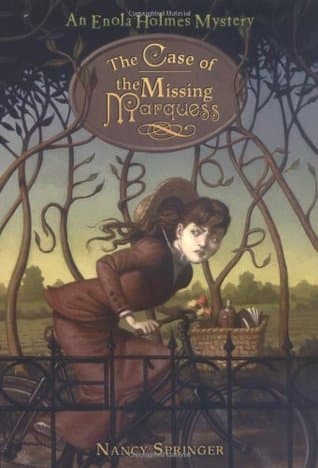
Nancy Springer (2006)
Genre
Children's / Historical Fiction / Mystery / Young Adult
Reading Time
180 min
Key Themes
See below
Sign in to track this book
Armed with wit, disguises, and an indomitable spirit, Sherlock Holmes's rebellious younger sister, Enola, plunges into the grimy heart of Victorian London to unravel her mother's disappearance, only to find herself entangled in a marquess's kidnapping and constantly evading her famous brother.
On the morning of her fourteenth birthday, Enola Holmes awakens at Ferndell Hall to discover her eccentric artist mother, Lady Eudoria, has disappeared. There is no note, only some peculiar gifts: a flower dictionary, a book on cryptology, and a sketch pad with charcoal. Enola, who has been homeschooled by her mother in a very unconventional manner, feels a deep sense of abandonment and confusion. She immediately sends telegrams to her much older brothers, Mycroft and Sherlock Holmes, informing them of their mother's absence. The brothers, who have largely ignored Enola for years, quickly arrive at Ferndell Hall, their presence disrupting Enola's solitary life and signaling a dramatic shift in her future.
Upon their arrival, Mycroft, the eldest and most pragmatic brother, immediately takes charge of Ferndell Hall and Enola's future. He dismisses Enola's unconventional education and declares his intention to send her to Miss Harrison's Finishing School for Young Ladies to transform her into a proper Victorian woman. Sherlock, while more sympathetic, largely defers to Mycroft. Overhearing their plans, Enola realizes she must escape if she wants to find her mother and maintain her independence. She deciphers a hidden message in her mother's gifts, realizing Lady Eudoria intended for her to be self-sufficient. Enola secretly packs a satchel, takes money hidden in a quilt, and disguises herself as a boy before slipping away from Ferndell Hall on a train bound for London.
Arriving in the bustling, overwhelming city of London, Enola quickly finds lodging in a respectable boarding house. She uses her mother's hidden money to purchase new clothes, transforming herself into a demure, grieving widow named Ivy Meshle. This disguise allows her to move about London unchaperoned, a freedom denied to single young women of her age. She rents a small office space, intending to set up a discreet detective agency specializing in finding missing persons, hoping this will aid her in her search for her mother. Her initial forays into the city reveal its vastness and the myriad stories it holds, solidifying her resolve to embrace her newfound independence and investigative ambitions.
While searching for clues about her mother, Enola stumbles upon newspaper reports detailing the disappearance of a young nobleman, Lord Tewkesbury, the Marquess of Basilwether. He vanished from his family estate, and the police, including Inspector Lestrade, are baffled. Intrigued by the case, Enola decides to investigate, seeing it as a potential way to hone her skills and earn money. She travels to the Basilwether estate and, using her observation skills, discovers a hidden satchel belonging to the Marquess. Inside, she finds a peculiar collection of items: a partially eaten apple, a broken corset, a pamphlet on ancient trees, and a strange, coded message, suggesting the Marquess's disappearance is more complex than a simple runaway.
Following the clues from the Marquess's satchel, particularly the details about ancient trees, Enola deduces that Lord Tewkesbury might be hiding in the vast, ancient woods near his estate. She eventually locates him, disguised as a common boy, foraging for food. Tewkesbury, who is younger than Enola and quite naive, reveals he ran away to avoid an unwanted marriage and the responsibilities of his title, but he is clearly being pursued by dangerous individuals. Before Enola can fully understand his story or formulate a plan, they are ambushed by two menacing figures: a large, brutal man named Trelawney and a severe woman, both of whom seem intent on capturing the Marquess. Enola and Tewkesbury are overpowered and taken prisoner.
Enola and Lord Tewkesbury are taken to a derelict, isolated house in the countryside, where they are held captive. Their captors, Trelawney and the woman, display a ruthless determination to keep Tewkesbury from his inheritance. Enola, despite her fear, maintains her composure and begins to observe their surroundings for any means of escape. She notices a loose floorboard and, using her ingenuity and the skills her mother taught her, manages to pry it open. Working together, Enola and Tewkesbury crawl through a narrow passage beneath the floorboards and out into the surrounding woods, narrowly evading their captors. This shared ordeal begins to forge a reluctant bond between them.
After their escape, Enola and Tewkesbury are relentlessly pursued by Trelawney and the woman. They make their way back towards London, utilizing their wits and a series of disguises to avoid detection. The chase culminates in a tense sequence through the newly opened London Underground system. Enola, drawing on her knowledge of the city and her quick thinking, manages to lead Tewkesbury through the chaotic crowds and labyrinthine tunnels, using the trains to throw their pursuers off their trail. The close calls and the constant threat of recapture reinforce the danger they are in and highlight Enola's growing resourcefulness under pressure.
While on the run with Tewkesbury, Enola has a near miss with her brother, Sherlock Holmes. She spots him searching for her, undoubtedly following a trail she left or deducing her location. Enola quickly dons another disguise, transforming herself into a respectable elderly woman, complete with a veiled hat and stooped posture. She manages to walk past Sherlock without him recognizing her, a feat that both thrills and frightens her. This encounter underscores her desire to remain independent and pursue her own path, separate from her brothers' expectations and influence, even as it reminds her of the ever-present threat of being discovered by them.
Using the flower dictionary and cryptology book her mother left her, Enola finally deciphers the coded message found in Tewkesbury's satchel. The message, hidden in a bouquet, reveals a conspiracy orchestrated by Tewkesbury's grandmother, the Dowager Marquess. She is vehemently against Tewkesbury inheriting his title and the accompanying political power, fearing he will vote in favor of the Reform Bill, which she opposes. The dowager, working with the ruthless Trelawney, intended to have Tewkesbury declared incompetent or killed, thus preventing him from taking his seat in the House of Lords. Enola realizes the stakes are much higher than a simple runaway boy.
Enola successfully helps Lord Tewkesbury return to his family estate, exposing his grandmother's plot and ensuring his safety and rightful inheritance. She manages to do this without revealing her true identity to her brothers, who are still searching for her. After ensuring Tewkesbury is safe, Enola returns to her London lodgings. She finds a final, more explicit message from her mother, hidden in a corset, confirming that Lady Eudoria left intentionally to pursue her own interests and supported Enola's independence. Enola realizes her mother wanted her to be free and self-reliant. With the Marquess's case solved and her mother's intentions clarified, Enola decides to continue her life as a secret detective, embracing her unique path.
The Protagonist
Enola transforms from a sheltered, somewhat naive girl into a confident, independent young woman who embraces her unique identity as a detective.
The Supporting/Catalyst
Her 'arc' is revealed through her past actions and messages, showing her journey towards personal freedom and her desire to empower her daughter.
The Supporting
Sherlock's arc involves a subtle shift in his perception of Enola, moving from dismissing her to grudgingly acknowledging her capabilities.
The Antagonist/Supporting
Mycroft remains largely static, representing the unchanging societal expectations Enola must overcome.
The Supporting
Tewkesbury grows from a frightened runaway to a more assertive young man, willing to confront his family and responsibilities.
The Antagonist
Her arc is static, remaining a firm antagonist motivated by her political beliefs and desire for control.
The Antagonist
Trelawney remains a flat character, serving as a physical threat throughout the narrative.
The Mentioned
Lestrade is a static character, serving as a benchmark for professional detective work that Enola ultimately surpasses.
Enola's journey is fundamentally about forging her own identity apart from the shadows of her famous brothers and the societal expectations placed upon her. Her mother's disappearance forces her to become self-reliant and to define who she wants to be. By adopting disguises like Ivy Meshle and a street urchin, Enola explores different facets of herself and learns to navigate the world on her own terms. The coded messages from her mother reinforce the idea that Enola should 'find her own way,' culminating in her decision to embrace life as a secret detective, independent and unbound by convention.
“''You must find your own way, Enola. For you are a Holmes, and a Holmes does not simply exist. A Holmes defines herself.'”
The novel strongly champions female independence and challenges the restrictive gender roles of Victorian society. Lady Eudoria's deliberate disappearance to pursue her own interests, and her subtle encouragement for Enola to do the same, are central to this theme. Enola constantly chafes against Mycroft's attempts to force her into a finishing school and a traditional female role. Her ability to operate successfully and intelligently in a male-dominated world, often through the use of disguises that grant her freedom, underscores the importance of female agency and breaking free from societal constraints.
“'You have a brain, Enola. Use it. Do not let them make you into a mere 'lady' when you are so much more.'”
Like her brother Sherlock, Enola possesses extraordinary powers of observation and deduction, a skill her mother diligently cultivated. This theme is central to her success as a detective. From deciphering her mother's coded messages using a flower dictionary and cryptology book to finding clues in Tewkesbury's satchel (like the broken corset or the specific apple), Enola's ability to notice small details and connect them logically drives the plot. Her deductions allow her to locate Tewkesbury, understand the conspiracy, and even evade her brothers, proving that her intellect is as formidable as theirs.
“'The world is full of clues, Enola. One merely needs to know how to look, and what to see.'”
Enola's initial feelings of abandonment after her mother's disappearance, coupled with her strained relationship with her older brothers, highlight her search for belonging. While she rebels against Mycroft's authority, she yearns for a connection with Sherlock and for understanding from her family. Her mother's final messages provide a sense of belonging, not necessarily within a traditional family structure, but within a shared spirit of independence. Ultimately, Enola finds a new sense of 'family' in her chosen path and the unexpected friendship with Tewkesbury, defining belonging on her own terms rather than seeking conventional acceptance.
“'Perhaps a family is not always what one is born into, but what one chooses to make for oneself.'”
The novel subtly explores themes of social class and the injustices inherent in Victorian society. The contrast between Enola's privileged upbringing and her experiences disguised as a working-class boy or a grieving widow exposes her to the realities of different social strata. The plot involving Lord Tewkesbury reveals the deep political divisions and the lengths to which the aristocracy would go to maintain power, even resorting to kidnapping and murder to prevent a 'misguided' vote on the Reform Bill. This highlights how power dynamics and class distinctions can lead to significant injustices.
“'The rich had their rules, and the poor had theirs, and never the twain should meet—unless, of course, one was a detective.'”
A recurring element allowing Enola to navigate Victorian society and evade her brothers.
Disguises are a crucial plot device for Enola, enabling her to move freely and investigate without suspicion in a restrictive Victorian society. Her transformations into a boy, a grieving widow (Ivy Meshle), and an elderly woman are not merely superficial changes but allow her to adopt different personas and access various social spheres. This device highlights the limitations placed on young women and underscores Enola's ingenuity in overcoming them. It also serves to allow her to evade Sherlock, demonstrating her developing skills as a detective in her own right.
A central mechanism for revealing Lady Eudoria's intentions and solving the Marquess's case.
Coded messages are fundamental to both the overarching mystery of Lady Eudoria's disappearance and the specific case of Lord Tewkesbury. Lady Eudoria leaves a series of cryptic gifts – a flower dictionary and a book on cryptology – which Enola must use to decipher her mother's true intentions and future plans. Similarly, a coded message hidden in a bouquet is key to unraveling the conspiracy behind Tewkesbury's abduction. This device showcases Enola's intelligence and her mother's unconventional teaching methods, making the reader actively participate in the puzzle-solving.
The central mystery that propels the protagonist into action and personal growth.
The disappearance of Lady Eudoria Holmes is the primary catalyst for the entire plot. It forces Enola out of her sheltered life, away from her controlling brothers, and into the dangerous world of London. This initial missing person case not only drives Enola's personal quest but also leads her to stumble upon the secondary missing person case of Lord Tewkesbury. Both disappearances serve to challenge Enola, develop her detective skills, and ultimately shape her identity as an independent young woman. It's a classic mystery trope that sets the stage for adventure and self-discovery.
Characters who highlight Enola's qualities by contrast.
Several characters serve as foils to Enola. Mycroft Holmes, with his rigid adherence to tradition and societal expectations, highlights Enola's independence and modern thinking. Sherlock, while brilliant, is often too focused on logic, contrasting with Enola's blend of intellect and empathy. Lord Tewkesbury, initially timid and somewhat helpless, serves to emphasize Enola's courage and resourcefulness. These contrasting characters underscore Enola's unique personality and the challenges she faces, allowing her strengths and values to shine more brightly through comparison.
“I am not a child. I am a detective.”
— Enola Holmes asserting her independence and identity to her brothers.
“A lady is not a piece of property to be bought and sold.”
— Enola reflecting on her mother's disappearance and societal expectations.
“The world is full of obvious things which nobody by any chance ever observes.”
— Enola using deduction skills, echoing Sherlock Holmes' methods.
“I would rather be a missing person than a found one.”
— Enola contemplating her own disappearance to avoid boarding school.
“A cipher is only a puzzle, and I am good at puzzles.”
— Enola decoding messages left by her mother.
“Sometimes the most important clues are the ones everyone else overlooks.”
— Enola explaining her detective approach to a minor character.
“My name is Enola, which is 'alone' spelled backwards. And I am alone.”
— Enola introducing herself and reflecting on her isolation.
“A marquess is missing, but so is my mother. Which mystery matters more?”
— Enola prioritizing her personal quest over the titular case.
“Invisibility is a superpower when you're a girl in a man's world.”
— Enola using societal expectations to her advantage in investigations.
“The truth is like a thread in a tapestry—pull it, and the whole picture unravels.”
— Enola describing how small discoveries lead to bigger revelations.
“I don't need rescuing. I need answers.”
— Enola rejecting help from Sherlock to solve her own problems.
“Every disappearance tells a story. You just have to learn how to read it.”
— Enola explaining her perspective on missing persons cases.
“My brothers see a problem to be solved. I see a person to be found.”
— Enola contrasting her empathetic approach with Sherlock's logic.
“The greatest mystery isn't who took the marquess, but why anyone would want him back.”
— Enola making a wry observation about the missing aristocrat.
Ready to see how well you understood this book? Take our interactive quiz with 10 questions.

Biography coming soon.

Dan Gemeinhart
4.5
Kate O'Hearn
4.4
Jeanne Birdsall
4.4

Jen Wang
4.4

Wendelin Van Draanen
4.3

John Marsden
4.3

Chris Van Allsburg
4.3
Jennifer A. Nielsen
4.2