“The wind was a living thing, full of secrets and whispers.”
— Enola often personifies nature, reflecting her own sense of being alive and observant.

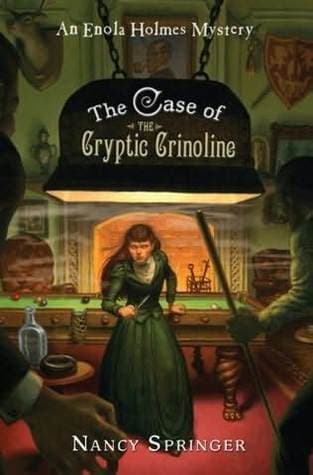
Nancy Springer (2009)
Genre
Children's / Historical Fiction / Mystery / Young Adult
Reading Time
90 min
Key Themes
See below
Sign in to track this book
When her beloved, if eccentric, landlady Mrs. Tupper is kidnapped, Enola Holmes must unravel a mystery involving cryptic clues and the legendary Florence Nightingale to find the only family she has left in London.
Enola Holmes, using the name Miss Meshle, returns to her lodgings at 14 Pothouse Lane. She finds the door open, a tea tray spilled, and a crinoline on the floor. This crinoline is Mrs. Tupper's prized possession, which she never removes. The silence is unsettling. Enola's worry grows when she realizes Mrs. Tupper, her kind but nearly deaf landlady, is gone. A faint smell of chloroform confirms Enola's fear: Mrs. Tupper has been taken. Enola immediately looks for clues, her detective skills at work.
Enola examines the crinoline. She notices unusual stiffness in one fabric panel. Looking closer, she finds a small, folded piece of paper in a cleverly sewn pocket. The note is in an unknown script, a coded message Enola recognizes as a cipher. This discovery confirms her belief that Mrs. Tupper's kidnapping is not random. It is connected to a secret, and the crinoline is key to the mystery. She carefully removes the note, knowing it holds the first real clue.
Enola works to decode the message from the crinoline. Using her knowledge of ciphers and her intelligence, she cracks the code. The message names 'Florence Nightingale' and includes a veiled threat to her safety, with a reference to a 'second warning.' This connection to the famous 'Lady with the Lamp' immediately raises the stakes. Enola realizes Mrs. Tupper's abduction is more serious than a simple robbery. It is likely tied to a larger, dangerous conspiracy involving one of England's respected figures. The need to find Mrs. Tupper increases.
Determined to warn Florence Nightingale, Enola disguises herself as a young lady seeking nursing advice. She visits the Nightingale Home for Nurses, a training school Nightingale founded. Enola tries to subtly convey the threat, mentioning the coded message and Mrs. Tupper's disappearance. However, Florence Nightingale is polite but wary. She dismisses what she sees as a young woman's tale. She believes Enola is mistaken or misguided and declines to take her warnings seriously. This leaves Enola frustrated but still determined.
While investigating, Enola almost runs into her eldest brother, Sherlock Holmes. He is also at Mrs. Tupper's lodgings, clearly investigating the abduction. Enola, wanting to stay independent and avoid finishing school, skillfully avoids him. She observes his methods and his serious manner, confirming the case is important enough for his attention. This encounter adds another layer to Enola's mission. She must now solve the mystery and remain hidden from her brilliant brother, who would try to control her life.
Following a subtle clue in the crinoline's fabric, Enola traces its origin to a specific silk weaver. Through questioning and observation, she discovers the crinoline was made with unique silk from India. This connection starts a new line of inquiry for Enola. It suggests the mystery might involve colonial affairs or the British Empire's presence abroad. The weaver gives some details about the original buyer, leading Enola to suspect Mrs. Tupper's past, or someone she knew, had ties to India and a secret now coming to light.
Enola's investigation into the Indian connection and coded messages uncovers a network of women, many of them suffragettes. She learns Mrs. Tupper was secretly part of this group. They worked to expose corruption in the British government's administration in India, especially regarding worker exploitation. The crinoline, with its hidden message, was a way for this group to communicate. Mrs. Tupper's abduction is an attempt to silence her and stop the group from revealing damaging information about powerful figures.
Through deduction and daring infiltration, Enola discovers Mrs. Tupper is held captive in a respectable-looking private asylum for 'nervous conditions.' This institution is a front. Conspirators use it to silence and discredit those who pose a threat. Mrs. Tupper, due to her age and perceived frailty, was an easy target to be declared mentally unfit and ignored. Enola realizes the true danger: Mrs. Tupper is not just kidnapped; her sanity and freedom are under attack by powerful, ruthless captors.
Enola, with her ingenuity, plans to infiltrate the asylum and rescue Mrs. Tupper. She uses disguises and wit to navigate the institution and finds her landlady. During the rescue, Enola gathers more evidence. This confirms the identities of the corrupt officials involved in the conspiracy to exploit India and silence dissenters. She arranges Mrs. Tupper's escape, ensuring her safety and exposing those responsible for her abduction and the wider corruption. The rescue is tense and dangerous, but Enola's determination wins.
After Mrs. Tupper's rescue and the conspirators' exposure, Florence Nightingale reveals her deeper involvement. She confesses she knew about the suffragettes' efforts and the corruption in India, having secretly supported their cause. She explains the initial message was a desperate attempt to warn her. Her initial dismissal of Enola was to avoid suspicion of her own secret activities. Nightingale acknowledges Enola's bravery and intelligence, thanking her for saving Mrs. Tupper and helping justice.
With Enola's evidence and Florence Nightingale's testimony, the corrupt officials are exposed. This leads to their arrests and the dismantling of their network. Mrs. Tupper returns home safely, shaken but unharmed, and grateful to Enola. The immediate threat is over. Enola maintains her independent lifestyle, having again proven her detective skills. She continues to avoid her brothers, Sherlock and Mycroft, keeping her freedom to follow her own path and do her unique investigative work, always ready for the next adventure.
The Protagonist
Enola grows in confidence and skill as a detective, solidifying her unique identity while reaffirming her ability to navigate and influence the male-dominated world of investigation.
The Supporting
Mrs. Tupper's character is revealed to be far more complex and courageous than initially perceived, showcasing the hidden power of seemingly ordinary women.
The Supporting
Sherlock continues to be a formidable, if distant, presence, unknowingly pushing Enola to further hone her skills and independence by forcing her to evade him.
The Supporting
Florence Nightingale moves from a seemingly aloof public figure to a revealed secret ally, demonstrating the quiet power and influence of women working for change.
The Antagonist
The conspirators are ultimately exposed and brought to justice, symbolizing a small victory against systemic corruption.
The Mentioned
Mycroft's influence remains a constant, unseen pressure on Enola, reinforcing her commitment to her independent lifestyle.
This theme is central to Enola's character. She constantly defies Victorian societal expectations for women, rejecting the idea of being confined to a finishing school or a traditional role. Her detective work, use of disguises, and determination to solve cases independently (even from her famous brothers) all show her strong desire for self-determination. The secret network of suffragettes, including Mrs. Tupper and Florence Nightingale, also highlights this theme. It shows women actively working to change their world and challenge established patriarchal structures, often secretly. Enola's refusal to be 'managed' by her brothers is a recurring example.
““I was a free woman, and I would not be put into a cage, no matter how gilded.””
The novel explores how unassuming individuals can have deep secrets and influence. Mrs. Tupper, initially a frail, deaf old landlady, is a courageous member of a secret society fighting injustice. Her crinoline, a common garment, becomes a key plot item holding a coded message. Even Florence Nightingale, a public figure of benevolence, has a hidden, more radical side, secretly supporting the suffragettes. This theme challenges first impressions and points out the quiet strength and agency that can exist beneath conventional appearances.
““One must never underestimate the power of those who appear to be the least threatening.””
The mystery is deeply rooted in social justice issues, specifically corruption and exploitation within the British Empire's administration in India. The suffragette group, which Mrs. Tupper belongs to, works to expose these injustices. This highlights the situation of exploited workers and the abuse of power by colonial officials. The story critiques the darker side of Victorian expansionism and the moral compromises made for economic gain. Enola's investigation is not just about finding Mrs. Tupper. It is about uncovering and confronting systemic wrongdoing, connecting her personal quest with a larger fight for ethical governance and human rights.
““There was more than one kind of darkness in the world, and some of it wore the finest silks.””
Enola's survival and success as a detective depend on her masterful use of disguises and her ability to deceive others. She takes on various roles—from a respectable lady to a young nurse—to infiltrate social settings and gather information without revealing her true identity or gender. This theme shows her cleverness and resourcefulness. It also shows her need to operate outside the conventional male-dominated world of detection. Her constant evasion of her brothers also relies on these skills, highlighting her autonomy and how far she goes to protect it. Disguise is both a tool and a symbol of her chosen freedom.
““One must learn to become invisible to those who would seek to control you.””
A seemingly ordinary garment that hides a vital coded message and serves as a key to the mystery.
The crinoline is the central plot device. Initially, it's a discarded item of Mrs. Tupper's clothing, signaling her abrupt departure. However, it quickly becomes a literal vessel for a secret, with a hidden pocket containing a coded message. This device serves multiple functions: it's the first tangible clue, it reveals Mrs. Tupper's secret life, and it propels Enola's investigation by providing the initial lead connecting the abduction to a larger conspiracy. Its ordinariness makes the hidden message all the more surprising and effective for covert communication.
Cryptographic puzzles that drive the plot forward and reveal crucial information.
Coded messages and ciphers are integral to the plot, particularly the one found in Mrs. Tupper's crinoline. Enola's talent for decoding these messages showcases her intellectual prowess and is essential for unraveling the mystery. Each deciphered message provides a new piece of the puzzle, leading her closer to Mrs. Tupper and the conspirators. This device not only adds an element of intellectual challenge for Enola but also highlights the clandestine nature of the suffragettes' activities and the need for secret communication in a repressive society.
Enola's strategic use of different identities to navigate Victorian society and conduct her investigations.
Enola's reliance on disguises and aliases is a recurring plot device across the series, but it's particularly crucial here. Her ability to transform her appearance and demeanor allows her to move through various social strata—from a respectable lady to a young nurse—without being recognized by her brothers or suspected by the conspirators. These disguises are not merely cosmetic; they enable her to access information, infiltrate locations like the Nightingale Home and the asylum, and ultimately protect her independence from her brothers' attempts to control her life. It's a key to her effectiveness as a detective.
Enola's missing mother, Eudoria, serves as an underlying motivation and a symbol of independence.
While not directly part of the immediate mystery, Enola's absent mother, Eudoria Holmes, serves as a powerful underlying plot device. Eudoria's deliberate disappearance at the beginning of the series, leaving Enola financial independence and the freedom to choose her own path, is the foundational event that allows Enola to become a detective. Her mother's unconventional example and her own coded messages continue to inspire Enola and reinforce her commitment to living independently and challenging societal norms. Eudoria's lingering influence is a constant reminder of the possibilities of female autonomy.
“The wind was a living thing, full of secrets and whispers.”
— Enola often personifies nature, reflecting her own sense of being alive and observant.
“One must always be prepared for the unexpected, especially when one is trying to avoid being found.”
— Enola's constant need for disguise and evasion fuels her pragmatic approach to life.
“There are many ways to be brave, and not all of them involve swords or shouting.”
— Enola reflects on different forms of courage, often valuing quiet resilience.
“A lady's attire can be her greatest weapon, if she knows how to wield it.”
— Enola often uses fashion and disguise as tools in her investigations.
“The truth is often hidden in plain sight, for those who bother to truly look.”
— Enola's detective skills involve keen observation of overlooked details.
“Being alone does not mean being lonely, especially when one has a purpose.”
— Enola embraces her independence and solitary pursuits.
“Sometimes the most important clues are not what you see, but what you don't see.”
— Enola's deductive reasoning often relies on noticing absences or inconsistencies.
“It is a rare thing to find someone who truly sees you, not just what they expect to see.”
— Enola, often underestimated, longs for genuine understanding.
“The world is full of wonders, if only one takes the time to notice them.”
— Enola's adventurous spirit and curiosity drive her appreciation for the world.
“A proper lady is not afraid to get her hands dirty, if the cause is just.”
— Enola challenges Victorian societal norms for women, prioritizing her mission.
“Secrets have a way of revealing themselves, given enough time and a persistent mind.”
— Enola's unwavering dedication to solving mysteries.
“Even the most respectable appearances can hide the darkest of intentions.”
— Enola often encounters deception behind a facade of propriety.
“One must learn to trust one's own instincts, for they are often the truest guide.”
— Enola relies heavily on her intuition in her investigations and personal decisions.
“Sometimes the greatest freedom lies in choosing your own path, even if it's a lonely one.”
— Enola's decision to live independently, away from her brothers' influence.
Ready to see how well you understood this book? Take our interactive quiz with 10 questions.

Biography coming soon.

Dan Gemeinhart
4.5

Kate O'Hearn
4.4

Jeanne Birdsall
4.4

Jen Wang
4.4

Wendelin Van Draanen
4.3

John Marsden
4.3

Chris Van Allsburg
4.3
Jennifer A. Nielsen
4.2