“There are many, many people in the world, and while one of the things that makes us individuals is our own particular list of fears, we aren't usually afraid of all the same things.”
— The narrator discussing the various fears people have.

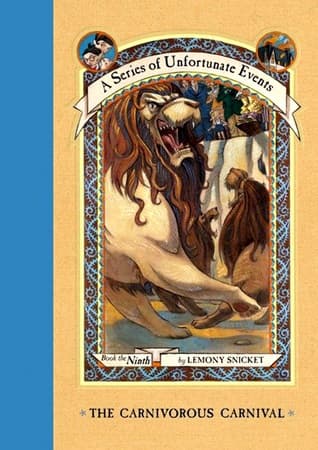
Lemony Snicket (2002)
Genre
Fantasy / Children's / Mystery / Young Adult
Reading Time
280 min
Key Themes
See below
Sign in to track this book
At a suspicious carnival, the Baudelaire orphans meet a two-headed ringmaster, a group of 'freaks,' and a mysterious map, all while trying to avoid Count Olaf and learn about their parents.
After escaping Esme and Jerome Squalor in a runaway caravan, the Baudelaire orphans—Violet, Klaus, and Sunny—are left on a deserted road. They avoid being hit by a truck driven by Hugo, who, with Kevin and Colette, are 'freaks' on their way to the Caligari Carnival. The Baudelaires need a safe place and want to find V.F.D. information, so they decide to pretend to be freaks to get in and avoid Count Olaf. They create characters: Beverly and Elliot (a two-headed person) for Violet and Klaus, and a wolf baby for Sunny, hoping to fit in with the carnival's performers.
At the Caligari Carnival, the Baudelaires meet Madame Lulu, a fortune-teller who claims to know past and future secrets. She gives readings from a tent using a crystal ball and many index cards. The orphans are assigned to the 'House of Freaks,' joining Hugo, Kevin, and Colette in the show. They learn about the carnival's schedule and that the main attraction is a lion pit. The Baudelaires also discover that the Hook-Handed Man, one of Count Olaf's henchmen, is already working at the carnival, making their disguise even more important for their safety.
The Baudelaires visit Madame Lulu, hoping for clues about V.F.D. and their parents. Lulu is vague, offering only cryptic statements. She mentions a 'survivor' of the fire that destroyed the Baudelaire mansion, making the orphans think one of their parents might be alive. Soon after, Count Olaf and his theater group arrive at the carnival, disguised as a ringmaster and assistants. Olaf immediately takes control of the carnival. He announces a new, more dangerous act where one of the 'freaks' will be fed to the lions, creating a scary atmosphere for the Baudelaires.
Violet, Klaus, and Sunny realize they must investigate the lion pit, believing it might hold a clue about the survivor or V.F.D. While Violet and Klaus try to understand Madame Lulu's index card system in her tent, Sunny, disguised as Chabo the Wolf Baby, is forced into Olaf's cruel acts. The orphans learn the lion pit is truly dangerous. They suspect Olaf plans to use the lions to get rid of someone, possibly them or another V.F.D. member. The Hook-Handed Man, working for Olaf, watches everyone closely, making their investigation risky.
Klaus discovers Madame Lulu is not a true seer but uses a large collection of V.F.D. documents for her 'prophecies,' often twisting information. He realizes her index cards contain important V.F.D. secrets and possibly the survivor's location. The Baudelaires learn Lulu is a former V.F.D. member who left and now uses her knowledge for her own benefit. They plan: while Sunny distracts Olaf during the lion show, Violet and Klaus will sneak into Lulu's tent to get a specific map they believe holds the key to the survivor's whereabouts. The map is rumored to point to the last safe place for V.F.D. volunteers.
Count Olaf announces that a blindfolded volunteer will throw a dart to choose which 'freak' will be fed to the lions. The Hook-Handed Man manipulates the dart to land on Hugo, Kevin, or Colette. As the chosen 'freak' is about to be pushed into the pit, Sunny bites Olaf's leg, creating a distraction. This unexpected act causes chaos among the carnival-goers and Olaf's group. While the crowd is distracted, the Baudelaires hope to get the map from Madame Lulu's tent, but the situation quickly becomes a dangerous free-for-all.
During the commotion from Sunny's diversion, a struggle happens near Madame Lulu's tent. The tent collapses, revealing its contents. Among the scattered index cards and old items, Violet and Klaus spot the map they've been searching for. It is a detailed, coded map that seems to point towards a mountain range. However, the map is incomplete and hard to read. Madame Lulu, trapped under the debris, reveals more about V.F.D.'s history and the split within the organization, stressing the map's importance for both sides of the V.F.D. conflict.
As Madame Lulu lies hurt, Count Olaf confronts her. Selfishly, she offers to tell Olaf the survivor's location if he spares her. However, before she can finish, Olaf's henchmen accidentally push her into the lion pit during a struggle. Her death leaves the Baudelaires with only a partial understanding of the map and the survivor's location. With Olaf's group closing in and the lions still a threat, the orphans realize they must escape the carnival immediately, taking the incomplete map as their only hope for finding the survivor and understanding V.F.D.
The carnival, already in chaos, catches fire, possibly by accident or arson. Amidst the flames and panic, the Baudelaires, with Hugo, Kevin, and Colette, make a desperate run for freedom. Count Olaf and his henchmen chase them, determined to capture the orphans and the map. The Baudelaires use their cleverness to create diversions and overcome obstacles, moving through the burning tents and escaping the villains. They leave the carnival behind, a fiery reminder of the danger they barely escaped, carrying the fragmented map and the burden of Madame Lulu's death.
Having escaped the burning Caligari Carnival, the Baudelaire orphans are again on the run, but now with a clue: the incomplete map from Madame Lulu's tent. They study the cryptic markings and realize it points towards the Mortmain Mountains, a dangerous, remote area. Despite the risks, they decide to follow this lead, believing it is their best chance to find the survivor of the Baudelaire fire and learn more V.F.D. secrets. The journey ahead will be challenging, but the hope of finding a family member drives them.
The Protagonist
Violet's resourcefulness is tested more than ever, forcing her to make difficult choices and take on increasing responsibility for her siblings' safety.
The Protagonist
Klaus's reliance on knowledge is challenged by the ambiguity of Madame Lulu's prophecies, pushing him to interpret information more critically.
The Protagonist
Sunny's physical abilities and emerging communication skills become increasingly vital to the orphans' survival, demonstrating her growing agency.
The Antagonist
Olaf continues his ruthless pursuit, showcasing his escalating cruelty and desperation to obtain the Baudelaire fortune, becoming more unhinged.
The Supporting
Madame Lulu's facade as a genuine seer crumbles, revealing her as a morally ambiguous ex-V.F.D. member caught between allegiances, leading to her demise.
The Supporting
The Hook-Handed Man remains a steadfast enforcer for Count Olaf, his loyalty unwavering despite the chaos.
The Supporting
They initially welcome the Baudelaires but become increasingly fearful under Olaf's tyranny, eventually escaping with the orphans.
This theme is important in 'The Carnivorous Carnival,' shown through Madame Lulu. She is a 'fortune-teller' without real powers, who instead uses information from her V.F.D. files. Her 'prophecies' are vague and often self-serving, showing how easily people can be tricked by partial truths or unclear promises. The Baudelaires themselves must wear disguises and use deception to survive in the carnival, blurring the lines between honesty and necessary tricks. The carnival, by its nature, relies on illusion and spectacle, making it a fitting place for this theme.
“A fortune-teller is not a person who can see the future; a fortune-teller is a person who makes money by telling people what they want to hear.”
The Caligari Carnival is a small example of how society treats those seen as 'different.' The 'freaks'—Hugo, Kevin, Colette, and the disguised Baudelaires—are used for public entertainment. Their unique qualities, like a hunchback, ambidexterity, or contortionism, are sensationalized instead of understood. Count Olaf's cruelty makes this worse, as he sees them as disposable for his gruesome entertainment, leading to his plan to feed one to the lions. This theme criticizes how society often excludes and mistreats people who do not fit typical norms.
“People are often afraid of what they do not understand.”
The idea of secrets and the weight of knowledge is explored through Madame Lulu's V.F.D. index cards. Her collection is a large, unorganized store of information that, while possibly valuable, is also dangerous and easily misused. Klaus's discovery of her methods shows that knowledge, without context or honesty, can be twisted or lead to bad outcomes. The Baudelaires constantly seek knowledge about V.F.D. and their parents, but each piece of information they find often brings more questions and greater danger, showing that truth can be a double-edged sword.
“A secret is not something you keep from others, it is something you keep from yourself.”
Despite being in constant danger, the Baudelaires' main goal is to find a safe home and connect to their past. Madame Lulu's hint about a 'survivor' sparks hope that one of their parents might still be alive, strengthening their resolve to understand the map. Even within the carnival, they seek a sense of belonging among the other 'freaks,' finding a temporary, fragile community. This theme highlights the orphans' deep emotional need for family and stability amid their chaotic and lonely lives, and their willingness to face any danger for that hope.
“It is a curious thing, the need for family, even a family that has been taken away from you.”
A fragmented guide to the survivor's location and V.F.D. secrets.
The incomplete map, retrieved from Madame Lulu's tent, serves as a crucial MacGuffin and a symbol of the Baudelaires' ongoing quest. It represents both hope and frustration, as it offers a potential path to the survivor but is riddled with missing pieces and cryptic markings. This device propels the plot forward by giving the orphans a new, albeit vague, destination. Its incompleteness ensures that the mystery of V.F.D. and the survivor's whereabouts remains unsolved, forcing the Baudelaires into further perilous adventures while also demonstrating that not all answers are easily found.
A false oracle powered by stolen V.F.D. intelligence.
Madame Lulu's crystal ball and her vast collection of index cards are a clever plot device that initially misleads both the characters and the reader. The crystal ball is merely a prop, while the index cards are revealed to be a disorganized archive of V.F.D. intelligence. This device highlights the theme of truth versus deception, demonstrating how information can be misused and manipulated. It also provides a mechanism for the Baudelaires to uncover crucial, albeit fragmented, details about V.F.D. and the survivor, while simultaneously exposing Lulu's ambiguous allegiance and moral compromises.
A deadly spectacle used by Count Olaf for murder and intimidation.
The lion pit is a harrowing plot device that creates immediate and visceral danger for the Baudelaires and the other 'freaks.' It serves as a literal death trap and a symbol of Count Olaf's escalating cruelty and disregard for human life. The threat of being thrown into the pit drives much of the tension and forces the Baudelaires to act decisively. It also serves as the climax of the carnival setting, leading to Madame Lulu's demise and the subsequent escape of the orphans, effectively closing this chapter of their journey with a brutal and unforgettable event.
The Baudelaires' temporary identities to infiltrate the carnival.
The Baudelaire orphans' disguises as 'freaks' (Beverly and Elliot, the two-headed person, and Chabo the Wolf Baby) are a classic plot device in the series. These disguises allow them to infiltrate the Caligari Carnival and observe Count Olaf's actions from within, providing a temporary shield from immediate recognition. However, the disguises also place them in greater danger, as they become targets of Olaf's cruel 'entertainment.' This device explores themes of identity, marginalization, and the necessity of deception for survival, while also showcasing the orphans' adaptability and resourcefulness.
“There are many, many people in the world, and while one of the things that makes us individuals is our own particular list of fears, we aren't usually afraid of all the same things.”
— The narrator discussing the various fears people have.
“No matter who you are, no matter where you live, and no matter how many people are chasing you, you're going to have to make some compromises.”
— The Baudelaire orphans are in a difficult situation and must make decisions.
“It is a legal fact that when someone says 'I object!' in a courtroom, it means that the person who is speaking thinks that something is wrong with the way the trial is proceeding.”
— The narrator explaining legal terms as the Baudelaires attend a trial.
“It is a curious thing, but you have to be careful when you're making a joke, especially if it's about someone else.”
— The narrator reflecting on the nature and potential harm of jokes.
“It is a sad but true fact that sometimes the most important things are not the things that are most easily seen.”
— The Baudelaires are trying to uncover hidden truths at the carnival.
“The world is a vast and complicated place, and there are many people in it who are not what they seem.”
— The Baudelaires encounter various deceptive characters at the carnival.
“You can always tell a lot about a person by the way they treat those who they believe are beneath them.”
— The treatment of the 'freaks' at the carnival by the other characters.
“It is often the case that when one is in a great deal of trouble, one finds oneself in an even greater deal of trouble.”
— The Baudelaires' predicament worsens after a series of unfortunate events.
“The saying 'Curiosity killed the cat' is a good one, but it is often misunderstood.”
— The narrator discussing the dangers and benefits of curiosity.
“Just because something is traditional doesn't mean it's right.”
— The Baudelaires questioning the 'freak show' tradition at the carnival.
“Sometimes, the only way to get through something terrible is to pretend that it's not happening, or that it's happening to someone else.”
— The children trying to cope with the horrors they witness.
“It is a rare and precious thing to find someone who understands you, even if they don't agree with you.”
— The Baudelaires finding unexpected allies amongst the carnival workers.
“The human mind is a mysterious and complicated thing, and it often does not behave in the way we expect it to.”
— The narrator reflecting on human behavior and decision-making.
“There are some things that cannot be unseen, and some things that cannot be unheard.”
— The Baudelaires witnessing disturbing events at the carnival.
“It is a unfortunate truth that when you are in a difficult situation, it is often difficult to tell who your friends are.”
— The Baudelaires struggling to identify allies amidst the chaos.
Ready to see how well you understood this book? Take our interactive quiz with 10 questions.
Biography coming soon.







