“Whan that Aprill with his shoures soote, The droghte of March hath perced to the roote, And bathed every veyne in swich licour Of which vertu engendred is the flour;”
— Opening lines of the General Prologue, setting the scene for the pilgrimage.

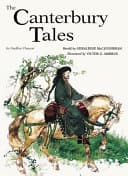
Geoffrey Chaucer (2003)
Genre
Historical Fiction
Reading Time
1200 min
Key Themes
See below
Sign in to track this book
A diverse group of pilgrims travels to Canterbury, sharing tales of love, humor, and morality that reflect medieval English life.
In April, twenty-nine pilgrims gather at the Tabard Inn in Southwark, London, planning to travel to the shrine of Saint Thomas Becket in Canterbury. The narrator, Chaucer, introduces each pilgrim, detailing their social status, job, appearance, and personality. Among them are a Knight, his Squire, and Yeoman; a Prioress, Monk, and Friar; a Merchant, Clerk, and Man of Law; a Franklin, Haberdasher, Carpenter, Weaver, Dyer, and Tapestry-maker; a Cook, Shipman, Physician, and Wife of Bath; a Parson, Plowman, Miller, Manciple, Reeve, Summoner, Pardoner, and Chaucer himself. The Host, Harry Bailly, suggests a storytelling contest for entertainment, with the best storyteller winning a free meal on their return.
The Knight, a man of honor, tells a classical romance set in ancient Athens. Two Theban knights, Palamon and Arcite, are captured by Duke Theseus and imprisoned. From their window, they both see and fall in love with Emelye, Theseus's sister-in-law. Arcite is later freed but banished, while Palamon stays imprisoned. Their rivalry grows, leading to a secret duel, interrupted by Theseus. He orders them to return in a year with a hundred knights each for a tournament, with Emelye as the prize. Arcite prays to Mars for victory, Palamon to Venus for Emelye, and Emelye to Diana for virginity or a good husband. Arcite wins the battle but is fatally injured by a divine act. After his death, Palamon and Emelye eventually marry.
The Miller, drunk and loud, insists on telling a crude story after the Knight's noble one. His story features John, a foolish old carpenter, and his beautiful young wife, Alison. Nicholas, a clever astronomy student staying with them, desires Alison and seduces her. They plan to trick John into believing a second Great Flood is coming. Nicholas convinces John to hang three tubs from the rafters, each with food and an axe, so they can escape to the roof. While John is suspended, Nicholas and Alison sleep together. Absolon, a lovesick parish clerk who also wants Alison, comes to her window. Alison plays a crude trick on him. In return, Absolon brands Nicholas with a hot iron. Nicholas's scream wakes John, who, thinking the flood has come, cuts the rope and falls, breaking his arm and becoming a joke.
The Wife of Bath, Alison, gives a long and blunt prologue, defending her many marriages and her right to sexual experience and control over her husbands. She argues against clerical celibacy and uses biblical interpretations to support her views on marriage and female independence. She recounts her experiences with her five husbands, especially her fifth, Jankyn, who beat her but eventually gave in to her will. Her tale is an Arthurian romance: a young knight rapes a maiden and is condemned to death. Queen Guinevere steps in, giving him a year and a day to find out 'what thing it is that women most desire.' After a fruitless search, he meets an old, ugly hag who promises him the answer if he agrees to do whatever she asks. He agrees, and she reveals that women desire 'sovereignty' over their husbands and lovers. The knight saves his life, but then has to marry the hag. On their wedding night, she offers him a choice: an old, ugly, but faithful wife, or a young, beautiful, but unfaithful one. He lets her choose, giving her sovereignty, and she transforms into a young, beautiful, and faithful woman.
The Pardoner, a dishonest religious figure, openly admits his fraudulent methods of selling fake relics and indulgences. He confesses that his only motive is greed, and that he preaches against avarice only to make others give him money, even though he commits the very sin he condemns. Despite his hypocrisy, he claims he can still tell a moral tale. His story is about three young men in Flanders who are drinking in a tavern when they hear a bell for a friend who died of the plague. They vow to find and kill Death. An old man directs them to a pile of gold coins under a tree. Overjoyed, they forget their quest and start planning to take the gold for themselves. The two older men plot to stab the youngest, who went to town for supplies. Meanwhile, the youngest poisons the wine he brings back for them. When he returns, the two older men kill him, then drink the poisoned wine and die. Thus, all three die because of their greed.
The Prioress, Madame Eglentyne, tells a tale of strong faith and anti-Semitism. Her story is set in an Asian city with both Christians and Jews. A young, innocent Christian boy, devoted to the Virgin Mary, learns to sing 'O Alma Redemptoris Mater' and sings it loudly as he walks through the Jewish neighborhood to school. The local Jews, influenced by Satan, are angered by his singing, which they see as an insult. They hire a villain to murder the boy, cut his throat, and throw his body into a privy. The boy's widowed mother searches for him. Miraculously, the boy's body begins to sing the hymn again, showing where it is. The local provost, a Christian, orders the arrest and torture of the Jews involved, who are then dragged by wild horses and hanged. The boy continues to sing until a holy abbot removes a grain from his tongue, after which the boy dies and is buried as a martyr.
The Nun's Priest tells a fable about a proud rooster named Chauntecleer, who lives with seven hens, his favorite being Pertelote, in a poor widow's yard. Chauntecleer dreams of a fox, which Pertelote dismisses as indigestion. Chauntecleer, however, gives a learned speech on the truth of dreams. Despite his intelligence, his pride in his singing leads to trouble. A clever fox named Daun Russell flatters Chauntecleer, praising his singing voice and challenging him to sing with his eyes closed. Chauntecleer, full of vanity, closes his eyes and stretches his neck, allowing the fox to grab him by the throat and run towards the woods. The entire farmyard chases them. As the fox is about to reach his den, Chauntecleer, recovering, advises the fox to boast to his pursuers. The fox opens his mouth to speak, and Chauntecleer flies to a nearby tree, escaping. The tale ends with a moral about the dangers of flattery and carelessness.
The Franklin tells a Breton lai, a story of true nobility and honorable behavior. It is about Arveragus, a knight, and his wife, Dorigen, who live in Brittany. They agree to a marriage based on mutual respect and equality, where Arveragus promises never to control Dorigen. While Arveragus is away for two years, Dorigen is courted by a young squire named Aurelius. To discourage him, she jokingly promises to be his if he can remove all the dangerous black rocks from the coast of Brittany. Aurelius, deeply in love, falls into despair. He seeks help from a magical clerk from Orleans, who, for a thousand pounds, creates an illusion that makes the rocks seem to vanish. Dorigen, horrified by her rash promise, tells Arveragus, who, keeping his word, tells her to honor her promise. Aurelius, moved by Arveragus's kindness, releases Dorigen from her vow. The clerk, in turn, is so impressed by Aurelius's generosity that he forgives his debt. The tale explores the meaning of true nobility.
As the pilgrims near Canterbury, the Parson, a truly devout man, is asked to tell a tale. He refuses, saying he cannot tell fables or rhyming verses. Instead, he offers a long, serious prose sermon on sin, penance, and salvation. He details the seven deadly sins – Pride, Envy, Wrath, Sloth, Avarice, Gluttony, and Lechery – and their various parts, giving examples and remedies for each. He then explains the three parts of penance: contrition (sorrow for sin), confession (admitting sins to a priest), and satisfaction (making up for sins). The Parson stresses the importance of true repentance and living a good life to achieve eternal happiness. This tale provides a spiritual conclusion to the pilgrimage, offering guidance for moral conduct and contrasting sharply with the often-worldly concerns of the other pilgrims and their stories.
At the very end of The Canterbury Tales, after the Parson's sermon, Chaucer offers a personal 'Retraction.' In this brief but important epilogue, he apologizes for any parts of his work that might be seen as immoral, worldly, or sinful, including some of the tales he just presented (referring to the more crude or secular ones) and other works he has written. He explicitly asks for God's mercy and forgiveness for these wrongdoings. Conversely, he expresses gratitude for any of his writings that have promoted virtue and led people to salvation. This retraction places a moral judgment on the entire collection, suggesting a final, serious reflection on the spiritual meaning of storytelling and artistic creation, fitting with the religious purpose of the pilgrimage itself.
The Authorial Voice/Pilgrim
The Narrator's arc is subtle, primarily serving as a framing device; he learns from the varied perspectives of the pilgrims, culminating in his personal retraction.
The Protagonist (of his tale)/Pilgrim
The Knight's character remains consistent as an ideal of virtue, his tale reinforcing his established moral standing.
The Protagonist (of her tale)/Pilgrim
Alison proudly asserts her independence and experience, remaining steadfast in her views on marriage and female agency throughout her discourse.
The Protagonist (of his tale)/Pilgrim
The Miller remains a consistent figure of robust, often vulgar, lower-class entertainment, his tale confirming his boisterous personality.
The Antagonist (morally)/Pilgrim
The Pardoner openly reveals his deceitful nature, showing no remorse but rather pride in his manipulative skills.
The Supporting/Pilgrim
The Host's role is primarily to facilitate the storytelling and maintain order, remaining a consistent figure of authority and good cheer.
The Supporting/Pilgrim
The Parson's character is consistently portrayed as a moral exemplar, his sermon reinforcing his virtuous nature.
The Mentioned/Object of desire
Emelye's arc is limited to being the passive object of male desire, eventually marrying Palamon after a tragic turn of events.
Chaucer details the social structure of medieval England, from the noble Knight to the humble Plowman, and satirizes the perceived good and bad qualities of each group. The General Prologue describes characters representing the military, clergy, and commoners, showing the hypocrisy and corruption common within each. For example, the good Parson contrasts sharply with the greedy Pardoner and the worldly Monk, revealing the Church's failures. The tales often reflect the tellers' social standing and personal biases, as seen in the Miller's crude story directly challenging the Knight's aristocratic romance, or the Reeve's retaliatory tale against a miller.
“He was a verray, parfit gentil knyght.”
A common theme throughout the tales is the widespread corruption within the medieval Church. Chaucer exposes the greed, hypocrisy, and moral failures of various religious figures. The Pardoner openly admits to selling fake relics and indulgences for money, while the Monk prefers hunting and worldly pleasures to monastic duties. The Friar cares more about drinking and seducing women than helping the poor. These characters stand in stark contrast to the ideal, truly pious Parson, who preaches and lives by Christian virtues. This theme critiques the institutional Church without necessarily condemning faith itself, showing the gap between religious ideals and their human followers.
“For though I telle noght myself for hooly, / Yet kan I telle a moral tale al soolily.”
Love and marriage are explored in many forms, from courtly love to crude, transactional relationships. The Knight's Tale shows idealized, though tragic, courtly love between Palamon, Arcite, and Emelye. In contrast, the Wife of Bath's Prologue and Tale offer a radical view on marriage, advocating for female control and sexual independence, based on her experiences with five husbands. The Miller's Tale presents a crude, farcical depiction of adultery and trickery within a marriage. The Franklin's Tale, conversely, explores a marriage built on mutual respect and equality. These varied stories question societal norms and expectations regarding gender roles, fidelity, and the power dynamics in romantic relationships.
“Wommen desiren to have sovereyntee / As well over hir housbond as hir love, / And for to been in maistrie him above.”
Many tales involve characters using deceit, trickery, or self-deception to reach their goals, often with funny or sad results. The Pardoner's honest confession of his fraudulent practices, even as he preaches against greed, is a prime example of deliberate deception. In the Miller's Tale, Nicholas and Alison trick John with the 'flood' story to have their affair. Chauntecleer in the Nun's Priest's Tale is fooled by the fox's flattery, almost costing him his life. Conversely, the Parson's Tale champions spiritual truth and sincere repentance. This theme explores the moral implications of honesty and dishonesty, and how easily people can be manipulated by appearances or their own desires.
“For though I knowe al this to be untrue, / I make men believe it is not newe.”
The entire structure of The Canterbury Tales is a celebration of storytelling. The pilgrimage acts as a larger story, with the tales forming a competition and revealing as much about the teller as the story. Chaucer explores different genres – romance, crude humor, sermon, animal fable – showing the versatility and power of narrative. The Host's role as judge highlights the performance aspect of storytelling, while the pilgrims' reactions to each other's tales (e.g., the Reeve's anger at the Miller) show the personal and social impact of stories. This theme reflects on the purpose of art, its ability to entertain, instruct, provoke, and reveal truth, even if that truth is sometimes uncomfortable or satirical.
“Who so shal telle a tale after a man, / He moot reherce as ny as evere he kan / Everich a word, if it be in his charge, / Al speke he never so rudeliche and large.”
A story within a story, where the main narrative sets the stage for a series of individual tales.
The Canterbury Tales employs a classic frame narrative structure. The overarching story is the pilgrimage itself, with the journey to Canterbury serving as the literal frame. Within this frame, each pilgrim tells a tale, creating a collection of diverse stories. This device allows Chaucer to present a wide range of genres, themes, and social commentaries, as each tale is filtered through the perspective and personality of its specific teller. The frame also provides opportunities for interaction between the pilgrims, as they react to each other's stories and personalities, adding depth and realism to the overall narrative.
Detailed descriptions of characters that reveal their social standing, personality, and moral fiber.
Chaucer's use of character sketches, particularly in the General Prologue and in the prologues to individual tales (like the Wife of Bath's), is a powerful plot device. These descriptions go beyond mere physical appearance, delving into the characters' professions, moral qualities, and often their hidden flaws or virtues. By presenting these detailed portraits before the tales are told, Chaucer primes the reader to interpret the stories through the lens of the teller's personality, biases, and social class. This technique creates dramatic irony and allows for satire, as the tales often confirm or contradict the initial impressions established in the prologues.
An authorial statement at the end of a work, apologizing for any potentially offensive content.
Chaucer's Retraction, placed at the very end of The Canterbury Tales, serves as a significant plot device. It is a personal epilogue where the author, in his own voice, apologizes for any of his writings that might be considered sinful or immoral, while expressing gratitude for works that lead to virtue. This device complicates the interpretation of the preceding tales, especially the more bawdy or satirical ones. It introduces a final layer of moral judgment, aligning the entire work with a spiritual purpose, and invites readers to reconsider the ethical implications of the stories they have just read, potentially shifting their understanding of Chaucer's ultimate intent.
The creation of a believable and lifelike setting and characters, despite fictional elements.
Chaucer masterfully uses verisimilitude to make his medieval world feel authentic and relatable. He achieves this through detailed descriptions of pilgrims' clothing, dialects (implied, though lost in translation), and social customs. The interactions between pilgrims, their squabbles (like the Miller and the Reeve), and their reactions to each other's tales lend a strong sense of realism to the journey. Even fantastical elements, like magic in the Franklin's Tale, are grounded in believable human motivations. This device immerses the reader in the fourteenth-century setting, making the characters and their diverse stories feel genuinely human and historically resonant.
“Whan that Aprill with his shoures soote, The droghte of March hath perced to the roote, And bathed every veyne in swich licour Of which vertu engendred is the flour;”
— Opening lines of the General Prologue, setting the scene for the pilgrimage.
“He was a verray parfit gentil knyght.”
— Description of the Knight in the General Prologue, highlighting his virtuous character.
“And though he were a philosophre yet had he but litel gold in his cofre.”
— Description of the Clerk of Oxford in the General Prologue, emphasizing his dedication to study over wealth.
“She was so charitable and so pitous She wolde wepe, if that she sawe a mous Caught in a trappe, if it were deed or bledde.”
— Description of the Prioress in the General Prologue, subtly hinting at her affectations.
“For he hadde geten hym yet no benefice, He was a povre scoler of Oxenforde.”
— Another line about the Clerk, reinforcing his studious poverty.
“If gold ruste, what shal iren do?”
— From the Parson's Tale, emphasizing the responsibility of the clergy to set a good example.
“My housbonde was a good man, for he loved me best of alle.”
— From the Wife of Bath's Prologue, a characteristic declaration about her martial experiences.
“But al for noght; I sette not a straw of hir dremynges.”
— Chanticleer's dismissal of Pertelote's warning about his dream in 'The Nun's Priest's Tale'.
“Mordre wol out, that se we day by day.”
— A proverb used in 'The Nun's Priest's Tale' and elsewhere, suggesting that truth will always be revealed.
“The firste cause of swich a murye peyne, Is love, which that bownden is in cheyne.”
— From 'The Knight's Tale', describing the bittersweet nature of love.
“Thanne longen folk to goon on pilgrimages, And palmeres for to seken straunge strondes, To ferne halwes, kouthe in sondry londes;”
— Further lines from the General Prologue, detailing the motivations for pilgrimage.
“And of his port as meek as is a mayde.”
— Description of the Squire in the General Prologue, noting his youthful gentleness.
“He knew the tavernes wel in every toun, And every hostiler and tappestere, Bet than a lazar or a beggestere.”
— Description of the Friar in the General Prologue, highlighting his worldly connections over his spiritual duties.
“Experience, though noon auctoritee Were in this world, is right ynogh for me To speke of wo that is in mariage;”
— The opening lines of the Wife of Bath's Prologue, asserting the value of her lived experience.
“For trewely ther is noon so hooly a lyf as for to love God with al thyn herte.”
— From the Parson's Tale, emphasizing true devotion over superficial piety.
Ready to see how well you understood this book? Take our interactive quiz with 10 questions.
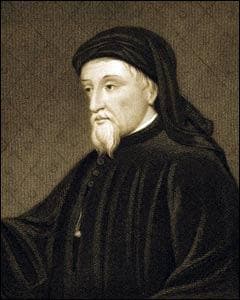
Geoffrey Chaucer was an English poet, author, and civil servant best known for The Canterbury Tales. He has been called the "father of English literature", or, alternatively, the "father of English poetry". He was the first writer to be buried in what has since come to be called Poets' Corner, in Westminster Abbey. Chaucer also gained fame as a philosopher and astronomer, composing the scientific A Treatise on the Astrolabe for his 10-year-old son Lewis. He maintained a career in the civil service as a bureaucrat, courtier, diplomat, and member of parliament.







