“There are four ways to run a ship: the right way, the wrong way, the Navy way, and my way.”
— Captain Queeg's philosophy on command, reflecting his rigid and often arbitrary approach.

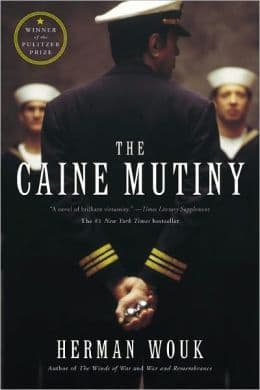
Herman Wouk (1951)
Genre
Literary Fiction / Historical Fiction
Reading Time
12-15 hours
Key Themes
See below
Sign in to track this book
A young ensign grapples with duty, command, and the fine line between eccentric leadership and dangerous incompetence aboard a WWII minesweeper, culminating in a dramatic mutiny and a morally complex court-martial.
Willie Keith, a privileged and sheltered Princeton graduate, is commissioned as an ensign in the U.S. Naval Reserve during World War II. Initially aiming for aviation, he's instead assigned to minesweepers due to his poor vision. After a brief, frustrating stint on the USS Vesuvius, a dilapidated four-piper destroyer, where he sees the harsh, unglamorous side of the Navy, Willie is transferred to the USS Caine, a DMS (destroyer minesweeper) operating in the Pacific. His romantic relationship with May Wynn, a nightclub singer from a working-class background, faces challenges due to his mother's disapproval and Willie's own immaturity regarding their differing social strata.
Willie Keith arrives aboard the USS Caine, finding it a disorganized and demoralized ship. He quickly befriends Ensign Barney Greenwald, the ship's legal officer, and Lieutenant Tom Keefer, an aspiring writer and intellectual. The Caine's current captain is soon replaced by Lieutenant Commander Philip Francis Queeg. From the outset, Queeg's leadership style is peculiar. He is rigid, by-the-book, and prone to micromanagement, often alienating his crew. His first major act is a thorough inspection that uncovers numerous deficiencies, leading to intense, often illogical, disciplinary actions that further degrade morale on the ship.
Queeg's command quickly devolves into a series of bizarre incidents. The most prominent is the 'yellow stain' incident, where Queeg accuses his officers of deliberately sabotaging the ship's cleanliness by staining his coffee with a nonexistent yellow substance. He meticulously investigates, even ordering paint scraped from a bulkhead, despite the officers' denials and the logical impossibility of the claim. This event, combined with his constant accusations of petty theft (like the missing strawberries), his insistence on useless drills, and his general incompetence in navigation and tactical situations, leads Lieutenants Keefer and Maryk to believe Queeg is mentally unstable and unfit to command. Willie, initially loyal, begins to have doubts.
Lieutenant Tom Keefer, a cynical intellectual, begins to openly discuss Queeg's unfitness for command with Lieutenant Steve Maryk, the executive officer. Keefer, citing Navy Regulations Article 184 (which allows for relief of command in cases of mental unfitness), subtly encourages Maryk to consider taking action. Maryk, a career Navy man deeply respectful of regulations, is torn. However, after witnessing more of Queeg's increasingly irrational decisions and fearful for the safety of the ship and crew, Maryk begins to keep a detailed log documenting every instance of Queeg's erratic behavior, poor judgment, and potential mental instability. This log becomes crucial evidence.
During a mission to tow targets at Kwajalein, Queeg's command reaches a new low. His navigation is faulty, his orders are contradictory, and he shows a lack of understanding of basic seamanship. He endangers the Caine and its crew by making a series of critical errors, almost causing a collision and mishandling the towing lines. This incident is a turning point for Maryk, who realizes that Queeg's incompetence is not merely annoying but actively dangerous. The officers, including Willie, become increasingly convinced that Queeg is a liability, but the thought of actual mutiny remains terrifying.
The USS Caine finds itself caught in the devastating Typhoon Mary. Queeg's leadership during the storm is disastrous. He orders the ship to turn directly into the wind, a maneuver that threatens to capsize the Caine, then becomes paralyzed by fear and indecision, clinging to the ship's rail. With the ship listing dangerously and the lives of the crew in imminent peril, Lieutenant Maryk, citing Article 184 and his meticulously kept log, makes the agonizing decision to relieve Queeg of command. Willie Keith, as officer of the deck, and other officers are present and witness the event. Maryk takes control, successfully navigating the Caine through the storm and saving the ship.
Following the typhoon, Maryk reports the incident, expecting commendation for saving the ship. Instead, he is immediately arrested and charged with mutiny, a capital offense in wartime. Willie Keith is also implicated as a witness. Lieutenant Barney Greenwald, a lawyer in civilian life, reluctantly agrees to defend Maryk, despite his personal reservations about challenging military authority. Greenwald begins preparing Maryk's defense, which hinges on proving Queeg's mental instability and the necessity of Maryk's actions under extreme duress. Lieutenant Tom Keefer, who initially encouraged Maryk, becomes a crucial witness for the defense, providing testimony about Queeg's erratic behavior.
The court-martial begins, a tense and dramatic affair. The prosecution attempts to paint Maryk as a disloyal officer who usurped authority. Greenwald, however, meticulously cross-examines Queeg, revealing his paranoia, his evasiveness, and his tendency to blame others. Through a series of sharp questions and by referencing Maryk's log, Greenwald exposes Queeg's psychological weaknesses and his actual incompetence during the typhoon. Queeg's breakdown on the stand, where he compulsively rolls steel balls in his hand and rambles about minor infractions, effectively undermines his credibility and confirms the defense's argument that he was unfit to command.
Lieutenant Maryk is acquitted of all charges. The verdict is a relief, but the victory is not without its bitterness. At a celebratory party, Greenwald, now drunk, confronts Keefer, accusing him of being the true instigator of the 'mutiny' by subtly manipulating Maryk. Greenwald reveals his deep contempt for Keefer, whom he sees as a coward who pushed Maryk to act while avoiding personal responsibility. He then throws a drink in Keefer's face, declaring that Queeg, despite his flaws, was a dedicated Navy man who served his country, unlike the intellectual Keefer who merely criticized from the sidelines.
Willie Keith, profoundly changed by the events on the Caine and the court-martial, matures significantly. He learns the importance of duty, loyalty, and the complexities of command. He eventually becomes an executive officer on another ship and distinguishes himself in combat. His relationship with May Wynn deepens, as he finally rejects his mother's snobbery and embraces May for who she is. After the war, Willie marries May and begins a career in journalism. The experiences on the Caine leave an indelible mark on him, shaping his understanding of leadership, moral responsibility, and the human condition.
The Protagonist
Willie transforms from a callow, privileged youth into a mature, responsible naval officer who finds his purpose and embraces his relationship with May Wynn.
The Antagonist
Queeg descends from a seemingly by-the-book captain into an increasingly paranoid and incompetent leader, ultimately breaking down under pressure during his court-martial.
The Supporting
Maryk, a loyal and traditional officer, is forced to make an unprecedented decision to save his ship, leading him to face the moral and legal consequences of 'mutiny'.
The Supporting
Keefer, initially a charismatic intellectual who inspires action, reveals himself to be a morally ambiguous character who avoids personal responsibility for his provocations.
The Supporting
Greenwald, initially a reluctant defense attorney, becomes a fierce advocate for Maryk, ultimately revealing his profound moral insights about duty and sacrifice in his condemnation of Keefer.
The Supporting
May's steadfast love and grounded nature help Willie mature and ultimately choose a life based on genuine affection rather than social expectations.
The Mentioned
Mrs. Keith's influence on Willie diminishes as he matures and makes his own choices, particularly regarding May Wynn.
The Supporting
N/A
This theme explores the conflict between an officer's sworn duty to obey orders and their moral obligation to protect their crew and ship when faced with an incompetent or mentally unstable superior. Maryk's agonizing decision to relieve Queeg exemplifies this struggle, as he weighs the severe consequences of 'mutiny' against the immediate danger posed by Queeg's command during Typhoon Mary. The novel suggests that while duty is paramount, there are extreme circumstances where personal conscience and the safety of others must take precedence, even if it means risking one's career and life. Greenwald's later speech complicates this, arguing for the necessity of the 'Queegs' in maintaining order during war.
““There is no more exciting sport than reading and writing. And I like to think that I do both as well as any man in the United States Navy, with the possible exception of Queeg.””
The novel examines various forms of leadership through its characters. Queeg represents a rigid, paranoid, and ultimately failed leader whose incompetence endangers his crew. Maryk embodies a reluctant leader forced into action by necessity, demonstrating courage and a deep sense of responsibility. Willie Keith's journey highlights the development of leadership qualities from an inexperienced ensign to a capable officer. The story suggests that effective leadership requires not just adherence to rules, but also judgment, courage, and the ability to inspire trust, even in imperfect circumstances. Greenwald's defense of Queeg, despite his flaws, points to the broader, often thankless, role of military leaders.
““The Caine was a mess, and Captain de Vriess was a mess, but he was a lovable mess, and you could learn from him.””
The Caine Mutiny explores the complexities of moral judgment, particularly in wartime. The court-martial forces characters and readers to grapple with who is truly 'right' and 'wrong.' While Queeg's incompetence is clear, Greenwald's powerful closing argument challenges the simplistic condemnation of Queeg, reminding everyone of the sacrifices made by dedicated, if flawed, military men. Keefer, who instigates the 'mutiny' idea, is revealed as a moral coward. The novel suggests that heroes and villains are rarely clear-cut, especially under the pressures of war, and that judging others requires a deep understanding of their circumstances and motivations. The events force Willie to confront his own simplistic views.
““There is no such thing as a mutiny in the United States Navy. There is only insubordination and disobedience of orders.””
Willie Keith's journey is a classic coming-of-age narrative. He begins as a naive, privileged young man, initially disillusioned by the mundane and often absurd realities of Navy life after expecting a romanticized war experience. His exposure to Queeg's tyranny, the horror of the typhoon, and the moral complexities of the court-martial force him to shed his innocence and confront the harsh truths of human nature and military service. He learns that heroism is often born out of desperate necessity, and that life, and war, are far more nuanced and morally ambiguous than he initially perceived.
““It took a war to make a man of me.””
Beyond the immediate conflict on the Caine, the novel explores the broader costs and sacrifices of World War II. Queeg, despite his flaws, is presented by Greenwald as a man who dedicated his life to the Navy, enduring hardships and performing essential, if unglamorous, duties. The court-martial itself, while focusing on a specific incident, highlights the immense pressure and psychological toll that war takes on individuals, transforming ordinary men into figures capable of both great courage and profound error. The ultimate message is that victory comes at a human cost, borne by all, from the lowest ranks to the highest command, and that even the flawed contribute to the larger effort.
““The Navy is not a home. It's a man's life.””
A legal drama serving as the climax and a vehicle for moral exploration.
The court-martial of Lieutenant Maryk is the central plot device, structuring the second half of the novel. It functions as a dramatic climax, allowing for a detailed re-examination of all previous events on the Caine through testimony and cross-examination. More importantly, it serves as a powerful forum for exploring the novel's core themes: duty, leadership, moral ambiguity, and the nature of justice. Through Greenwald's defense and Queeg's breakdown, the trial exposes the psychological toll of command and the complex ethical dilemmas faced by military personnel, moving beyond a simple good-versus-evil narrative.
A detailed record of Queeg's actions, serving as crucial evidence and a symbol of growing dissent.
Lieutenant Maryk's meticulously kept log of Queeg's erratic behavior and incompetent decisions is a key plot device. It initially serves as Maryk's personal documentation, a way for him to process his concerns about his captain. During the court-martial, it becomes the most damning piece of evidence against Queeg, providing concrete, dated examples of his unfitness. The log symbolizes Maryk's methodical and conscientious nature, his reluctance to act without justification, and the burden of responsibility he carries. Its existence elevates the 'mutiny' from a rash act to a considered, albeit desperate, decision based on documented evidence.
A natural disaster serving as the catalyst for the 'mutiny' and a test of leadership.
Typhoon Mary is a critical plot device, representing a force of nature that exposes the true character of the leaders aboard the Caine. It acts as the ultimate test of Queeg's leadership, revealing his complete paralysis and incompetence under extreme pressure. Simultaneously, it provides the dire circumstances that justify Maryk's decision to relieve Queeg of command, transforming a potential act of insubordination into a necessary measure to save the ship and its crew. The typhoon is not just a backdrop; it is an active agent that forces the central conflict to a head and highlights the stakes of Queeg's command.
A post-trial monologue that recontextualizes the entire narrative and reveals the novel's moral core.
Greenwald's drunken speech at the victory party, delivered after Maryk's acquittal, is arguably the most significant plot device in the novel. It functions as a dramatic reversal and a profound moral commentary, shifting the reader's perspective on Queeg and the 'mutiny.' Greenwald's passionate defense of Queeg, despite his flaws, as a necessary 'old man' who stood guard against greater evils (like Nazism), and his condemnation of Keefer's intellectual cowardice, forces a re-evaluation of the entire narrative. It underscores the novel's theme of moral ambiguity and the complex sacrifices required in wartime, providing a deeper, more nuanced understanding of duty and leadership.
“There are four ways to run a ship: the right way, the wrong way, the Navy way, and my way.”
— Captain Queeg's philosophy on command, reflecting his rigid and often arbitrary approach.
“The Caine was a ship designed by a genius to be run by an idiot.”
— Willie Keith's early cynical observation about the ship's design and operational challenges.
“Ah, but the 'mutiny' - the real mutiny - began the day Queeg took command.”
— Lt. Greenwald's retrospective analysis during the court-martial, suggesting Queeg's incompetence was the true catalyst.
“The great truth of the sea is that it has no mercy.”
— A reflection on the harsh realities of naval life and the unforgiving nature of the ocean.
“A man must obey orders, right or wrong, or there's no Navy.”
— A fundamental principle of military discipline, often debated in the context of Queeg's command.
“The only thing that holds the Navy together is the concept of implicit obedience to superior orders.”
— Greenwald's argument highlighting the bedrock of military structure, even when it leads to difficult situations.
“Strawberries! But where are the strawberries?”
— Captain Queeg's obsessive search for missing strawberries, a key indicator of his paranoia and mental instability.
“There is no such thing as a good mutiny.”
— A legal and military perspective on the act of mutiny, emphasizing its inherent illegality.
“The Navy, you see, is not a democracy. It is a dictatorship tempered by mutiny.”
— A sardonic observation about the military's command structure and the extreme consequences of its failures.
“Every man has his breaking point.”
— A general statement about human endurance, particularly relevant to the crew's deteriorating morale under Queeg.
“The truth is a tricky thing. It's never just one thing, is it?”
— A philosophical reflection on the complexity of truth, especially in the context of the court-martial's differing accounts.
“That's the way it is in the Navy. You do your job, you keep your mouth shut, and you go home.”
— An expression of the pragmatic, often resigned attitude of many enlisted men.
“A captain is like a god on his own ship.”
— Underlines the immense power and authority vested in a ship's commanding officer.
“The Caine was a mess, but she was our mess.”
— Willie Keith's evolving sense of belonging and loyalty to his ship and crew, despite its flaws.
Ready to see how well you understood this book? Take our interactive quiz with 10 questions.
Biography coming soon.







