“The old gods, they do not die easily. They cling to the earth, to the stones, to the blood of those who remember them.”
— Spoken by a character discussing the enduring power of ancient beliefs in Scotland.

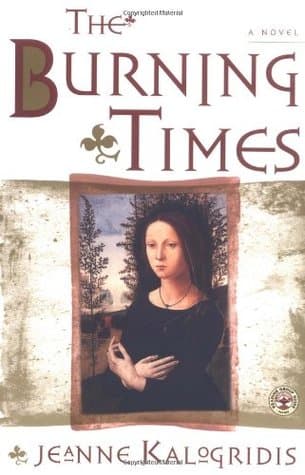
Jeanne Kalogridis (2001)
Genre
Fantasy / Historical Fiction / Romance
Reading Time
10-12 hours
Key Themes
See below
Sign in to track this book
In 1357 France, a midwife with magic flees the Inquisition, finding her forbidden powers and love for a compassionate monk entangle her in a struggle for survival during the Black Death and the Hundred Years' War.
In St. Jacques, Sybille, a young midwife, helps her grandmother, Maeve, deliver babies and heal the sick with herbs and touch. Her abilities are often seen as magic, both respected and feared. When she cannot save a child during a difficult birth, the grieving mother accuses Sybille of witchcraft. The accusation spreads quickly through the superstitious village, fueled by the local priest's warnings. Fearing for her life as the Inquisition approaches medieval France, Sybille must flee her home, leaving her family and old life behind, with the threat of the pyre.
After a difficult journey, Sybille seeks refuge in the Franciscan convent, Abbey of Ste. Claire, far from her village. To protect herself, she takes a new identity, becoming Sister Marie Francoise. Inside the convent, she finds some peace and purpose, caring for the sisters and the infirmary. Her healing abilities, now disguised as pious care, quickly make her essential. However, convent life and the constant fear of being discovered weigh on her as she tries to hide her true nature and the 'gift' that once brought her danger. She finds comfort in the quiet routines but remains watchful.
The peace of the Abbey of Ste. Claire ends with the arrival of Brother Michel, a young, devout, and intelligent Franciscan monk sent by the Inquisition. He is there to investigate the suspicious death of a local lord, rumored to involve sorcery, and coincidentally, to look into a report about a 'witch' who fled to a convent in the region — a description that matches Sybille's past. Michel, a man of faith and compassion, begins his interrogations, sifting through testimonies. His presence immediately makes Sybille, now Sister Marie Francoise, anxious, forcing her to face the danger she tried to escape. She fears her true identity and gifts will be exposed.
Under Brother Michel's close watch, Sybille, as Sister Marie Francoise, confesses her past. She reveals her true name, Sybille, and the reasons she came to the convent, including her healing abilities and the witchcraft accusation. Michel, instead of condemning her, is struck by her sincerity, intelligence, and compassion. He feels drawn to her, not just as a subject of investigation, but as a complex woman. This growing connection complicates his duty as an Inquisitor, as he struggles to balance his faith and vows with the empathy and feelings he develops for Sybille, clouding his judgment.
The Black Death comes to France, affecting even the isolated Abbey of Ste. Claire. The plague devastates the convent and nearby villages, bringing death and despair. Sybille, using her forbidden healing knowledge and Maeve's old remedies, works tirelessly to care for the sick and dying, often using methods that seem 'magical.' Brother Michel, seeing her selfless dedication and the effectiveness of her unconventional treatments, helps her, putting aside his Inquisitorial duties to ease suffering. Their shared fight against the plague deepens their bond, creating an intimate partnership that further blurs the lines between monk and accused, Inquisitor and 'witch,' strengthening their forbidden affection.
During a time of caring for plague victims, Sybille and Michel share a mystical vision. This spiritual experience, beyond their individual beliefs, reveals a deeper understanding of the universe and their place in it. The vision strengthens their spiritual bond, showing Michel that Sybille's 'gift' is not demonic but a connection to a higher, natural force. This shared intimacy, born of crisis and spiritual revelation, ignites a powerful, forbidden love between them. They acknowledge their feelings, understanding the immense danger their relationship poses within the Church and the Inquisition, yet unable to deny their deep connection.
As the plague crisis lessens, the Inquisition's hunt for heresy resumes. Brother Michel is called back to his duties, and the investigation into Sybille, now known as a 'witch' to more people, intensifies. Witnesses from her old village are brought forward, recounting the tragic birth and her 'unnatural' abilities. Evidence, both real and false, is gathered against her, painting a picture of sorcery and demonic pacts. Sybille feels increasingly isolated, with the Church's legal and theological power against her, making her conviction seem certain. Michel struggles internally, torn between duty and love.
Facing Sybille's imminent trial and almost certain condemnation, Brother Michel takes desperate measures. He knows that legal means will not save her. Using his knowledge of Church law, his understanding of the Inquisition's methods, and his love for Sybille, he plans. This plan involves manipulating legal proceedings and possibly committing acts that could be seen as heretical himself, risking his reputation, vows, and even his life. He is determined to save Sybille, even if it means sacrificing everything he has known and believed, showing the depth of his commitment to her.
Sybille is brought before the Inquisition's tribunal, enduring a trial filled with accusations, leading questions, and the threat of torture. Her fate seems sealed. However, at the climax, Michel's plan begins. Through legal maneuvering, exploiting loopholes, and perhaps some 'unorthodox' methods, he creates a diversion or introduces evidence that casts doubt on the prosecution's case, or even orchestrates an escape. His intervention is audacious and unexpected, leading to a miraculous turn of events that, against all odds, allows Sybille to escape the Inquisition and certain death by fire.
Having escaped the Inquisition, Sybille and Michel must abandon their old lives entirely. They become fugitives, seeking refuge in a world still hostile to Sybille's gifts and their forbidden love. Their journey takes them to new lands, away from the Church's immediate power. They dream of a life where Sybille can openly practice her healing arts without fear, and where their love can grow without the shadow of sin or heresy. Their shared experiences have created an unbreakable bond, and they face the future together, united in their determination to build a new life, embracing their love and Sybille's connection to the natural world.
The Protagonist
From a fearful, persecuted young woman, Sybille evolves into a resilient survivor who embraces her true nature and finds love and acceptance.
The Protagonist/Love Interest
Michel transforms from a rigid Inquisitor into a man willing to sacrifice everything for love and a broader understanding of spirituality.
The Supporting
Maeve remains a steadfast mentor, her wisdom and legacy enduring through Sybille.
The Antagonist/Supporting
Father Antoine remains a static figure of religious intolerance, a symbol of the forces Sybille must escape.
The Supporting
She provides a sanctuary for Sybille, representing the more humane side of the Church, but is ultimately powerless against the Inquisition's full might.
The Antagonist
Jean-Luc remains a steadfast and cruel antagonist, a representation of oppressive religious authority.
The Mentioned/Catalyst
His death serves as a catalyst for the main plot, initiating the conflict.
This theme explores the Church's rigid faith definitions against more natural or intuitive forms of spirituality, often called heresy or witchcraft. Sybille's healing gifts, from ancient wisdom and nature, are seen as demonic by the Inquisition, though she uses them for good. Brother Michel's journey is key here, as he grapples with his beliefs and the goodness he finds in Sybille, making him question the Church's authority. The shared mystical vision between Sybille and Michel (Plot Summary #6) directly challenges the Church's narrow view of divine revelation.
““The Church teaches us to fear the unknown, but sometimes, the unknown is simply a different path to God.””
The forbidden love between Sybille, an accused witch, and Brother Michel, an Inquisitor, is the emotional core of the novel. Their relationship defies societal norms, religious rules, and the dangers of the Inquisition. Their bond grows through shared hardship, especially during the Black Death (Plot Summary #5), where their work together strengthens their respect and affection. Their love shows a powerful human connection that goes beyond institutional barriers and personal sacrifices, ending with Michel risking everything to save Sybille (Plot Summary #8).
““Some loves are not meant to be, they say. But ours, Sybille, was meant to be, against all that the world would deny.””
The novel shows how knowledge, especially that outside accepted doctrine, can be both powerful and dangerous. Sybille's healing knowledge and natural remedies, passed down (Plot Summary #1), make her valuable but also a target. The Church, through the Inquisition, tries to control and suppress any knowledge that challenges its authority, fearing it could empower individuals and weaken its power. The act of healing, when not approved by the Church, becomes dangerous.
““Ignorance is a weapon in the hands of the fearful, but knowledge, once awakened, cannot be truly extinguished.””
Persecution is central to Sybille's journey, as she is hunted for her gifts and beliefs during the Inquisition (Plot Summary #1, #7). The novel shows the fear, injustice, and brutality faced by those accused of heresy or witchcraft. However, it also emphasizes human resilience. Sybille's ability to survive, adapt, and overcome these oppressive forces, keeping her identity and compassion, shows this resilience. Her journey shows the strength of individuals against systemic oppression.
““They can burn the body, but they cannot burn the spirit, nor the truth that lives within it.””
The story explores the vulnerable position of women in medieval society, especially those with skills or knowledge outside traditional roles. Sybille, as a midwife and healer, shows this vulnerability, as her professional and spiritual independence makes her open to witchcraft accusations. The convent offers a complex sanctuary, providing both protection and confinement. The narrative highlights the limited choices for women and the patriarchal power structures that sought to control female bodies, knowledge, and spirituality, often through fear and violence.
““A woman with knowledge is a dangerous thing, they say. And in these times, a dangerous thing is a dead thing.””
Sybille's innate healing ability and connection to nature.
Sybille's 'gift' serves as the primary catalyst for the entire plot. It is both her greatest asset, allowing her to heal and save lives, and the source of her persecution, marking her as a 'witch' in the eyes of the fearful and superstitious. It drives her flight from her village, her adoption of a new identity, and ultimately, her connection with Brother Michel. The nature of the gift—is it divine, natural, or demonic?—is a central question that Michel must confront, symbolizing the clash between scientific observation and religious dogma.
A historical plague that acts as a crucible for character development and plot progression.
The Black Death is a significant historical event woven into the narrative, serving as a powerful plot device. It disrupts the established order, creating chaos and despair that paradoxically allows for intimacy and growth between Sybille and Michel (Plot Summary #5). In the face of widespread death, their roles as Inquisitor and accused become secondary to their shared humanity and efforts to save lives. The plague also tests their resilience and deepens their bond, pushing them to confront their beliefs and feelings in a way that normal circumstances would not allow.
The historical institution of religious persecution, serving as the primary antagonist.
The Inquisition is not just a backdrop but the overarching antagonistic force in the novel. It represents institutional power, religious dogma, and the suppression of individual freedom and alternative beliefs. Its relentless pursuit of 'heretics' and 'witches' drives Sybille's flight and subsequent trials, creating constant tension and danger. The Inquisition's methods, its legalistic yet brutal approach, and its unwavering authority are central to the conflict, forcing characters like Michel to choose between loyalty to the institution and their own moral compass.
A place of refuge that simultaneously offers protection and confinement.
The Abbey of Ste. Claire functions as a dual-natured plot device. Initially, it is a sanctuary for Sybille (Plot Summary #2), offering her protection from immediate persecution and a new identity. However, it also becomes a form of confinement, restricting her true nature and forcing her to suppress her gifts. As the Inquisition closes in, the convent transforms from a safe haven into a potential trap, highlighting the precariousness of any refuge in a time of widespread fear and persecution. It symbolizes the limited freedom available to women, even within religious structures.
“The old gods, they do not die easily. They cling to the earth, to the stones, to the blood of those who remember them.”
— Spoken by a character discussing the enduring power of ancient beliefs in Scotland.
“Fear is a powerful weapon, my lady. More potent than any blade, for it turns a man against himself.”
— A character reflecting on the political climate and the use of fear to control people.
“Love, true love, is not a gentle thing. It is a fire, a storm, a force that can consume or create.”
— A deep reflection on the nature of passionate love within the story.
“There are some truths that men are not meant to know, or perhaps, are not strong enough to bear.”
— A mystical character hinting at hidden knowledge and the dangers of revealing it.
“The wind carries the whispers of the past, if only you know how to listen.”
— A moment emphasizing the connection to history and ancestral voices.
“A woman's heart is a labyrinth, easily lost within, and harder still to escape.”
— A male character's observation on the complexities of a woman's emotions and mind.
“The world is changing, and those who cling to the old ways will be swept away by the tide.”
— A commentary on the transition from paganism to Christianity in Scotland.
“Sometimes, the greatest strength lies in knowing when to yield, when to bend so you do not break.”
— A lesson learned about resilience and survival in difficult times.
“Blood remembers, even when the mind forgets.”
— A recurring theme about inherited memory and ancestral connections.
“Magic is not in spells or incantations, but in the belief that anything is possible.”
— A character's philosophical view on the true nature of magic.
“To be truly free, one must first be free of fear.”
— A profound statement on the path to liberation, both personal and political.
“The future is not set in stone, but woven by the choices we make today.”
— A character contemplating free will versus destiny.
“Grief is a heavy cloak, but one must eventually cast it aside to feel the sun again.”
— A moment of reflection on overcoming loss and finding hope.
“There is a wildness in the heart of Scotland that cannot be tamed, only respected.”
— A description of the untamed spirit of the Scottish landscape and its people.
Ready to see how well you understood this book? Take our interactive quiz with 10 questions.

Biography coming soon.







