“Being a god meant never having to say you’re sorry. Being a god also meant being completely alone.”
— Apollo reflecting on his immortality and isolation, especially after his fall from grace.

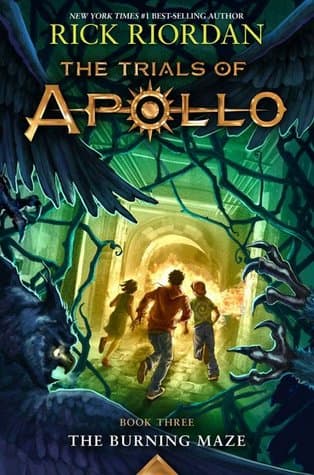
Rick Riordan (2018)
Genre
Fantasy / Children's / Young Adult
Reading Time
360 min
Key Themes
See below
Sign in to track this book
Apollo, now the mortal Lester, must go through the Labyrinth with a demigod and a satyr to face a Roman emperor and an Oracle, all to save Camp Jupiter.
Lester Papadopoulos (the mortal Apollo) and Meg McCaffrey are in the Labyrinth, teleported there by Hecate at the end of the last book. They look for Grover Underwood, who disappeared while checking strange environmental issues. They find Grover in a cavern trying to save demigod Piper McLean from a Manticore. After a fight, they defeat the Manticore and save Piper. Piper says her father, Jason Grace, sent her to find the lost Oracle of Erythraean Sibyl. As they try to leave the Labyrinth, the Erythraean Sibyl, as a dryad named Mellie, appears and gives a new prophecy: 'The burning maze shall be your tomb, unless the cloven guide alone the way does know.'
The prophecy mentions a 'cloven guide,' meaning a satyr. Meg first thinks of her adoptive father, the god Pan, who is gone, but then realizes it means Grover Underwood. Grover, feeling the prophecy's weight, agrees to lead them. They decide to enter the Labyrinth from a new entrance Mellie showed them, which leads to the Burning Maze in the American Southwest. Before entering, they meet the empousa Kelli, who warns them about the dangers inside. Despite the warnings, the three, with Piper, step into the Labyrinth. It immediately proves to be a dangerous, changing place, with fire traps and monsters.
Inside the Burning Maze, the group faces immediate dangers. Fire-breathing scorpions attack them. Grover's knowledge of the Labyrinth and his connection to nature help them find paths and avoid traps. They find a market run by headless Blemmyae, who are friendly and offer supplies. Here, they also meet the sorceress Medea, an old enemy of Jason Grace, now working for the Triumvirate. Medea tries to tempt Piper with power and a cure for her father, but Piper stays loyal to her friends. Medea then attacks, making the group run deeper into the maze.
As they go through the maze, Medea's automatons ambush them. As they are about to be defeated, Jason Grace, Piper's father and a demigod son of Jupiter, arrives to help. He says Leo Valdez warned him about the Triumvirate's plans, and he has been looking for them. Together, they fight off Medea's forces. But the battle draws the attention of Emperor Caligula, who appears with his pet, Emperor Commodus's lion. Jason sacrifices himself to hold off Caligula and his forces, giving Apollo, Meg, Grover, and Piper time to escape deeper into the maze. His death affects everyone deeply, especially Piper.
Devastated by Jason's death, the remaining group continues, determined to get revenge and stop the Triumvirate. They find Caligula's floating yacht, a luxurious but scary base in the Labyrinth. They get onto the yacht, hoping to stop him. They discover Caligula wants to become a god and plans to use the Erythraean Sibyl's power to become immortal and destroy Camp Jupiter. He reveals his alliance with Commodus and Nero, and his plan to use the Labyrinth itself as a weapon. Apollo, still mortal, feels helpless and angry facing the former emperor, who mocks his past as a god.
The group reaches the chamber where the Erythraean Sibyl is, but Caligula has captured her. He is taking her prophetic energy for his own bad plans, weakening her and making her prophecies unclear. The Sibyl, as the dryad Mellie, is barely conscious. Apollo realizes that to free the Oracle, they must defeat Caligula and also restore her power. This is a huge challenge, as Caligula has imperial guards and strong magic, and the Sibyl's spirit is connected to the Labyrinth, making her open to its destructive nature.
A fierce battle starts aboard Caligula's yacht. Apollo, Meg, Grover, and Piper fight Caligula's forces, including his monster pets and automatons. Meg's imperial gold sickles work well, while Grover uses his nature magic to control the environment. Piper's charmspeak helps confuse enemies. Apollo, despite his mortal weakness, uses his intelligence and what little divine energy he has. Their goal is to reach Caligula and stop his control over the Sibyl. The fight is desperate, with many losses for Caligula's side, but the emperor himself is a strong enemy, protected by old magic and cruel cleverness.
In a final fight, Apollo and Meg corner Caligula. Using Meg's power and Apollo's strategy, they hit the emperor with a critical blow. Caligula is defeated, his plans for godhood stopped. However, the Sibyl's dryad host, Mellie, is badly hurt during the battle and dies. Before she dies, she gives a clear prophecy, guiding Apollo to his next challenge and revealing more about the Triumvirate's main plan. Her death is a sad moment, reminding Apollo of the mortal cost of his quest.
After Caligula's defeat and Mellie's death, Piper is sad about her father, Jason. She decides she needs to leave the quest to mourn and help her family. She gives Apollo a small item that belonged to Jason, telling him to remember his friend's sacrifice. Apollo, Meg, and Grover, though heartbroken, understand her choice. With the Erythraean Sibyl's Oracle restored, they get clearer guidance for their next steps, realizing they must continue their journey to stop the remaining emperors and save Camp Jupiter.
Coming out of the Labyrinth, Apollo, Meg, and Grover regroup, tired but determined. They process the losses and wins, especially Jason's sacrifice. The restored Erythraean Sibyl's final prophecy guides them to their next stop: facing the second emperor, Commodus, in a new and dangerous place. Apollo, still mortal, feels the weight of his duties more than ever, realizing that his personal growth and his friends' sacrifices are most important for his success. They prepare for the next part of their dangerous journey, knowing that the world's fate rests on them.
The Protagonist
From a self-centered, powerless god, he learns humility and sacrifice, growing into a more compassionate and responsible leader.
The Protagonist/Supporting
She grows in confidence and self-reliance, confronting her past trauma and solidifying her loyalty to her friends.
The Supporting
He embraces his role as the Lord of the Wild, using his unique connection to nature to guide and protect his friends.
The Supporting
She endures profound loss and makes a difficult choice to prioritize her family and personal healing over the immediate quest.
The Supporting
He makes the ultimate sacrifice, embodying heroism and selflessness.
The Antagonist
He attempts to ascend to godhood through the Sibyl's power but is ultimately defeated and killed.
The Supporting/Antagonist
She attempts to thwart the heroes and manipulate Piper but is ultimately overcome.
The Supporting
She serves as the host for the Oracle, guiding the heroes through her prophecies, and ultimately sacrifices herself to deliver a clear message.
The Mentioned
His influence is felt as part of the Triumvirate's threat, setting up future conflicts.
The Mentioned
His past actions continue to influence Meg's character and drive, setting up his eventual confrontation.
Sacrifice is a main idea in 'The Burning Maze,' especially with Jason Grace's death to save his friends. This act deeply affects Apollo and Piper, making them face the real and often harsh costs of their quest. Mellie's sacrifice as the Sibyl's host also shows this, proving that even small characters can make important, sad contributions. These losses help Apollo mature, removing his godly distance and making him value mortal lives and the sacrifices made for good.
““I’m sorry, Apollo,” Piper said, her voice raw. “But it’s time to go.” Her eyes, red-rimmed but resolute, met his. “Jason bought us that time.””
Apollo's journey from a self-centered god to a more caring mortal is a main idea. Without his powers, he must rely on others and feel fear, pain, and loss directly. His interactions with Meg, Grover, and Piper teach him the value of mortal courage and kindness. He starts to understand the effect of his past godly arrogance and learns to appreciate demigods' strength. The suffering he sees and experiences, especially Jason's death, reduces his self-centeredness, creating a new sense of responsibility and real care for others.
““I had been a god of many things, but never of humility. Now, it was forced upon me like a crown of thorns.””
The Triumvirate emperors, especially Caligula, show how unchecked power corrupts. Caligula's obsession with godhood, his cruelty, and his willingness to use others (like the Sibyl) for his own gain show how absolute power can lead to madness and tyranny. His actions in the Burning Maze, from creating fire traps to enslaving the Sibyl, show he completely disregards life and morals. This idea contrasts with the heroes' struggles; they, despite their own powers, try to use them for good and protect the innocent.
““Power. It’s what everyone wants, isn’t it? And once you have it, why would you ever give it up?””
Grover Underwood's role as the Lord of the Wild and the Burning Maze setting highlight environmentalism. Caligula corrupts and weaponizes the Labyrinth itself, showing humanity's harmful effect on nature. Grover's strong connection to the earth lets him navigate the maze and feel its distress, showing the importance of protecting the natural world. Despite the destruction, nature's strength is also shown, with new life finding ways to grow even in the maze's toughest parts, mirroring the heroes' lasting hope.
““The Labyrinth… it’s a living thing. And it’s hurting. I can feel it.””
Friendship and loyalty are very important for the heroes to survive and succeed. Apollo, Meg, and Grover, with Piper and Jason, depend on each other's strengths and support. Meg's strong loyalty to Apollo, despite his faults, and Grover's steady commitment as the 'cloven guide' are clear examples. Jason's final sacrifice is a deep act of loyalty to his friends, showing that these connections are strong enough to overcome even the biggest threats. These relationships provide emotional support and practical help throughout their dangerous journey.
““You’re my best friend, Apollo. I’m not leaving you.””
A sentient, ever-shifting underground maze that serves as the primary setting and a major antagonist.
The Labyrinth functions as both the main setting and a formidable antagonist. In 'The Burning Maze,' it is specifically the 'Burning Maze' section, a fiery, dangerous, and constantly shifting network beneath the American Southwest. It's a sentient entity that reacts to its inhabitants, manifesting new traps and paths. Caligula has amplified its destructive capabilities, turning it into a weapon. Its unpredictable nature forces the characters to rely on improvisation and Grover's unique connection to the wild, constantly challenging their navigation and survival skills.
A divine source of prophecy that guides the quest but is exploited by the antagonist.
The Erythraean Sibyl is one of the Oracles Apollo must restore. Its role as a plot device is two-fold: it provides the initial, cryptic prophecy that sets the heroes on their path (the 'cloven guide' prophecy) and serves as the ultimate objective within the Burning Maze. Its capture and exploitation by Caligula create the central conflict, as freeing and restoring the Sibyl is essential for Apollo to gain clearer guidance for his larger quest. The Sibyl's final, clear prophecy after Mellie's sacrifice provides crucial information for the next stage of the journey.
An overarching antagonistic force composed of three resurrected Roman emperors.
The Triumvirate serves as the overarching antagonistic force of 'The Trials of Apollo' series. In this book, Caligula represents one-third of this evil alliance. The Triumvirate's goal to destroy Camp Jupiter and regain power drives the entire narrative. While only Caligula is physically present, the constant mention of Commodus and Nero, and the knowledge of their combined power, creates a sense of escalating threat and a clear series-long objective for Apollo. Their existence provides a unified, powerful enemy for Apollo's quest.
A pivotal character death that serves as a major turning point and motivator for the protagonists.
Jason Grace's death is a critical plot device that serves as a major turning point in the narrative and for Apollo's character development. It is a moment of profound loss that raises the stakes significantly, demonstrating the real danger of the Triumvirate. His heroic sacrifice directly enables the other heroes to escape, making his death both tragic and necessary. Emotionally, it fuels Piper's grief and Apollo's determination, deepening their resolve to stop the emperors and avenge their friend, pushing them towards greater maturity and responsibility.
A specific, cryptic prophecy that dictates the necessary companion for the quest.
The prophecy 'The cloven guide alone the way does know' is a crucial plot device that not only foreshadows Grover's vital role but also dictates the composition of the questing party. It immediately points to a satyr, specifically Grover, as the indispensable leader through the Labyrinth. This prophecy sets up Grover's unique abilities as a guide and validates his importance, ensuring that the heroes seek him out and trust his instincts, which are essential for navigating the treacherous Burning Maze.
“Being a god meant never having to say you’re sorry. Being a god also meant being completely alone.”
— Apollo reflecting on his immortality and isolation, especially after his fall from grace.
“Hope, like a star, doesn't disappear when the sun rises. It's still there, just hidden.”
— Lester/Apollo's internal monologue about maintaining hope despite dire circumstances.
“Sometimes the greatest power is not in what you can destroy, but what you can protect.”
— Apollo's realization about true strength, moving beyond his past destructive tendencies.
“The past is a stubborn ghost. It doesn't just haunt you; it tries to rewrite your present.”
— Apollo grappling with his past mistakes and their impact on his current quest.
“Even a god can be afraid. It’s what you do with that fear that defines you.”
— Apollo confronting his own anxieties and trying to act bravely.
“True friendship isn't about always agreeing, but about always caring.”
— Reflecting on his developing relationships with Meg and his mortal friends.
“Monsters aren't born. They're made, sometimes by the very people who claim to fight them.”
— Apollo contemplating the origins of evil and the cyclical nature of conflict.
“The world doesn't owe you anything. You have to earn your place in it, every single day.”
— Lester's hard-won lesson about humility and effort as a mortal.
“A hero isn't someone who never falls. A hero is someone who gets back up, every time.”
— Apollo's changing perspective on heroism, moving away from his divine arrogance.
“Sometimes the greatest victories are the ones where you don't lose yourself in the fight.”
— Apollo considering the moral cost of conflict and the importance of integrity.
“You can't outrun your destiny, but you can choose how you face it.”
— Apollo's internal struggle with the prophecies and his fated path.
“The greatest prison is not made of bars, but of your own mind.”
— Apollo realizing his own mental limitations and biases have held him back.
“Even in the darkest maze, there's always a way out. You just have to be brave enough to find it.”
— A general theme of the book, relating to the literal maze and metaphorical challenges.
“Small acts of kindness can echo louder than the grandest pronouncements.”
— Apollo observing the impact of simple compassion compared to his former divine decrees.
Ready to see how well you understood this book? Take our interactive quiz with 10 questions.

Biography coming soon.







