“I don't know where I am. I don't know who they are. I don't know why I'm here. All I know is that I'm in a room. And I'm not alone.”
— Leo's initial thoughts upon waking in the bunker.

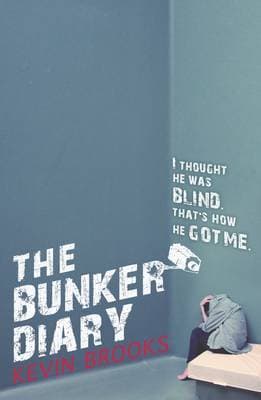
Kevin Brooks (2013)
Genre
Thriller / Mystery / Young Adult
Reading Time
320 min
Key Themes
See below
Sign in to track this book
A kidnapped teenager awakens in a concrete bunker with five strangers, connected to the outside only by an elevator, as they deal with captivity and the chilling realization their captor watches them.
Linus Weems, a sixteen-year-old homeless boy in London, is lured into a van by an old man offering a job. He is drugged and wakes up disoriented in a cold, concrete room. He discovers he is in an underground bunker, a series of six small rooms connected by a main corridor. There are no windows or exits except for an elevator that brought him down. The bunker is sparsely furnished, with a toilet, a shower, and a single light bulb in his room. Linus panics when he realizes he is trapped, and his first attempts to find a way out or understand his situation fail. He starts a diary, writing about his new reality and his hope for escape.
Days later, the elevator brings a new captive: a young girl named Jenny, who seems about nine or ten. Linus is horrified by her presence, seeing the increased danger and the disturbing pattern of their abduction. He tries to comfort Jenny, who is frightened and confused, and takes on a protective role. Her innocence and vulnerability make the situation harder for Linus, as he struggles to explain their predicament without terrifying her more. Jenny's arrival confirms Linus's worst fears: this is not a random act, but a deliberate, cruel confinement, with an unknown number of victims planned.
Soon after Jenny arrives, a voice, likely their abductor (whom Linus calls 'The Owner'), speaks through an intercom. The Owner sets arbitrary rules, like specific times for eating and using the bathroom, and warns them against trying to escape. He provides minimal food and water, just enough to sustain them. The communication is sporadic and unsettling, meant to assert control and instill fear. Linus tries to reason with the voice, to understand the motive, but gets only cryptic, mocking responses. The Owner's disembodied voice becomes a constant source of anxiety, a symbol of their powerlessness and the psychological war against them.
The elevator continues to bring new prisoners. First is Fred, an older, respectable businessman who initially tries to maintain order and hope. Then comes Anja, a young woman who is deeply traumatized and withdrawn. Finally, Russell, a drug addict with a volatile temper, and Bird, an elderly, frail woman with dementia, complete the group. Each new arrival brings a different dynamic to the bunker, from Fred's initial leadership attempts to Russell's aggressive outbursts and Bird's confusion. Linus observes and records their varied reactions to their shared nightmare, noting how quickly their sanity and civility decline under extreme stress.
Driven by despair and a small hope, the prisoners make several escape attempts. Fred, with his logical mind, tries to analyze the bunker's structure and weak points. They try to pry open the elevator doors, bang on the walls, and use the limited cleaning tools. Russell's attempts are often violent and destructive, fueled by his addiction and rage. Linus, while participating, records how futile their efforts are. The Owner, through the intercom, mocks their attempts, showing his complete control and knowledge of their actions. Each failed attempt further reduces their morale and deepens their hopelessness, showing how well-designed their prison is.
The Owner introduces 'games' meant to pit the prisoners against each other and break their spirits. He manipulates their food supply, giving better rations for compliance and deprivation for defiance. He forces them into uncomfortable social interactions, such as ordering them to share rooms or do specific activities. One disturbing 'game' involves forcing them to choose who gets a limited resource, creating intense conflict and showing the darker aspects of human nature under pressure. Linus documents these psychological tortures, seeing them as deliberate attempts to dehumanize and control them, eroding their trust and camaraderie.
As days turn into weeks, the captives' physical and mental health significantly declines. Food and water become scarcer, leading to weakness and illness. Fred's composure crumbles, Anja becomes catatonic, and Russell's aggression escalates. Bird's dementia worsens, making her a constant source of confusion and distress. Linus, despite trying to stay strong for Jenny, feels his own sanity fraying. The lack of sunlight, fresh air, and privacy, combined with the psychological torment, strips them of their dignity and humanity. The bunker becomes a grim reflection of their fading hope, as each day brings them closer to despair.
The first death occurs when Bird, weakened by age, dementia, and harsh conditions, dies quietly in her sleep. Her death, while sad, is almost a relief. Soon after, Russell, in a fit of withdrawal and desperation, becomes violent and is 'dealt with' by the Owner, likely killed, though the exact circumstances are unclear. His body is removed by the elevator. These deaths deeply traumatize the remaining prisoners, especially Linus and Jenny. The reality of their mortality and the Owner's absolute power becomes terrifyingly clear, ending any lingering illusions of a peaceful resolution or rescue. The bunker turns into a tomb.
As the only remaining captives, Linus tries desperately to protect Jenny. However, Jenny falls gravely ill, likely due to malnutrition, stress, and unsanitary conditions. Linus nurses her as best he can with the meager resources, but her condition worsens quickly. He holds her, comforts her, and tells her stories, trying to shield her from the grim reality. He feels an overwhelming sense of responsibility and love for the young girl. Her slow decline breaks Linus's spirit more than anything else. He continues to write in his diary, documenting her last moments and his grief, knowing he is witnessing the end of her innocent life.
Jenny eventually dies in Linus's arms. Her death is the ultimate blow, leaving Linus utterly alone in the bunker. The Owner removes Jenny's body, leaving Linus to face complete isolation. He is consumed by grief, guilt, and an overwhelming despair. With Jenny gone, his last reason to fight and maintain hope vanishes. He continues to write in his diary, but his entries become increasingly disjointed and bleak, reflecting his rapidly deteriorating mental state. The bunker, once a shared prison, becomes his solitary tomb, with no one left to witness his suffering or share his memories.
In his final diary entries, Linus's writing becomes fragmented, hallucinatory, and hard to read. He describes his body failing, his mind wandering, and his struggle to hold the pen. He thinks about his life before the bunker, the people he knew, and the cruel irony of his situation. He records his last coherent thoughts, a mix of anger, resignation, and a desperate plea for his story to be known. The very last entries are barely legible, indicating his imminent death. The book ends ambiguously, with Linus's diary stopping, leaving the reader to conclude he has died, trapped forever in the bunker, his story a chilling example of human cruelty and resilience.
The Protagonist
Linus transforms from a street-smart survivor into a tragic figure, losing everything but his will to record the truth, ultimately succumbing to the bunker's horrors.
The Supporting
Jenny's arc is one of tragic innocence, gradually succumbing to the harsh realities of captivity despite Linus's efforts to shield her.
The Supporting
Fred's arc shows the rapid erosion of a 'civilized' man's composure and rationality under extreme, dehumanizing conditions.
The Supporting
Anja's arc is one of rapid psychological collapse, becoming a silent, traumatized victim of the bunker's horrors.
The Supporting
Russell's arc is a tragic descent into violence and self-destruction, driven by his addiction and the bunker's torment, culminating in his death.
The Supporting
Bird's arc is one of innocent suffering and eventual peaceful death, her dementia shielding her somewhat from the full horror.
The Antagonist
The Owner's 'arc' is static, remaining a consistent, disembodied force of evil and control throughout the narrative.
The bunker's conditions and the Owner's psychological games strip the captives of their humanity and dignity. Linus observes how basic needs like privacy, cleanliness, and freedom are denied, leading to a quick decline in civility and self-respect among the prisoners. The forced sharing of rooms, the poor bathroom facilities, and constant surveillance erode their sense of self. This theme is clear in Fred's change from a composed businessman to a desperate man, and in Anja's complete withdrawal. It shows how extreme circumstances can reduce individuals to their most basic, often ugly, instincts.
“What happens when someone simply takes all that away? What happens when you're stripped of everything that makes you human?”
Linus's diary is the central expression of this theme. Despite the terrifying circumstances, he feels a need to record what is happening, to witness the atrocities. His writing is an act of defiance, a way to reclaim control and ensure their suffering is not forgotten. The diary is not just a personal record but a desperate attempt to communicate with the outside world, to leave a record of their ordeal. This theme shows the human need to make sense of trauma through writing and the lasting power of personal testimony, even when facing complete despair.
“This diary is the only thing I have left. It's my only way of proving that I exist. That we existed.”
The book explores how resilient people are when under extreme stress. Linus, despite his fear, observes, analyzes, and cares for others, especially Jenny. However, the novel also shows the limits of this resilience, as characters like Fred and Anja quickly suffer psychological breakdowns. Constant threats, deprivation, and psychological torment push individuals to their breaking points, showing the fragility of the human mind and the complex connection between hope, despair, and the will to live. It asks what it means to survive when everything is taken away.
“I'm not going to give up. I'm not going to let him win. Not while I can still write.”
The Owner, as the unseen antagonist, is an arbitrary and chilling form of evil. His motives are never revealed, making his actions more terrifying. He does not seek ransom or revenge; instead, his goal seems to be the sadistic manipulation and psychological torment of his captives. This ambiguity suggests that evil can exist without a clear reason, appearing as a desire for absolute control and pleasure from others' suffering. The bunker itself, a sterile and isolated environment, becomes a metaphor for this contained, inexplicable malice.
“He doesn't want anything from us. He just wants to watch us break.”
Linus deals with a strong sense of responsibility, especially for Jenny. He feels a moral obligation to protect her, to keep her spirits up, and to shield her from the worst aspects of their captivity. This responsibility weighs heavily on him, and her eventual death leaves him consumed by guilt, feeling he failed. The theme also extends to the broader question of human responsibility in the face of suffering—how do we react when faced with injustice, and what are our duties to one another when all societal structures break down? Linus's internal struggle shows the burden of empathy.
“I promised her I'd look after her. And now she's gone. It's my fault.”
The entire story is told through Linus's personal diary entries.
The novel is presented as the actual diary entries of Linus, dating from his abduction until his presumed death. This device provides an intimate, subjective, and immediate account of the events, allowing readers direct access to Linus's thoughts, fears, and observations. It heightens the sense of claustrophobia and isolation, as the reader experiences the bunker solely through his perspective. The deteriorating quality of the writing towards the end also effectively conveys Linus's declining mental and physical state, making the narrative itself a testament to his suffering and the passage of time.
The abductor remains a disembodied voice, never physically appearing.
The Owner's identity and physical presence are never revealed; he communicates only through an intercom. This lack of visual representation makes him a more terrifying and abstract figure of evil. It prevents the reader (and the captives) from attributing human characteristics or understanding his motives, thereby amplifying the sense of arbitrary cruelty and absolute power. His disembodied voice symbolizes the insidious nature of psychological torment and control, as he manipulates and toys with his victims from a safe, unseen distance, making him an omnipresent, yet absent, threat.
The isolated bunker serves as a symbolic representation of society under extreme duress.
The bunker itself functions as a contained experimental environment, a microcosm where the normal rules of society are stripped away. The diverse group of captives—from a homeless teenager to a businessman, a drug addict, and an elderly woman—represents various facets of humanity. Their interactions and rapid deterioration under the Owner's control illustrate how easily social structures, morality, and individual sanity can collapse when basic human rights and dignity are denied. It explores primal human reactions to fear, deprivation, and powerlessness, mirroring societal breakdown on a smaller, more intense scale.
The Owner uses mind games and manipulation rather than direct physical violence.
While physical deprivation is present, the primary method of torment in the bunker is psychological. The Owner's 'games' are designed to sow distrust, force difficult choices, and break the captives' spirits from within. He manipulates food, privacy, and social interactions to pit them against each other, creating an environment of paranoia and fear. This focus on psychological warfare emphasizes the insidious nature of control and how mental anguish can be as, if not more, destructive than physical harm, leading to the rapid disintegration of the captives' mental health and relationships.
“I don't know where I am. I don't know who they are. I don't know why I'm here. All I know is that I'm in a room. And I'm not alone.”
— Leo's initial thoughts upon waking in the bunker.
“The worst thing about fear is that it makes you stupid. It makes you do things you wouldn't normally do.”
— Leo reflecting on how fear affects human behavior in the bunker.
“Hope is a dangerous thing. It can make you do crazy things. It can make you believe in things that aren't true.”
— Leo's increasingly cynical view of hope as time passes in the bunker.
“We're all just animals, really. Scratch the surface, and that's all you find.”
— Leo observing the regression of the bunker inhabitants.
“The man. He's always watching. Always listening. Always there. Even when he's not.”
— Leo's growing paranoia about the unseen 'man' controlling their fate.
“It's funny how quickly you get used to things. Even the most terrible things.”
— Leo's reflection on the human capacity for adaptation to extreme circumstances.
“Silence. That's the real killer. The silence that eats away at you, bit by bit.”
— Leo describing the psychological toll of the bunker's isolation.
“We made our own rules down here. And then we broke them. All of them.”
— Leo lamenting the breakdown of order and morality among the prisoners.
“The diary. My only friend. My only witness. My only proof that I was here.”
— Leo's reliance on his diary as a means of maintaining sanity and a record.
“It wasn't about surviving anymore. It was about not giving up. About holding on to something, anything.”
— Leo's shift in perspective from mere survival to maintaining a shred of humanity.
“The worst prison isn't made of bars. It's made of your own mind.”
— Leo contemplating the psychological entrapment within the bunker.
“He wants to see what we'll do. How far we'll go. What we'll become.”
— Leo's theory about the 'man's' motives for their imprisonment.
“Sometimes, the only way to win is to lose. To let go. To stop fighting.”
— Leo's contemplation of surrender in the face of overwhelming odds.
“The light. Always the light. It blinds you, but it also shows you the way.”
— Leo's ambiguous feelings about the artificial light in the bunker, symbolizing truth or control.
Ready to see how well you understood this book? Take our interactive quiz with 10 questions.

Biography coming soon.







