“He trains my hands for war, so that my arms can bend a bow of bronze.”
— Daniel reciting the psalm that inspires the title and his rebellion.

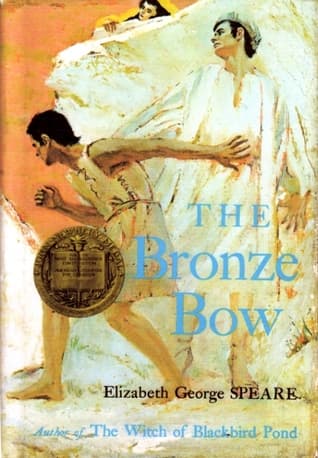
Elizabeth George Speare (1961)
Genre
Children's / Historical Fiction / Young Adult
Reading Time
240 min
Key Themes
See below
Sign in to track this book
A young Jewish rebel, Daniel bar Jamin, is consumed by hatred for the Roman occupiers who killed his family. He must choose between violent revenge and the message of love and forgiveness preached by Jesus of Nazareth.
Eighteen-year-old Daniel bar Jamin, a young blacksmith, has left his cruel master in Capernaum. He lives with a group of Zealot rebels led by Rosh in the mountains above his village. Daniel hates the Roman occupiers, blaming them for his father's crucifixion and his mother's death. His younger sister Leah is mute and mentally fragile because of these events. He wants to avenge his family and drive the Romans out of Israel. He practices with his father's bronze bow, hoping to become a warrior for Rosh. Daniel's life is hard and focused on the Zealot mission, keeping him separate from normal village life.
Rosh sends Daniel to Capernaum for information. There, Daniel meets Joel bar Hezron and his twin sister Malthace, who are visiting their grandmother. Joel is educated and also resents Roman rule, sharing Daniel's strong desire for Israel's freedom. Malthace is more careful and refined. Daniel is initially suspicious of their privileged background but finds common ground with Joel in their shared patriotism. They talk about forming a small group to support Rosh, and Daniel feels a little hope for companionship beyond the grim reality of the mountain camp.
Daniel and Joel plan to rescue a strong slave named Samson from Roman captivity. They succeed, and Samson pledges loyalty to Daniel, becoming his silent, devoted follower. This strengthens the bond between Daniel and Joel, who sees Daniel as a leader. Malthace, despite her first doubts about their dangerous activities, starts to admire Daniel's courage. This event is a turning point for Daniel, as he begins to gather his own small group of followers, inspired by his commitment to liberation.
Daniel learns his grandmother is dying. He reluctantly leaves the mountain camp and returns to his village. He finds his grandmother near death and his sister, Leah, even more fragile. After his grandmother dies, Daniel becomes Leah's only guardian. This responsibility keeps him in the village and prevents him from fully dedicating himself to Rosh's mountain operations. He struggles to care for Leah and adjust to village life, feeling torn between his duty to his sister and his desire for revenge against the Romans. His blacksmith skills become necessary for their survival.
While working in the village, Daniel often meets Jesus of Nazareth, a carpenter who preaches love, forgiveness, and a kingdom not of this world. Daniel, along with Joel and Malthace, is initially drawn to Jesus, hoping he might be the warrior Messiah who will lead an uprising against Rome. However, Jesus's teachings often conflict with Daniel's deep hatred and desire for violent retribution. Daniel struggles with Jesus's emphasis on loving enemies, finding it against his life's mission. He often attends Jesus's gatherings, watching the crowds and listening, but remains unconvinced by the path of peace.
Inspired by his Zealot ideals and Rosh's example, Daniel starts to gather young boys from the village, including the shepherd boy Thacia. He trains them in stealth, combat, and loyalty. He teaches them to despise the Romans and prepares them for the uprising. Daniel gives them his fierce determination and purpose. This small group of followers, including Joel's younger sister Thacia who often visits him, becomes Daniel's personal army. He takes pride in their loyalty, believing he is building the start of a resistance movement.
Daniel's loyalty to Rosh is tested when Rosh orders him to rob a wealthy man, Marcus, known for his kindness to the poor. Daniel hesitates but complies. He is further disturbed by Rosh's casual cruelty and lack of concern for others' suffering. Rosh's true character as a selfish bandit, not a principled freedom fighter, becomes clear. Later, when Joel is captured by the Romans, Daniel asks Rosh for help, but Rosh refuses to risk his men. This indifference shatters Daniel's image of Rosh and leaves him disillusioned with the Zealot leader and his methods.
Leah's delicate health worsens significantly. She becomes gravely ill with a fever and seizures. Daniel, desperate, realizes he needs help he cannot provide alone. A Roman soldier, Marcus, who sometimes passes their house, shows unexpected kindness, offering help and even bringing a doctor. Daniel's deep hatred for Romans is challenged by Marcus's genuine compassion. He struggles to understand this act of human decency, forcing him to confront the complexities of good and evil beyond simple labels of 'Roman' or 'Jew.'
Thacia, Joel's younger sister, who has been a constant presence in Daniel's life, tells him she loves him. Daniel, still focused on his mission and emotionally closed off, struggles to return her feelings, though he values her friendship and loyalty. Meanwhile, Joel, after his capture and release, decides to fight Rome through scholarship and political action in Jerusalem. He believes intellectual and spiritual strength are more effective than violence. This difference in paths shows how individuals choose to pursue freedom and justice, further isolating Daniel in his commitment to physical force.
Driven by desperation and fading hope, Daniel tries to start a small revolt against a Roman legion passing through his village, hoping to free Joel, who has been imprisoned again. His small group of boys is no match for the trained Roman soldiers. The attempt ends tragically with the death of Samson, who sacrifices himself for Daniel. Devastated, Daniel finally faces the futility of his hatred and violence. He seeks out Jesus, who is visiting his house to heal Leah. Jesus teaches Daniel that love, not hate, is true strength, and that only love can break the chains of bitterness.
Jesus visits Daniel's house and, through his gentle presence, brings peace and healing to Leah. Her mental and physical health improve. She begins to speak and interact with the world again. Witnessing this act of love and healing, Daniel changes completely. He finally understands Jesus's message. He invites the Roman soldier Marcus, who had shown kindness during Leah's illness, into his home. This symbolizes forgiveness and freedom from his lifelong hatred. Daniel chooses love over vengeance, finding true freedom and peace.
The Protagonist
Daniel transforms from a hateful, vengeance-driven youth into a man who understands and embraces the power of love, compassion, and forgiveness.
The Supporting
From a traumatized, withdrawn, and fearful girl, Leah finds healing and peace through the love and compassion of Jesus, eventually opening up to the world.
The Antagonist/Supporting
Rosh remains unchanged in his ruthlessness, serving as a static representation of the destructive path Daniel ultimately rejects.
The Supporting
Joel shifts from a desire for violent rebellion to a commitment to intellectual and spiritual resistance against Roman oppression.
The Supporting
Malthace remains a steady, compassionate presence, influencing Daniel towards gentler emotions and away from hatred.
The Supporting
Jesus's teachings and presence consistently offer a path of love and forgiveness, serving as the unchanging truth that ultimately transforms Daniel.
The Supporting
Samson remains fiercely loyal to Daniel, culminating in a selfless act of sacrifice that deeply impacts Daniel.
The Supporting
Thacia's love for Daniel remains steadfast, offering him a consistent, unconditional affection that he eventually comes to appreciate.
The Supporting
Marcus remains a consistent example of individual kindness, serving as a catalyst for Daniel's final rejection of hatred.
The novel shows how hatred consumes Daniel, isolating him, leading to violence, and ultimately failing to bring true freedom. His life is defined by a desire for vengeance against the Romans, which blinds him and prevents him from forming good relationships. Rosh's violent methods and Daniel's own small rebellion fail, showing that hatred only continues a cycle of violence and suffering, as seen in Samson's tragic death. Daniel finds peace and liberation only when he lets go of his hatred.
“Can’t you see, Daniel, it is hate that is the enemy? Not men. Hate does not die with killing. It only springs up a hundredfold. The only thing stronger than hate is love.”
In contrast to Daniel's hatred, love and forgiveness are presented as the ultimate source of strength and healing. Jesus's teachings advocate for loving enemies and showing compassion. His healing of Leah is an act of love, and Daniel's decision to invite Marcus, a Roman, into his home shows this. The novel argues that true freedom comes not from violently overthrowing oppressors, but from freeing oneself from bitterness and embracing universal love and understanding.
“He who is able to love, is able to forgive.”
The book explores different ideas of freedom. For Daniel and the Zealots, freedom means political liberation from Roman rule, achieved through armed rebellion. However, Jesus offers a different kind of freedom: spiritual and emotional liberation from sin, hatred, and fear. Daniel's journey shows that external political freedom is meaningless if one is still enslaved by internal bitterness. True freedom, the novel suggests, is found in peace, love, and the ability to forgive, going beyond earthly political struggles.
“For where your treasure is, there will your heart be also.”
Daniel's sense of duty towards his family, especially Leah, drives him. His responsibility for Leah's well-being pulls him away from his single-minded Zealot mission and makes him face life's practicalities beyond vengeance. This duty keeps him in the village and prevents him from fully following Rosh's reckless path. The tension between his duty to his family and his perceived duty to his country highlights the sacrifices and choices people make in conflict. It shows that personal responsibilities can lead to deeper understanding.
“A man’s life is not his own. It belongs to God and to his country.”
Daniel struggles to find his place. He first belongs to the isolated Zealot group, then reluctantly returns to his village. He wants a sense of community, but his hatred often pushes others away. The difference between Rosh's selfish 'community' and the genuine, compassionate community around Jesus is clear. Daniel finds true belonging not through shared hatred, but through shared love and acceptance of others, as shown by the small, loving 'family' he forms with Leah and Malthace, and his eventual acceptance of Marcus.
“The kingdom of God is not a kingdom of war, but of peace.”
A symbolic object representing strength, vengeance, and Daniel's journey.
The bronze bow is Daniel's ancestral weapon, inherited from his father. It symbolizes Daniel's physical strength, his family legacy, and his initial commitment to violent vengeance against the Romans. The biblical quote from 2 Samuel 22:35, 'He trains my hands for war, so that my arms can bend a bow of bronze,' serves as an epigraph and a guiding principle for Daniel's early life. As Daniel's understanding of strength evolves from physical might to spiritual love, the bow loses its significance as his primary tool, representing his ultimate rejection of violence as the path to freedom.
Two opposing leaders who represent contrasting ideologies for achieving freedom.
Rosh and Jesus serve as powerful foil characters, presenting Daniel with two radically different paths to freedom. Rosh embodies violent rebellion, self-interest, and hatred, demonstrating the destructive and ultimately futile nature of such a path. Jesus, on the other hand, represents love, forgiveness, spiritual strength, and a kingdom not of this world. Daniel's internal conflict and eventual transformation are largely driven by his exposure to, and struggle between, these two opposing ideologies and the men who embody them. Their contrasting philosophies highlight the central thematic conflict of the novel.
A physical manifestation of the emotional and spiritual suffering caused by hatred, and the power of love to heal.
Leah's physical and mental illness is a direct consequence of the violence and trauma she experienced due to Roman oppression. Her mute, fearful, and often feverish state symbolizes the spiritual sickness that afflicts Daniel and his community, born of hatred and vengeance. Her miraculous healing by Jesus, accompanied by her newfound peace and ability to interact, directly parallels Daniel's own spiritual healing and transformation from hatred to love. Her recovery serves as a tangible representation of the redemptive power of compassion and forgiveness.
A humanizing element that challenges Daniel's deep-seated prejudice and broad generalizations.
Marcus, the kind Roman soldier, serves as a crucial plot device by introducing a nuanced perspective to Daniel's black-and-white view of his enemies. Daniel's ingrained hatred dictates that all Romans are evil, but Marcus's genuine compassion and assistance towards Leah force Daniel to confront the reality that individuals transcend their group affiliations. This personal encounter with a 'good' Roman is a significant step in breaking down Daniel's prejudice, paving the way for his eventual embrace of universal love and his realization that hate is the true enemy, not specific people.
“He trains my hands for war, so that my arms can bend a bow of bronze.”
— Daniel reciting the psalm that inspires the title and his rebellion.
“Hate is a burden too heavy to bear.”
— Jesus speaking to Daniel about letting go of vengeance.
“I will not be a slave to any man.”
— Daniel declaring his independence after escaping slavery.
“Love is stronger than hate.”
— Jesus teaching Daniel a central lesson of the story.
“We are not fighting for ourselves alone, but for all Israel.”
— Rosh rallying his band of rebels in the mountains.
“A man is not measured by the strength of his arm, but by the strength of his heart.”
— Simon the Zealot advising Daniel about true courage.
“The kingdom of heaven is within you.”
— Jesus speaking to Daniel about spiritual peace.
“I have been like a bow strung too tight.”
— Daniel reflecting on his anger and tension.
“We wait for a leader who will break the bow of bronze.”
— Daniel and his friends discussing messianic hopes.
“There is no freedom in hatred.”
— Leah, Daniel's sister, observing his struggle.
“The Romans are not our only enemy.”
— Daniel realizing internal conflicts matter too.
“Sometimes the bravest thing is to lay down your sword.”
— Daniel learning about non-violent resistance from Jesus.
“You cannot build anything on hate.”
— Jesus teaching Daniel about constructive love.
“My life is bound with yours.”
— Daniel to his sister Leah, showing familial loyalty.
Ready to see how well you understood this book? Take our interactive quiz with 10 questions.

Biography coming soon.

Dan Gemeinhart
4.5

Kate O'Hearn
4.4

Jeanne Birdsall
4.4

Jen Wang
4.4

Wendelin Van Draanen
4.3

John Marsden
4.3

Chris Van Allsburg
4.3
Jennifer A. Nielsen
4.2