“The bridge must be built. It is a matter of honor.”
— Colonel Nicholson insists on constructing the bridge despite the prisoners' suffering.

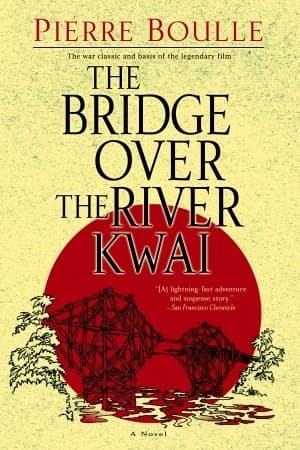
Pierre Boulle (1964)
Genre
Historical Fiction
Reading Time
270 min
Key Themes
See below
Sign in to track this book
In the jungles of World War II, a British POW colonel, obsessed with duty, builds a strategic bridge for his Japanese captors, only to find his pride clash with his country's mission to destroy it.
In 1942, British prisoners of war, led by Colonel Nicholson, arrive at a Japanese prison camp in the Siamese jungle. Colonel Saito commands the camp. Saito immediately announces that all prisoners, regardless of rank, will work on building a railway bridge over the River Kwai, a key part of the Japanese war effort. Nicholson, following the Geneva Convention, says that officers cannot be forced to do manual labor. This starts a conflict between the two colonels. Saito, angry at Nicholson's defiance, orders all officers, including Nicholson, into 'the oven' – a small, hot punishment hut – while the enlisted men go to work in harsh conditions.
Colonel Nicholson and his officers spend days in 'the oven,' suffering from heat, hunger, and sickness. Their spirits remain strong. Nicholson keeps strict discipline among his men. Meanwhile, bridge construction goes slowly under the Japanese engineers and the discouraged British enlisted men. Saito faces a strict deadline for the bridge's completion and the threat of ritual suicide for failure, becoming more desperate. His Japanese engineers are not good at their job, and the British enlisted men sabotage and work slowly, further delaying progress. The bridge project falls behind schedule, making Saito's position difficult.
Because the bridge project is failing and Nicholson remains unyielding, Colonel Saito eventually gives in. He releases Nicholson and his officers from 'the oven,' acknowledging Nicholson's success in defending the officers' rights. However, Nicholson, upset by the poor work and lack of discipline among the British enlisted men and Japanese engineers, offers his officers and himself to oversee the bridge's construction. For Nicholson, the bridge becomes a symbol of British skill, efficiency, and morale, showing his men's ability even while captive. He sees it as a way to restore pride and purpose to his discouraged troops.
Under Colonel Nicholson's careful supervision, the British prisoners, now motivated by purpose and professionalism, begin to build a bridge. Nicholson works constantly, designing, planning, and overseeing every detail, from choosing timber to the angles of the supports. He pushes his men hard but fairly, demanding excellence and efficiency. The bridge becomes a symbol of their skill and resilience, a monument to British engineering despite the difficulties. Colonel Saito is impressed by the speed and quality of the work; his deadline is now reachable. The British officers and men find renewed dignity and friendship in their shared effort.
Unknown to the prisoners in Camp 16, an Allied commando unit is forming to destroy the bridge Nicholson is building. Major Shears, an American who escaped from a different Japanese camp and is pretending to be an officer, is persuaded by Major Warden to join 'Operation Green.' The mission is important to cut Japanese supply lines. Shears, along with Warden and two Siamese agents, Saiyok and Khun Yai, parachute into the jungle near the Kwai River. Their goal is to reach the bridge, plant explosives, and detonate it as the first train crosses, stopping the Japanese war effort and preventing the transport of troops and supplies.
Major Warden, Major Shears, and their Siamese operatives travel through the dense, difficult jungle. They face many problems, including tough terrain, snakes, and the constant threat of Japanese patrols. One of the Siamese agents dies during their journey, showing the mission's extreme danger. Warden, suffering from an old shrapnel wound, becomes increasingly unable to move, forcing Shears to take more leadership. Despite the problems and fewer numbers, the remaining commandos continue, driven by the strategic importance of their goal. Their determination is important as they race against time to reach the bridge before it is finished.
The bridge over the River Kwai is finished on time, a feat of engineering and human endurance. Colonel Saito holds a celebration, recognizing the British prisoners' work. He even gives a commendation to Colonel Nicholson, which satisfies Nicholson's sense of professional pride. The British prisoners, despite being captive, feel a sense of accomplishment and pride in their creation. They have built a strong structure. For Nicholson, the bridge represents a triumph of order, discipline, and British spirit, even if it helps the enemy's war machine. He is very happy seeing the completed structure.
The commando team, now Shears, Warden (badly injured), and Khun Yai, finally reaches the bridge area. Under cover of darkness, they carefully place explosives on the bridge's main parts, connecting them to a detonator. Their plan is to detonate the charges as the first train, carrying Japanese officials and troops, crosses the bridge at dawn. However, as the sun rises, Colonel Nicholson, taking a final walk over his bridge, finds the wires connecting the explosives. His professional pride is shattered by the thought of his perfect bridge being destroyed; he is unaware of why it needs to be destroyed.
After finding the wires, Colonel Nicholson, still unaware of the full reason for the commandos' mission, immediately begins to dismantle the detonating mechanism, seeing it as senseless damage to his creation. He even gets a Japanese guard to help him. Major Shears, realizing Nicholson's misplaced loyalty to the bridge, comes out of hiding, trying to reason with him and stop him from revealing their position. A tense confrontation follows. Colonel Saito, alerted to the noise, also arrives. The first train, loaded with Japanese troops and officials, approaches, marking the critical moment for detonation.
In a struggle, Nicholson, still determined to save his bridge, fights with Shears. Major Warden, despite his injuries, crawls toward the detonator but is shot by a Japanese guard. As the train begins to cross, Nicholson, in his fight with Shears, falls onto the plunger, accidentally detonating the explosives. The bridge, along with the train and its occupants, explodes. Nicholson, fatally wounded, realizes the irony of his actions before he dies. Shears is also killed by Japanese fire. The only survivor, Khun Yai, sees the destruction. The camp doctor, Clipton, who watched Nicholson's growing obsession, says the final words, 'Madness! Madness!'
The Protagonist
Nicholson transforms from a principled officer defending his men's rights to an obsessive engineer whose pride in his creation tragically overrides his patriotic duty, only realizing his folly in his final moments.
The Antagonist
Saito initially asserts his dominance through brutality but is forced to compromise and eventually respects Nicholson's abilities, though his primary focus remains the bridge's completion and his own honor.
The Supporting/Secondary Protagonist
Shears begins as a cynical survivor but becomes a dedicated commando, ultimately sacrificing himself to complete the mission, highlighting the practical demands of wartime.
The Supporting
Warden leads his mission with unwavering resolve, battling both physical injury and the challenges of the jungle, and remains committed to the mission until his death.
The Supporting
Clipton maintains his medical duty and observes the escalating 'madness' of war and duty, ultimately serving as a moral commentator.
The Supporting
Khun Yai steadfastly aids the commandos in their mission, demonstrating loyalty and skill, and survives the final confrontation.
The Supporting
Reeves remains a dedicated and professional officer, assisting Nicholson in his engineering endeavors throughout his captivity.
The Mentioned
Joyce dies early in the story, symbolizing the initial cost of upholding military principles against a brutal enemy.
The novel explores different ideas of duty and honor. Colonel Nicholson's strict adherence to the Geneva Convention is initially honorable, but his later obsession with building a 'perfect' bridge for his captors, even though it hurts the Allied cause, shows a warped sense of duty. His professional pride overrides his patriotism. Colonel Saito is also driven by duty and honor, fearing ritual suicide for failure. The commandos, conversely, act out of a practical duty to their country's war effort, even if it means destroying a masterpiece. The theme suggests that duty, when taken too far or misdirected, can become a dangerous obsession, making people blind to the wider results of their actions, as seen in Nicholson's tragic end.
“''Madness! Madness!''”
Boulle uses irony to show the absurdity of war. The most striking example is Colonel Nicholson, a British officer, carefully building a bridge for the Japanese war machine, a bridge the Allies are trying to destroy. His pride in his engineering blinds him to the strategic importance, creating a situation where the 'enemy' within (Nicholson's misplaced loyalty) is as much a threat to the Allied mission as the Japanese themselves. The climax, where Nicholson accidentally triggers the destruction of his own bridge, is the ultimate ironic twist, showing the chaotic and often illogical nature of conflict where individual efforts can be tragically misaligned.
“''He was a man whose sense of duty was so perfect that it became a fault.''”
A main conflict in the novel is the tension between professional pride and national loyalty. Colonel Nicholson, a skilled engineer, finds great satisfaction and purpose in building a well-made bridge. This professional pride, however, eventually overshadows his patriotism. He sees the bridge as a monument to British skill and discipline, showing his men's capabilities, even if it helps the enemy. This internal conflict leads him to try and prevent the bridge's destruction by his own side. The commandos, especially Major Shears and Major Warden, represent the opposite: their only focus is patriotism and strategic victory, even if it means destroying a beautiful structure. The book makes the reader question which loyalty is more important in wartime.
“''You're talking about a bridge. I'm talking about a war.''”
Despite the harsh conditions of the POW camp and the brutal treatment by their captors, the British soldiers, especially under Nicholson's leadership, show resilience. They endure hunger, sickness, and forced labor, yet keep their morale and discipline, finding new purpose in building the bridge. This theme shows how people can adapt and find meaning even in the worst situations. The commandos also show great resilience, surviving the dangerous jungle trek and overcoming injuries to complete their mission. The novel shows how individuals and groups try to survive, both physically and mentally, during wartime.
“''The bridge, in its way, was a victory for the British, a monument to their professional pride, even if it was for the enemy.''”
The book shows different leadership styles. Colonel Saito leads through fear and brutality, yet he is also affected by pressure from his superiors and his own code of honor. Colonel Nicholson, on the other hand, leads through principle, discipline, and professional excellence. His leadership initially saves his officers' dignity and later inspires his men to achieve an engineering feat. The commandos, led by Major Warden, show a more practical, mission-focused leadership. The novel examines how effective and moral these different leadership approaches are in extreme situations, showing how a leader's character affects their subordinates and the results of their efforts.
“''Discipline, gentlemen, is the backbone of the army.''”
The physical bridge represents conflicting ideals and human endeavors.
The bridge over the River Kwai is the central symbolic element of the novel. For Colonel Nicholson, it symbolizes British engineering prowess, discipline, and a triumph of morale and purpose over adversity, even if built for the enemy. It becomes his 'masterpiece' and a source of immense professional pride. For Colonel Saito, it represents the fulfillment of his duty and the avoidance of ritual suicide. For the Allied commandos, it is a crucial strategic target, a symbol of Japanese military expansion that must be destroyed. Its destruction ultimately symbolizes the clash of these ideals and the tragic irony of war, where human achievements can be rendered meaningless or even destructive by larger conflicts.
The audience knows more than Colonel Nicholson, creating tension and tragedy.
Dramatic irony is heavily employed throughout the narrative, particularly concerning Colonel Nicholson's actions. The reader is aware of the Allied mission to destroy the bridge, while Nicholson remains completely ignorant of it. This creates a powerful sense of tension and foreboding as Nicholson pours his heart and soul into building a structure that his own side intends to annihilate. His eventual discovery of the explosives and his desperate attempt to save the bridge, believing it to be mere vandalism, is a tragic culmination of this irony, highlighting his misguided loyalty and the profound disconnect between his personal pride and the realities of the war.
The conflict between British and Japanese military codes drives much of the initial plot.
The novel vividly portrays a clash between British and Japanese military ideologies and cultural norms. Colonel Nicholson represents the rigid adherence to the Geneva Convention and a sense of professional dignity, even in captivity. Colonel Saito embodies the Japanese bushido code, emphasizing honor, absolute obedience, and the concept of ritual suicide for failure. This cultural collision is the catalyst for the initial conflict over officers' labor and dictates their interactions. It highlights the vast differences in how duty, honor, and warfare are perceived, leading to misunderstandings, brutality, and ultimately, a strange, grudging respect born out of shared professional diligence in building the bridge.
The story questions the true meaning and morality of duty in wartime.
The narrative consistently questions the nature of duty. While characters like Major Warden clearly act out of a conventional sense of patriotic duty, Colonel Nicholson's 'duty' becomes increasingly self-serving and detached from the Allied cause. His initial, principled stand for officers' rights is commendable, but his subsequent dedication to building the bridge for the enemy, viewing it as a matter of professional honor, is presented as a tragic flaw. The book suggests that duty, when unexamined or taken to an extreme, can lead to absurd and self-destructive outcomes. Major Clipton's final 'Madness!' serves as a commentary on the corrupted or misdirected sense of duty that ultimately leads to tragedy.
“The bridge must be built. It is a matter of honor.”
— Colonel Nicholson insists on constructing the bridge despite the prisoners' suffering.
“A soldier's first duty is to obey orders, but a man's first duty is to his conscience.”
— Shears reflects on the moral conflict between military obedience and personal ethics.
“We are not here to win the war for the Japanese. We are here to survive with dignity.”
— Nicholson argues for building the bridge to maintain discipline and morale.
“Madness is sometimes the only sane response to an insane situation.”
— A character comments on the absurdity of the prison camp conditions.
“The bridge is a symbol of our endurance, not our submission.”
— Nicholson defends the bridge project to his fellow officers.
“In war, the line between hero and fool is often blurred.”
— Narrator observes the ambiguous actions of characters under duress.
“We build not for them, but for ourselves—to prove we are still men.”
— A prisoner justifies the labor on the bridge as a form of psychological resistance.
“The river does not care for bridges or wars; it flows on indifferent.”
— Descriptive passage highlighting nature's indifference to human conflicts.
“Sometimes the greatest victory is in refusing to be broken.”
— Reflection on the prisoners' mental resilience despite physical hardships.
“A bridge can be a monument to folly as easily as to genius.”
— Commentary on the dual nature of the bridge's construction.
“We are all prisoners here, even those who hold the keys.”
— Observation on how the war imprisons both captives and captors psychologically.
“The true battle is not over the river, but within our own minds.”
— Shears discusses the internal struggles faced by the characters.
“Honor without humanity is a hollow thing.”
— Critique of Nicholson's rigid adherence to military honor at the expense of compassion.
“In the end, the bridge will stand as a testament to our stubbornness.”
— Prediction about the lasting impact of the bridge project.
Ready to see how well you understood this book? Take our interactive quiz with 10 questions.
Biography coming soon.







