“We're not supposed to be friends, you and me. We're meant to be enemies.”
— Bruno says this to Shmuel, reflecting on the artificial barriers of their friendship.

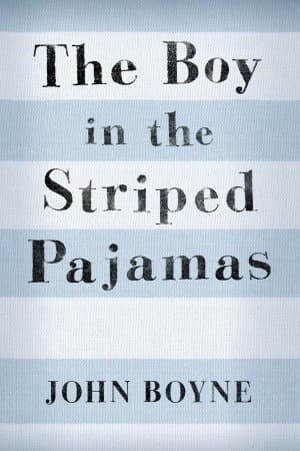
John Boyne (2006)
Genre
Children's / Historical Fiction / Young Adult
Reading Time
240 min
Key Themes
See below
Sign in to track this book
A nine-year-old German boy's innocent friendship with a boy on the other side of a concentration camp fence reveals the Holocaust's unseen horrors.
Bruno, a nine-year-old boy, lives a comfortable life in a large Berlin house with his parents, twelve-year-old sister Gretel, and servants. He likes exploring with his three friends and sees his house as full of secret places. One day, he finds their maid, Maria, packing his things. The family is moving because his father, a high-ranking Nazi officer, has been promoted to Commandant and assigned a new post far from Berlin. Bruno is upset, not wanting to leave his friends and familiar home. He struggles to understand why they are moving, which his parents explain vaguely as a new opportunity for his father.
The family arrives at their new home, which Bruno calls 'Out-With' because he mishears 'Auschwitz.' The new house is much smaller and isolated than their Berlin residence. It stands alone on a bare plot of land with no other houses or children nearby. From his bedroom window, Bruno sees a long fence and, beyond it, what he thinks is a farm. He observes many men and boys, all wearing striped pajamas, living a strange existence. He is disappointed and lonely, feeling isolated and bored in this unwelcoming place, a contrast to his life in Berlin.
Bruno tells his sister, Gretel, about his confusion regarding the people in 'striped pajamas.' Gretel, two years older and more aware of the war, dismisses Bruno's 'farm' idea, suggesting it might be a camp for soldiers, though she does not fully understand its true nature. They watch the people beyond the fence, noticing their uniform appearance and the children. Gretel is concerned about the lack of other girls. Their conversation shows their innocence and limited understanding of the concentration camp, which their parents hide from them. Their talks about the 'farm' are full of childish assumptions and a growing sense of unease.
Bruno tries to talk about his unhappiness with his father, who, despite being stern, tries to explain his duty. His father makes it clear that Bruno's opinions on their new home do not matter and that this is an important post for him. Later, Bruno speaks with Maria, the family's maid, who gently tells him not to complain too much. Maria reveals that Bruno's father was very kind to her during a difficult time, offering her work and support after her mother's death. This adds complexity to Bruno's view of his father, showing a side beyond his military persona and highlighting Maria's loyalty.
Lieutenant Kotler, a young, handsome, and arrogant soldier, visits the house often, flirting with Gretel and being overly familiar with Bruno's mother. Bruno dislikes Kotler's bullying and how he treats the Jewish prisoners who work at the house, especially Pavel, an elderly man who peels vegetables and serves dinner. Pavel, once a doctor, helps Bruno when he falls from a tire swing, cleaning his knee. This act of kindness from Pavel, a prisoner, contrasts with Kotler's harshness and makes an impression on Bruno, further complicating his simple understanding of the people 'on the other side' of the fence.
Driven by boredom and a desire for exploration, Bruno walks along the fence, though he is forbidden to go too far. After walking a long time, he meets a boy sitting on the other side. The boy, named Shmuel, is nine years old, like Bruno, and also has a birthday on April 15th. Shmuel wears the same striped pajamas as all the other people on his side of the fence. Bruno is happy to find a friend and immediately asks Shmuel about his life, unaware of Shmuel's grim situation. Their conversation starts their secret friendship.
Bruno and Shmuel begin meeting almost every day at the same spot along the fence. Bruno brings Shmuel food, as Shmuel is always hungry, and they talk for hours. Shmuel shares details about his life before the camp, including being taken from his home in Krakow, the crowded train journey, and the loss of his grandfather. Bruno, still naive, struggles to understand the horrors Shmuel describes, often comparing Shmuel's experiences to his own, much more privileged, life. Their conversations mix childish innocence and the contrast of their realities, with Bruno often failing to grasp the severity of Shmuel's suffering, but their friendship grows.
One day, Bruno finds Shmuel in his kitchen, polishing glasses. Lieutenant Kotler had brought him to the house because his hands were small enough for the task. Bruno, excited to see his friend, offers Shmuel some chicken. Kotler enters and finds Shmuel eating, accusing him of stealing. Shmuel, scared, says Bruno gave him the food. When Kotler asks Bruno, Bruno, fearing Kotler, denies knowing Shmuel and says he has never seen him before. Shmuel is severely beaten. Bruno is filled with guilt, and when he sees Shmuel a few days later, Shmuel's face is bruised. Bruno apologizes, and Shmuel forgives him, strengthening their bond despite Bruno's momentary betrayal.
Bruno's mother becomes increasingly unhappy at 'Out-With.' She drinks sherry often and openly says she wants to return to Berlin, especially after Pavel was severely beaten by Lieutenant Kotler. Her unhappiness leads to a heated discussion with Bruno's father. They decide that Bruno, Gretel, and their mother will return to Berlin, while his father will stay at 'Out-With' for his duties. Bruno is sad about leaving Shmuel but also excited to return to his old life and friends. The decision is made, and preparations for their departure begin.
The day before his scheduled departure, Bruno meets Shmuel at the fence. Shmuel is upset because his father went missing after being taken for a 'march' and has not returned. Bruno, wanting one last adventure with his friend and to make amends for his earlier betrayal, offers to help Shmuel search for his father. Shmuel arranges for Bruno to get a pair of striped pajamas. Bruno digs a hole under the fence and slips into the camp. He is shocked by the desolate and terrifying reality inside, a contrast to his imagined 'farm,' but he is determined to help his friend.
Inside the camp, Bruno is overwhelmed by the squalor, the emaciated people, and the sadness. He quickly realizes this is not the 'farm' he imagined. He and Shmuel search for Shmuel's father but find no trace. As they search, soldiers round up a large group of prisoners, including Bruno and Shmuel, for a 'march.' The boys are herded into a dark, crowded building. Bruno, scared but holding Shmuel's hand, reassures his friend. The doors are sealed. Bruno's last thought is how much he loves Shmuel before the sounds of the gas chambers begin, sealing their fate.
Back at the house, Bruno's absence is noticed. His family frantically searches for him. His mother and Gretel stay at 'Out-With' for months, hoping. One year later, Bruno's father returns to the spot where Bruno's clothes were found by the fence. He notices the loose bottom of the fence and realizes what happened to his son. The horrifying truth dawns on him: Bruno crawled under the fence and died in the gas chambers, like the thousands of Jews he was responsible for. His father is consumed by grief and guilt, understanding the ultimate result of his actions and his family's closeness to the atrocities.
The Protagonist
From a sheltered, somewhat oblivious boy, Bruno develops a deep friendship that ultimately leads him to confront, and succumb to, the harsh reality he previously ignored.
The Supporting
Shmuel endures the horrors of the camp with quiet resilience, finding a brief solace and connection in his friendship with Bruno before meeting his tragic end.
The Antagonist
From a proud, unyielding Commandant, he is eventually shattered by the personal tragedy that forces him to confront the grim reality of his actions.
The Supporting
Her initial resignation to her husband's posting evolves into deep unhappiness and a desperate desire to protect her children from the surrounding horrors.
The Supporting
Gretel transitions from a typical pre-teen girl obsessed with dolls to a young woman becoming increasingly aware of and influenced by Nazi propaganda.
The Antagonist
Kotler remains a consistently cruel and self-serving character, embodying the casual brutality of the regime without significant personal development.
The Supporting
Maria remains a steady, watchful presence, her loyalty to the family tempered by her quiet understanding of the horrors around them.
The Supporting
Pavel endures his suffering with quiet dignity, briefly showing a glimpse of his past life before being subjected to fatal brutality.
The Mentioned
Her character remains a symbol of moral opposition and the joyful past, primarily through Bruno's memories.
The novel is told from Bruno's point of view, a nine-year-old boy who does not understand the real nature of 'Out-With' (Auschwitz). His innocence prevents him from seeing the horrors around him; he sees the camp as a 'farm' and the prisoners' uniforms as 'striped pajamas.' This lack of understanding lets the reader experience the tragedy through a lens of deep misunderstanding, making the final revelation more devastating. For example, Bruno's inability to understand Shmuel's hunger or his father's disappearance shows how children were kept from, or simply could not grasp, the atrocities.
“What exactly was the difference? he wondered. And who decided which people wore the striped pyjamas and which people wore the uniforms?”
Though told through a child's eyes, the book quietly shows the atrocities of the Holocaust. Shmuel's constant hunger and fear, the prisoners' thin appearance, Pavel's past as a doctor compared to his current servitude, and Lieutenant Kotler's casual cruelty all paint a grim picture. The 'fence' itself is a symbol of segregation and imprisonment. Bruno's death in the gas chamber is a stark climax that fully exposes the brutal reality that his innocence had hidden from him, bringing the horror directly to the perpetrator's family.
“He looked down at the hand and it was a tiny hand and the five fingers were like five skinny sausages. He hadn’t noticed before that Shmuel was so thin.”
Despite the physical barrier of the fence and large societal divisions, Bruno and Shmuel form a deep, unlikely friendship. Their bond goes beyond their different worlds, giving both boys comfort and company in their loneliness. Bruno's desire for a friend and Shmuel's need for human kindness drive their secret meetings. This theme shows the lasting power of human connection, even in the most inhumane situations, and suggests that true friendship knows no boundaries of race, religion, or social status. This ultimately leads to a shared fate that emphasizes their deep connection.
“Despite the fact that one of them was wearing a uniform and the other was wearing a pair of striped pyjamas, they were in fact almost identical.”
The novel explores the conflict between following orders and following one's moral compass. Bruno's father follows orders, putting his duty to the Nazi regime over the ethical implications of his actions. Characters like Maria, who is thankful to the Commandant but uncomfortable with their situation, and Bruno's grandmother, who openly disapproves of her son's uniform, show different levels of moral conscience. The story questions how easily people can become involved in evil when they choose obedience over questioning and empathy, leading to the tragic consequences for the Commandant's own family.
“He was a man to watch and be wary of. And Bruno was right to be wary of him.”
While Bruno remains innocent until the end, the novel ultimately shows a loss of innocence, for the individual and for humanity. Bruno's final moments in the gas chamber represent the brutal shattering of his sheltered world and the horrifying reality of what happened to children like Shmuel. His death is not just a personal tragedy but symbolizes the millions of innocent lives lost and the world's collective loss of innocence during the Holocaust. Even Gretel's change from dolls to maps and propaganda hints at a more subtle, ideological loss of innocence.
“He looked at Shmuel and felt that he had never had a friend like him. 'You're my best friend, Shmuel,' he said. 'My best friend.'”
The story is told almost exclusively through Bruno's naive eyes.
The novel uses a third-person limited omniscient narrator, but the perspective is almost entirely confined to Bruno's thoughts, feelings, and limited understanding. This device is crucial for creating dramatic irony, as the reader, possessing adult knowledge of the Holocaust, understands the true nature of 'Out-With' and the 'striped pajamas' while Bruno does not. This narrative choice heightens the tragedy, making Bruno's gradual, albeit incomplete, realization of the horrors more impactful and emphasizing the incomprehensibility of such events through the lens of childhood innocence.
Bruno's misinterpretations of key terms related to the Holocaust.
Bruno frequently mishears or misunderstands crucial terms, most notably 'Auschwitz' as 'Out-With' and 'Führer' as 'Fury.' He also refers to the concentration camp prisoners' uniforms as 'striped pajamas.' These euphemisms and mispronunciations serve multiple functions: they highlight Bruno's extreme innocence and the shielded environment he lives in, create a chilling contrast between his perception and the horrific reality, and force the reader to confront the true meaning behind the softened language, underscoring the insidious nature of the regime's attempts to sanitize its atrocities.
A physical and symbolic barrier separating two worlds.
The fence serves as the central symbolic and physical barrier in the novel. Physically, it separates Bruno's relatively comfortable, albeit lonely, life from Shmuel's horrific imprisonment. Symbolically, it represents the divide between perpetrator and victim, innocence and experience, knowledge and ignorance, and ultimately, life and death. The fence is the meeting point for Bruno and Shmuel, but it also tragically becomes the point of no return for Bruno when he crosses it, blurring the lines and leading to his devastating fate. It embodies the segregation and dehumanization at the heart of the Holocaust.
The audience knows more than the protagonist.
Dramatic irony is a pervasive device throughout the novel. The reader, generally aware of the historical context of the Holocaust, understands the grim reality of 'Out-With' and the fate of its inhabitants, while Bruno remains blissfully ignorant. This creates a constant tension and foreboding. For example, when Bruno describes the 'farm' or the 'game' Shmuel plays, the reader's knowledge of the gas chambers and forced labor camps makes these innocent descriptions deeply unsettling and tragic, building towards the inevitable and devastating climax where Bruno's ignorance leads to his own demise.
The uniform of the prisoners, representing dehumanization and shared suffering.
The 'striped pajamas' are a potent symbol in the novel. To Bruno, they are simply another type of clothing, perhaps a strange uniform. To the reader, they represent the dehumanization, loss of identity, and shared suffering of the Jewish prisoners in the concentration camps. When Bruno dons a pair of these pajamas, he symbolically sheds his privileged identity and fully merges with the victims, highlighting the arbitrary nature of the fence and the shared humanity of all people, ultimately leading to his shared fate with Shmuel and the others.
“We're not supposed to be friends, you and me. We're meant to be enemies.”
— Bruno says this to Shmuel, reflecting on the artificial barriers of their friendship.
“Sitting around in their pajamas all day long. That's not a job at all.”
— Bruno's naive observation about the prisoners at Auschwitz.
“He looked at the ground and realized that he couldn't tell which were his feet and which were Shmuel's.”
— Bruno and Shmuel sit together, symbolizing their blurred identities.
“The thing about exploring is that you have to know whether the thing you've found is worth finding.”
— Bruno reflects on his adventures and discoveries.
“You're my best friend, Shmuel. My best friend for life.”
— Bruno declares his friendship to Shmuel.
“I think I might have made a mistake in coming here.”
— Bruno's father expresses doubt about his role at Auschwitz.
“They're not people at all. They're Jews.”
— Bruno's sister Gretel parrots Nazi propaganda.
“The fence is there for a reason. It's to keep us apart.”
— Shmuel explains the reality of their separation to Bruno.
“I don't know which one is which. They all look the same.”
— Bruno struggles to distinguish prisoners in striped pajamas.
“He had never seen anyone look so sad.”
— Bruno observes Shmuel's despair.
“Out-With is a terrible place. I don't think I'll ever get used to it.”
— Bruno complains about his new home near Auschwitz.
“We're like twins, you and me.”
— Bruno notes their similarities despite the fence.
“Sometimes I think you're the only person who understands me.”
— Bruno confides in Shmuel about his loneliness.
“The soldiers are here to protect us, Bruno. They're good men.”
— Bruno's mother tries to justify the Nazi presence.
Ready to see how well you understood this book? Take our interactive quiz with 10 questions.

John Boyne is an Irish novelist. He is the author of fourteen novels for adults, six novels for younger readers, two novellas and one collection of short stories. His novels are published in over 50 languages. His 2006 novel The Boy in the Striped Pyjamas was adapted into a 2008 film of the same name.

Dan Gemeinhart
4.5

Kate O'Hearn
4.4

Jeanne Birdsall
4.4

Jen Wang
4.4

Wendelin Van Draanen
4.3

John Marsden
4.3

Chris Van Allsburg
4.3

Jennifer A. Nielsen
4.2