“It's no good going on pretending. We're not wanted. We Borrowers are finished.”
— Pod expresses despair about the future of the Borrowers.

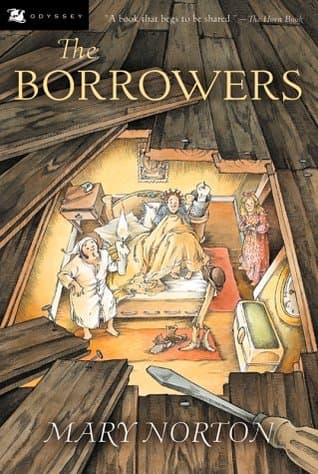
Mary Norton (1952)
Genre
Fantasy / Children's / Young Adult
Reading Time
180 min
Key Themes
See below
Sign in to track this book
Beneath the floorboards, a tiny family of 'Borrowers' carefully 'borrows' their existence from the giant 'human beans' above, until a curious young Borrower's forbidden friendship threatens to expose their hidden world.
The story begins with Mrs. May, an elderly woman, telling a story her brother, a boy named Kate, told her. Kate arrives at Firbank Hall for the summer to get better after being sick. He is interested in the old house's secrets. Nanny tells him stories about 'little people' in the house. Under the drawing-room floorboards, the Clock family – Pod, Homily, and their daughter Arrietty – live by 'borrowing' what they need from the 'human beans' above. Thimbles become cooking pots and stamps decorate walls in their miniature world. Arrietty, a curious girl, wants adventure beyond their small home. This desire sets up her world to meet Kate's.
Arrietty is growing restless, and Homily worries about her future, as there are no other Borrowers for her to marry. Pod, her father, a skilled and careful Borrower, decides to take Arrietty on her first borrowing trip into the 'human' house. They need to find a needle for Homily. Pod shows Arrietty how to borrow, moving through the large and dangerous human house. While Pod is busy, Arrietty, alone in the study, accidentally meets Kate, the human boy. This meeting, where Arrietty talks to Kate, breaks Borrower law. Pod fears it, as Borrowers who are seen are believed to disappear.
Pod warns Arrietty about the dangers of being seen, but Arrietty is drawn to Kate's kindness and the chance of a friend. Kate is also interested. He leaves tiny gifts for Arrietty, like a doll's teacup and a thimble, and starts leaving messages. Arrietty writes back on small pieces of paper, telling him about her family and the Borrower world. This secret communication becomes a friendship. Kate learns about the Borrowers' problems and their need for supplies. He becomes a link to the human world, bringing them things they need. Homily is happy at first, before she learns where the gifts come from.
Homily is happy about the useful human items appearing in their home. She asks Pod where they came from. When she learns Arrietty has been seen and is talking to Kate, she is scared, fearing the worst for their family. She thinks they must move right away. However, Kate wants to help his new friends. He starts bringing them many gifts, including a doll's house, which he places under the floorboards near their home. This unexpected generosity gives the Borrowers comfort and luxury. This eases some of Homily's immediate worries, but her fear of being found remains.
Kate wants to provide for Arrietty and her family. He brings them a doll's house with furniture. He puts it under the floorboards near their home. This creates a luxurious and spacious home, much better than anything the Borrowers could have imagined. Homily is surprised but soon enjoys the comforts, planning how to decorate and live in such a grand space. Pod appreciates the gifts but worries about depending on a human. Arrietty continues talking with Kate, sharing stories and learning about the human world. This strengthens their bond and her understanding of their connected lives.
Mrs. Driver, the stern housekeeper at Firbank Hall, notices odd things. She sees Kate often going under the floorboards. Items from the doll's house disappear or are in strange places. A silver thimble and other small objects go missing, making her more suspicious. She confronts Kate, who tries to avoid her questions. Mrs. Driver thinks Kate is stealing or causing trouble. She decides to investigate, setting a trap for the 'little people' she believes are responsible, or to catch Kate in the act.
Mrs. Driver's suspicions lead her to ask the gardener, Crampfurl, to fumigate the house. She targets the areas where she thinks Kate has been hiding things. She pours carbolic acid down the grating near the Borrowers' home, creating a toxic environment. The fumes fill their small home, making it unlivable. The Clock family sees the danger and knows they cannot stay. They pack a few important items and, under cover of darkness, start a journey through the walls and foundations of Firbank Hall, looking for an escape.
The Borrowers are now refugees. They need to find a new, safe home. Pod, Homily, and Arrietty move through the pipes, drains, and vents within the house. Their journey is dangerous. The human world is vast. There is a constant threat of being found, and physical challenges of climbing and crossing unknown areas. They face darkness, dampness, and the echoing sounds of the human world. Homily worries, but Arrietty's adventurous spirit and Pod's calm nature lead them on. They are determined to find a new sanctuary.
After a difficult journey through the house's hidden passages, the Clock family finds an exit. They emerge into the overgrown garden outside Firbank Hall. The outdoor world offers freedom from Mrs. Driver, but it brings new challenges. They are exposed to the weather, the vastness of nature, and predators like birds and cats. They have no shelter, and their future is unclear. The story ends with the Borrowers having escaped the house, but their fate is open, leaving the reader to wonder about their next adventure in the wide world.
The Protagonist
Arrietty grows from a restless child to a more experienced and resilient survivor, learning the harsh realities of the world while retaining her hopeful spirit.
The Supporting
Pod grapples with the changing dynamics of their lives, balancing his deep-seated caution with the unexpected advantages and dangers of human interaction.
The Supporting
Homily shifts from fearful resistance to cautious acceptance of human gifts, only to be forced to confront her deepest fears during their forced exodus.
The Supporting
Kate's initial fascination with a childhood myth transforms into a profound and protective friendship.
The Antagonist
Mrs. Driver's growing suspicion culminates in her decisive, destructive action against the perceived 'pests' in the house.
The Supporting
Crampfurl remains a static character, a compliant helper in Mrs. Driver's schemes.
The Supporting
Nanny provides the initial spark of wonder and belief, setting the stage for the main narrative.
The Mentioned
Mrs. May serves as the frame narrator, presenting the story as a cherished family tale.
The Borrowers deal with their identity as a race living in the shadow of humans. They constantly look for a place where they belong. Arrietty wants to connect with Kate because she wants to understand her place in the world beyond her family. The family struggles with what 'home' means—whether it's under the floorboards, in a doll's house, or outside. They want to belong somewhere without fear of being found or dying out. Their moving life shows how fragile their identity is and their constant search for a secure place.
“'Borrowers don't steal,' said Arrietty. 'They just — borrow. It's their way of life.'”
A main theme is the danger Borrowers face if 'seen' by humans. This rule controls their entire lives, forcing them to hide and be watchful. Arrietty breaks this rule, making a friendship, but it leads to her family being forced from their home. The theme explores the conflict between wanting connection and needing secrecy to survive. Mrs. Driver's discovery and the fumigation show the bad results when their hidden world is exposed to human attention and fear.
“'It's the worst thing that can happen to a Borrower,' said Pod. 'Being seen.'”
The Borrowers show great cleverness and resourcefulness. They use everyday human objects for their miniature lives—thimbles for cooking, postage stamps for paintings, matchboxes for dressers. This theme shows their ability to adapt and do well in a world not made for them, using what they 'borrow.' Their survival depends on their cleverness in the human world and their ability to create a working society from discarded items. Their final journey, adapting to the outdoor world, shows this trait more.
“'Everything we have,' said Homily, 'we owe to human beans. But we don't like to be reminded of it.'”
The friendship between Arrietty and Kate bridges the large physical and cultural difference between their species. Despite the dangers, their bond comes from mutual curiosity, kindness, and a shared feeling of loneliness. Kate's generosity and Arrietty's trust show that real connection can cross even unlikely gaps. This theme explores the power of empathy and understanding. It suggests that true friendship can grow even when one person is seen as a 'pest' by others of their friend's kind. Their connection offers hope and warmth in a dangerous existence.
“'You're not a human bean,' said Arrietty. 'You're just—you.'”
Creates wonder and highlights the Borrowers' vulnerability and ingenuity.
The concept of a miniature world existing beneath and within the human one is the foundational plot device. By presenting the Borrowers' perspective, the story transforms mundane human objects (thimbles, stamps, matchboxes) into grand, functional, or decorative items for the Borrowers. This contrast in scale emphasizes the Borrowers' vulnerability, making a human house a vast and dangerous landscape, while simultaneously highlighting their incredible resourcefulness and ingenuity in adapting to their oversized environment. It also allows for moments of wonder and unique challenges, such as crossing a carpet or climbing a table leg.
Introduces the story as a cherished, potentially true, family legend.
The story is framed by Mrs. May recounting her brother Kate's (Tom's) experiences to a young girl. This device serves several purposes: it lends a sense of authenticity and wonder to the fantastical tale, suggesting it's a real memory passed down through generations rather than pure fiction. It also creates a distance, allowing the reader to accept the magical realism of the Borrowers' existence. By having an adult reflect on a childhood encounter, it adds a nostalgic tone and reinforces the idea that such hidden worlds might exist, just beyond our perception.
Drives the central conflict and creates suspense.
The strict Borrower rule against being seen by 'human beans' is a crucial plot device. It immediately establishes the core conflict and danger of their existence. Arrietty's violation of this rule by speaking to Kate sets the entire plot in motion, leading to both the benefits of human generosity and the ultimate catastrophe of discovery. This rule creates constant tension and suspense, as every interaction with Kate carries the risk of exposure and the dire consequences that follow, ultimately forcing the Borrowers to abandon their home.
Symbolizes both comfort and the double-edged sword of human intervention.
The doll's house, provided by Kate, acts as a significant plot device and symbol. Initially, it represents an unprecedented level of luxury and comfort for the Borrowers, allowing Homily to dream of a grander life. It highlights Kate's generosity and the potential benefits of human interaction. However, it also becomes a focal point for Mrs. Driver's suspicions due to missing items and Kate's frequent visits to it. Thus, the doll's house symbolizes the double-edged nature of human intervention: while it offers temporary security and ease, it ultimately contributes to the Borrowers' downfall and forced displacement.
“It's no good going on pretending. We're not wanted. We Borrowers are finished.”
— Pod expresses despair about the future of the Borrowers.
“Human beans are for Borrowers—like bread's for butter!”
— Arrietty explains the Borrowers' perspective on humans.
“We're not mice, you know. We're people.”
— Arrietty asserts her identity to the boy.
“Borrowing is a very delicate art.”
— Pod describes the skill and care required in borrowing.
“The great thing is to have a plan.”
— Pod emphasizes the importance of strategy in survival.
“We live in the secret places of quiet old houses.”
— Arrietty describes the hidden world of the Borrowers.
“It's not stealing. It's borrowing.”
— Arrietty defends the Borrowers' way of life.
“You have to be very, very quiet.”
— Pod instructs Arrietty on the need for stealth.
“We're the last of the Borrowers.”
— Homily reflects on their dwindling kind.
“The world is a very big place.”
— Arrietty marvels at the vastness beyond their home.
“We must never be seen.”
— Pod states a fundamental rule of Borrower life.
“It's a dangerous world for little people.”
— Homily warns about the perils they face.
“We take only what we need.”
— Arrietty explains the Borrowers' ethical code.
“Home is where you make it.”
— Pod reflects on creating a safe haven.
Ready to see how well you understood this book? Take our interactive quiz with 10 questions.

Biography coming soon.







