“I am a weapon. My purpose is to destroy. To destroy the ones who created me. To destroy the ones who would use me.”
— Phoenix's self-realization and mission statement.

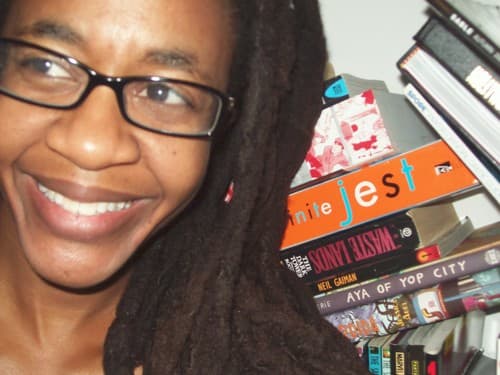
Nnedi Okorafor (2015)
Genre
Fantasy / Science Fiction / Young Adult
Reading Time
200 min
Key Themes
See below
Sign in to track this book
Born of fire and rebellion, a genetically accelerated woman escapes her gilded cage to unleash a fiery revolution that will reshape humanity's destiny across continents.
Phoenix, a genetically engineered 'accelerated woman,' has the physical and mental maturity of an adult despite being only two years old. She lives in the secluded Tower 7 in New York. She shares a deep, loving relationship with Saeed, another 'Old World' genetically altered human. Their existence is controlled, with limited knowledge of the outside world. One day, Saeed sees something horrifying on a hidden screen in the Tower's archives, which leads him to commit suicide by jumping from the Tower. Devastated and confused, Phoenix is denied answers by the Tower's overseers, especially the 'Mother.' This event shatters Phoenix's naive contentment and makes her question her existence and Tower 7's nature.
Grief and suspicion drive Phoenix to investigate Saeed's death and Tower 7's true purpose. She discovers that Tower 7 is a sophisticated prison designed to contain and study 'Old Worlders' – genetically modified humans like herself and Saeed. These humans have enhanced abilities and are seen as threats by the 'New Worlders' who control the facility. The 'Old Worlders' are systematically harvested for their organs and genetic material. Realizing this truth, Phoenix's latent powers, linked to her ability to generate intense heat and fire, begin to show uncontrollably. In rage and desperation, she unleashes a fiery explosion, destroying Tower 7 and killing many staff. Her escape ends her innocent existence.
After her destructive escape, Phoenix is disoriented in a changed New York City, a world she barely knows. Other Old Worlders, who had also escaped or were never captured, find her. This group is led by Mmu, who controls plants, and includes River, who manipulates water. They tell Phoenix about the global scale of the New Worlders' oppression, explaining that Tower 7 was one of many such facilities around the world, all designed to imprison and exploit their kind. They inform her that the New Worlders are trying to eradicate Old Worlders, fearing their abilities. Phoenix begins to understand the larger conflict she is a part of.
Guided by Mmu and River, Phoenix travels to Africa, specifically to a region near Ogoniland. This journey is to understand her origins and the source of the Old Worlders' powers. They speak of ancient knowledge and a 'Great Book' that holds the secrets of their creation and existence, possibly linked to an ancient African deity. The journey is hard, with encounters with both supportive and hostile humans, and the constant threat of New Worlder surveillance. During this time, Phoenix struggles to control her immense power, often feeling overwhelmed. She also forms deeper bonds with her fellow Old Worlders, finding a sense of belonging she never had in Tower 7.
In Ogoniland, Phoenix and her companions discover a hidden community of Old Worlders who have lived in relative peace, preserving their traditions and knowledge. A wise elder, a woman with ancient wisdom and insight into Old Worlder history, welcomes them. This elder recognizes Phoenix's unique power and explains that Phoenix is a direct descendant or manifestation of an ancient, powerful spirit, a 'fire spirit' linked to creation and destruction. The elder reveals that Phoenix's genetic code contains echoes of this primordial force and that the 'Great Book' is not a physical book but inherent knowledge passed down through generations, residing within their being. Phoenix begins to accept her true nature.
The peace in Ogoniland is short-lived. The New Worlders, having tracked Phoenix and her allies, attack the hidden Old Worlder community. Advanced weaponry and genetically engineered soldiers descend upon them, threatening to eradicate the last of Old Worlder civilization. During this battle, many Old Worlders are killed or captured. Seeing the destruction and suffering of her newfound family, Phoenix fully embraces her fiery power. She transforms into a being of pure flame, unleashing destructive energy that decimates the New Worlder forces. This act saves some, but also shows the immense and terrifying scale of her abilities.
After the battle, Phoenix is no longer just an 'accelerated woman' but a living fire spirit. Her transformation is complete, and she understands her purpose: to be a catalyst for change, a force that can both destroy the old oppressive world and pave the way for a new one. She recognizes that her existence is linked to the cycle of creation and destruction, like the mythical phoenix. This realization empowers her, but also burdens her with the immense responsibility of her power. She becomes a beacon of hope and fear for both Old and New Worlders, a living legend that reshapes the future.
With the New Worlder threat temporarily repelled, Phoenix, along with the surviving Old Worlders, begins to plan for the future. She understands that direct confrontation is not the only path; she must also inspire and guide. Her actions have already sent ripples across the globe, forcing both Old and New Worlders to re-evaluate their positions. Phoenix's power becomes a legend, whispered among the oppressed and feared by the oppressors. She starts to subtly influence global events, protecting pockets of Old Worlders, and indirectly fostering a new understanding of what humanity can be. She envisions a future where Old Worlders are respected, not hunted, and where the cycle of violence can finally be broken, leading to a more harmonious co-existence.
Phoenix's journey ends with her becoming an almost mythical figure, an eternal guardian of the Old Worlders and a catalyst for humanity's evolution. Her story is passed down through generations, becoming the 'Great Book' itself – a living narrative of power, oppression, and liberation. She does not simply disappear but becomes an omnipresent force, ensuring that the lessons learned from the conflict between Old and New Worlders are not forgotten. Her existence signifies a shift in the balance of power, a promise of a future where genetic diversity is celebrated rather than feared, and where the potential of humanity is allowed to flourish, guided by the fiery spirit she embodies.
The Protagonist
From a naive, isolated captive, Phoenix evolves into a powerful, self-aware fire spirit who champions the cause of her oppressed people.
The Supporting
His brief but impactful arc serves as the primary catalyst for Phoenix's awakening and escape.
The Supporting
Serves as a steadfast leader and mentor, helping Phoenix navigate the complexities of her new reality.
The Supporting
A loyal companion and protector, his arc is intertwined with the group's survival and quest for knowledge.
The Antagonist
Remains a static antagonist, representing the systemic oppression Phoenix fights against.
The Supporting
They serve as keepers of ancient wisdom, passing on crucial knowledge to Phoenix to help her fulfill her destiny.
The Antagonist
Their collective arc is one of sustained oppression, eventually challenged and disrupted by Phoenix.
The Mentioned
Serves as a narrative goal that evolves from a literal object to a symbolic understanding of inherent knowledge.
Phoenix's journey is about discovering who she is, not just as an 'accelerated woman' but as a being connected to ancient power. Her initial existence in Tower 7 is one of imposed identity. Saeed's death forces her to question everything, leading her to uncover her true nature as a powerful fire spirit, a manifestation of the mythical phoenix. This theme is explored as she deals with her destructive potential and ultimately embraces her role as a force of change, moving from an individual seeking answers to a legendary figure embodying her people's legacy.
“She was the Great Book, living and breathing fire, a story waiting to be told and rewritten.”
The main conflict of the novel is the oppression of 'Old Worlders' by 'New Worlders.' Tower 7 is a symbol of this, where Old Worlders are imprisoned, experimented upon, and harvested. Phoenix's escape and subsequent fight are an act of liberation, both personal and collective. The theme explores the dehumanizing effects of oppression and the fierce, often destructive, power needed to break free. It shows the struggle for survival and the fight for the right to exist for a marginalized group.
“They were not just keeping us. They were harvesting us.”
Phoenix has immense, destructive power, capable of leveling buildings and incinerating enemies. The novel explores the burden of this power and the responsibility that comes with it. Initially, Phoenix struggles to control her fiery abilities, often acting out of rage. As she matures, guided by Mmu and the Elders, she learns to use her power, not just for destruction but for protection and creation. Her transformation into a fire spirit shows that true power is not just its raw force, but the wisdom and purpose with which it is used for her people's greater good.
“Her fire was a part of her, a living entity that demanded respect and understanding.”
The novel blends science fiction with African mythology, especially the concept of the phoenix and ancient spirits. Phoenix is not just a genetically engineered human; she is an ancient fire spirit, linked to cycles of death and rebirth. The 'Great Book' itself is a living, spiritual legacy rather than a physical text. This shows the cyclical nature of knowledge and power. This theme suggests that the 'Old Worlders' are not just mutants but inheritors of ancient, primal forces, blurring the lines between science and myth.
“You are the book, Phoenix. You are the story.”
The book questions what it means to be human through the contrast between 'Old Worlders' and 'New Worlders.' Are the Old Worlders, with their enhanced abilities, more or less human? The New Worlders' fear and cruelty show a narrow, prejudiced view of humanity. Phoenix's journey challenges this, suggesting that humanity is not defined by genetic purity or lack of power, but by compassion, resilience, and the capacity for love and connection. The novel argues for a broader, more inclusive definition of humanity, embracing diversity and potential.
“They called us 'Old Worlders,' as if we were relics. But we were the future.”
A biological trait that makes Phoenix and other Old Worlders mature rapidly.
This device establishes Phoenix's unique nature, being only two years old but possessing the body and mind of an adult. It highlights her innocence combined with immense power and responsibility. It also serves as a key characteristic that differentiates Old Worlders from New Worlders, making them both extraordinary and feared. This rapid development contributes to their perceived threat level by the New Worlders and underscores the unnatural (yet powerful) aspects of their genetic makeup within the narrative.
A conceptual repository of ancient knowledge and the true origins of the Old Worlders.
Initially presented as a literal object Phoenix seeks, 'The Great Book' evolves into a powerful symbol of inherent knowledge, ancestral memory, and the living legacy of the Old Worlders. It represents the spiritual and cultural heritage that the New Worlders sought to suppress. Its transformation from a physical quest to an internal realization emphasizes Phoenix's journey of self-discovery and her eventual embodiment of this ancient wisdom, blurring the lines between written history and inherited identity.
A dystopian prison and scientific facility, symbolizing oppression and false security.
Tower 7 is a central plot device, functioning as both Phoenix's home and her prison. It symbolizes the deceptive nature of oppression, presenting a controlled, seemingly safe environment that masks a horrific reality of exploitation and experimentation. Its destruction by Phoenix is a pivotal moment, representing her liberation and the shattering of the New Worlders' control. The Tower also serves as a microcosm of the global conflict, with similar structures existing worldwide to contain Old Worlders.
The protagonist's name and powers directly reference the mythical bird of rebirth.
The direct allusion to the mythical phoenix is central to the protagonist's character arc and the novel's overarching themes. Phoenix's ability to generate fire, her literal 'death' in Tower 7 (of her old self), and her subsequent 'rebirth' as a powerful, liberated entity directly mirror the legend. This device foreshadows her destiny as a bringer of destruction and renewal, tying her individual story to a larger, cyclical narrative of societal transformation and the enduring power of ancient myths within a futuristic setting.
The scientific basis for the 'Old Worlders' enhanced abilities and their conflict with 'New Worlders'.
This device establishes the fundamental difference between the two factions and the source of the conflict. The 'Old Worlders' are products of genetic engineering or natural mutation, resulting in enhanced abilities (fire, water, plant control). This scientific difference fuels the 'New Worlders'' fear and desire for control, leading to the creation of facilities like Tower 7. It grounds the fantastical elements in a plausible (within sci-fi) scientific premise, exploring the ethical implications of genetic manipulation and the societal response to perceived 'otherness'.
“I am a weapon. My purpose is to destroy. To destroy the ones who created me. To destroy the ones who would use me.”
— Phoenix's self-realization and mission statement.
“They say that when you die, your life flashes before your eyes. But what if you have lived many lives?”
— Phoenix reflecting on her long existence and multiple pasts.
“Humans are such strange creatures. They build great things, and then they destroy them. They love deeply, and then they betray.”
— Phoenix's observation on humanity.
“My name is Phoenix. I am not a bird. I am not a myth. I am real. And I am coming for you.”
— A defiant declaration of her existence and intent.
“The past is a stubborn thing. It clings to you, no matter how far you run.”
— Phoenix contemplating the inescapable nature of her history.
“Freedom is not given. It is taken. With blood and fire, if necessary.”
— Phoenix's belief about achieving true liberation.
“They thought they could control me. They thought they could own me. They were wrong.”
— Phoenix's defiance against her creators and captors.
“Love is a weakness, they said. But it is also a strength. The greatest strength of all.”
— Phoenix's evolving understanding of love's power.
“Every lie has a root. And if you dig deep enough, you will find it.”
— Phoenix's determination to uncover the truth.
“We are all stories, waiting to be told. Or to be unwritten.”
— A philosophical thought about individual narratives and agency.
“The world is a cage, and most people don't even realize they are trapped.”
— Phoenix's cynical view of societal constraints.
“Sometimes, the only way to heal is to burn everything down and start anew.”
— Phoenix's embrace of destruction as a path to renewal.
“My power is not just in my body. It is in my mind. In my will. In my refusal to break.”
— Phoenix recognizing the mental and emotional aspects of her strength.
“Even a god can fall. Especially a god who forgets their humanity.”
— Phoenix's warning about the hubris of power.
Ready to see how well you understood this book? Take our interactive quiz with 10 questions.
Biography coming soon.







