“The best thing for being sad is to learn something.”
— Merlyn advising the young King Arthur on how to cope with sorrow.

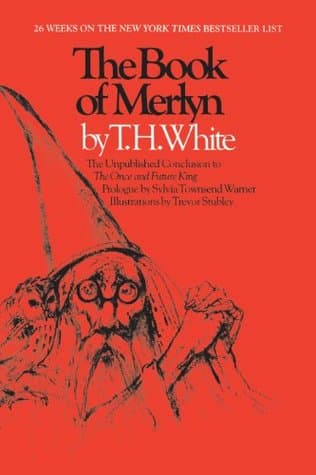
T.H. White (1977)
Genre
Fantasy / Historical Fiction
Reading Time
180 min
Key Themes
See below
Sign in to track this book
On his final night, King Arthur, guided by Merlyn, revisits his life's triumphs and tragedies through the eyes of animals, seeking truths about humanity, war, and peace before his end.
King Arthur, old and tired, is alone in his tent on Salisbury Plain, the night before his final battle against his son, Mordred. He feels despair over his ruined ideals and the failure of his Round Table. To his surprise, his old tutor, Merlyn, appears. Merlyn, released from his magical prison, looks as he did when Arthur was young. He explains that he has returned to help Arthur understand humanity's failures and the true nature of war and peace before his end. Merlyn suggests a final series of lessons, like those he gave Arthur as a boy, to offer perspective on his life's work and the human condition.
Merlyn begins Arthur's final education by changing him into an ant. As an ant, Arthur sees the ants' strict, communal society, where individuals are not important, and communication is mostly through smell. He observes their constant, brutal, and seemingly pointless wars with other ant colonies, driven by instinct and a lack of reason. Merlyn points out how the ants' tribalism, their 'might makes right' approach, and human conflicts are similar. He shows how group identity can override individual ethics and lead to endless war without rational thought or compassion. Arthur is bothered by the ants' unquestioning obedience and their lack of a concept of peace.
Next, Merlyn changes Arthur into a wild goose. As a goose, Arthur experiences the freedom of flight and the flock's communal life, led by a wise gander. He learns about their natural laws, migration patterns, and their lack of land disputes, only fighting over food. The geese respect individual space within the group and communicate well without violence. This experience is very different from the ants, showing Arthur another way to live together where individuals are free within a supportive community. Conflicts are rare because resources are shared, and there is no 'ownership' beyond immediate need. Arthur finds peace and natural order among the geese.
Merlyn then changes Arthur into a badger. As a badger, Arthur listens to a wise old badger tell the ancient story of creation and humanity's unique, but flawed, nature. The badger explains that humans were given reason and the ability to choose, but also a dangerous capacity for violence and self-destruction. He discusses 'original sin' not as a religious idea, but as a flaw in human nature that often makes them choose power and conflict over peace and cooperation. This lesson explores the philosophical roots of human aggression, suggesting that while humans can be good, their instincts often mislead them, making peace a constant struggle.
Merlyn continues Arthur's education by having him observe nature from different views, including as an owl and a snake. As an owl, Arthur experiences the predatory instinct and the need for the food chain, understanding that death is a natural part of life that keeps the ecosystem balanced. As a snake, he learns about a cold-blooded, instinct-driven life, free from human worries. These changes show how all living things are connected and part of a natural order. Even violence serves a purpose in keeping balance, unlike the often pointless violence of humans. Merlyn uses these examples to show Arthur that while nature has its 'cruelties,' they are usually functional, not driven by meanness or beliefs.
Returning to his human form, Arthur has a deep philosophical debate with Merlyn. Arthur considers why humans wage war despite having reason, comparing it to animal behaviors. Merlyn explains that human wars come from fear, greed, pride, and the wrong use of reason, often fueled by nationalism, religion, and the desire for power. He argues that 'might makes right' is a basic instinct humans have not overcome. Merlyn says that true peace requires understanding, compassion, and a conscious effort to overcome these basic instincts. He emphasizes education and developing empathy as important tools.
Merlyn looks deeper into the human condition, explaining that humanity's 'fall' was not just a biblical event but an ongoing struggle with their own nature. He describes how humans, unlike animals, have self-awareness and the ability for abstract thought, which can lead to great good and great evil. He explains that the animal changes were not random lessons but a type of 'beast fable' designed to make Arthur think about human behavior by watching simpler, more instinct-driven lives. Merlyn stresses that peace comes from understanding these instincts and consciously choosing to overcome them through reason and compassion, rather than giving in to them.
Arthur regrets the failure of his Round Table, which was based on chivalry, justice, and peace, but ended in internal conflict. Merlyn explains that Arthur's good intentions were not enough; real change needs a basic shift in human nature, which only comes through education and developing individual conscience. He argues that the Round Table, though well-intentioned, became a rigid system that failed to adapt to human complexities and eventually gave in to the very flaws it tried to stop: pride, jealousy, and the desire for power. Merlyn emphasizes that knowledge and empathy are the real weapons against war.
Despite the bleakness of Arthur's current situation, Merlyn offers a careful glimmer of hope for the future. He speaks of humanity's ability to grow, to learn from mistakes, and to eventually choose reason and compassion over brute force and tribalism. He suggests that while Arthur's efforts might seem to have failed, the ideas of 'Might for Right' and the search for peace will last and inspire future generations. Merlyn believes that through continuous education, critical thinking, and a commitment to understanding, humanity can slowly move towards a more peaceful existence, even if it is a long and hard journey.
As dawn nears, signaling the coming battle, Arthur, now with new understanding and a sense of peace, accepts his unavoidable fate. He realizes that his life's work, though seemingly ending in tragedy, was not wasted. Merlyn's lessons have given him a deeper insight into the human condition and the ongoing struggle between good and evil, reason and instinct. Merlyn, having finished his purpose of guiding Arthur one last time, says a final goodbye, disappearing as quietly as he arrived. Arthur, alone again, prepares to face his destiny, carrying his knowledge and a quiet hope for humanity's future.
The Protagonist
Arthur transforms from a despairing, self-reproaching king to one who accepts his fate with a deeper understanding of human nature and a quiet hope for the future.
The Mentor/Supporting
Merlyn's arc is less about personal change and more about fulfilling his final duty to Arthur, delivering his accumulated wisdom before Arthur's end.
The Antagonist
Mordred's character arc is not explored in this book, as he is primarily a looming threat and symbol of Arthur's downfall.
The Supporting/Symbolic
As a symbolic entity, the Ant has no arc, but its observation profoundly impacts Arthur's understanding of war.
The Supporting/Symbolic
As a symbolic entity, the Wild Goose has no arc, but its observation offers Arthur hope and an alternative to conflict.
The Supporting/Symbolic
As a symbolic entity, the Badger has no arc, but its wisdom is crucial to Arthur's understanding.
The Mentioned
Nimue's arc is not explored; she serves as a plot device to bring Merlyn back.
The Mentioned
Guenever's arc is not explored; she is part of the backstory that led to Arthur's despair.
The Mentioned
Lancelot's arc is not explored; he is part of the backstory that led to Arthur's despair.
This is the main theme, seen through Arthur's despair and Merlyn's lessons. The book explores the causes of conflict—instinct, greed, fear, misused reason—and compares human warfare with nature's functional 'violence.' It questions if peace is truly possible for humanity, suggesting it needs conscious effort, education, and overcoming basic instincts. The animal transformations provide different ways of living together and dealing with conflict, showing humanity's unique ability to make both destructive and constructive choices.
“The greatest tragedy of mankind is that they have reason, but do not use it.”
The novel looks closely at humanity's flaws, such as pride, tribalism, and the desire for power, which often lead to self-destruction. Merlyn and the Badger discuss humanity's 'original sin' as an innate tendency towards violence despite having reason. However, the theme also explores humanity's potential for good, for empathy, and for learning from mistakes, suggesting that while flawed, humans can choose peace through education and conscious effort. Arthur's own journey shows this internal conflict.
“Man has been endowed with reason, which he uses to commit the most unreasonable acts.”
Education, both formal and through experience, is shown as the main tool for overcoming humanity's destructive tendencies. Merlyn's teaching method—using animal transformations and philosophical debate—highlights the importance of gaining knowledge and using reason to understand the world and oneself. The Round Table's failure is partly due to a lack of basic change in human nature, which Merlyn believes can only happen through intellectual and moral education, encouraging critical thinking and empathy.
“The only thing that can conquer the world is reason.”
The book explores how human history often repeats, with cycles of war and the rise and fall of civilizations. Arthur's story, ending sadly, reflects this cycle. However, Merlyn offers a nuanced view that, despite apparent failures, the ideals of 'Might for Right' and the pursuit of peace can last and inspire future generations. There is a careful optimism that humanity, through slow and hard progress, can eventually learn and evolve towards a more peaceful future, breaking the cycle of violence.
“There is only one hope for the future: to teach men to think for themselves.”
This theme is clearly shown through Arthur's animal transformations. The ant colony represents extreme group living where individual identity is suppressed for the group's sake, leading to thoughtless warfare. In contrast, the geese show a balanced communal life where individuals thrive within a supportive group without losing freedom or resorting to conflict. This comparison makes Arthur consider how human societies manage the balance between individual rights and group identity, and how this balance affects peace and conflict.
“They had no individuality, no personality, only the group. And they were always at war.”
Arthur's magical transformations into various animals to gain perspective.
This is the primary narrative device, where Merlyn transforms Arthur into an ant, a goose, and a badger (among others). Each transformation allows Arthur to experience life from a non-human perspective, observing different societal structures, forms of communication, and approaches to conflict. The animal fables serve as allegories, providing concrete examples that illuminate the abstract philosophical concepts Merlyn discusses about human nature, war, and peace. They allow Arthur, and the reader, to gain critical distance and compare human behavior to the instinct-driven world of animals.
Merlyn's method of teaching Arthur through questioning and debate.
Merlyn employs a Socratic method of teaching, guiding Arthur through questions and discussions rather than simply lecturing. This encourages Arthur to actively engage with the philosophical concepts, draw his own conclusions, and critically reflect on his past actions and the nature of humanity. The extended dialogues between Merlyn and Arthur are central to the book, serving as the vehicle for exploring the complex themes of war, peace, and human nature, and highlighting the importance of reasoned thought and intellectual inquiry.
The entire story is set during Arthur's final night before his last battle.
The entire narrative is framed by Arthur's last night on earth, alone in his tent before his final battle against Mordred. This creates a sense of urgency, introspection, and ultimate finality. The impending doom provides a poignant backdrop for Merlyn's lessons, emphasizing the stakes of Arthur's reflections and the timeless relevance of the questions being posed. It allows for a comprehensive retrospective on Arthur's life and reign, culminating in a moment of profound understanding before his inevitable end.
Merlyn's awareness of future historical events and scientific concepts.
Merlyn possesses knowledge that transcends his historical period, including concepts like communism, nationalism, and even hints of future scientific understanding. This anachronistic wisdom allows him to provide Arthur with a broader, more detached perspective on human history and behavior, drawing parallels between Arthur's time and future conflicts. It reinforces Merlyn's magical nature and his role as an omniscient guide, enabling him to offer timeless insights into the human condition that resonate beyond the Arthurian legend.
“The best thing for being sad is to learn something.”
— Merlyn advising the young King Arthur on how to cope with sorrow.
“The only thing that never changes is that everything changes.”
— Merlyn reflecting on the nature of time and existence.
“We are all born mad. Some remain so.”
— Merlyn commenting on human nature and sanity.
“The destiny of Man is to unite, not to divide.”
— Merlyn discussing the ideal of unity and peace in governance.
“Love is a force more formidable than any other.”
— Merlyn explaining the power of love to Arthur.
“To learn is to change. Education is not the filling of a pail, but the lighting of a fire.”
— Merlyn teaching Arthur about the true purpose of learning.
“The world is full of magic things, patiently waiting for our senses to grow sharper.”
— Merlyn encouraging Arthur to perceive the wonders around him.
“Courage is not the absence of fear, but the triumph over it.”
— Merlyn advising Arthur on the nature of bravery.
“History is a nightmare from which I am trying to awake.”
— Merlyn reflecting on the cyclical nature of human conflict.
“The price of freedom is eternal vigilance.”
— Merlyn warning Arthur about the responsibilities of ruling justly.
“We are what we pretend to be, so we must be careful about what we pretend to be.”
— Merlyn discussing identity and self-deception.
“The greatest enemy of knowledge is not ignorance, it is the illusion of knowledge.”
— Merlyn cautioning against arrogance in learning.
“To be yourself in a world that is constantly trying to make you something else is the greatest accomplishment.”
— Merlyn encouraging Arthur to remain true to his ideals.
“The only way to deal with an unfree world is to become so absolutely free that your very existence is an act of rebellion.”
— Merlyn on resisting oppression through personal freedom.
Ready to see how well you understood this book? Take our interactive quiz with 10 questions.

Biography coming soon.







