“The way of the Law is to find the Law. The way of the Law is to keep the Law. The way of the Law is to break the Law.”
— From Chapter 1, 'The Crocodile', exploring the paradoxical nature of law and spiritual progression.

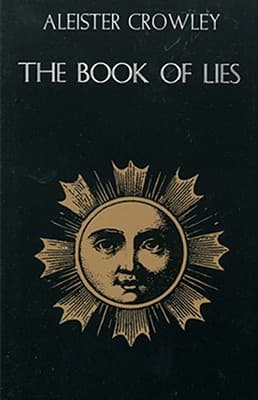
Aleister Crowley (1973)
Genre
Fantasy / Children's / Young Adult
Reading Time
196 min
Key Themes
See below
Sign in to track this book
A collection of cryptic poems, bizarre rituals, and qabalistic riddles, penned by Aleister Crowley, guiding readers through 93 pages of esoteric thought.
Chapter 1 presents a short, enigmatic poem. It seems to invoke a powerful, chthonic entity, possibly Baphomet or a similar figure linked to occult sabbats. The text mentions 'Lord of the Sabbath' and 'the Goat,' suggesting ritual communion or allegiance. Imagery of a 'black flame' and 'stars' conveys a sense of cosmic, forbidden power. The language's brevity and symbolic nature set the book's tone, hinting at deeper meanings requiring qabalistic or esoteric understanding. It initiates readers into Crowley's thought, marking a departure from conventional religious or philosophical frameworks.
Chapter 2, 'The Cry of the Hawk,' is a direct statement of the Thelemic principle: 'Do what thou wilt shall be the whole of the Law.' It speaks from the perspective of a powerful, soaring entity—the hawk—symbolizing the liberated individual or divine self. The text rejects external authority and dogma, emphasizing each person's inherent divinity and sovereignty. It declares freedom from sin and the right to pursue one's true will without constraint. This chapter summarizes a core tenet of Thelema, stating that individual will, when aligned with 'True Will,' is the ultimate moral and spiritual guide, challenging traditional ideas of morality and obedience.
Chapter 3, 'The Oyster,' uses the metaphor of an oyster creating a pearl to discuss manifestation from potential. The oyster, an empty vessel, transforms irritation into beauty and value. This can be interpreted qabalistically as Kether (the Crown) giving rise to Malkuth (the Kingdom), or the unmanifest giving rise to the manifest universe. The 'pearl' represents creation, emerging from an initial 'lie' or illusion of separation. It suggests that truth and beauty can come from what appears to be nothingness or imperfection, hinting at the spiritual journey's transformative power and the material world's inherent illusion.
Chapter 4, 'The Starfish,' explores the symbolism of the pentagram and unity within diversity. The starfish, with its five arms, naturally represents the pentagram, a central symbol in Western esotericism. Crowley uses this image to discuss the 'Five-Fold Star' or Pentagrammaton, representing the perfected human or the microcosm reflecting the macrocosm. It alludes to the five elements (Spirit, Air, Fire, Water, Earth) and their synthesis in the individual. The chapter subtly suggests that true spiritual attainment involves harmonizing these diverse aspects within oneself, leading to a unified and divinely aware consciousness, transcending fragmentation.
Chapter 5, 'The Lion and the Serpent,' presents a classic alchemical and qabalistic motif of opposing forces: strength and wisdom, solar and lunar, conscious and unconscious. The lion symbolizes strength, will, and the fiery solar principle. The serpent represents wisdom, transformation, and the chthonic, lunar principle. The chapter implies a dynamic interplay between these two powerful archetypes, suggesting that true power and enlightenment come from their harmonious integration and balance, not one dominating the other. This union often leads to a higher state of being, a recurring theme in esoteric traditions where reconciling opposites is key to spiritual advancement.
In 'The Battle of the Ants,' Crowley uses the seemingly insignificant conflict of ants to satirize human warfare and arbitrary moral judgments. The ants fight over trivial matters, driven by instinct, much like humans. This chapter critiques dualistic thinking that labels actions 'good' or 'evil,' suggesting such distinctions are often artificial and based on limited views. It implies that from a higher, cosmic viewpoint, many human endeavors and conflicts are meaningless, reinforcing the Thelemic idea that 'Every man and every woman is a star,' and their individual wills are paramount, not collective, often destructive, struggles.
Chapter 7, 'The Dinosaurs,' meditates on impermanence and the rise and fall of civilizations and species. The dinosaurs, once dominant, vanished, leaving only fossils. This serves as a metaphor for the fleeting nature of all earthly power, empires, and even spiritual doctrines. Crowley suggests that even the most formidable forces are subject to change and dissolution. The chapter implicitly encourages the reader to look beyond transient forms and seek eternal, underlying truths, rather than clinging to temporary manifestations of power or belief systems destined to pass away.
Chapter 8, 'The Lamp,' refers to the inner light of spiritual awareness or gnosis. It is not an external source but an intrinsic quality within the individual. The lamp symbolizes awakened consciousness, which, once lit, reveals reality's true nature. The chapter may offer cryptic instructions or allegorical hints on how to ignite this lamp, suggesting meditation, self-inquiry, or ritual. It emphasizes that this light comes from within and does not depend on external sources or dogmas, aligning with the Thelemic emphasis on individual spiritual experience and direct knowledge rather than blind faith.
Chapter 9, 'The Blow,' represents a sudden, impactful event or realization that shatters old ideas and initiates a profound shift in consciousness. It is the 'blow' that breaks through illusion, dogma, or ignorance, forcing the individual to confront a deeper reality. This could be a spiritual crisis, a moment of intense insight, or a deliberate act of will to transcend limitations. The chapter suggests that such a forceful disruption is often necessary for true spiritual progress, shaking one out of complacency and opening the mind to new possibilities, even if the initial experience is jarring or uncomfortable.
Chapter 10, 'The Wand,' focuses on the magical tool symbolizing will and direction. In ceremonial magic, the wand directs energy and intention, representing the magician's active will in shaping reality. This chapter alludes to focused intent's power and the individual's ability to manifest desires through disciplined will. It connects to 'True Will' as the driving force behind creation and spiritual attainment. The wand is not just a physical object but a metaphor for the inner faculty of will, which, when understood and wielded, can transform the world.
Chapter 11, 'The Pyramid,' uses the iconic structure to symbolize stability, hierarchy, and the path of spiritual ascent. The pyramid, with its broad base and singular apex, represents the journey from the mundane to the divine, from multiplicity to unity. It can also refer to the universe's structure, or the individual's spiritual development, built on a solid foundation of self-knowledge and discipline. The chapter suggests a systematic approach to spiritual work, where each level of attainment builds on the last, leading to enlightenment or union with the divine, the 'apex' of consciousness.
Chapter 12, 'The Arrow,' represents focused intention, rapid movement, and the direct path to a goal. Like an arrow shot from a bow, the spiritual aspirant must have clear aim and unwavering purpose to reach their target. This chapter emphasizes the importance of direct action and eliminating distractions in pursuing one's True Will. It implies that the path to spiritual enlightenment is not always meandering but can be a swift, decisive trajectory when driven by pure will. The arrow also symbolizes the link between the earthly and the divine, piercing through illusion to reach truth.
Chapter 13, 'The Egg,' is a powerful symbol of potential, new beginnings, and consciousness's gestation. The egg contains life's blueprint, representing latent spiritual possibilities within each individual and the universe. It suggests a period of incubation, where ideas and spiritual truths develop before full manifestation. This chapter alludes to the A.'.A.'. (Argenteum Astrum) and its role in bringing forth a new aeon, or the birth of a new, enlightened self. It signifies the promise of future revelation and the cyclical nature of creation and destruction, leading to rebirth.
Chapter 14, 'The Cup,' is a multifaceted symbol representing reception, sacrifice, and the divine elixir. In esoteric traditions, the cup can hold the waters of knowledge, the wine of ecstasy, or the blood of sacrifice. It signifies the vessel of experience, both joy and suffering, necessary for spiritual growth. The chapter might allude to the Holy Grail, symbolizing ultimate spiritual attainment, or the cup of suffering that must be drunk on the path to enlightenment. It suggests one must be open to receiving all experiences, transforming them into wisdom, and partaking in the divine essence.
Chapter 15, 'The Sword,' represents intellect, discrimination, and the ability to cut through illusion and falsehood. In magic, the sword commands and separates, symbolizing the analytical mind that discerns truth from deception. This chapter emphasizes clear thought and the ability to critically examine beliefs and phenomena. It suggests that spiritual progress requires keen intellect to distinguish between superficial and profound, and to sever ties that bind one to ignorance or attachment. The sword is a tool for liberation, cutting away what is not essential to reveal core truth.
The Author/Narrator/Spiritual Guide
Crowley's arc within the book is not personal development, but rather the consistent articulation and reinforcement of his Thelemic philosophy, evolving the reader's understanding.
The Muse/Symbolic Figure
Laylah's 'arc' is not personal development but her consistent role as an inspirational force and a symbolic representation of the divine feminine and the 'Scarlet Woman' concept.
The Protagonist (Implied)
The aspirant's arc involves a gradual awakening and transformation of consciousness as they engage with the book's teachings, moving from confusion to insight and self-realization.
The Abstract/Divine Principle
The Logos is static in its divine nature but is progressively revealed and reinterpreted through the reader's evolving understanding of the text.
The Antagonist/Catalyst
The 'Lies' remain constant in their paradoxical nature, but their effect on the reader transforms from initial confusion to eventual enlightenment.
The Divine Principle (Mentioned)
Hadit, as a divine principle, does not have an arc but is consistently presented as the unchanging, eternal essence of the individual and the universe.
The Divine Principle (Mentioned)
Nuit, as a divine principle, does not have an arc but is consistently presented as the unchanging, eternal totality of existence.
The Divine Principle (Mentioned)
Horus, as a divine principle representing the current aeon, remains a static symbol of the new spiritual era established in Thelema.
"The Book of Lies" explores truth's paradoxical nature. Its title, and the subtitle 'which Thought is itself Untrue,' immediately establish this theme. Crowley uses 'lies' not as deceptions, but as deliberate misdirections or superficial appearances that, when understood, reveal deeper spiritual truths. Chapters like 'The Oyster' (Ch. 3), where beauty emerges from irritation, or 'The Battle of the Ants' (Ch. 6), which satirizes perceived moral absolutes, show how false or trivial things can hold deep wisdom. The book challenges readers to move beyond conventional dualistic thinking and embrace a reality where truth is often hidden by its opposite, forcing an active search for meaning beyond the literal.
“The Book of Lies is a book of truth.”
A central tenet of Thelema, 'Do what thou wilt shall be the whole of the Law,' appears throughout "The Book of Lies." This theme emphasizes each individual's inherent divinity and autonomy, stating that one's 'True Will' is the ultimate moral and spiritual guide. Chapters such as 'The Cry of the Hawk' (Ch. 2) directly articulate this freedom from external authority and dogma, proclaiming the individual's right to self-determination. The book encourages self-knowledge and the pursuit of one's unique path, free from societal or religious constraints. It is a call to awaken the inner god and live authentically according to one's deepest purpose.
“Every man and every woman is a star.”
The entire structure and content of "The Book of Lies" are rich in Qabalistic symbolism. Each of its 93 chapters corresponds to a specific Qabalistic number, path, or concept, making esoteric knowledge essential for full understanding. Chapters like 'The Starfish' (Ch. 4) with its five points alluding to the pentagram, or 'The Lion and the Serpent' (Ch. 5) representing alchemical and elemental forces, are full of these allusions. The book serves as a condensed guide to Qabalistic thought, challenging the reader to engage with its layered meanings and decode its cryptograms. It highlights the belief that deeper truths are often hidden within symbolic language, accessible only to those willing to study esotericism.
“To interpret this book merely as a collection of absurdities is to confess oneself an ass.”
Crowley's work redefines traditional ideas of God and the universe, presenting them through the Thelemic pantheon of Nuit, Hadit, and Horus. Rather than an external, anthropomorphic deity, God is often portrayed as immanent—within the individual (Hadit) and as the boundless space of existence (Nuit). Chapters implicitly or explicitly touch on these cosmic principles. The book explores the relationship between the microcosm and macrocosm, suggesting that the individual's spiritual journey mirrors the universe's unfolding. It invites a mystical understanding of reality where the divine is not separate but interwoven with all existence, leading to unity and interconnectedness.
“I am the secret Serpent coiled about to spring: in my coiling there is joy. If I lift up my head, I and my Nuit are one. If I droop down my head, and shoot forth venom, then it is a lie, and a shame and a child of hell.”
"The Book of Lies" is a guide to spiritual transformation and awakening. It challenges the reader to shed old paradigms, break free from illusions, and embark on self-discovery. The text's cryptic nature acts as a catalyst, making the aspirant think differently and engage with deeper consciousness. Chapters like 'The Blow' (Ch. 9), signifying a shattering realization, or 'The Egg' (Ch. 13), symbolizing potential and rebirth, directly address profound change. The book aims to facilitate an alchemical transformation of the individual, leading to gnosis and the realization of one's True Will.
“My Word is Law; the Law of the Strong. This is our holy book, the Book of Lies.”
Hidden meanings and references that require esoteric knowledge to decode.
Crowley extensively uses cryptograms and obscure allusions throughout 'The Book of Lies.' Each chapter, often just a single page, is packed with symbolic language, Qabalistic references, and hints at magical practices or philosophical concepts that are not immediately apparent. This device forces the reader to engage deeply with the text, often requiring external knowledge of Qabalah, Thelema, alchemy, or other esoteric traditions to unravel its full meaning. It acts as a gatekeeper, ensuring that only those truly committed to understanding will penetrate its layers, and simultaneously serves as a teaching tool, guiding the diligent student toward further study and personal insight.
Contradictory statements that reveal deeper, non-dualistic truths.
Paradox is a fundamental plot device in 'The Book of Lies,' evident from its title. Crowley deliberately presents contradictory statements or seemingly illogical ideas to break the reader's reliance on linear, rational thought. By challenging conventional logic, these paradoxes compel the mind to seek understanding on a more intuitive, symbolic, or mystical level. For example, a 'lie' is presented as a path to 'truth,' or a 'nothing' is described as the source of 'everything.' This device is designed to shatter preconceived notions and open the mind to a non-dualistic reality, where opposites can coexist and even define each other, fostering a more expansive consciousness.
The use of specific images and numbers to represent complex esoteric concepts.
The book is saturated with Qabalistic and alchemical symbolism. Every chapter number, every animal, object, or abstract concept mentioned (e.g., 'The Goat,' 'The Oyster,' 'The Lion and the Serpent,' 'The Wand,' 'The Sword') carries layers of esoteric meaning derived from these traditions. This device allows Crowley to convey vast philosophical and spiritual ideas in extremely condensed forms. The symbols act as keys, unlocking deeper levels of understanding for those initiated into their meanings, or prompting inquiry for those who are not. It transforms the text from a mere collection of poems into a rich tapestry of interconnected esoteric wisdom, where each symbol contributes to the overall 'plot' of spiritual revelation.
Short, pithy, and often enigmatic statements designed to provoke contemplation.
Many chapters in 'The Book of Lies' consist of aphoristic or koan-like statements. These are concise, often poetic, and deeply enigmatic declarations that defy easy interpretation. Like Zen koans, they are designed not to be logically solved but to be meditated upon, provoking a shift in consciousness or a sudden insight. This device forces the reader into active contemplation, encouraging them to look beyond the literal words and grasp the underlying spiritual truth. It bypasses the rational mind, aiming directly for intuitive understanding, and is a powerful tool for spiritual instruction, fostering a direct, experiential engagement with the text's wisdom.
The book frequently comments on its own nature and the act of reading it.
Crowley's 'The Book of Lies' often engages in meta-commentary, referencing its own nature as a book of 'lies' or advising the reader on how to approach its content. The subtitle itself, 'The Wanderings or Falsifications of the One Thought of Frater Perdurabo, which Thought is itself Untrue,' is a prime example. This device creates a self-aware text that guides the reader's interpretation and sets expectations. It reinforces the theme of truth and illusion, reminding the reader that the 'truth' is not found on the surface but through active engagement with the text's deliberate obfuscations. It makes the act of reading a conscious, transformative process, rather than passive consumption.
“The way of the Law is to find the Law. The way of the Law is to keep the Law. The way of the Law is to break the Law.”
— From Chapter 1, 'The Crocodile', exploring the paradoxical nature of law and spiritual progression.
“There is no god but Man.”
— From Chapter 3, 'The Oysters', a bold declaration of human divinity and autonomy.
“The Magician is the slave of the will of his Master. And his Master is the Devil.”
— From Chapter 6, 'The Starfish', discussing the nature of the magician's subservience to a higher, often perceived as dark, will.
“Love is the law, love under will.”
— From Chapter 9, 'The Glow-Worm', a central tenet of Thelema, emphasizing love as a directed force.
“Every man and every woman is a star.”
— From Chapter 11, 'The Serpent', asserting the unique and divine nature of each individual.
“The word of Sin is Restriction.”
— From Chapter 13, 'The Toad', defining sin not as moral transgression but as self-imposed limitation.
“Do what thou wilt shall be the whole of the Law.”
— From Chapter 15, 'The Bat', the most famous maxim of Thelema, advocating for the pursuit of one's true will.
“Truth is a lie, and a lie is a truth.”
— From Chapter 22, 'The Lynx', exploring the subjective and fluid nature of truth and falsehood.
“The soul is a worm that crawls in the dust.”
— From Chapter 25, 'The Octopus', a provocative statement challenging traditional notions of the soul's grandeur.
“There is no light but the black light.”
— From Chapter 28, 'The Lion', a paradoxical statement suggesting true illumination comes from darkness or the unknown.
“The end of the work is the beginning of the work.”
— From Chapter 31, 'The Scarab', highlighting the cyclical and continuous nature of spiritual and magical endeavor.
“Silence is the language of God.”
— From Chapter 33, 'The Chameleon', emphasizing the ineffable and transcendent nature of the divine.
“Remember that existence is pure joy; that all the sorrows are but as shadows; they pass, and are done; but there is that which remains.”
— From Chapter 49, 'The Dragon', offering a perspective on the ephemeral nature of suffering compared to enduring joy.
“The great work is to unite the Microcosm with the Macrocosm.”
— From Chapter 69, 'The Lamp', defining the ultimate goal of spiritual and magical practice as the union of self with the universe.
Ready to see how well you understood this book? Take our interactive quiz with 10 questions.

Aleister Crowley was a highly influential, albeit controversial, English occultist and ceremonial magician. He is most famous for authoring "The Book of the Law" (1904), the foundational text of Thelema. Crowley also wrote "The Book of Lies" (1913) and numerous other works on magic, religion, and philosophy, shaping modern occult thought.







