“The struggle of man against power is the struggle of memory against forgetting.”
— A central philosophical theme of the book, often repeated and explored through various characters' experiences.

Milan Kundera (2020)
Genre
Literary Fiction / Philosophy
Reading Time
4-5 hours
Key Themes
See below
Sign in to track this book
Kundera explores the human condition through interconnected stories, each a variation on memory, exile, and the fight against political and personal erasure in Prague.
Mirek, a dissident intellectual in Soviet-occupied Czechoslovakia, wants to retrieve old love letters from his former mistress, Zdena. He fears these letters, which contain political information, could be used against him. He is also bothered by Zdena's older appearance, which he thinks spoils his memory of their affair. This section looks at 'forgetting' as a political tool, where the regime erases individuals and events from history, mirroring Mirek's own fight to control his story and memories. Mirek's trip to Zdena's flat to get the letters is full of anxiety, showing the fear under totalitarian rule.
Tamina, a young Czech émigré living abroad, is troubled by her husband's death, which happened shortly after their escape from Czechoslovakia. She wants to write down her memories of him, believing he will be completely forgotten if she doesn't. But she cannot recall details of their life together, especially intimate moments. Her inability to fully grieve or rebuild her past is made worse by her restaurant job, where she is surrounded by everyday life. Tamina's struggle shows the pain of forced exile and how it separates people from their personal histories, leaving them lost in anonymity and unspoken grief.
This section introduces 'litost,' a Czech word for the torment caused by suddenly seeing one's own misery. Kundera mixes philosophical thoughts with personal stories, including a student demonstration where young people, like Karel, do a 'circle dance' as an innocent act of rebellion. The narrator watches, reflecting on collective memory and how simple acts can be reinterpreted or forgotten by history. The 'angels' represent a higher, perhaps ironic, view of human folly and the cycle of oppression and resistance. The story questions the true meaning of laughter when joy and sorrow are constantly manipulated.
The story returns to Mirek's intense search for Zdena's letters, showing his desperation to control his past. He sees the letters not just as a political risk but as a record of his true self, which he fears is being changed by Zdena's continued existence and the regime's historical changes. Kundera uses Mirek's story to show the totalitarian desire to rewrite history, not just through official rules but by eroding personal memories and relationships. Forgetting is shown as a deliberate, harmful weapon, used to disempower individuals and cut their connection to their identities. Mirek's anxiety becomes a symbol for the broader societal amnesia enforced by the state.
Tamina finds herself on an island populated only by children, a strange and unsettling place. She is forbidden from speaking about her past or her dead husband, reinforcing the theme of forced forgetting. The children, seemingly innocent, subtly control her, representing a collective amnesia. Tamina's attempts to hold onto her memories are met with resistance, and she slowly loses her identity. This allegorical setting explores the totalitarian impulse to create a 'new' world by erasing the past, and its chilling implications. Tamina's vulnerability among the children shows how fragile individual memory is against forced oblivion.
This section expands on Kundera's philosophical thoughts, linking the 'angel' to the idea of a world without true meaning or suffering. He discusses how evil is trivialized under totalitarian regimes, where deep human experiences become superficial slogans or are forgotten. The narrator reflects on 'kitsch,' which he defines as the aesthetic ideal of absolute agreement with being, excluding any disagreement. This part also touches on the absurdity of human life and how political systems use our desire for meaning, even if that meaning is manufactured. The 'angels' watch human struggles with detached, perhaps cynical, amusement.
Mirek's attempts to retrieve the letters fail. He is arrested by the secret police, and his personal fight against forgetting is overwhelmed by political oppression. The letters, whether retrieved or not, become secondary to his fate. This final part of Mirek's story shows the futility of individual resistance against a system designed to erase all traces of dissent. His personal memory, and thus his identity, is lost to the state. The regime's power is not just in its ability to punish, but in its capacity to control and manipulate memory, ensuring inconvenient truths are simply forgotten.
On the island, Tamina's struggle to keep her memories becomes more desperate and useless. The children's constant pressure and the island's rules slowly erode her sense of self. In a sad climax, she is lured into the sea, where her last memories are washed away, leading to her drowning. Her death symbolizes the ultimate victory of forgetting, not just politically but personally. Tamina's story explores how identity is linked to memory and how losing one leads to the other's collapse, leaving only an empty shell.
In this section, Kundera directly addresses the reader about his novel's structure and purpose. He explains his use of variations and how different stories connect. He restates his main concerns: the power of memory and forgetting, the nature of totalitarianism, and the role of laughter and irony in human life. This meta-narrative allows Kundera to clearly state his philosophical arguments, reinforcing that the book itself is a reflection on these themes rather than a straightforward plot. He emphasizes the political and existential consequences of memory's fragility.
The novel ends with a final image of a circle dance, a recurring symbol. This dance, sometimes innocent and joyful, sometimes a symbol of conformity or forgetting, represents the cyclical nature of human experience. Kundera reflects on the universal human desire for connection, meaning, and the elusive nature of freedom and happiness. The ending leaves the reader with a sense of the ongoing tension between individual memory and collective oblivion, and the lasting power of both laughter and forgetting in shaping our view of reality and history. It is a thoughtful and open-ended conclusion, inviting continued contemplation.
The Protagonist
Mirek begins with a desperate quest to reclaim his past but ultimately fails, succumbing to the regime's power and the inevitability of forgetting.
The Protagonist
Tamina's arc is a tragic descent into complete oblivion, as her memories are systematically stripped away, leading to her demise.
The Supporting
Zdena remains largely static, serving as a catalyst for Mirek's internal conflict and external actions.
The Supporting
Karel's brief appearance serves to illustrate a moment of collective expression, without a distinct personal arc.
The Protagonist/Authorial Voice
The narrator's arc is intellectual, evolving his philosophical understanding of the central themes as the novel progresses.
The Supporting/Antagonists
The children remain a static, symbolic force, representing the relentless pressure to forget.
The Mentioned
Eva's role is purely referential, without a developed arc.
The Mentioned
The Minister's role is purely symbolic, illustrating the theme of historical revision.
This is the novel's main theme, seen through individual and collective experiences. Kundera shows how personal memories can fade due to time, grief (Tamina's struggle to remember her husband), and the wish to rewrite one's past (Mirek's obsession with Zdena's letters). On a societal level, the book reveals how totalitarian regimes deliberately manipulate and erase historical events and people, using 'forgetting' as a tool of oppression. The removal of Clementis from a photograph with the Minister is a clear example. The novel argues that losing memory, whether personal or collective, leads to losing identity and truth.
“The struggle of man against power is the struggle of memory against forgetting.”
Kundera criticizes totalitarian regimes, especially Soviet-style communism in Czechoslovakia. He focuses not just on obvious violence but on the subtle ways these regimes control thought, history, and personal lives. The secret police, censorship, and the systematic erasure of dissidents (like Clementis) are central. The novel explores how the regime tries to create a 'new' reality by deciding what is remembered and what is forgotten, thereby stripping individuals of their history and control. Mirek's fear of the letters and Tamina's forced amnesia on the island are direct results of this oppressive environment.
“A nation that has lost its memory is like a person who has lost his soul.”
Laughter has complex meanings in the novel. It can be a joyful expression of freedom (the student circle dance), a tool of power (the devil's laughter that mocks human suffering), or a sign of accepting the absurd. Kundera often uses irony to highlight the contradictions and absurdities of human behavior and political systems. The 'angels' in the book, with their detached view, embody a cosmic irony. The novel suggests that in a world where truth is manipulated and suffering is downplayed, laughter can be both a form of resistance and a sign of ultimate despair, reflecting the inherent absurdity of the human condition.
“The devil's laughter is a sign that everything is meaningless.”
Exile is an important theme, especially through Tamina's story. Forced to leave her homeland, she is displaced not only geographically but also emotionally and historically. Her inability to fully mourn or remember her husband is a direct result of her exile, which separates her from her past life. Exile is shown as a condition that fragments identity, making it hard to maintain a clear sense of self when one faces a new reality and cannot revisit the places of memory. The novel suggests that true belonging is tied to an unbroken connection with one's personal and collective history.
“To live in exile is to live with a constant amputation.”
Sex and love are explored as both deep human connections and as areas vulnerable to degradation and manipulation. Mirek's memory of his affair with Zdena is tainted by her later appearance, showing how the physical can distort the emotional. The novel also touches on how intimate acts can be trivialized or even used as weapons in a repressive society. Kundera often depicts the vulnerability in sexual relationships, and how easily they can become mere physical acts, separate from deeper meaning, especially when memory is unreliable or deliberately suppressed. This theme often connects with the idea of 'litost.'
“Love is the longing for the half of ourselves we have lost.”
The novel's structure, presenting interconnected themes through distinct, yet related, narratives.
Kundera structures 'The Book of Laughter and Forgetting' as a series of 'variations,' similar to a musical composition. Each of the seven parts explores the central themes of memory, forgetting, laughter, and totalitarianism from different angles and through different characters (Mirek, Tamina, the narrator). These variations are not always chronological or causally linked in a traditional plot sense, but rather resonate with each other thematically, deepening the reader's understanding of the core ideas. This device allows Kundera to present a multifaceted exploration of his philosophical concerns without being constrained by a linear narrative, creating a rich tapestry of interwoven ideas and experiences.
The narrator directly addresses the reader, commenting on the novel's themes and structure.
Kundera frequently employs metafiction, where the narrator (often identified with Kundera himself) breaks the fourth wall to directly address the reader. This device allows the author to explain his philosophical concepts, comment on the nature of storytelling, and explicitly connect the disparate narratives. It transforms the novel from a mere story into a meditation on its own creation and meaning. This direct engagement with the reader reinforces the intellectual and philosophical core of the book, inviting the audience to actively participate in the exploration of its themes rather than passively consume a plot.
Objects, actions, or settings that carry deeper, often allegorical, meanings.
Kundera uses various symbols to enrich the novel's thematic depth. The 'circle dance' represents different things in various contexts: innocent joy, collective conformity, or even a ritual of forgetting. The 'angels' symbolize a detached, perhaps ironic, perspective on human folly and the trivialization of suffering. The mysterious 'island' where Tamina finds herself, populated only by children, is an allegory for a totalitarian society that seeks to erase the past and enforce a state of collective amnesia. These symbols add layers of meaning, allowing Kundera to explore complex philosophical ideas through evocative imagery and allegorical settings.
A Czech word describing a state of torment caused by the sudden insight into one's own wretchedness.
Kundera introduces and defines the Czech word 'litost' as a specific emotional state that is central to understanding certain character motivations and thematic concerns. It is a feeling of torment induced by the sudden realization of one's own misery or inadequacy, often leading to a desire for revenge or self-destruction. This concept helps to explain the psychological underpinnings of characters like Mirek, whose actions are partly driven by a 'litost' against Zdena's perceived degradation of his past. By highlighting this untranslatable word, Kundera emphasizes the unique cultural and psychological nuances that inform his characters and the broader human condition.
“The struggle of man against power is the struggle of memory against forgetting.”
— A central philosophical theme of the book, often repeated and explored through various characters' experiences.
“A person who lives in a country where he has no right to vote, no right to speak, no right to assemble, is a person who lives in a country where he has no right to laugh.”
— Reflecting on the nature of totalitarian regimes and the suppression of fundamental human expressions.
“The first step in liquidating a people is to erase its memory. Destroy its books, its culture, its history. Then have somebody write new books, manufacture a new culture, invent a new history. Before long the nation will begin to forget what it is and what it was.”
— Discussing the methods of cultural and historical erasure under oppressive regimes.
“Love is a battle, love is a war; love is a growing up.”
— Exploring the complexities and challenges within romantic relationships.
“Humanity's true oppressor is its own desire for repetition.”
— A more philosophical reflection on human nature and the cyclical patterns of history and behavior.
“Laughter is a political act. It is an act of defiance.”
— Emphasizing the subversive power of humor against authority.
“The end of history is not the end of suffering.”
— A poignant observation on the persistent nature of human pain despite grand historical narratives.
“The absolute absence of a meaning, the absolute freedom from a meaning, is the only possible meaning.”
— A deep existential reflection on meaninglessness and the liberation found within it.
“Kitsch causes two tears to flow in quick succession. The first tear says: How nice to see children running on the grass! The second tear says: How nice to be moved, together with all mankind, by children running on the grass!”
— A famous definition of kitsch, illustrating its sentimental and conformist nature.
“A man who has lost his memory is like a man who has lost his shadow.”
— Comparing the loss of memory to the loss of an essential part of one's being and identity.
“The heaviest of burdens is simultaneously an image of life's most intense fulfillment. The heavier the burden, the closer our lives come to the earth, the more real and true they become.”
— Exploring the paradoxical nature of burdens and their role in grounding human existence.
“The only reason people want to be in the dark is so they can imagine themselves in the light.”
— A psychological insight into human desire and the role of imagination.
“Forgetting is a form of death.”
— A direct and stark statement on the profound consequences of forgetting, especially in a historical or personal context.
“The angels are laughing at us, because they know that everything we do is absurd.”
— A whimsical yet profound reflection on the human condition and the inherent absurdity of existence.
Ready to see how well you understood this book? Take our interactive quiz with 10 questions.
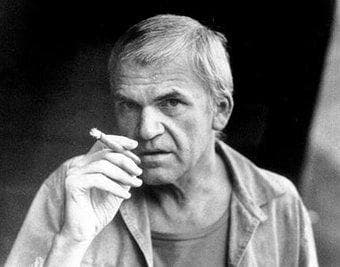
Milan Kundera is a Czech-born French writer. Kundera went into exile in France in 1975, acquiring citizenship in 1981. His Czech citizenship was revoked in 1979 and restored in 2019. He "sees himself as a French writer and insists his work should be studied as French literature and classified as such in book stores".







