“A man's got to know his limitations.”
— Sherman McCoy's internal mantra, reflecting on his precarious position.


Tom Wolfe (2018)
Genre
Literary Fiction
Reading Time
15-20 hours
Key Themes
See below
Sign in to track this book
In the opulent, cutthroat world of 1980s New York, a 'Master of the Universe' bond trader's life spectacularly unravels after a seemingly minor hit-and-run, exposing the city's ravenous media, political machinations, and class warfare.
Sherman McCoy, a 'Master of the Universe' on Wall Street, drives his mistress, Maria Ruskin, home to her apartment in the East Eighties. Lost in the Bronx while trying to return to Manhattan, they take a wrong exit off the Major Deegan Expressway. In a dimly lit, rundown area, they encounter two young black men, Henry Lamb and Roland Auburn, who attempt to block their path. Maria, panicked, urges Sherman to drive away. During the chaotic escape, Sherman's Mercedes hits one of the men, Lamb, and they flee, believing they merely struck a tire or an object. This incident sets in motion a chain of events that will unravel Sherman's life.
Peter Fallow, a British journalist for the tabloid 'The City Light,' is a cynical, alcoholic hack desperate for a career-making story. When Henry Lamb, the young black man struck by Sherman's car, is hospitalized in a coma, the incident becomes a symbol of racial injustice in the city. Fallow, sensing the potential for sensationalism, begins to investigate, fueled by the city's racial and class divides. His editor, Emilio Lopez, encourages him, seeing the story as a way to boost circulation. Their reporting, often based on speculation, quickly turns Lamb into a martyr and the unknown driver into a villain, creating a public outcry for justice.
Lawrence 'Larry' Kramer, an ambitious and somewhat insecure Assistant District Attorney in the Bronx, is assigned to the Henry Lamb case. Under pressure from his superior, District Attorney Abe Weiss, who is running for re-election, Kramer understands the political capital in prosecuting a high-profile case involving a white perpetrator and a black victim in a racially charged city. Kramer, though initially hesitant about the lack of concrete evidence, is swayed by the opportunity to advance his career. He aggressively pursues leads, knowing a conviction could elevate him significantly within New York's legal and political landscape.
Following the accident, Sherman McCoy tries to suppress the memory, but the relentless media coverage of Henry Lamb's condition and the search for the hit-and-run driver begins to erode his composure. He experiences increasing paranoia, fearing discovery. His wife, Judy, senses his unease but remains unaware of the specific incident or his affair with Maria. Sherman's world of wealth and privilege feels increasingly fragile, and he struggles to maintain his outward facade of a successful 'Master of the Universe' while battling the weight of his secret and the growing public outrage.
Maria Ruskin, Sherman's mistress, initially stays silent about the accident. However, she is driven by social climbing and self-preservation. When the police begin to close in on her and the pressure becomes unbearable, Maria makes a calculated decision. Fearing for her own reputation and potential legal repercussions, she contacts the authorities and provides information that implicates Sherman McCoy as the driver of the car that struck Henry Lamb. Her betrayal is a critical turning point, directly leading to Sherman's arrest and the public unraveling of his life. This shows her ultimate loyalty is only to herself.
Sherman McCoy is dramatically arrested at his Park Avenue apartment by Bronx detectives, an event quickly leaked to the media. The image of the wealthy bond trader being led away in handcuffs becomes a potent symbol of justice for the public and a humiliating spectacle for Sherman. He is arraigned and released on bail, but the damage to his reputation is irreparable. The 'Master of the Universe' is now a pariah, his name synonymous with the perceived injustice against Henry Lamb. His arrest signifies not just a legal battle, but a public trial by media and a complete dismantling of his social standing.
Reverend Reggie Bacon, a prominent and vocal black activist in the Bronx, quickly latches onto the Henry Lamb case. He sees it as a perfect opportunity to rally his community, gain media attention, and exert political pressure for his own causes. Bacon organizes protests, delivers fiery sermons, and holds press conferences, portraying Sherman McCoy as the embodiment of white privilege and racial injustice. His rhetoric inflames tensions, ensuring the trial becomes a deeply politicized event rather than a straightforward legal proceeding, further complicating Sherman's defense and making a fair trial nearly impossible.
Sherman McCoy's trial for the hit-and-run and subsequent charges begins in the Bronx. The courtroom is a volatile arena, packed with journalists, activists, and a public eager for a conviction. Larry Kramer, the prosecutor, presents a case heavily reliant on Maria Ruskin's testimony and circumstantial evidence, playing on racial sentiments. Sherman's defense team, led by Thomas Killian, struggles to counter the overwhelming public opinion and the politically charged atmosphere. The trial is less about legal facts and more about the symbolic battle between the haves and have-nots, and between racial communities in New York City.
Sherman McCoy, despite his lawyer Thomas Killian's efforts, often proves to be his own worst enemy. His arrogance and sense of entitlement clash with the working-class jury and the public's perception. The defense struggles to provide a convincing alternative, especially after Maria Ruskin's testimony. Furthermore, the media's relentless portrayal of Sherman as a heartless elitist makes it difficult for the jury to sympathize with him. The trial highlights the stark contrast between Sherman's privileged world and the harsh realities of the Bronx, making it nearly impossible for him to receive an impartial hearing.
The trial of Sherman McCoy reaches its climax. The prosecution presents its closing arguments, painting Sherman as a cold, remorseless perpetrator. The defense attempts to sow doubt, but the racial and class tensions in the courtroom are palpable. The jury, after much deliberation, delivers a verdict that reflects the complex social dynamics at play. Regardless of the legal outcome, Sherman's life as he knew it is irrevocably destroyed. His fall from grace is a commentary on the fragility of wealth and status in a city rife with social and racial divisions, and the power of media and public opinion.
The Protagonist
Sherman experiences a spectacular fall from grace, losing his wealth, social standing, and freedom, forcing him to confront the vulnerability of his privileged existence.
The Supporting
Maria initially enjoys the thrill of her affair and social climbing but ultimately exposes Sherman to protect her own interests, revealing her true opportunistic nature.
The Supporting
Kramer rises in prominence through his zealous prosecution of Sherman McCoy, leveraging the case for political gain, though not without internal ethical struggles.
The Supporting
Fallow's career is resurrected by his opportunistic and exaggerated reporting on the Lamb case, transforming him from a hack to a celebrated journalist.
The Supporting
Bacon capitalizes on the Lamb case to increase his own power and influence within the black community and on the broader political stage.
The Supporting
Judy's initial ignorance of Sherman's transgressions evolves into resentment and a calculated decision to protect her own interests amidst his public disgrace.
The Mentioned
Lamb remains largely comatose, his physical state a constant reminder of the accident and the catalyst for the entire narrative.
The Supporting
Killian diligently works to defend Sherman, facing an uphill battle against public opinion and the complexities of the legal system.
The novel vividly portrays the rampant materialism, greed, and moral bankruptcy of 1980s New York, particularly among the wealthy elite. Sherman McCoy's 'Master of the Universe' lifestyle, his affair with Maria, and his disdain for those outside his class exemplify this excess. The 'bonfire' refers to the self-destructive nature of these vanities, as Sherman's world is consumed by the very forces of ambition and self-interest that defined it. The moral decay extends to the media and political figures who exploit human suffering for their own gain, showing a city where integrity is scarce.
“He was a Master of the Universe! He knew the world, knew how it worked, knew the game, knew all the angles. And now this…”
A central theme is the stark and often violent division between the wealthy, predominantly white elite of Manhattan and the impoverished, predominantly black and Hispanic communities of the Bronx. The hit-and-run incident acts as a catalyst, exposing these deep-seated tensions. The novel highlights how justice is not blind but is influenced by race, class, and political power. The media's portrayal of Henry Lamb and Sherman McCoy, and the motivations of characters like Reverend Bacon and Larry Kramer, show how these divides are exploited and perpetuated, making a fair resolution almost impossible.
“The Bronx. It was a jungle, a real jungle, a concrete jungle, and he was lost in it.”
The novel critically examines the sensationalist and manipulative nature of tabloid journalism. Peter Fallow, driven by ambition and desperation, shows how the media distorts truth, inflames public opinion, and creates narratives that serve its own commercial interests rather than journalistic integrity. The constant pursuit of a 'good story' and the pressure to increase circulation blur the lines between fact and fiction, effectively turning the courtroom into a media circus and shaping public perception of Sherman McCoy long before any verdict. The media's role is not just reporting but actively constructing reality.
“He knew the game. Give them a headline, give them a villain, give them a martyr. The truth was secondary.”
Sherman McCoy's entire identity is built upon his status as a 'Master of the Universe' and his reputation. The novel shows how quickly this can be shattered by a single misstep and subsequent public scrutiny. His fall from grace is not just a legal battle but a public shaming, where his wealth and connections prove insufficient to protect him from public opinion. The story highlights how, in a society obsessed with appearances, reputation can be a more valuable, yet more vulnerable, asset than actual wealth.
“He had been a Master of the Universe. Now he was merely a defendant, a specimen under a microscope.”
The novel questions the true nature of justice within a system influenced by political ambition and public pressure. Larry Kramer, the prosecutor, and District Attorney Abe Weiss are more concerned with their careers and public image than with the nuanced pursuit of truth. Reverend Bacon uses the case to further his own political agenda, while the judge and jury are swayed by the emotionally charged atmosphere. The legal proceedings become a battleground for competing interests, where the actual facts of the case often take a backseat to the desire for a politically expedient outcome or a symbolic victory.
“Justice? It was a word bandied about, but what it really meant was who had the power to define it.”
The story is told from the viewpoints of various characters, offering a panoramic view of New York society.
Wolfe employs multiple third-person limited perspectives, shifting between Sherman McCoy, Peter Fallow, Larry Kramer, and other key figures. This device allows the reader to experience the same events through different lenses, highlighting the subjective nature of truth and the diverse motivations at play. It effectively showcases the stark contrasts between Manhattan and the Bronx, the media's manipulation, and the political machinations, painting a comprehensive and often contradictory picture of the city's complex social fabric and the unfolding drama.
The Bronx functions as a symbolic 'other world' representing danger, poverty, and racial tension for Sherman.
For Sherman McCoy, the Bronx is not merely a geographic location but a symbol of everything he fears and despises: poverty, crime, racial unrest, and the breakdown of order. His accidental entry into the Bronx is the catalyst for his downfall, immediately placing him outside his privileged comfort zone. The borough represents the raw, unforgiving reality that the Manhattan elite largely ignore, serving as a stark physical and social divide that ultimately consumes Sherman's life. It symbolizes the forgotten underbelly of the glamorous city, a place where the rules of Manhattan do not apply.
A recurring epithet that defines Sherman McCoy's self-perception and the hubris of his class.
The phrase 'Master of the Universe' is repeatedly used to describe Sherman McCoy and, by extension, the powerful bond traders of Wall Street in the 1980s. This self-aggrandizing title encapsulates their immense wealth, perceived invincibility, and arrogant belief in their control over their own destinies and the global economy. As Sherman's life unravels, the irony of this title becomes painfully apparent, highlighting his ultimate powerlessness in the face of public opinion, the legal system, and social forces beyond his control. It serves as a constant reminder of his hubris and subsequent fall.
The legal proceedings are presented as a public spectacle, heavily influenced by media and political agendas.
The courtroom in 'The Bonfire of the Vanities' is less a place of impartial justice and more a theater for public performance and political maneuvering. The novel portrays the trial as a media circus, with journalists, activists, and politicians using the proceedings to further their own narratives and agendas. The pursuit of truth is often overshadowed by the desire for a sensational story, a political victory, or a symbolic act of retribution. This device highlights how the legal system can be co-opted and distorted by external pressures, turning justice into a form of entertainment or a tool for social engineering.
“A man's got to know his limitations.”
— Sherman McCoy's internal mantra, reflecting on his precarious position.
“The city was a jungle, and it was a jungle of money.”
— Narration describing the cutthroat financial landscape of New York.
“You are a Master of the Universe!”
— A common salutation among bond traders, highlighting their inflated sense of self-importance.
“He was a WASP, a White Anglo-Saxon Protestant, and he knew it, and he knew what that meant.”
— Describing Sherman McCoy's background and the societal expectations tied to it.
“The entire city seemed to be a series of conspiracies, some grand, some petty, all of them operating simultaneously.”
— A general observation about the political and social machinations within New York.
“When you're a reporter, you're always looking for the angle, the hook, the story that will sell.”
— Peter Fallow's cynical perspective on journalism.
“There was no such thing as a small lie. A lie was a lie, and it had a way of growing.”
— Sherman McCoy's internal struggle with the consequences of his initial deception.
“The Bronx was burning, but not with fire. It was burning with resentment, with rage, with a sense of injustice.”
— Describing the social unrest and anger in the Bronx, particularly among the black community.
“He felt like a man who had walked into a trap, and the trap was closing in around him.”
— Sherman McCoy's growing sense of entrapment as his legal troubles mount.
“The courthouse was a theater, and everyone in it was playing a part.”
— Observation on the performative nature of the legal system.
“It was a world of surfaces, of appearances, where what you seemed to be was more important than what you were.”
— Reflection on the superficiality of high society and status.
“The rich were different, not just in their money, but in their assumption of invulnerability.”
— Commentary on the mindset of the wealthy and their perceived immunity from consequences.
“He had become a symbol, a scapegoat, a convenient target for all the rage and frustration boiling in the city.”
— Sherman McCoy realizing his role in the public eye.
“New York was a city of endless possibilities and crushing realities.”
— A summary of the paradoxical nature of living in New York City.
“The vanity of human wishes was never more apparent than in the pursuit of power and position.”
— A broader philosophical reflection on the motivations driving the characters.
Ready to see how well you understood this book? Take our interactive quiz with 10 questions.
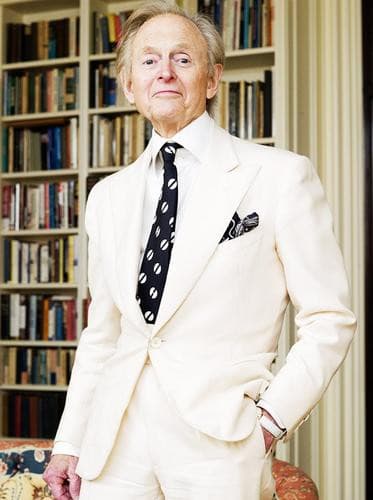
Thomas Kennerly Wolfe Jr. was an American author and journalist widely known for his association with New Journalism, a style of news writing and journalism developed in the 1960s and 1970s that incorporated literary techniques. Much of Wolfe's work was satirical and centred on the counterculture of the 1960s and issues related to class, social status, and the lifestyle of the economic and intellectual elites of New York City.







