“Children are dying. The world is bleeding. And you stand here, talking of honour?”
— Fiddler's internal thoughts on the futility of traditional military honour in the face of immense suffering.

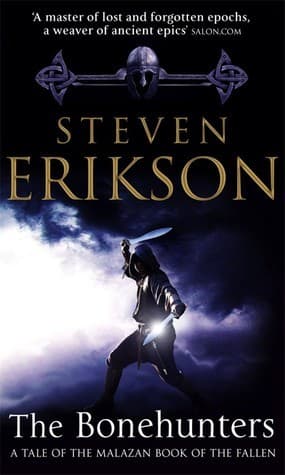
Steven Erikson (2006)
Genre
Fantasy
Reading Time
2000 min
Key Themes
See below
Sign in to track this book
As rebellion's remnants cling to a cursed city, gods draw knives in a cosmic war, their celestial blood set to spill into the mortal realm and change existence.
The Malazan 14th Army, led by High Fist Sengar and Adjunct Tavore Paran, approaches Y'Ghatan, the last rebel stronghold led by Leoman of the Flails. The city is grim for Malazans, as it was where Dassem Ultor died and the Empire suffered a huge defeat. The army, tired from the campaign, is worried about the coming siege. Tavore, seemingly distant, leads with firm resolve, while her officers, like Captain Kindly and Sergeant Hellian, deal with troop morale and the city's dark history. Unknown to most, the Claw, led by Pearl, are also there, pursuing their own goals.
Fiddler, Kalam, Apsalar, and Cutter arrive at Y'Ghatan, drawn by their own paths. Fiddler, now a sapper in the 14th Army, reunites with old Bridgeburner comrades in Tavore's forces. Kalam, on a mission for Empress Laseen, watches the siege, his loyalty always tested. Apsalar, driven by her own mysterious goals and Cotillion's lingering influence, guides Cutter, who struggles with his identity as a killer. Their presence adds layers of intrigue and personal stakes to the situation, as they face war's harsh realities and the manipulative forces at work.
During the siege, Leoman of the Flails uses a devastating tactic: setting Y'Ghatan on fire with oil-soaked streets. The Malazan forces, trapped in the burning city, fight for survival against both the flames and the remaining rebels. Fiddler and his sappers help create escape routes and protect comrades. Many Malazan soldiers die in the fire, and the retreat becomes a desperate, chaotic escape. Tavore's resolve is tested as she sees her army decimated, while Leoman and his remaining followers escape the burning city, leaving destruction behind.
After the disastrous siege of Y'Ghatan, the weakened 14th Army, now called the Bonehunters, begins a hard march across the Glass Desert, chasing Leoman. The harsh environment, exhaustion, and low supplies push the soldiers to their limits. Tavore's leadership is questioned by her tired troops, though her resolve remains. Leoman, despite his Y'Ghatan victory, also struggles, his forces depleted and his belief wavering. The chase becomes a test of endurance and will, with both sides suffering heavy losses in the desolate land.
Heboric Ghost Hands, with Mappo Runt and Icarium, goes on a journey to the Refugium to cleanse himself of the Crippled God's influence and retrieve his old companion's soul. Their journey is dangerous, as they meet the destructive Jade Giants, celestial beings drawn to the Crippled God's presence. Heboric struggles with his past and his cursed hands, while Mappo continues watching over Icarium, whose suppressed rage threatens to erupt. Their path links with the larger conflict around the Crippled God, showing the cosmic stakes involved.
Leoman of the Flails, trapped and desperate, decides to make a final stand against the chasing Bonehunters in the Glass Desert. The battle is fierce, fought in the harsh terrain. The Bonehunters, though battered, fight with renewed determination, driven by loyalty to Tavore and a desire for revenge. Leoman, despite his fanaticism, shows signs of weariness and doubt. The conflict is a brutal display of attrition, with both sides suffering heavy casualties. Leoman is defeated, but his sacrifice shows the pointlessness and cost of the rebellion.
Heboric, Mappo, and Icarium reach the Refugium, a hidden realm of ancient races and powerful beings. Here, Heboric seeks to face the Crippled God's lingering influence and find spiritual release. They meet various mysterious figures, including the Forkrul Assail, who guard the Refugium. Icarium's true nature as a T'lan Imass is revealed, and his immense power becomes a main concern. Mappo's long-held secret, his role in stopping Icarium from unleashing his destructive fury, comes to light, leading to a painful confrontation between the two friends.
The Crippled God's influence spreads beyond the Glass Desert, appearing as a sickness affecting mortals and gods. His entry into the Malazan pantheon creates a split among the gods, forcing them to choose sides in a coming cosmic war. We see his growing power and the suffering he endures, which in turn feeds his malice. The effects of his presence are felt by characters like Heboric, who is deeply tied to his fate, and through the increasingly erratic behavior of various ascendants. The story stresses the catastrophic potential of his suffering.
As the Bonehunters continue their journey, Tavore Paran's true mission slowly becomes clear. Her actions, at first seen as cold and distant, are shown to be part of a larger, more secret goal, planned by figures like Laseen and possibly the Empress herself. Crushing the Seven Cities rebellion was only a first step. Her firm focus, the seemingly suicidal nature of her initial orders, and her willingness to sacrifice her soldiers point to a goal beyond normal warfare. The implications of this hidden agenda raise questions about loyalty, sacrifice, and the true nature of power in the Malazan Empire.
Karsa Orlong, the Toblakai warrior, continues his brutal and philosophical journey, seeking to define his own freedom and challenge the gods. He travels through various lands, meeting different cultures and facing his changing understanding of justice and power. His interactions with other characters, including Samar Dev, make him think about his past actions and the results of his immense strength. Karsa's story often contrasts with the larger conflicts, showing individual agency and the fight against outside control, whether mortal or divine. His path is one of strong self-assertion and a refusal to be a pawn in anyone's game.
The Bonehunters, after their difficult journey, return to the damaged lands of Seven Cities. The region is still recovering from the rebellion and the Whirlwind Goddess's devastating influence. They encounter pockets of resistance, desperate survivors, and the lingering spiritual effects of the conflict. The return forces the soldiers to face the true cost of their victory and the desolation left behind. This part stresses the cyclical nature of conflict and the ongoing suffering of the land and its people, even after the 'war' has officially ended. The past echoes through the present, shaping their future.
Kalam's mission to assassinate Empress Laseen, an order from a secret faction, becomes more complex. He meets agents of the Claw, the Empress's elite assassins, who are themselves divided in their loyalties. His journey involves navigating complex political networks and facing former comrades. Kalam's inner struggle between his past as a Bridgeburner and his current role as an assassin for hire is central to his story. The narrative reveals the deep conspiracies within the Malazan Empire and the morally ambiguous nature of those who hold power, forcing Kalam to make hard choices about whom he truly serves.
Ancient and powerful beings, long asleep or hidden, begin to stir and are drawn into the growing cosmic war. The Forsaken, powerful Ascendants tied to the Crippled God, appear and use their influence, often with terrible results. Jaghut figures, known for their great power and isolation, also appear, some as allies, others as enemies. Their involvement shows the vastness of the Malazan world and the deep history that supports current events. These encounters often provide important details about magic, ascendance, and the ancient conflicts that still shape the present.
Mappo Runt's heartbreaking secret is finally revealed: he was told by the Trell to stop Icarium from remembering his past and unleashing his destructive power. This betrayal, born of desperate love and a desire to protect the world, comes out during their time in the Refugium. Icarium, realizing the extent of Mappo's deception, is devastated. The confrontation between them is emotional, showing their deep bond and the painful choices Mappo had to make. This revelation shatters their friendship, leaving both characters broken and alone.
The plans of various gods and ascendants, combined with the suffering of the Crippled God, lead to his chains weakening significantly. This event signals a major shift in the cosmic balance, as the possibility of his full, uncontrolled power being unleashed on the mortal world becomes a terrifying reality. The implications are catastrophic, promising an unprecedented war among the gods and a reshaping of existence. This moment sets the stage for future conflicts, stressing the grave danger posed by the Crippled God's suffering and the desperate measures needed to contain him.
The Protagonist
Tavore begins as a mysterious, seemingly ruthless commander and slowly reveals a deeper, more compassionate, and world-saving purpose behind her actions.
The Protagonist
Fiddler continues to grapple with the loss of his old unit while finding a new sense of purpose and leadership within the Bonehunters.
The Protagonist
Kalam's mission to assassinate Laseen forces him to confront his past and choose where his true loyalties lie, evolving from a detached agent to a more morally engaged individual.
The Supporting
Apsalar continues to shed the remnants of Cotillion's influence, becoming more self-possessed and defining her own moral compass.
The Supporting
Cutter grapples with the moral implications of his past as a killer, striving to find a new identity and purpose beyond violence.
The Supporting
Heboric continues his arduous pilgrimage to cleanse himself of the Crippled God's curse, seeking spiritual release and reconciliation with his past.
The Supporting
Mappo's long-held secret about Icarium is revealed, leading to a heartbreaking betrayal that shatters their bond and forces him to confront his choices.
The Supporting
Icarium slowly regains fragments of his memories, leading to the devastating revelation of Mappo's betrayal and the re-emergence of his destructive potential.
The Antagonist
Leoman leads a final, desperate stand against the Malazans, ultimately dying for his cause but leaving a lasting impact on his pursuers.
The Supporting
Karsa continues to assert his individuality and challenge the gods, slowly evolving his understanding of power and responsibility.
The novel explores the heavy psychological and moral burdens on leaders, especially Tavore Paran. Her distant yet committed command style forces her to make decisions that cause great suffering and loss, such as the catastrophic siege of Y'Ghatan. This theme questions the idea of 'necessary' sacrifice in war and the ethical compromises needed to reach a larger, often unknown, goal. The cost of leadership is not just strategic, but deeply personal, affecting those who hold it.
“Compassion was a weapon, and in this war, the Adjunct had chosen not to wield it.”
Loyalty is a complex and often changing idea in 'The Bonehunters.' Characters like Kalam and Fiddler struggle with their allegiances to the Malazan Empire, their comrades, and their own codes. The most moving exploration of this theme comes with Mappo's long-held betrayal of Icarium, driven by love and a desperate wish to protect the world. This betrayal highlights the painful choices people make when faced with conflicting loyalties and the devastating impact of such deceptions on even the strongest bonds. The novel asks if loyalty to an ideal or a greater good can justify personal betrayal.
“Love was not a thing to be measured, but a thing to be suffered.”
The novel vividly shows war's brutal and dehumanizing effects, especially through the Malazan 14th Army, the 'Bonehunters.' The siege of Y'Ghatan, the march across the Glass Desert, and constant losses leave soldiers physically and psychologically scarred. Characters like Fiddler carry the weight of past losses and the trauma of seeing terrible events. The story does not shy away from the grim realities of combat, showing how it wears down morale, forces desperate actions, and leaves lasting scars on people and the land, emphasizing the futility and endless suffering in conflict.
“War was a feast for crows, and men were the meat.”
The presence of powerful gods and ascendants in the Malazan world constantly blurs the lines between fate and free will. The Crippled God's growing influence and the split among the gods directly affect mortal lives, yet characters like Karsa Orlong boldly assert their own agency, refusing to be pawns. Heboric's struggle with the Crippled God's curse and Tavore's seemingly divinely-guided mission highlight the intricate dance between divine plans and mortal choices. The novel explores whether mortals can truly make their own destiny or if they are ultimately subject to the whims of higher powers, and the consequences of challenging those powers.
“The gods were not to be trusted. Their games were their own, and mortals were but pieces upon their board.”
Many characters in 'The Bonehunters' are changing and struggling with their identities. Cutter, once Ambassador, grapples with his role as an assassin and seeks a new purpose. Apsalar sheds the remnants of Cotillion's possession, striving to define herself. Even Karsa Orlong, despite his strength, is on a journey of self-discovery, questioning his Toblakai heritage and the meaning of true freedom. These personal quests for identity often happen amid the chaos of war and the influence of powerful external forces, showing the resilience of the human spirit in shaping one's own destiny.
“We are all of us, in the end, nothing more than the sum of our choices.”
A pervasive, destructive cosmic force that drives much of the overarching narrative.
The Crippled God's presence in the Malazan pantheon acts as a central catalyst for the unfolding cosmic conflict. His suffering and the efforts to either appease or exploit him directly impact mortals and gods alike. His influence manifests as a corrupting force, a source of immense power, and a symbol of cosmic injustice. This device creates a sense of impending doom and raises the stakes for every character, as his eventual release or containment could determine the fate of existence. His suffering is a literal weapon, poisoning the world and driving the narrative towards a climactic confrontation.
An ancient, enigmatic race dedicated to 'justice,' whose interventions are often brutal and absolute.
The Forkrul Assail serve as an ancient, powerful, and morally ambiguous force. Their rigid adherence to their own concept of 'justice' makes them unpredictable and terrifying. Their presence often signals a fundamental shift in power dynamics or the arrival of catastrophic judgment. This device introduces a philosophical challenge to conventional morality and highlights the dangers of absolute, uncompromising ideals. Their re-emergence from the Refugium emphasizes the deep history of the Malazan world and the awakening of ancient powers that transcend mortal understanding, further complicating the struggle against the Crippled God.
Magical dimensions and pathways used for travel, power, and the domains of gods.
The Warrens and Holds are essential magical dimensions that facilitate travel, provide sources of magical power, and serve as the domains for various gods and ascendants. They function as a narrative device for rapid movement across vast distances, unexpected encounters, and the manifestation of divine power. Their often perilous nature adds a layer of danger to travel and exploration. The manipulation and control of these warrens are central to both military strategy and magical combat, shaping the possibilities and limitations of characters and events within the Malazan world. They are a constant reminder of the magical underpinnings of reality.
The lingering impact and moral compass of a legendary, almost mythical Malazan unit.
The legacy of the Bridgeburners, a legendary Malazan army unit, serves as a powerful moral compass and a source of both pride and trauma for characters like Fiddler and Kalam. Their reputation for camaraderie, resilience, and a certain anti-authoritarian spirit shapes the actions and loyalties of many. This device provides a consistent theme of loyalty, brotherhood, and the enduring impact of past sacrifices. It also highlights the contrast between the ideals of the Bridgeburners and the harsh realities of the current Malazan Empire, influencing how characters perceive their duty and their place in the world.
Colossal celestial beings, physical manifestations of the Crippled God's influence and suffering.
The Jade Giants are massive, silent celestial bodies that descend upon the world, acting as a direct, physical manifestation of the Crippled God's suffering and his corrupting influence. They are a sign of impending cosmic catastrophe and a potent symbol of the immense, overwhelming power at play. As a plot device, they introduce an element of awe and terror, forcing characters to confront forces beyond their comprehension. Their destructive impact on the landscape and their connection to Heboric's pilgrimage underscore the direct, tangible threat posed by the Crippled God's pain to the mortal realm.
“Children are dying. The world is bleeding. And you stand here, talking of honour?”
— Fiddler's internal thoughts on the futility of traditional military honour in the face of immense suffering.
“There are no easy answers. Only choices. And some of those choices will break you.”
— Reflecting on the difficult decisions faced by characters throughout the campaign.
“History is written by the survivors, and so it is that the dead are always wrong.”
— A bitter observation on the nature of historical record and the fate of the vanquished.
“Compassion is a weapon, and it is wielded by the strong.”
— Karsa Orlong's evolving understanding of strength and empathy.
“The price of peace is not paid in gold, but in blood and tears.”
— A somber reflection on the cost of ending conflict.
“We are all just moments, caught between the past and the future, trying to make sense of the now.”
— A philosophical musing on human existence and the passage of time.
“Hope is a dangerous thing. It can drive men to madness, or to greatness.”
— Considering the dual nature of hope in dire circumstances.
“Sometimes, the only way to save someone is to let them go.”
— A painful realization regarding the limits of intervention and the necessity of personal journeys.
“The world is not fair, and it never will be. But that does not mean we should stop fighting for what is right.”
— A defiant stance against cynicism and a call for continued moral struggle.
“Fear is a choice. And so is courage.”
— A stark reminder of agency in the face of terror.
“To forget is to betray. To remember is to suffer.”
— The dilemma of memory and its associated pain for those who have experienced trauma.
“There is no such thing as a clean war. Only degrees of filth.”
— A cynical but realistic view of the nature of conflict and its inevitable grime.
“The gods are not kind. They are merely powerful.”
— A character's disillusionment with divine benevolence, recognizing raw power instead.
“Every step taken, every word spoken, echoes into eternity.”
— Reflecting on the lasting impact of actions and decisions.
Ready to see how well you understood this book? Take our interactive quiz with 10 questions.

Biography coming soon.







