“The bone collector is a man who collects bones, but not just any bones. He collects the bones of the dead to tell their stories.”
— Early description of the killer's moniker and motive.

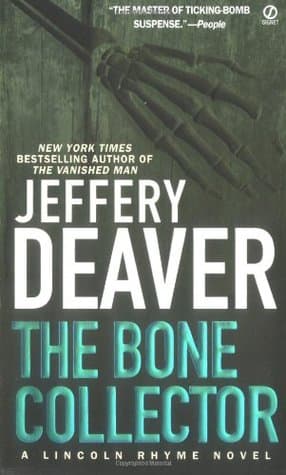
Jeffery Deaver (1996)
Genre
Thriller / Mystery
Reading Time
528 min
Key Themes
See below
Sign in to track this book
A quadriplegic forensic genius, confined to his bed, guides a young detective through New York's streets to decipher clues left by a serial killer who dismembers victims based on a forgotten historical terror.
The novel opens with Lincoln Rhyme, a brilliant but quadriplegic former head of NYPD forensics, considering assisted suicide. His plans stop when his former partner, Detective Lon Sellitto, and his protégé, Detective Jerry Banks, arrive. They present a strange and gruesome case: a wealthy businessman, T.J. Colfax, and his girlfriend, Pamela Sloane, abducted from JFK Airport. Sloane's body is later found in a Queens railyard, her hand posed to point towards a railway signal, wearing a diamond ring that is not hers. The scene is arranged with seemingly minor clues, confusing traditional police methods. Sellitto, desperate, asks for Rhyme's expertise, despite his physical state and initial reluctance.
Lincoln Rhyme, seeing the unique nature of the crime scene and the killer's carefulness, agrees to consult. He requires a dedicated crime scene investigator to collect evidence under his instruction. Detective Amelia Sachs, a young patrol officer with PTSD after a shooting, is the first on the scene where Pamela Sloane's body is found. Her carefulness and sharp observations, despite her distress, impress Rhyme. Despite her doubts about being 'eyes' for a bedridden man, Sachs is assigned to Rhyme, becoming his link to the physical investigation. Their first interactions are tense due to Rhyme's demanding nature and Sachs's inexperience with forensic collection.
The media names the killer 'The Bone Collector.' He abducts and murders another victim, college student Colin Stanton, found drowned in the East River. The crime scene is again carefully arranged with obscure clues: old rope, a specific type of sand, and a piece of a historical map. Rhyme, working from his bed, guides Sachs through collecting these small pieces of evidence. Using his deductive reasoning and knowledge of forensics and New York history, Rhyme begins to understand the killer's method: he uses historical New York City crime scenes and landmarks as a guide, recreating elements from a forgotten era to stage his murders.
As the investigation continues, Rhyme and Sachs, with Sellitto and Banks, realize the killer leaves clues that are not random objects but historical artifacts or references to obscure New York City history. Each victim connects to a specific historical event or location, often a past crime or tragedy. The killer is not just murdering; he stages elaborate, old-fashioned scenes. Rhyme deduces the killer uses an old, out-of-print book about New York City's forgotten past as his guide, targeting people who, in some way, represent these historical events. This discovery helps Rhyme predict the killer's next moves and the types of clues he might leave.
The team finds a pattern: the killer targets victims who have offended him or represent something he dislikes. They also realize the killer uses a specific antique railroad lantern as a signature. Through analysis of collected evidence – soil samples, fibers, insect fragments, and historical documents – Rhyme narrows the killer's operating area and builds a psychological profile. Sachs, overcoming her initial hesitation, becomes good at forensic collection, often anticipating Rhyme's needs and showing a natural talent for the work. Their professional relationship grows, marked by mutual respect despite Rhyme's demanding ways and Sachs's increasing confidence.
The Bone Collector, sensing the police are near, becomes bolder. He abducts another victim, a young girl, and stages a scene in a disused slaughterhouse. During the investigation of this scene, the killer, disguised as a taxi driver, tries to abduct Amelia Sachs. Sachs escapes, but the encounter shakes her and strengthens her resolve to catch the killer. This personal attack makes the investigation more urgent for both Rhyme and Sachs. The killer leaves a key clue at this scene: a piece of a unique, antique map, which Rhyme identifies as a rare map of old New York's sewer system, showing the killer's knowledge of the city's hidden places.
By cross-referencing historical records, the map fragment, and the killer's targets, Rhyme makes a breakthrough. He realizes the killer's identity: Richard Thompson, a former forensic specialist who worked under Rhyme years ago. Thompson, who became quadriplegic in a car accident, resented Rhyme's perceived lack of sympathy and his own ruined life. The clues at the crime scenes are not just historical references but personal taunts, aimed at Rhyme, showing Thompson's desire for revenge and to prove himself better. This realization deeply shocks Rhyme, who feels responsible for Thompson's turn.
Having identified Thompson, the team rushes to catch him. However, Thompson, anticipating their moves, gets into Rhyme's secured Upper West Side brownstone. He disables the security and enters Rhyme's room, intending to murder him and complete his revenge. A tense standoff follows, with Rhyme, despite his paralysis, using his mind and limited tools to outwit Thompson. Sachs, rushing back to Rhyme's house after a feeling, arrives in time to confront Thompson, creating a dangerous three-way confrontation in Rhyme's bedroom.
During the intense struggle in Rhyme's bedroom, Thompson tries to kill Rhyme with a knife. Amelia Sachs, showing bravery and quick thinking, steps in. A violent struggle occurs between Sachs and Thompson. Sachs, using her police training and determination, subdues Thompson, eventually shooting him dead. The immediate danger ends, and Rhyme is saved. The Bone Collector case closes, but the events leave a lasting impact on both Rhyme and Sachs. Rhyme, though physically unchanged, has an emotional shift, finding new purpose and respect for Sachs. Sachs finds her calling as a forensic investigator, having proven herself under extreme pressure.
After Thompson's death, Rhyme decides not to pursue assisted suicide. He sees Sachs's role in his survival and the investigation's success, and he sees a future where his mind can still help law enforcement. He offers Sachs a permanent position as his partner on future cases. Sachs, having found her calling and gained respect for Rhyme's brilliance, accepts. The novel ends with their unique partnership, setting the stage for future investigations, with Rhyme as the 'brain' and Sachs as his 'legs and eyes,' ready to tackle crime.
The Protagonist
From a suicidal, bitter recluse, Rhyme finds renewed purpose and a will to live through the intellectual challenge of the case and his partnership with Sachs.
The Protagonist/Supporting
From a traumatized patrol officer, Sachs discovers her true calling in forensic investigation and gains confidence, becoming a skilled and respected partner.
The Antagonist
Thompson's character arc is one of escalating madness and a relentless pursuit of revenge, culminating in his violent demise.
The Supporting
Sellitto remains a steadfast and reliable figure, facilitating the investigation and supporting Rhyme and Sachs.
The Supporting
Banks's arc shows him growing in respect for Rhyme's methods and becoming a more integrated part of the investigative team.
The Supporting
Thelma remains a constant, supportive figure, ensuring Rhyme's physical needs are met throughout the intense investigation.
The Supporting
Dr. Berger's role is primarily to frame Rhyme's initial state of mind and his contemplation of assisted suicide.
The Supporting
Thom consistently provides the technical support necessary for Rhyme's investigation.
The Mentioned
Colfax's role is primarily to initiate the plot and establish the killer's modus operandi.
The Mentioned
Sloane's role is to provide the initial crime scene and crucial clues that launch the investigation.
Redemption is central to Lincoln Rhyme's story. Initially despairing and considering assisted suicide due to his quadriplegia, the Bone Collector case gives him a chance to find purpose. His mind, once a source of professional pride, becomes his only tool for survival and justice. Through his work with Amelia Sachs, he rediscovers his worth and a reason to live, moving past his physical limits to a future where he can still contribute. This is clear in his decision to abandon suicide plans and form a lasting partnership with Sachs.
“"He'd found a reason to live, after all. Or rather, a reason to keep living, to keep fighting. The work."”
This theme explores the mind's power over physical limitations. Lincoln Rhyme is trapped in his body, dependent on others for physical needs. Still, his mind stays sharp, a weapon against the killer. The novel contrasts Rhyme's physical vulnerability with his mental strength. Amelia Sachs is his physical extension, the 'body' that carries out Rhyme's 'mind's' commands. The killer, Richard Thompson, mirrors Rhyme's physical state but shows the destructive side of a brilliant mind consumed by bitterness and revenge, highlighting this theme's duality.
“"His body was a ruin, a sarcophagus of flesh and bone. But his mind... his mind was a weapon."”
Richard Thompson's motive as the Bone Collector is based on obsession and revenge. His murders are not just violence but a game meant to taunt and punish Lincoln Rhyme, whom he blames for his own paralysis and ruined life. Thompson's obsession with Rhyme's past cases and his desire to prove his intellectual superiority drives his crimes, making him a mirror of Rhyme's brilliance, but corrupted by malice. This theme shows the destructive power of unresolved grievances and personal vendettas.
“"He'd known this would be a game, a challenge. But he hadn't known it was a personal one."”
The relationship between Lincoln Rhyme and Amelia Sachs is a main part of the story. Their partnership starts with reluctance and tension, but quickly becomes one of deep mutual respect and reliance. Rhyme, the brilliant but immobile mind, depends on Sachs, his 'eyes and ears,' to accurately collect and interpret forensic evidence. Sachs, initially overwhelmed, learns to trust Rhyme's judgment and gains confidence in her own skills, becoming an essential part of the team. Their collaboration shows the power of complementary skills and trust forged under pressure.
“"She was his hands, his legs, his eyes. And he, in turn, was her guide, her mentor, her anchor."”
The killer's methods directly show this theme. The Bone Collector recreates parts of forgotten New York City history, especially obscure crimes and legends, to stage his murders. The clues he leaves are often historical artifacts or references, making Rhyme and Sachs look into the city's past to understand the present danger. This adds an intellectual challenge to the mystery and suggests that unresolved historical traumas or forgotten injustices can reappear in terrifying ways, influencing current events and people.
“"The killer was a ghost, pulling threads from the past to weave a tapestry of death in the present."”
A physically confined genius who solves crimes through remote direction.
This is the central conceit of the novel. Lincoln Rhyme's quadriplegia forces him to rely solely on his intellect and the observations of others. This device creates immense narrative tension as Rhyme cannot physically intervene or even visit crime scenes. It necessitates the creation of a unique partnership with Amelia Sachs, who acts as his physical proxy, translating his instructions into action. This limitation also amplifies Rhyme's psychological depth, showcasing his frustration, brilliance, and ultimate resilience. It forces the reader to experience the crime scenes through detailed verbal descriptions and the meticulous collection of minute evidence, emphasizing the power of forensic science over direct engagement.
Crime scenes as elaborate puzzles designed to challenge the investigators.
The Bone Collector's signature is his highly theatrical and meticulous arrangement of crime scenes. These are not random acts of violence but carefully staged tableaux, replete with obscure historical clues, specific objects, and symbolic poses. This device serves multiple functions: it highlights the killer's brilliance and psychological complexity, it provides the 'puzzle' that only Rhyme's mind can solve, and it forces the investigators to look beyond the obvious, paying attention to the tiniest details. Each scene is a message, a taunt, and a piece of a larger historical narrative that the killer is recreating.
Amelia Sachs acting as Rhyme's physical conduit to the outside world.
This device is intrinsically linked to Rhyme's quadriplegia. Amelia Sachs functions as Rhyme's physical extension, his 'eyes and ears' at the crime scenes. She must relay every detail, no matter how minute, back to Rhyme, who then processes the information. This creates a unique dynamic where the reader experiences the crime scenes through Sachs's observations, filtered through Rhyme's interpretive genius. It emphasizes the importance of communication, trust, and precise descriptive language in their partnership, transforming a potentially passive role into an active, indispensable one.
Using forgotten New York City history as a key to the killer's motives and locations.
The killer's reliance on obscure New York City history and forgotten lore is a crucial plot device. Each crime scene is linked to a specific historical event, landmark, or legend, often from an old, rare book. This device provides a unique layer of intellectual challenge to the mystery, requiring Rhyme's extensive knowledge and research to decipher the killer's patterns. It also immerses the reader in the rich, often dark, history of New York, making the city itself a character in the investigation and adding depth to the killer's twisted logic.
“The bone collector is a man who collects bones, but not just any bones. He collects the bones of the dead to tell their stories.”
— Early description of the killer's moniker and motive.
“I'm not a cripple. I'm a quadriplegic. There's a difference.”
— Lincoln Rhyme correcting someone about his condition.
“The evidence is everything. It never lies.”
— Rhyme emphasizing forensic science.
“Sometimes the smallest detail can solve the biggest crime.”
— Rhyme explaining his investigative philosophy.
“Fear is a tool. Use it, don't let it use you.”
— Rhyme advising Amelia Sachs.
“The city is a living organism, and every crime is a symptom of its disease.”
— Reflection on New York City's criminal landscape.
“You don't need legs to chase a killer. You need a mind.”
— Rhyme asserting his capabilities despite paralysis.
“The dead have no secrets, only the living do.”
— Comment on uncovering truths through forensics.
“Every killer leaves a signature. You just have to know where to look.”
— Discussing criminal profiling.
“Pain is temporary. Evidence is forever.”
— Rhyme pushing through physical discomfort.
“In this city, you're either the hunter or the hunted.”
— Observation on the thriller's setting.
“The truth isn't always pretty, but it's always necessary.”
— Emphasizing the importance of uncovering facts.
“A mind in chains can still be free to solve puzzles.”
— Rhyme's perspective on his confinement.
“Don't mourn the victims. Solve their murders.”
— Rhyme's pragmatic approach to crime-solving.
Ready to see how well you understood this book? Take our interactive quiz with 10 questions.

Biography coming soon.







