“The most important things are the hardest things to say. They are the things you get ashamed of, because words diminish them.”
— Reflection on the difficulty of expressing deep emotions and truths.

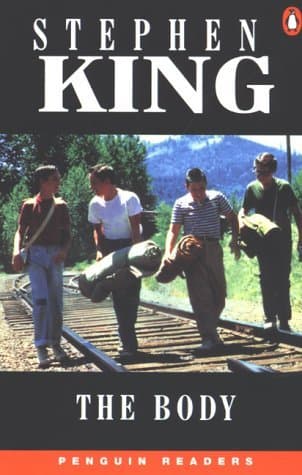
Stephen King (1988)
Genre
Thriller / Mystery / Young Adult
Reading Time
90 min
Key Themes
See below
Sign in to track this book
In the summer of 1960, four boys go into the woods of Maine to find a dead body, uncovering truths about life, death, and friendship that change them forever.
The story, narrated by the adult Gordie LaChance looking back, introduces his childhood friends in Castle Rock, Maine, during the summer of 1959. There is Chris Chambers, the tough leader from a notorious family; Teddy Duchamp, eccentric and hearing-impaired; and Vern Tessio, overweight and timid. They spend their days in their treehouse, playing cards, telling stories, and smoking stolen cigarettes. Gordie, feeling overshadowed by his recently deceased older brother Denny, often retreats into his own thoughts and writing. Their summer is a mix of boredom and the typical adventures of boys on the cusp of adolescence in a small, isolated town. This occurs alongside underlying tensions from their working-class families and the town's social hierarchy.
One hot afternoon, Vern Tessio, while digging for a jar of pennies he buried years ago, overhears his older brother, Billy Tessio, and his friend Charlie Hogan discussing Ray Brower's recent disappearance. Ray was a boy from a nearby town. They say Billy saw Ray's body beside the railroad tracks after he was hit by a train, but they did not report it because they were driving a stolen car. Vern shares this with Gordie, Chris, and Teddy in their treehouse. The boys, driven by morbid curiosity, the desire to be heroes, and the hope of gaining local fame, decide to find Ray Brower's body themselves. They pack supplies, including food, sleeping bags, and a compass, and set out on their journey.
The four friends begin their long walk along the railroad tracks, heading towards the area where Vern's brother claimed to have seen the body. Their journey is filled with both camaraderie and growing pains. They share their food, tell jokes, and discuss their hopes and fears. During this part of the trip, Chris tells Gordie he wants to escape his family's reputation and become something more, perhaps even a lawyer. Gordie, still dealing with his parents' neglect after Denny's death, finds comfort in Chris's friendship and shared vulnerability. They face minor problems, like a close call with a train and the exhaustion of the long walk, but their determination to find the body keeps them going.
As the boys continue their trek, they pass through the local junkyard, owned by Milo Pressman, a man known for his vicious dog, Chopper. Teddy, known for his recklessness and a deep anger from his abusive father, taunts Milo and tries to jump the fence into the junkyard. Milo, enraged, calls Teddy's father a 'loony' and insults his war service, which causes Teddy to become violently angry. Chris and Gordie have to physically restrain Teddy to prevent a serious fight. This incident shows Teddy's volatile nature, his deep loyalty to his father despite the abuse, and the underlying pain that drives his often erratic behavior. It reminds them of the harsh realities of their lives.
After hours of walking, the boys decide to cool off in a murky pond near the tracks, despite their initial hesitation. They strip down and jump in, enjoying the momentary relief from the heat. However, their relaxation quickly turns to horror when they discover their bodies are covered in blood-sucking leeches. Panicked, they scramble out of the water, trying to pull the leeches off. Vern and Teddy are particularly distressed, while Gordie and Chris try to help. The experience is disgusting and terrifying, leaving them shaken and covered in small wounds. This scene shows the unpredictable dangers of their journey and the raw, sometimes grotesque, aspects of nature.
As night falls, the boys set up a makeshift camp in the woods beside the tracks. They build a fire, share stories, and eat their remaining food. The conversation becomes more personal and thoughtful. Chris, in a vulnerable moment, admits his fear of being trapped by his family's reputation and his desire to break free. He tells Gordie about his dream of going to college. Gordie, in turn, shares his feelings of invisibility and grief over his brother's death, and his love for writing. The shared experience strengthens their bonds, allowing them to express their anxieties about their futures and the harsh realities of their small town. This builds solidarity and mutual understanding.
The next morning, after a restless night, the boys resume their journey. After several more miles, they find Ray Brower's body in a clearing beside the tracks. He is lying face down, his head clearly deformed from the train impact. The sight is shocking and disturbing, far more gruesome than they had imagined. The reality of death hits them hard, removing any romantic ideas of heroism. They stand in stunned silence, their initial excitement replaced by a deep sadness and the grim realization of the boy's fate. The discovery is the end of their quest, but it is a somber, unsettling victory.
Shortly after the boys find Ray Brower's body, Ace Merrill, the leader of the local older toughs, arrives with his gang, which includes Billy Tessio and Charlie Hogan. Ace had also heard about the body and plans to claim it for himself and his gang, hoping to gain notoriety. A tense standoff follows. Ace and his gang demand that Gordie and his friends leave. Chris, surprisingly, stands up to Ace, refusing to back down and saying they found it first. The confrontation gets worse, with Ace pulling a switchblade. Gordie, showing unexpected courage, fires a warning shot into the air with a pistol Chris had stolen from his father, forcing Ace and his gang to retreat, though they threaten future revenge.
After Ace and his gang leave, the four friends decide not to move the body or claim the discovery. They realize that finding Ray Brower and confronting Ace was more important than fame. They report the body anonymously to the authorities later. Exhausted and deeply affected, they begin their long walk back to Castle Rock. The journey has changed them; they are no longer just innocent boys but have faced the harsh realities of life, death, and violence. Their bond is strong, but their childhood innocence has been lost, replaced by a deeper understanding of themselves and the world.
The adult Gordie LaChance thinks about the years after that summer. The four boys drifted apart as they grew older, their paths diverging. Vern and Teddy stayed in Castle Rock, living unremarkable and troubled lives; Vern married young and worked in a lumberyard before dying in a house fire, while Teddy continued his eccentric behavior and eventually died in a car crash. Chris, despite his difficult background, managed to leave Castle Rock, went to college, and became a lawyer, as he had dreamed. However, he was tragically stabbed to death while trying to break up a fight in a restaurant. Gordie, the only one who truly left Castle Rock behind, became a successful writer, always carrying the memories of that summer and the friends he lost.
The Protagonist
From a grieving, insecure boy seeking validation, Gordie grows into a more confident individual who embraces his identity as a writer and finds his voice.
The Protagonist/Supporting
Chris strives to overcome his predetermined social standing, demonstrating surprising intelligence and moral strength, ultimately achieving his dream before his untimely death.
The Supporting
Teddy remains largely static in his eccentric and volatile nature, unable to escape the psychological scars of his upbringing.
The Supporting
Vern remains largely unchanged in his timidity, eventually settling into a conventional, if unremarkable, life in Castle Rock.
The Antagonist
Ace remains a static character, a symbol of unredeemed malice and violence, ultimately leading to his own destructive end.
The Mentioned
As a deceased character, Ray Brower has no personal arc, but his death profoundly impacts the protagonists' development.
The Supporting
As a deceased character, Denny has no personal arc, but his memory and the grief surrounding his death are central to Gordie's emotional journey.
The Supporting
Billy remains a static character, entrenched in the delinquent lifestyle of Ace's gang.
The Mentioned
Milo serves as a static obstacle, his role limited to the junkyard confrontation.
The main theme of 'The Body' is the boys' change from childhood innocence to a harsher understanding of the adult world. Their search for Ray Brower's body makes them face death, violence, and the grim realities of life. This effectively ends their childhood. The journey, filled with both wonder and terror, removes their innocence, changing them forever. Gordie's narration clearly describes this shift, marking the summer of 1959 as the definite end of his and his friends' innocent youth.
“I never had any friends later on like the ones I had when I was twelve. Jesus, does anyone?”
The strong bond between Gordie, Chris, Teddy, and Vern is the emotional center of the story. Their journey shows the power of childhood friendship, marked by shared secrets, mutual support, and loyalty when things are hard. They confide in each other, protect each other, and find strength together. Even as their paths separate in adulthood, the narrator, Gordie, constantly talks about the unique connection they shared during that summer. It shows the lasting impact it had on their lives.
“It was the best of times, it was the worst of times... and it was a time that changed all of us.”
Gordie's personal journey is tied to his grief over his older brother Denny's death and his parents' subsequent emotional neglect. His parents, consumed by sorrow for Denny, largely ignore Gordie, making him feel invisible and unloved. This neglect makes him want recognition and adds to his feeling of isolation, even with his friends. The quest becomes a way for Gordie to find his own value and purpose outside of his family's shadow. His writing becomes an outlet for his unspoken pain and observations.
“My parents loved Denny; they just didn't have much left over for me.”
The story looks at how social class and family reputation can seem to decide one's future in a small town like Castle Rock. Chris Chambers, in particular, struggles against the low expectations placed on him because of his family's history of alcoholism and crime. He wants to break free from this cycle, telling Gordie about his dreams of becoming a lawyer. The ultimate fates of the boys—with Vern and Teddy staying in Castle Rock's lower social class and Chris, despite his efforts, dying tragically—show how difficult it is to rise above one's background.
“I was just a dirty Chambers, and everyone knew it.”
Gordie LaChance, as the adult narrator and a successful writer, presents the entire story as a remembrance. He emphasizes how storytelling can help process trauma, keep memories alive, and make sense of the past. His detailed recounting of the summer of '59 is not just a plot summary but an act of creation. It gives meaning to the events and honors his lost friends. The stories the boys tell each other during their journey, especially Gordie's 'Lard-Ass Hogan' tale, hint at his future profession. They also show how stories shape their understanding of themselves and their world.
“The most important things are the hardest to say. They are the things you get ashamed of, because words diminish them.”
An adult Gordie LaChance narrates the story, looking back on his childhood.
The entire novel is framed by the adult Gordie LaChance, a successful writer, reflecting on the pivotal summer of 1959. This narrative device allows for a mature, retrospective voice that provides insight, foreshadowing, and commentary on the events and characters. The adult Gordie interjects with his present-day thoughts, revealing the ultimate fates of his friends and the lasting impact of their childhood journey, adding layers of poignancy and a sense of inevitable loss to the youthful adventure. It emphasizes memory's role in shaping identity and understanding the past.
The object that drives the plot forward, though its inherent value is secondary.
Ray Brower's deceased body serves as the primary MacGuffin in the story. It is the object that the four boys are searching for, providing the motivation for their arduous journey. While the discovery of the body is the goal, its true significance lies not in the body itself, but in the experiences, character development, and confrontations that the quest for it precipitates. The body forces the boys to confront mortality, violence, and their own fears, transforming them in ways that the mere 'finding' of a body could not achieve on its own.
Represents the path of life, danger, and the journey into the unknown.
The railroad tracks symbolize several aspects of the boys' journey. Literally, they are the path they follow into the wilderness and towards the discovery of the body, representing their linear progression towards a darker understanding of life. Metaphorically, they represent the pre-ordained paths some individuals are forced to follow, the dangers inherent in straying from the 'right' track, and the unstoppable force of fate (like the train that killed Ray Brower). The tracks also evoke a sense of freedom and adventure, but also the potential for destruction and the crossing into unknown, adult territories.
Hints and clues about future events and characters' fates.
King frequently uses foreshadowing, primarily through the adult Gordie's narration. The narrator often alludes to the eventual tragic fates of Chris, Teddy, and Vern, creating a sense of melancholy and inevitability even during the boys' youthful adventures. For example, Chris's dreams of becoming a lawyer and escaping his family's reputation are mentioned with an underlying sadness that hints at his eventual, violent death. This technique heightens the emotional impact of the story, emphasizing the preciousness and fleeting nature of their childhood bond.
“The most important things are the hardest things to say. They are the things you get ashamed of, because words diminish them.”
— Reflection on the difficulty of expressing deep emotions and truths.
“We never know which lives we influence, or when, or why.”
— Observation on the unpredictable impact of our actions on others.
“The world is full of magic things, patiently waiting for our senses to grow sharper.”
— A philosophical musing on perception and wonder in everyday life.
“You can't be careful on a skateboard, man.”
— A character's remark about the inherent risks and freedom in youth.
“The body was far away now, like something seen through the wrong end of a telescope.”
— Description of a character's emotional detachment from a traumatic event.
“Sometimes being a friend means mastering the art of timing. There is a time for silence. A time to let go and allow people to hurl themselves into their own destiny.”
— Advice on friendship and the importance of knowing when to intervene or step back.
“I think that we're all mentally ill. Those of us outside the asylums only hide it a little better.”
— A darkly humorous take on human nature and sanity.
“The trust of the innocent is the liar's most useful tool.”
— A cynical observation on manipulation and innocence.
“We lie best when we lie to ourselves.”
— Reflection on self-deception and its power.
“The place where you made your stand never mattered. Only that you were there... and still on your feet.”
— A message about resilience and perseverance in the face of adversity.
“Time takes it all, whether you want it to or not.”
— A melancholic acknowledgment of the inevitability of change and loss.
“Maybe there aren't any such things as good friends or bad friends—maybe there are just friends, people who stand by you when you're hurt and who help you feel not so lonely.”
— A simple definition of friendship based on support and companionship.
“The only way to keep a secret is to never tell anyone.”
— Practical advice on secrecy and trust.
“You have to be a little crazy to stay sane in this world.”
— A paradoxical view on maintaining sanity in a chaotic world.
Ready to see how well you understood this book? Take our interactive quiz with 10 questions.

Stephen Edwin King is an American author of horror, supernatural fiction, suspense, crime, science-fiction, and fantasy novels. Described as the "King of Horror", his books have sold more than 350 million copies as of 2006, and many have been adapted into films, television series, miniseries, and comic books. King has published over 65 novels/novellas, including seven under the pen name Richard Bachman, and five non-fiction books. He has also written approximately 200 short stories, most of which have been published in book collections.







