“The beautiful, wicked countess, who is not a woman but a vampire, said to me: ‘You are a man. You are a woman. You are a beast.’”
— From 'The Lady of the House of Love,' describing the protagonist's encounter with the vampire countess.

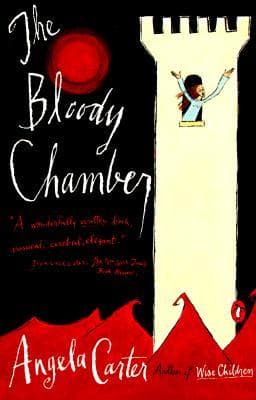
Angela Carter (1979)
Genre
Fantasy
Reading Time
128 min
Key Themes
See below
Sign in to track this book
Angela Carter's 'The Bloody Chamber' luxuriates in the gothic shadows of classic fairy tales, reimagining them with a subversive, sensual darkness that exposes the raw, beating heart beneath familiar fables.
A seventeen-year-old virgin pianist marries a wealthy, older Marquis and travels with him to his isolated, gothic castle. During their honeymoon, the Marquis lavishes her with jewels and attention, but also displays a possessive, almost predatory desire. He gives her a master key, explicitly forbidding her from opening one specific room: the bloody chamber. Driven by curiosity and a growing unease about her husband's past, she eventually succumbs to temptation and enters the room, discovering the gruesome remains of his previous wives, all beheaded. The key, now stained with indelible blood, reveals her transgression. The Marquis returns, discovers her disobedience, and prepares to execute her, but her mother, a formidable and resourceful woman, arrives just in time to save her, shooting the Marquis dead.
A financially ruined merchant, lost in a snowstorm, seeks refuge in a mysterious, opulent mansion. He plucks a single white rose for his youngest daughter, Beauty, from the Beast's garden. The Beast, a melancholy and solitary figure, confronts him, demanding Beauty's presence at his castle as recompense. Beauty, out of filial duty, agrees and lives with the Beast, who treats her with utmost kindness and respect, never forcing himself upon her. She gradually grows fond of him, seeing beyond his monstrous appearance. When her father falls ill, she returns home, promising to come back. However, she lingers, almost forgetting her promise, until she realizes the Beast is dying of a broken heart. She rushes back, confesses her love, and as she kisses him, he transforms into a handsome man.
A young woman, the daughter of an impoverished nobleman, is lost by her father in a game of cards to a wealthy, reclusive Beast. She is taken to his desolate, luxurious castle, where she is attended by silent, automaton-like servants. The Beast, who is revealed to be a tiger-man, desires to see her naked, a request she initially resists. However, she gradually sheds her societal inhibitions and embraces her own wildness. The Beast's valet, an old man, attempts to persuade her to leave, but she refuses. In a pivotal scene, the Beast strips away his own tiger skin, revealing a man beneath, and she, in turn, sheds her human skin, transforming into a tigress to join him, embracing her animalistic nature and true self.
Puss-in-Boots, a flamboyant, cunning, and highly articulate cat, serves an impoverished young man, a former soldier. Puss is a master manipulator, using trickery and deception to elevate his master's social standing. He engineers a series of elaborate schemes, including stealing and framing a rival, to convince the local wealthy merchant that his master is a powerful count. Puss also orchestrates a passionate affair between his master and the merchant's beautiful, sheltered daughter. Through his audacious lies and strategic interventions, Puss ensures his master marries the merchant's daughter, securing their fortune and position. The story is a witty, amoral take on ambition and the power of illusion, with Puss as the ultimate puppet master.
A young woman wanders into a dark, ancient forest, drawn by its mysterious allure. She encounters the Erl-King, a beautiful yet sinister figure who lures young women to their deaths, transforming them into songbirds in cages. He seduces her with his charm and the promise of warmth and comfort, offering her a nest of his own hair. She feels a primal fear and fascination, recognizing his predatory nature. The forest itself seems to conspire with him, its sounds and shadows amplifying her unease. Ultimately, she realizes his true intent to trap her. In a moment of defiant clarity, she strangles him with his own hair, freeing herself from his enchantment and escaping the forest, though forever marked by the encounter.
A Count, riding through a snowy landscape with his Countess, expresses a whimsical desire for a child 'as white as snow, with lips as red as blood, and hair as black as that raven's wing.' Almost immediately, a naked girl fitting this description appears, seemingly born from the snow itself. The Countess, consumed by jealousy, tries to harm the Snow Child. The Count, however, is captivated by her ephemeral beauty and innocence. As quickly as she appeared, the Snow Child begins to melt, leaving behind only a bloody stain on the snow where a rose had been, and a single black feather from her hair. The story is a brief, stark exploration of male desire, female jealousy, and the fleeting nature of perfection.
A young English soldier, a virgin and a rationalist, is traveling through Romania by train. He decides to visit a ruined castle, unaware it is the lair of a beautiful, lonely vampire countess, a descendant of Dracula. The Countess is cursed with eternal life and an insatiable thirst for blood, which she despises. She lives in a state of melancholic despair, surrounded by the decaying opulence of her ancestral home and a garden of dead roses. She attempts to seduce the soldier, but he, innocent and unburdened by her dark history, simply falls asleep in her arms. His purity and lack of fear break her curse, and as dawn approaches, she turns into a mortal woman and dies peacefully, finally freed from her torment.
Wolf-Alice is a wild girl, found abandoned and raised by wolves, who is brought to a convent to be civilized. She is completely feral, acting on instinct, unable to speak, and reflecting no image in mirrors. The nuns struggle to tame her, seeing her as an animal. She is eventually sent to live with the Duke, a reclusive, cursed figure who is a werewolf. Living in the Duke's decaying castle, Wolf-Alice slowly begins to shed her animalistic habits. She observes the Duke's transformations and eventually sees her own reflection in a bloody mirror, a moment of profound self-recognition. Through this, she begins to understand her humanity and the nature of the Duke's curse, learning compassion and self-awareness.
A young, innocent girl, on her way to visit her grandmother, encounters a charming, handsome hunter in the forest. Her grandmother has warned her about wolves, both literal and metaphorical. The hunter challenges her to a race to her grandmother's house, promising a kiss to the winner. He arrives first, kills the grandmother, and disguises himself. When the girl arrives, she notices his strange appearance but, instead of fear, feels a growing sense of attraction and curiosity. She willingly disrobes and lies with him, embracing her own burgeoning sexuality and the wildness within her, transforming into a wolf herself rather than becoming a victim, and finding a new kind of freedom and power.
A young girl lives in a superstitious village surrounded by a dangerous forest where wolves and werewolves are believed to roam. She is sent to her grandmother's house, carrying a basket of food. On her way, she encounters a wolf, which she bravely fends off, cutting off its paw with her axe. She brings the paw home as proof of her encounter. Later, she visits her ailing grandmother and finds her with a bandaged hand. The severed paw she brought home is discovered to be her grandmother's hand, revealing the grandmother as the werewolf. The villagers then execute the grandmother, and the girl inherits her cottage and property, demonstrating a pragmatic and unsentimental approach to survival in a harsh world.
Wolf-Alice, a girl raised by wolves, is brought to a convent but remains wild and unkempt. She is then sent to live with the Duke, a reclusive werewolf. Initially, she is a creature of instinct, unable to comprehend human concepts like reflection or shame. Her transformation begins subtly as she observes the Duke's nightly struggles with his curse. One night, after the Duke has torn himself in his wolf form, she finds a shard of mirror stained with his blood. Looking into it, she finally sees her own reflection, a moment of profound self-recognition that shatters her animalistic innocence. This act of seeing herself and then tending to the Duke's wounds marks her true awakening to humanity and compassion.
The Protagonist
Transforms from an innocent, submissive bride into a survivor who confronts evil and embraces her agency.
The Antagonist
Remains static in his evil, ultimately meeting a violent end.
The Protagonist
Learns to value inner kindness over outward beauty, breaking a curse through genuine affection.
The Supporting
Transforms from a beastly figure into a human man through Beauty's love.
The Protagonist
Remains consistently cunning and amoral, successfully elevating his master's status.
The Antagonist
Remains a static predatory force, ultimately defeated by his victim's defiance.
The Protagonist
Finds release from her vampiric curse and achieves peaceful death through the purity of an innocent soldier.
The Protagonist
Evolves from a feral creature into a self-aware, compassionate human being.
The Protagonist
Transforms from an innocent girl into a powerful, self-possessed woman who embraces her animalistic nature.
Carter frequently challenges the traditional portrayal of innocent, passive heroines in fairy tales. Her female protagonists often move beyond victimhood to exert their own agency, often through embracing their sexuality or their 'animalistic' nature. In 'The Bloody Chamber,' the young bride's mother saves her, subverting the damsel-in-distress trope. In 'The Company of Wolves,' the girl doesn't fear the wolf but instead embraces her own wildness, transforming into a wolf herself, a powerful act of self-possession. This theme explores how women find power by rejecting societal expectations of purity and submission.
“She was not afraid of wolves, for she knew that the wolf is always in the forest, living there in the darkness of the trees, and that the only way to avoid him is to stay out of the forest.”
Many stories blur the lines between human and animal, exploring what it truly means to be a 'beast' or 'human.' Carter often suggests that savagery and civility are not mutually exclusive, and that true humanity can be found in unexpected places. In 'The Courtship of Mr Lyon' and 'The Tiger's Bride,' the monstrous Beasts are shown to possess more tenderness and integrity than many human characters. Conversely, 'The Bloody Chamber' reveals the Marquis's refined exterior hides a truly bestial cruelty. 'Wolf-Alice' directly tackles the journey from animalistic instinct to human self-awareness, suggesting that humanity is a learned state.
“Is she a wolf? Is she a child? The nuns would beat her to make her say 'amen.'”
Carter boldly reclaims and redefines female sexuality, often portraying it as a source of power rather than shame or vulnerability. The stories are steeped in sensuality, exploring both the liberating and dangerous aspects of desire. In 'The Bloody Chamber,' the Marquis's predatory sexuality is horrifying, but the bride's burgeoning awareness of her own body is a key part of her awakening. In 'The Tiger's Bride,' the protagonist's transformation into a tigress is an embrace of her primal, uninhibited desire. The collection challenges puritanical views, presenting female sexuality as a complex, potent force.
“The secret of his extraordinary powers was that he had a lady's hand; but she no longer possessed the hand of a lady.”
Carter masterfully employs gothic elements – decaying castles, dark forests, isolated settings, and supernatural undertones – to create an atmosphere of dread and heightened emotion. The grotesque is used to shock and disturb, highlighting the darker aspects of human nature and the unsettling beauty of the macabre. The bloody chamber itself, with its gruesome display of headless wives, is the quintessential gothic image. The transformation scenes, like the Beast shedding his skin or Wolf-Alice seeing her reflection, often contain elements of the grotesque that are simultaneously terrifying and revelatory.
“The castle is a gloomy, magnificent place, and the Marquis is its bloody lord.”
Carter's entire collection is a testament to the enduring power of fairy tales and myths, even as she deconstructs and reconstructs them. She uses familiar narratives as a foundation, then twists them to expose their underlying psychological, social, and sexual implications. By retelling these stories, she reveals how myths shape our understanding of gender, power, and desire, and how they can be reinterpreted to reflect contemporary concerns. The act of retelling itself becomes a powerful tool for challenging established narratives and creating new meanings.
“All stories are born from other stories.”
Used to represent self-awareness, identity, and the gaze.
Mirrors and reflections are recurring motifs, particularly in 'Wolf-Alice' and 'The Tiger's Bride.' In 'Wolf-Alice,' the inability to see her reflection initially signifies her lack of human self-awareness. Her eventual recognition of herself in a bloody mirror marks her transition to humanity. In 'The Bloody Chamber,' the mirror reflects the bride's transformation and complicity. This device explores how characters perceive themselves and are perceived by others, often linking identity with visual representation and the gaze.
Represents hidden truths, repressed desires, and patriarchal control.
Most prominently featured in 'The Bloody Chamber,' this device symbolizes the husband's darkest secrets and the patriarchal boundaries imposed upon women. It is a space of hidden knowledge and danger, tempting the protagonist to transgress. Her entry into the chamber is an act of defiance, leading to a terrifying revelation. Metaphorically, it can also represent the hidden aspects of a relationship or the repressed desires within the self that, once explored, lead to profound and often dangerous truths.
Explores the blurring of human and animal, and the embrace of primal nature.
A central device, particularly in 'The Company of Wolves,' 'The Tiger's Bride,' and 'Wolf-Alice.' This transformation is not always a curse, but often a liberation or an embrace of an authentic, primal self. It challenges the conventional divide between human and animal, suggesting that savagery and instinct are inherent parts of human nature, especially female nature. It allows characters to shed societal constraints and embody a raw, powerful identity, often linked to sexuality and freedom.
Establishes an atmosphere of mystery, dread, and heightened emotion.
Carter frequently uses classic gothic settings – isolated castles ('The Bloody Chamber,' 'The Courtship of Mr Lyon'), dark, enchanted forests ('The Erl-King,' 'The Company of Wolves'), and decaying mansions ('The Lady of the House of Love'). These settings are not just backdrops; they are active elements that amplify themes of confinement, fear, sexual tension, and the supernatural. They create a sense of unease and foreboding, contributing to the stories' dark, sensual, and often terrifying atmosphere, immersing the reader in a world where logic is often superseded by primal forces.
Reimagines and subverts traditional fairy tale narratives.
The entire collection is built upon the device of intertextuality, directly referencing and retelling classic fairy tales like 'Beauty and the Beast,' 'Little Red Riding Hood,' and 'Bluebeard.' Carter uses these familiar frameworks to both evoke a sense of the archetypal and to deliberately subvert expectations. By twisting known narratives, she forces readers to re-examine the original stories' latent meanings, particularly concerning gender roles, sexuality, and power dynamics, offering radical new interpretations.
“The beautiful, wicked countess, who is not a woman but a vampire, said to me: ‘You are a man. You are a woman. You are a beast.’”
— From 'The Lady of the House of Love,' describing the protagonist's encounter with the vampire countess.
“For the Lord has an insatiable appetite for pain.”
— From 'The Bloody Chamber,' reflecting on the Marquis's sadistic desires.
“The lamb must learn to run with the tigers.”
— From 'The Company of Wolves,' spoken by the grandmother, advising her granddaughter.
“My father said he loved me, but he never said I was beautiful.”
— From 'The Bloody Chamber,' the narrator reflecting on her father's affection.
“Fear and a little shame, and a good deal of curiosity.”
— From 'The Bloody Chamber,' describing the narrator's feelings upon entering the forbidden room.
“He was a carnival; the chapbook hero; the beau ideal of a wolf.”
— From 'The Company of Wolves,' describing the handsome young man who is secretly a werewolf.
“The perennial sadness of a girl who is always waiting for a man.”
— From 'The Lady of the House of Love,' describing the countess's eternal existence.
“She was a woman of that impeccable and severe beauty that takes a man’s breath away.”
— From 'The Bloody Chamber,' describing the narrator's mother.
“Can a bird sing only the song it knows or can it learn a new song?”
— From 'The Courtship of Mr Lyon,' a metaphorical question about change and nature.
“She knew she was nobody's meat.”
— From 'The Company of Wolves,' describing the girl's self-awareness and defiance.
“The Devil is a woman.”
— From 'The Erl-King,' reflecting on the deceptive and dangerous nature of the Erl-King.
“She could not bring herself to feel any fear of him, for he was not a wolf, nor a beast, but a man.”
— From 'The Company of Wolves,' the girl's realization about the true nature of danger.
“This is a world that is not so much a place as a state of mind.”
— From 'The Snow Child,' describing the surreal and symbolic landscape.
“He was an excellent provider, but he did not know how to love.”
— From 'The Courtship of Mr Lyon,' describing the Beast's initial character.
Ready to see how well you understood this book? Take our interactive quiz with 10 questions.

Angela Olive Pearce, who published under the name Angela Carter, was an English novelist, short story writer, poet, and journalist, known for her feminist, magical realism, and picaresque works. She is best known for her book The Bloody Chamber, which was published in 1979. In 2008, The Times ranked Carter tenth in their list of "The 50 greatest British writers since 1945". In 2012, Nights at the Circus was selected as the best ever winner of the James Tait Black Memorial Prize.







