“One is not born, but rather becomes, a woman.”
— A foundational statement on gender construction.


Simone de Beauvoir (1948)
Genre
Historical Fiction / Philosophy
Reading Time
240 min
Key Themes
See below
Sign in to track this book
A Resistance leader, during the Nazi occupation, faces a terrible choice: sacrifice his lover for the cause, or doom others. He must confront the impact of his moral decisions.
The novel begins with Jean Blomart at Hélène Bertrand's hospital bedside. She is dying from injuries from a Resistance mission. Throughout the night, as Hélène weakens, Jean struggles with his responsibility. He leads a Resistance network and personally assigned Hélène to the dangerous mission. This vigil makes him confront the ethical problems of his role: the need to sacrifice individuals for a group cause, and the personal cost of such choices. His thoughts show his struggle to balance his love for Hélène with his commitment to the Resistance. This sets up a deep look at freedom, responsibility, and the justification of violence.
Flashbacks show Jean's privileged but emotionally empty childhood. Born into a wealthy family, he felt distant from their values of comfort. His father, a factory owner, represented everything Jean wanted to avoid. As a young man, Jean chose a path of poverty and manual labor, working in his father's factory and later as a printer. He wanted to understand ordinary people's lives and create an identity free from expected roles. This period shows his early attempts to define himself through action, rather than by passively accepting his circumstances, which hints at his later dedication to the Resistance.
Jean's factory experiences show him the harsh realities of class inequality and worker exploitation. He sees the struggles of his fellow laborers and starts to develop a strong sense of social justice. His intellectual pursuits and talks with friends who shared similar socialist and anti-fascist views further increase this awareness. He comes to believe that individual freedom connects to collective liberation and that not acting against injustice is a form of complicity. This period marks his move from personal rebellion to a political commitment, recognizing how individual lives connect within a larger society.
Jean meets Hélène Bertrand, a young, somewhat lighthearted woman, through mutual friends. Hélène is first drawn to Jean's intensity and commitment, though she struggles to fully understand his deep existential and political concerns. Their relationship grows, marked by Jean's wish for Hélène to find her own real commitment, not just copy his. He wants her to choose freely, but his love for her creates a conflict with his belief in a cause that goes beyond individual happiness. This dynamic highlights the clash between personal affection and the demands of a larger struggle.
As World War II begins and France is occupied by Germany, Jean's political beliefs become a firm resolve to act. He sees the occupation as a clear threat to freedom and human dignity, requiring active opposition. He gets involved in the early Resistance movement, seeing this as the ultimate test of his commitment to others and to his chosen values. The abstract philosophical questions he once considered now have real, life-or-death consequences. He dedicates himself to organizing and leading a Resistance cell, accepting the personal risks and moral compromises such a struggle involves.
Hélène, initially more focused on personal happiness and less political than Jean, slowly starts to understand the seriousness of the situation and the importance of the Resistance. Jean encourages her to make her own free choice, not to follow him without thinking. By seeing the oppression and the bravery of those around her, and perhaps driven by her love for Jean, Hélène decides to join the Resistance. Her commitment is a deep act of self-definition, moving past her earlier passivity to embrace a cause bigger than herself. This decision, though freely made, ultimately leads to her fatal mission.
As a leader, Jean must make difficult decisions, including assigning people to very dangerous tasks. He assigns Hélène to a mission to distribute Resistance propaganda, a task with significant risk. During the mission, Hélène is caught by the Gestapo, captured, and severely wounded. This event is why she is in the hospital, and it is the main focus of Jean's painful thoughts throughout the novel. His direct role in sending her to her death forces him to face the full effects of his leadership and the sacrifices the Resistance demands.
As Hélène's life ends, Jean has an intense internal debate about his responsibility. He acknowledges that he sent her, but he also recognizes Héléne's own free choice to accept the mission. He thinks about how every person's actions, or lack of action, contribute to the shared experience of existence and suffering. He understands that in a world with oppression, no one can be completely innocent; even choosing not to act is a choice with consequences. This philosophical idea underlies his struggle to justify the 'blood of others' shed for a cause he believes in, and the inherent sadness of human freedom.
The night is not just about Hélène's death; it is also about the ongoing struggle. Jean learns that another important Resistance operation is planned for the morning, requiring him to send more people into danger. This immediate demand for more sacrifice increases his internal conflict. He knows that Hélène's death is not an isolated event but a grim example for the choices he must keep making. The novel ends with him having to decide whether to proceed with the next mission, fully aware that he is sending others to a fate potentially as tragic as Hélène's, thus extending the chain of responsibility and sacrifice.
As morning nears and Hélène finally dies, Jean finds a grim resolution. He accepts that the fight against oppression continues and requires constant commitment, even at great personal cost. He decides to keep leading the Resistance, understanding that the 'blood of others' will be shed, and that he will carry the burden of those deaths. His decision is not an easy justification but a tragic necessity, a recognition that true freedom and responsibility involve choosing to act in a world where perfect solutions do not exist. The novel ends with Jean returning to the fight, forever changed by his choices.
The Protagonist
From a disillusioned bourgeois individual seeking personal authenticity, Jean evolves into a committed Resistance leader who accepts the tragic burden of sacrificing others for a greater cause.
The Supporting
Hélène transforms from a somewhat apolitical individual to a committed Resistance fighter, making a free choice that leads to her ultimate sacrifice.
The Supporting
Remains steadfast in his commitment to the Resistance, serving as a reliable and practical counterpart to Jean's philosophical introspection.
The Mentioned
No specific arc, serves as a static symbolic figure representing Jean's past.
The Mentioned
No specific arc, serves as a static symbolic figure representing Jean's past.
The Supporting
Remains committed to the Resistance, a steady presence in the background of the struggle.
The Mentioned
No specific arc, her mention highlights the widespread impact of the war.
The novel's main theme explores the burden of human freedom. Jean struggles with the idea that every choice, even inaction, affects himself and others. He believes true freedom means making real choices and taking full responsibility for their results, even when those results are tragic. Hélène's decision to join the Resistance, and Jean's decision to send her on a mission, show the existentialist view that people must be free and must create meaning through their actions, accepting the 'blood of others' as a consequence of commitment.
“One is responsible for everything, even for one's desertions.”
The novel directly addresses the moral problems of sacrificing individuals for a greater good. Jean's role as a Resistance leader forces him to send people, including his lover, to their possible deaths. He agonizes over whether such actions can ever be truly justified, looking at the tension between useful outcomes and individual human value. The 'blood of others' refers not only to those killed by the enemy but also to those sacrificed by the Resistance itself, raising questions about the moral purity of any cause that demands such a price. It is a deep examination of means and ends in wartime.
“How many others will I send to their death before morning?”
Jean's journey is a search for a real existence, one defined by his own choices and commitments rather than by inherited status or passive acceptance. He rejects his wealthy background to engage directly with the world and its injustices. Both Jean and Hélène find authenticity by actively committing to the Resistance, moving beyond self-interest to embrace a cause bigger than themselves. The novel suggests that true selfhood is created through action and solidarity with others, even when that commitment leads to suffering and loss.
“To be free is to choose, to invent, to commit oneself.”
The idea of 'the other' is central, emphasizing how human lives connect and the ethical duty towards fellow beings. Jean's political awakening comes from recognizing the suffering of others and his responsibility to act. The title, 'The Blood of Others,' stresses that individual lives are not separate but connected, and that one's actions always affect others. The Resistance movement is shown as an act of solidarity, where people unite against oppression, accepting shared risks and responsibilities for humanity, even as it forces difficult personal sacrifices.
“There are no others. We are all others.”
The relationship between Jean and Hélène shows the conflict between personal love and ideological commitment. Jean loves Hélène deeply but believes that individual happiness must sometimes be less important than a greater cause. He wants Hélène to choose her commitment freely, not just to follow him, which complicates their bond. Their story explores whether love can exist with, or even be strengthened by, shared sacrifice for an ideal, or if it must be compromised by the harsh demands of political struggle. Hélène's death represents the ultimate tragic clash of these two forces.
“I wanted her to commit herself freely, not for my sake.”
Narrative technique revealing Jean's deep philosophical and moral struggles.
The novel is largely driven by Jean Blomart's internal thoughts and reflections as he waits by Hélène's deathbed. This allows the reader direct access to his existential angst, his ethical deliberations, and his philosophical inquiries into freedom, responsibility, and the justification of violence. It blurs the line between past and present, as his memories and present anxieties intertwine, creating a deeply immersive and introspective narrative experience that focuses on the character's moral landscape rather than external action.
Used to provide Jean's backstory and contextualize his present moral dilemma.
Interspersed throughout the vigil, flashbacks reveal Jean's privileged upbringing, his rejection of bourgeois values, his early search for authenticity, and his political awakening. These provide crucial context for understanding his current commitment to the Resistance and the profound weight of his decisions. They show his journey from personal rebellion to collective action, illustrating how his past choices and experiences have shaped the man who now grapples with sending others to their deaths, making his present moral crisis more resonant.
Represents the human cost and moral burden of collective action.
The title itself is a central symbolic device. It refers not only to the literal blood shed by victims of the occupation and Resistance fighters but also to the moral stain and heavy responsibility borne by those who make decisions that lead to such sacrifices. It symbolizes the tragic necessity of human suffering and death in the pursuit of freedom, and the inescapable interconnectedness of individual lives. It encapsulates the core ethical dilemma of the novel: the justification of violence and sacrifice for a greater cause, and the indelible mark it leaves on the conscience of the decision-maker.
A framing device that intensifies the moral and philosophical introspection.
The entire novel is framed by Jean's all-night vigil at Hélène's deathbed. This confined, time-limited setting creates intense psychological pressure and forces Jean into a profound period of introspection. The impending death of his lover, directly caused by a mission he assigned, serves as a powerful catalyst for his moral reckoning. The vigil isolates him, allowing for deep philosophical exploration without external distractions, making the internal conflict the primary 'action' of the story and highlighting the timelessness of his ethical questions.
“One is not born, but rather becomes, a woman.”
— A foundational statement on gender construction.
“Man is a being for whom being is in question insofar as this being is for itself its own being.”
— Exploring the self-awareness and self-creation of human existence.
“To be free is not to have the power to do anything you like; it is to be able to surpass the given toward an open future.”
— Defining freedom not as license, but as the capacity for transcendence.
“The oppressor would not be so strong if he did not have accomplices among the oppressed.”
— Highlighting the role of complicity in maintaining oppressive systems.
“Existence precedes essence.”
— A core tenet of existentialism, asserting that we define ourselves through our actions.
“Every man has to invent his own way.”
— Emphasizing individual responsibility for forging one's path.
“One's life has value so long as one attributes value to the life of others, by means of love, friendship, indignation and compassion.”
— Connecting personal meaning to relationships and empathy.
“The meaning of an action is not determined by its result but by the intention that animates it.”
— Focusing on the internal motivations behind actions rather than just outcomes.
“Every time a man chooses, he chooses for all men.”
— Underscoring the universal implications of individual choices.
“We are condemned to be free.”
— A famous paradox highlighting the burden and responsibility of freedom.
“The present is not a potential past; it is the moment of choice and action.”
— Rejecting determinism and emphasizing the immediacy of human agency.
“One does not love a woman because she is beautiful, but she is beautiful because one loves her.”
— Reversing the conventional understanding of beauty and love, emphasizing subjective experience.
“The root of all evil is the belief that one is separate from all others.”
— Suggesting that egoism and alienation are the source of moral failings.
“Authenticity consists in living one's own truth, in being what one is.”
— Defining authenticity as self-alignment and genuine self-expression.
Ready to see how well you understood this book? Take our interactive quiz with 10 questions.
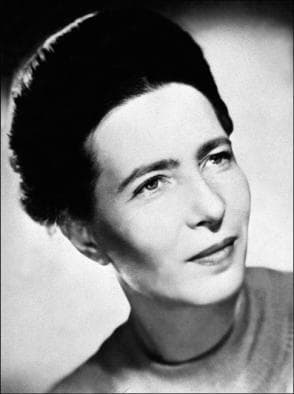
Simone Lucie Ernestine Marie Bertrand de Beauvoir was a French existentialist philosopher, writer, social theorist, and feminist activist. Though she did not consider herself a philosopher, nor was she considered one at the time of her death, she had a significant influence on both feminist existentialism and feminist theory.







