“The blob was coming. And it was hungry.”
— Early realization of the blob's true nature and threat.

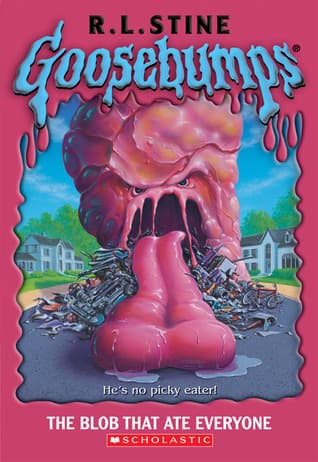
R.L. Stine (1994)
Genre
Fantasy / Children's / Mystery / Science Fiction / Young Adult
Reading Time
90 min
Key Themes
See below
Sign in to track this book
When aspiring horror writer Zackie Beauchamp discovers a mysterious typewriter that brings his monstrous stories to life, his fictional pink blob monster threatens to consume not just his town, but his very reality.
Zackie Beauchamp, an aspiring horror writer, is writing his latest story: a tale about a giant, pink, slimy blob monster that devours a town. He spends his days in his room, surrounded by horror items, typing on his old machine. His best friend, Alex, often teases him about his obsession, but Zackie wants to create a story scary enough to make him famous. He pictures the blob's path through the fictional town of Springville, unaware that his writing is about to become real and dangerous.
While exploring the ruins of a recently burned-down antique store, Zackie finds an old typewriter among the charred remains. Despite its burnt look, it seems to be in good condition. Feeling drawn to it, he decides to take it, believing it could replace his old machine and improve his writing. He brings the heavy, black typewriter home, cleans it, and sets it on his desk, eager to try it for his next writing session.
Zackie begins typing on his new antique typewriter, continuing his blob story. He writes a scene where his younger sister, Sara, is about to spill a glass of milk. Moments later, he hears a crash from the kitchen, followed by Sara's cry. He rushes in and finds Sara standing among spilled milk, just as he had written. He dismisses it as a strange coincidence, thinking it was his imagination, but a hint of unease begins to settle in his mind as he considers the event's timing.
The coincidences continue. Zackie writes about a dog chasing a cat through his yard, and moments later, he sees his neighbor's dog, Sparky, chasing a stray cat outside his window. Later, he describes a tree branch falling onto his house during a storm, and soon after, a loud thud confirms a branch has crashed onto their roof. These events shake Zackie's doubt, making him wonder if the typewriter has some supernatural power, beyond being just a source of ideas.
Unable to ignore the pattern, Zackie decides to test the typewriter's power. He types a description of his monstrous blob appearing in the fictional town of Springville, imagining its size and pink goo. To his horror, a real, pulsating, pink blob begins to appear in his backyard, growing fast and oozing towards the town. Panic sets in as Zackie realizes the danger he has released, not just in his story, but in his actual reality, threatening his home and everyone in it.
The blob, now a huge entity, begins its destructive rampage through Springville, just as Zackie had written. It covers cars, trees, and even small buildings, growing larger with each item it consumes. The townspeople panic, screaming and fleeing. Zackie watches in horror from his window, the full weight of his creation pressing down on him. He knows he is responsible for this chaos and must find a way to stop it before it devours everything and everyone he knows.
Overwhelmed and scared, Zackie tells his best friend, Alex, about the magical typewriter and the living blob. Alex, always practical, is skeptical, at first thinking Zackie's story is a prank or a fantasy. However, when the blob's presence becomes clear, oozing past Alex's own house, Alex finally understands the situation. Together, they realize the danger and the urgent need for a solution, both now facing the monstrous result of Zackie's writing.
Zackie rushes back to the typewriter, trying to write an ending that will make the blob disappear. He types, 'The blob vanished,' but nothing happens. He tries, 'The blob shrank,' but it continues to grow. The pressure builds as the blob gets closer to his house and family. With every failed attempt, his anxiety grows, realizing that simply wishing it away is not enough. He needs to find the perfect words to reverse the terror he unleashed, a task much harder than creating it.
In his panic, Zackie makes a typing error, accidentally writing 'The blob was hungry for words.' Suddenly, the blob pauses its rampage, seemingly drawn to the typewriter. This accidental phrase gives Zackie an idea. If the blob is 'hungry for words,' perhaps the solution is not to make it disappear, but to feed it the right kind of words, or perhaps, words themselves. This unexpected turn offers a glimmer of hope amid the growing crisis.
Acting on his new idea, Zackie types, 'The blob was so hungry, it began to eat itself.' To his surprise and relief, the huge pink blob shudders, then slowly begins to consume its own mass, shrinking quickly. The terrifying creature, which had threatened to engulf Springville, disappears, leaving only a faint, sticky residue. The town is saved, and Zackie and Alex are left breathless, witnessing the undoing of the disaster.
With the blob gone, Springville slowly returns to normal, though the memory of the event remains. Zackie, shaken but relieved, realizes the power and danger of the antique typewriter. He knows he cannot risk using it again, no matter how tempting the idea of creating stories that come true might be. He and Alex decide that the only safe action is to destroy the typewriter, ensuring its reality-altering capabilities can never again threaten their world or anyone else's.
After destroying the antique typewriter, Zackie returns to his passion for writing, but with new respect for the line between fiction and reality. He buys a new, ordinary typewriter, vowing to stick to stories that only exist on paper. He begins a new story, perhaps a less terrifying one, but still with the imaginative flair that makes him a true horror writer. The experience taught him a lesson about responsibility and the power of words, even if they don't literally come true.
The Protagonist
Zackie transforms from an aspiring writer focused on fame to a responsible individual who understands the true power and potential danger of words.
The Supporting
Alex moves from skepticism to belief, becoming a crucial partner in resolving the supernatural crisis.
The Supporting
Sara remains largely unaware of the supernatural cause of events, serving as a catalyst for Zackie's realization of the typewriter's power.
The Antagonist
The Blob is created, grows to immense size, and is ultimately unmade through Zackie's writing.
This theme explores the power of creative thought and written language. Zackie's imagination, amplified by the mysterious typewriter, literally shapes reality. What begins as a harmless horror story becomes a real threat, showing that words can have real-world consequences. The narrative highlights the responsibility that comes with such creative power, as seen when Zackie must carefully write the words to undo the disaster he created.
“Because now every word Zackie writes is starting to come true. . . .”
A core theme is that with great power comes great responsibility. Zackie, at first wanting to write a scary story, quickly learns the severe consequences of his actions when his fictional blob becomes a real threat to his town and family. He must face the direct impact of his creative choices and take responsibility for undoing the chaos he unleashed. The story is a cautionary tale about understanding the potential effects of one's actions, even those seemingly confined to fiction.
“He knew he was responsible for this chaos and must find a way to stop it.”
The novel constantly blurs the lines between what is real and what is imagined. The antique typewriter acts as a link, making Zackie's fictional narratives appear in the real world. This creates a sense of unease, challenging the characters' perceptions of what is possible. The initial 'coincidences' gradually become undeniable reality, forcing Zackie to accept that his stories are no longer confined to the page, making the fantastical concrete.
“But there's something really odd about that typewriter. Something really dangerous.”
Zackie's desire to be a famous horror writer leads him to use the mysterious typewriter, even after strange events occur. This theme explores how ambition and the pursuit of a goal can blind people to dangers. The appeal of having his stories come true is at first exciting, but it quickly turns terrifying when he loses control. The story suggests that while dreams are important, an unchecked desire for power or recognition can lead to unforeseen and disastrous outcomes.
“A famous horror writer. That's what Zackie Beauchamp wants to be.”
An antique typewriter that brings written words to life.
The magical typewriter is the central plot device, serving as the catalyst for all the supernatural events. Discovered in a burned-down antique store, its mysterious origins are never fully explained, enhancing its enigmatic quality. It functions as the direct link between Zackie's imagination and reality, transforming his fictional narratives into tangible occurrences. Its power is both a source of wonder and immense danger, driving the entire conflict of the story and highlighting the theme of the power of words.
Minor events that subtly hint at the typewriter's power before the main conflict.
Before the full horror of the blob is unleashed, the narrative employs foreshadowing through a series of escalating 'coincidences.' Zackie writes about his sister spilling milk, and it happens. He writes about a dog chasing a cat, and it happens. These seemingly minor events build suspense and gradually convince Zackie (and the reader) that something supernatural is at play, preparing them for the much larger and more terrifying manifestation of the blob. This device builds tension and makes the ultimate reveal more impactful.
An unintended action that leads to a crucial breakthrough or realization.
This device is critical when Zackie accidentally types 'The blob was hungry for words' instead of his intended phrase. This mistake, a moment of panic-induced error, ironically provides the key insight needed to defeat the blob. It highlights that solutions can sometimes come from unexpected places or even from errors, rather than deliberate planning. This 'oops' moment serves as a turning point, shifting the narrative from desperate attempts to a focused strategy for resolving the conflict.
“The blob was coming. And it was hungry.”
— Early realization of the blob's true nature and threat.
“It wasn't just a blob. It was an intelligent blob. A very hungry, very intelligent blob.”
— Discovering the blob's unexpected sentience.
“Sometimes you just have to run. And run really, really fast.”
— A moment of desperate escape from the encroaching blob.
“My stomach rumbled. I wondered if the blob's stomach rumbled too. And if so, what kind of food it preferred.”
— A moment of dark humor amidst the terror, wondering about the blob's appetite.
“It was slimy. It was gooey. And it was definitely not friendly.”
— A sensory description of the blob's unpleasant physical attributes.
“We had to stop it. Before it ate... well, before it ate everyone.”
— The protagonists realize the dire stakes and their mission.
“Panic was a terrible feeling, but it was nothing compared to the feeling of being slowly, inexorably, absorbed.”
— Contemplating the horror of being engulfed by the blob.
“The only thing worse than a monster under your bed is a monster that *is* your bed.”
— A playful, yet chilling, thought about the blob's pervasive nature.
“Sometimes the biggest threats come in the most unexpected, and squishiest, packages.”
— Reflecting on the unusual form of the antagonist.
“It wasn't just eating. It was growing. Bigger and bigger, with every bite.”
— Observing the blob's rapid growth as it consumes.
“We needed a plan. A really, really good plan. One that didn't involve becoming part of the blob.”
— The characters strategizing to defeat the monster.
“Even blobs have weaknesses. You just have to be brave enough to find them.”
— A moment of resolve and determination to confront the blob.
“And that's how we saved the world. From a giant, hungry, intelligent blob. Just another Tuesday.”
— A humorous, understated reflection on saving the day.
Ready to see how well you understood this book? Take our interactive quiz with 10 questions.

Biography coming soon.







