“He was a wild thing, born of the wind and the prairie, and he knew nothing of fences or saddles or men.”
— Describing the colt's birth and early nature.

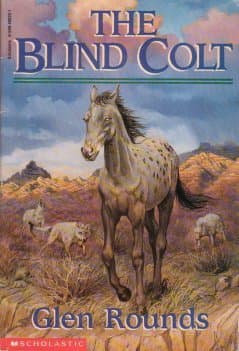
Glen Rounds (1900)
Genre
Children's / Young Adult
Reading Time
90 min
Key Themes
See below
Sign in to track this book
Born blind on the Dakota plains, a courageous wild mustang navigates the prairie's dangers before finding an unexpected connection and purpose with a determined ten-year-old boy.
On the vast, sun-drenched plains of the American West, a wild mustang mare, known for her speed, gives birth to a new foal. From birth, it is clear something is different: he is blind. The mare, protective and attentive, soon realizes how severe his condition is. The other wild horses are wary, sensing his vulnerability. Despite his disability, the blind colt has courage and a strong will to survive, relying heavily on his mother's guidance and his other senses, which quickly sharpen. His early days are a constant struggle against the harsh realities of the wild, where weakness often means death.
The blind colt, whom the narrator often calls 'the colt,' begins to learn the prairie's rhythms. He depends entirely on his mother, following her closely, guided by the sound of her hooves and her scent. His other senses become remarkably sharp; he can detect subtle wind changes, hear distant predators, and identify plants by smell and texture. His mother, an experienced wild mare, is fiercely protective, always positioning herself between him and danger. She teaches him to recognize other horses' calls, the rumble of thunder, and the feel of different terrains, helping him build a mental map of his surroundings.
As the blind colt grows stronger, he gradually joins the larger wild mustang herd. While some other horses remain cautious or dismissive of his disability, the herd's leader, a wise old stallion, subtly ensures his safety during migrations. The colt learns to keep pace with the galloping mustangs, relying on the group's collective sounds and movements. He develops a keen sense of his position within the herd, avoiding collisions by anticipating others' movements. This period is important for his survival, as he adapts to the complex social dynamics and the constant need for vigilance against predators.
Life on the open range holds many dangers, and the blind colt's vulnerability makes him a target for predators. One terrifying night, a mountain lion stalks the herd. The horses are spooked, scattering in a frantic flight. The blind colt, disoriented by the chaos, is separated from his mother. He uses his heightened hearing to navigate the stampede, barely avoiding being trampled. His mother, however, bravely confronts the mountain lion, distracting it long enough for the colt to find a hiding place. The encounter is a sharp reminder of the constant danger he faces and his mother's extraordinary efforts to protect him.
Ten-year-old Whitey, a ranch boy who explores the vast plains, finds the wild mustang herd. He is particularly drawn to a mare and her unusual foal. Observing them from a distance, Whitey quickly realizes the colt is blind. He watches, fascinated, as the mare guides her son, showing almost human care and patience. Whitey, known for his gentle nature and understanding of animals, feels an immediate connection to the vulnerable colt. He begins to visit them secretly, bringing small offerings of grain, hoping to gain their trust without disturbing their wild freedom. This starts his fascination with the blind colt.
The annual roundup of wild mustangs by local ranchers begins, a necessary measure to control herd sizes and manage grazing lands. Whitey watches with a heavy heart as the cowboys expertly drive the wild horses into corrals. In the chaos, the blind colt is separated from his mother. The mare, frantic, tries to break free to reach her son, but the cowboys are too skilled. Whitey is distraught, knowing the blind colt's chances of survival alone in a strange environment are slim. He pleads with his father, a seasoned rancher, to let him care for the blind colt, arguing that the colt would surely die otherwise.
Whitey's father, initially hesitant due to a blind horse's perceived impracticality, eventually agrees, moved by his son's sincerity and compassion. He allows Whitey to take the blind colt back to their ranch. This is a big moment for Whitey, who sees not a burden, but a challenge and a friend. The blind colt, at first disoriented and fearful in his new surroundings, slowly begins to trust Whitey. Whitey dedicates himself to the colt's care, providing food, shelter, and constant reassurance. He understands that building trust will take time, but he is determined to give the colt a chance at a different kind of life.
Whitey begins the challenging task of training the blind colt. He uses his voice, touch, and consistent presence to guide the colt. He teaches him to respond to verbal commands and gentle reins, slowly introducing him to a saddle and bridle. Whitey clears paths for the colt, removing obstacles, and verbally describes their surroundings, becoming the colt's eyes. Through endless patience and kindness, Whitey earns the colt's complete trust. The colt learns to navigate the ranch, recognizing different sounds and smells, and moving with increasing confidence under Whitey's guidance. Their bond grows stronger with each successful step.
Against all odds, the blind colt, now named 'Blind Bill' by Whitey, becomes a remarkably capable saddle horse. While he cannot be used for tasks requiring sight, such as herding cattle, he does well at jobs within the familiar ranch. He learns to pull a small cart, carry Whitey on errands, and even help with lighter farm work. Blind Bill's other senses are so sharp that he can detect changes in the ground and anticipate obstacles, often surprising visitors with his agility. He becomes a beloved and respected member of the ranch, showing Whitey's dedication and the colt's spirit.
The story ends with Whitey and Blind Bill sharing a lasting and unique friendship. Their bond is a powerful example of trust and understanding between human and animal. Blind Bill, once a vulnerable wild creature, finds purpose and security through Whitey's love and care. Whitey, in turn, learns lessons about empathy, patience, and the value of looking past physical limitations. They spend many years together, navigating the world as a team, proving that even a blind horse can lead a fulfilling and productive life when given a chance. Their story becomes a legend on the ranch, inspiring all who witness their remarkable connection.
The Protagonist
From a vulnerable, dependent wild animal, he transforms into a confident, valuable working horse and beloved companion.
The Protagonist
He grows from a curious boy into a responsible and deeply empathetic young man, learning profound lessons about compassion and perseverance.
The Supporting
Her arc is primarily in her role as a protector, ensuring her son's survival in the wild before he is adopted.
The Supporting
He moves from skepticism to acceptance and quiet support of Whitey's unusual project.
The Supporting
His arc is static, serving as a symbol of the wild's protective yet unforgiving nature.
This theme is central to the blind colt's journey. Despite being born with a severe disability in a challenging environment, the colt shows remarkable resilience. His heightened senses and will to survive allow him to navigate the wild, and later, to learn and thrive in a domestic setting. Whitey's training also shows overcoming adversity, as he takes on the difficult task of making a blind horse useful. The story emphasizes that limitations do not define potential, as seen when Blind Bill becomes a valuable working horse on the ranch.
“He might be blind, but he wasn't helpless. He just needed someone to show him the way.”
Whitey's character shows this theme. His decision to rescue the blind colt, and his dedication to its training, are driven by deep compassion. He sees the colt not as a burden but as a creature deserving of a chance. His patience is constant, as he spends hours guiding, teaching, and reassuring the colt, slowly building trust. This theme highlights how kindness and sustained effort can change lives, helping the vulnerable find strength and purpose. The bond between Whitey and Blind Bill is a direct result of this compassionate patience.
“A blind horse needed more than just food and water; he needed eyes, and Whitey was willing to be them.”
The unique relationship between Whitey and the blind colt forms the emotional core of the book. It illustrates the deep connection that can develop between humans and animals, especially when one relies entirely on the other. Whitey acts as the colt's guide, protector, and friend, while the colt offers Whitey companionship and a sense of purpose. Their bond goes beyond a typical owner-pet dynamic, becoming a partnership built on mutual trust, respect, and unspoken communication. This theme celebrates the enriching power of such relationships.
“Their unspoken language was one of trust, a bond forged in darkness and guided by a boy's gentle hand.”
This theme is clear from the blind colt's birth. In the wild, he adapts by sharpening his other senses to compensate for his blindness, learning to navigate and survive among predators. Once with Whitey, his adaptation continues as he learns to understand human commands and function in a domestic environment. The story suggests that all living beings, when faced with challenges, have an inherent capacity to adapt and find new ways to thrive. The colt's journey shows the power of resilience in the face of life's unpredictable circumstances.
“He learned to hear the whisper of the wind, to feel the shift of the earth, to know the world not by sight, but by every other sense.”
Early scenes hint at the blind colt's potential for forming deep bonds.
While the blind colt is still in the wild, his reliance on his mother and his sensitivity to her guidance foreshadow his later ability to trust Whitey. His innate need for a 'guide' sets the stage for Whitey to fill that role. This device subtly suggests that the colt, despite being wild, possesses a capacity for deep connection and learning, making his eventual bond with Whitey feel natural and earned rather than a sudden transformation.
Blindness represents vulnerability and the triumph of inner strength.
The colt's blindness is not merely a physical condition; it symbolizes vulnerability and the challenges that life can present. However, it also becomes a symbol of triumph, as the colt learns to 'see' the world through other senses and through the trust he places in Whitey. His blindness highlights the idea that true ability and worth come from inner qualities like resilience, courage, and the capacity for connection, rather than just physical perfection. It encourages readers to look beyond superficial limitations.
The blind colt's journey highlights the contrast between two lifestyles.
The story uses the blind colt's transition from the wild to Whitey's ranch as a character foil, contrasting the harsh, untamed freedom of the prairie with the secure, purposeful life offered by human care. In the wild, the colt relies on instinct and his mother's protection, constantly facing danger. In domesticity, he finds safety, guidance, and a new purpose through Whitey. This contrast emphasizes the unique benefits each environment offers and how the colt adapts to both, ultimately thriving in the latter due to Whitey's intervention.
Environmental conditions often reflect the emotional tone of the narrative.
The story occasionally uses weather and environmental descriptions to mirror the emotional state of the characters or the prevailing mood. For instance, the harshness of the open range and the threat of storms often coincide with moments of danger or vulnerability for the blind colt. Conversely, sunny, calm days are associated with moments of peace, learning, and the strengthening bond between Whitey and the colt. This device enhances the emotional resonance of the narrative, allowing the setting to subtly amplify the story's highs and lows.
“He was a wild thing, born of the wind and the prairie, and he knew nothing of fences or saddles or men.”
— Describing the colt's birth and early nature.
“The world was a warm, soft place, full of strange new smells and sounds.”
— The blind colt's initial perception of his surroundings.
“He learned to trust his other senses, to feel the vibrations of the earth, to smell the approach of danger.”
— How the blind colt adapted to his disability.
“The mare was his eyes, his guide, his protector.”
— Highlighting the crucial bond between the colt and his mother.
“The wind was his friend, bringing him news from far away.”
— The colt's connection to nature through his senses.
“He knew the feel of the sun on his back, the taste of the sweet grass, the sound of the prairie dogs barking.”
— Illustrating the rich sensory world of the blind colt.
“It was a hard life, full of danger and sudden fears, but it was the only life he knew.”
— Reflecting on the challenges of the wild for the colt.
“The boy moved slowly, quietly, letting the colt get used to his smell, his presence.”
— The beginning of the boy's patient approach to taming the colt.
“He felt the boy's hand on his neck, gentle and firm, and for the first time, he did not pull away.”
— The moment the colt begins to accept human touch.
“The boy was patient, as patient as the prairie itself.”
— Emphasizing the boy's enduring quality in his efforts.
“He learned that not all hands were meant to harm, that some could bring comfort and safety.”
— The colt's evolving understanding of humans.
“The world of men was different, full of strange rules and boundaries, but it also held warmth and food.”
— The colt's gradual adjustment to life with humans.
“He might be blind, but he was not helpless. He had learned to see with his heart.”
— A poignant reflection on the colt's true strength.
“And the boy, he understood. He knew that even a blind colt could run free, if given the chance.”
— The boy's empathy and understanding of the colt's spirit.
Ready to see how well you understood this book? Take our interactive quiz with 10 questions.

Biography coming soon.
Dan Gemeinhart
4.5

Kate O'Hearn
4.4

Jeanne Birdsall
4.4

Jen Wang
4.4
Wendelin Van Draanen
4.3

John Marsden
4.3

Chris Van Allsburg
4.3
Jennifer A. Nielsen
4.2