“The dead are always with us, but they are not always silent.”
— Reflection on the lingering presence of death in the investigation.

Genre
Thriller / Mystery
Reading Time
420 min
Key Themes
See below
Sign in to track this book
Commander Dalgliesh recovers from illness and finds a care home's compassionate image hides death and lies, risking his life to investigate an old friend's suspicious end.
Adam Dalgliesh, still recovering from a serious illness in his London flat, receives an urgent and somewhat strange letter from his old friend, Father Michael Baddeley. Father Baddeley, now the chaplain at Toynton Grange, a private home for the disabled on the Dorset coast, asks Dalgliesh for advice on a serious matter. Despite being ill, Dalgliesh feels he must respond, driven by friendship and a feeling of unease. He drives to Toynton Grange, a remote and isolated place, expecting to find his friend in some minor trouble, but is unprepared for the dark secrets waiting for him.
Upon reaching Toynton Grange, a forbidding and isolated building, Dalgliesh immediately notices its oppressive atmosphere. He meets Mr. Julius Court, the owner and director of the home, who tells him Father Baddeley died just days before Dalgliesh arrived. The death was officially ruled a suicide, with Baddeley having fallen from the Black Tower, a notable feature of the grounds. Dalgliesh, knowing his friend's personality, finds this explanation very suspicious. He also learns of another recent death, that of a patient named Grace Willison, who died from an overdose of medication, also called accidental or self-inflicted. The quick succession of deaths and the dismissive explanations immediately make Dalgliesh suspect the true nature of Toynton Grange.
Determined to find the truth behind his friend's death, Dalgliesh decides to stay at Toynton Grange pretending to be a relative of a prospective resident. He starts to quietly investigate, watching the staff and residents. He notices the tense relationships among the staff: the controlling Mr. Court, the seemingly fragile Miss Helen Rainer, the blunt Dr. Etherege, and the mysterious Christian, a male nurse. Dalgliesh finds that staff members are vague and often contradict each other in their accounts of Father Baddeley's last days. The residents, many severely disabled, offer broken or fearful insights, hinting at widespread fear and control within the institution. He learns about the strict routines and the residents' isolation.
As Dalgliesh continues his quiet inquiries, another death happens at Toynton Grange. Ursula Hollis, a wheelchair-bound patient with a sharp mind and tongue, is found dead. Her death is first blamed on natural causes, but Dalgliesh, having seen her vitality and her growing willingness to share information with him, is sure it is murder. He suspects she was about to reveal something important about the previous deaths. This third death within a short time confirms Dalgliesh's belief that a killer operates within the Grange, systematically removing anyone who might expose the truth. The official dismissals of these deaths only strengthen his resolve to prove them murders.
Dalgliesh starts to look deeper into the backgrounds of the staff and the dead patients. He uncovers information about Toynton Grange's financial problems and Mr. Court's desperate need for money. He learns that Grace Willison had a large inheritance and that Ursula Hollis was also wealthy. Father Baddeley, he discovers, had been very worried about how patients were treated and had been writing a report detailing abuses and suspicious financial dealings. Dalgliesh also puts together the complex and often illegal personal relationships among the staff, including a secret affair involving Christian and Miss Rainer, and the long-standing, angry history between Court and Dr. Etherege. These discoveries begin to show a place full of greed, manipulation, and dark secrets.
As Dalgliesh gets closer to the truth, the killer becomes aware of his investigations. An attempt is made on his life when his medication, prescribed for his recovery, is tampered with. He barely avoids a fatal overdose because of his careful habits and a growing sense of paranoia. This direct attack confirms to Dalgliesh that he is on the right track and that the killer is increasingly desperate and dangerous. The incident also shows the murderer's cunning and ruthlessness, willing to target Dalgliesh directly to protect their secrets. The isolation of Toynton Grange means Dalgliesh is mostly on his own, making his situation even more dangerous.
Dalgliesh, having carefully gathered evidence and noticed subtle clues, finally corners the killer in the Black Tower. He reveals that the initial deaths of Father Baddeley and Grace Willison were murders, planned to stop exposure of the home's bad practices and to get inheritances. Ursula Hollis was killed because she, too, was about to expose the truth. The killer, Christian, the male nurse, confesses to the murders, driven by greed and a twisted loyalty to Mr. Court, whom he was helping to fleece the wealthy patients. Christian had been systematically giving overdoses and staging suicides to cover his tracks. The confrontation is tense and dangerous, with Dalgliesh's life again at risk.
After Christian's confession and arrest, the full extent of the crimes and abuses at Toynton Grange comes out. Mr. Court is involved in the financial exploitation of the residents and covering up the murders. The home's kind image falls apart, revealing neglect, manipulation, and death beneath its supposed charitable exterior. The remaining staff are questioned, and the surviving residents are eventually moved to better care facilities. Dalgliesh, though tired by the experience, finds some peace in getting justice for his friend and the other victims. The case leaves a lasting mark on him, deepening his understanding of human wickedness and how fragile life is.
The Protagonist
Dalgliesh recovers physically and mentally from his illness by immersing himself in the investigation, finding renewed purpose in seeking justice.
The Victim/Catalyst
His death, though occurring before Dalgliesh's arrival, reveals his moral integrity and sets the stage for the unmasking of evil.
The Antagonist
His facade of respectability crumbles as Dalgliesh exposes his complicity in the crimes and financial malfeasance.
The Antagonist
Initially a quiet and unassuming presence, he is exposed as a cunning and cold-blooded murderer.
The Supporting
Her initial complicity through silence gives way to a tragic end, highlighting the corrosive nature of the Grange.
The Supporting
His cynicism and inaction are challenged by Dalgliesh's presence, leading him to a reluctant cooperation.
The Victim
Her increasing awareness of the truth leads directly to her tragic murder, making her a martyr for justice.
The Victim
Her death is a crucial early indicator of the criminal enterprise at Toynton Grange, even though it occurs off-page.
The Supporting
She endures the grim reality of Toynton Grange, her quiet observations aiding Dalgliesh's investigation.
The novel explores Dalgliesh's personal and professional commitment to justice. His investigation into Father Baddeley's death is a moral duty, driven by friendship and a strong sense of right and wrong. He feels he must uncover the truth for the vulnerable residents of Toynton Grange who cannot speak for themselves. This theme is clear in his willingness to risk his own life, still recovering from illness, to expose the evil at the institution's core. The book asks what true justice means in a system that first dismisses suspicious deaths.
“He knew that he would not rest until he had unearthed the truth, not only for Michael, but for all the others who had died in this house of secrets.”
A main theme is the exploitation of vulnerable people by those in power. Toynton Grange, supposedly a caring home, is a small example of this abuse, where disabled residents, dependent on their caregivers, are systematically exploited and murdered for money. Mr. Court and Christian manipulate and control every part of the residents' lives, while the staff's fear and involvement continue the cycle of abuse. The novel clearly shows how easily trust can be broken and how the powerless can be silenced, emphasizing the ethical duties of those who care for society's most vulnerable.
“In this house, the weak were not protected; they were merely convenient.”
The physical and psychological isolation of Toynton Grange is a key theme. The remote Dorset setting adds to the feeling of being trapped and allows crimes to go unnoticed. The institution itself is a closed world, creating an atmosphere of secrecy and suspicion among staff and residents. This isolation prevents outside examination and allows the perpetrators to keep up their respectable appearance. Dalgliesh's struggle to enter this isolated world shows how secrecy can lead to corruption and how hard it is to expose wrongdoing when a community is purposely cut off from the outside.
“The Grange was a self-contained world, its secrets as effectively guarded as if by a high, unscalable wall.”
The novel constantly shows the difference between appearance and reality. Toynton Grange presents itself as a kind and caring home for the disabled, but beneath this image lies a dark reality of murder, financial exploitation, and neglect. Characters like Mr. Court project an image of professionalism and compassion, while secretly planning terrible crimes. Dalgliesh's job is to remove these layers of deception, revealing the sinister truth hidden behind polite manners and institutional rules. This theme highlights the danger of judging by appearances and the difficulty of telling real care from cynical manipulation.
“The veneer of benevolence was thin, easily scratched to reveal the cold, hard ambition beneath.”
Dalgliesh's own recent close call with death and his ongoing recovery fill the story with a strong sense of mortality and the fragility of human life. This personal experience makes him especially aware of the suspicious deaths at Toynton Grange, increasing his empathy for the victims. The novel explores how easily life can end and how quickly one can become vulnerable, especially when dependent on others. The deaths of the patients, often called natural or accidental, show how uncertain existence is for those who are already physically compromised.
“He knew, perhaps more than ever, how tenuous a hold one had on life, and how easily it could be snatched away.”
A symbolic and literal setting for death and confrontation.
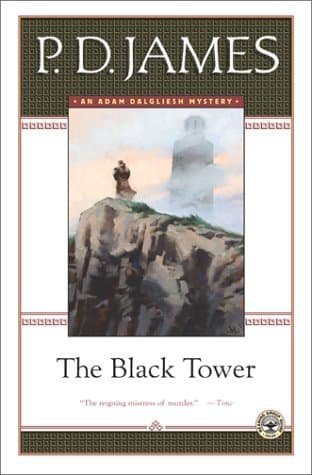
The Black Tower is a prominent architectural feature of Toynton Grange, serving both as a literal location for one of the initial deaths (Father Baddeley's 'suicide') and as a powerful symbol. Its name evokes a sense of foreboding, isolation, and darkness, mirroring the grim secrets hidden within the institution. It represents the oppressive atmosphere and the looming threat of death that hangs over the Grange. The tower's height and isolation make it a fitting place for the final confrontation, a dramatic stage for the revelation of truth and the apprehension of the killer, emphasizing the climax of Dalgliesh's investigation.
A remote institution that enables secrecy and control.
Toynton Grange's remote location on the Dorset coast is a crucial plot device. Its isolation from outside scrutiny allows the staff, particularly Mr. Court and Christian, to operate with impunity, fostering an environment where crimes can be committed and covered up without immediate detection. This geographical detachment reinforces the theme of secrecy and vulnerability, as the residents are effectively cut off from the outside world. The oppressive atmosphere of the Grange, described with gothic undertones, mirrors the psychological entrapment felt by both the residents and the investigating Dalgliesh, making escape or intervention difficult.
The protagonist's weakened state, adding vulnerability and introspection.
Dalgliesh's recovery from a life-threatening illness is not merely background detail; it's a significant plot device. His physical weakness and ongoing need for medication make him vulnerable to the killer's attempts to silence him, heightening the stakes. More importantly, his convalescence forces him into a state of introspection and heightened sensitivity, allowing him to perceive subtle cues and emotional undercurrents that a fully robust detective might overlook. It also provides a personal motivation for his deep engagement with the case, as he grapples with his own mortality while seeking justice for others, making the investigation a form of therapeutic recovery.
A series of deaths designed to appear as natural causes or suicides.
The killer's method of operation—administering overdoses that mimic natural causes or staging suicides—is a central plot device. This 'perfect' murder scheme relies on the vulnerability of the victims (disabled patients or an elderly priest) and the isolation of the setting, making the deaths easily dismissible by local authorities. Dalgliesh's challenge is to dismantle this illusion, proving that these seemingly innocuous deaths are, in fact, meticulously planned murders. This device creates suspense and complexity, requiring Dalgliesh to rely on his intuition and meticulous observation rather than overt forensic evidence, as the evidence has been carefully obscured.
“The dead are always with us, but they are not always silent.”
— Reflection on the lingering presence of death in the investigation.
“In the black tower, secrets are buried deeper than bones.”
— Describing the ominous setting of the story.
“Fear is a more potent weapon than any knife or gun.”
— Observation on psychological manipulation in the thriller.
“Truth, like light, can be blinding when it finally emerges.”
— Comment on the revelation of facts in the mystery.
“In the shadows of doubt, even the innocent can appear guilty.”
— Reflection on suspicion and perception in the investigation.
“A detective's greatest tool is not deduction, but patience.”
— Advice on investigative methods in the story.
“The past is a prison if you let it hold you.”
— Character insight on dealing with history.
“Evil often wears the mask of normalcy.”
— Observation on the deceptive nature of villains.
“In every mystery, there is a key that unlocks more than one door.”
— Metaphor for clues leading to multiple revelations.
“Silence can scream louder than any accusation.”
— Reflection on the power of unspoken truths.
“Justice is not always found in a courtroom; sometimes it's in the quiet resolve of those who seek it.”
— Comment on the pursuit of justice outside legal systems.
“The human heart is the darkest mystery of all.”
— Philosophical musing on human nature in the thriller.
“In the end, we are all prisoners of our own choices.”
— Reflection on consequences and free will.
Ready to see how well you understood this book? Take our interactive quiz with 10 questions.

Biography coming soon.







