“There are some things that are best left untouched, and the Black Cauldron is one of them.”
— Taran learns about the Cauldron's power.

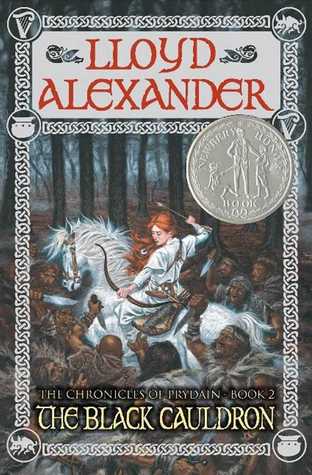
Lloyd Alexander (1965)
Genre
Fantasy / Children's / Young Adult
Reading Time
180 min
Key Themes
See below
Sign in to track this book
An assistant pig-keeper, driven by courage, must face deathless warriors and mischievous enchantresses to take the source of evil's power, unaware that victory will demand a sacrifice greater than any battle.
Taran, the Assistant Pig-Keeper, is called by Dallben and Coll to a meeting at Caer Dallben. Prince Gwydion announces that Arawn, the Death-Lord, is again creating an army of deathless warriors, the Cauldron-Born, from the Black Cauldron. To defeat Arawn, the Cauldron must be found and destroyed. A group is formed for this quest: Taran, Gwydion, Fflewddur Fflam, Doli, and Gurgi. They go into the Marshes of Morva, where the Cauldron is said to be hidden, wanting to end Arawn's threat to Prydain, despite the great dangers.
As the group goes into the Marshes of Morva, three old and powerful witches capture them: Orddu, Orwen, and Orgoch. These strange, shape-shifting sisters have the Black Cauldron. Instead of fighting, the witches suggest a trade. They want a magical item, Orwen's enchanted brooch, which Gwydion reluctantly gives. The witches accept the trade but warn that destroying the Cauldron is not easy. It can only be broken if a living man willingly climbs into it, sacrificing himself to remove its evil power. This news makes the quest seem much harder, as it means one of them must die.
With the Black Cauldron, the group starts the long journey back, looking for a place to destroy it. Adaon, Lord of the House of Adaon, and Princess Eilonwy soon join them. During their travels, Arawn's warriors ambush them. Adaon defends the group but is badly hurt and dies. His death affects Taran deeply, who gets Adaon's magical brooch and the weight of his courage. The group continues, their resolve stronger from the loss and the understanding of what is at stake to save Prydain from Arawn.
As the companions continue, Cauldron-Born warriors, led by the Huntsmen of Annuvin, ambush them. The group is scattered in the battle. Taran is separated from his friends, and the Black Cauldron is taken by the enemy. Believing his companions are lost or captured, and that the Cauldron is back with Arawn, Taran feels great despair. He walks alone, sure the quest has failed and he has lost everything, questioning his own worth and leadership. His hope fades as Prydain's future seems worse.
Lost and sad, Taran finds a hidden community of the Fair Folk, led by King Gwystyl. These small, old beings give Taran shelter, food, and encouragement. Gwystyl says that Doli, the grumpy dwarf of the Fair Folk, who was with the original group, has been captured by the Huntsmen. Gwystyl also tells Taran that the Black Cauldron is going to Annuvin, Arawn's stronghold, and that his companions might still be alive. This news gives Taran hope, reminding him that the fight is not over and his friends might be saved.
Guided by the Fair Folk, Taran goes to Annuvin, Arawn's dark fortress. With help from Gwystyl and his people, Taran gets into the stronghold. Inside, he finds that his companions – Gwydion, Eilonwy, Fflewddur, and Gurgi – are alive, but imprisoned. A rescue happens, and Taran, now with his friends, feels a renewed sense of purpose and strength. Together, they plan their next move, determined to get the Black Cauldron back and finish their quest, even though they are deep in enemy territory and face many challenges.
Inside Annuvin, the companions find the Black Cauldron in Arawn's inner room. They realize the only way to destroy it is for a living man to willingly go inside, as the witches of Morva had said. Prince Gwydion, as the leader and a prince of Prydain, immediately steps forward, ready to make the sacrifice. However, Taran, remembering Adaon's sacrifice and feeling his own responsibility, argues against it. The group is divided, understanding how serious the decision is and the great cost to save Prydain from Arawn. The tension is clear as they discuss who will make the sacrifice.
Just as Gwydion prepares to enter the Cauldron, Coll, Taran's stout, bald mentor from Caer Dallben, appears in Annuvin. Coll reveals a long-kept secret: as a young man, he was a warrior and had been saved by Arawn from a fatal wound, but was cursed with a life of service. Now, Coll says he will fulfill the prophecy himself, offering his own life to destroy the Cauldron and break Arawn's power. He says he is the 'living man' the witches spoke of, having lived a full life, and that this sacrifice is his way to make up for his past with Arawn. His arrival moves the choice from Gwydion and Taran, offering a selfless solution.
With a solemn goodbye, Coll bravely climbs into the Black Cauldron. A bright flash of light happens, followed by a loud roar. The Cauldron breaks into many pieces, its dark magic gone. The Cauldron-Born, who were brought to life by its evil power, instantly fall into piles of lifeless bones and rust, their curse broken. Arawn's main weapon is destroyed, and the threat of his deathless army is gone. The companions, though sad about Coll's death, feel triumph and relief, knowing that Prydain is safe from this terror. The air of Annuvin, once heavy, now feels lighter.
With the Black Cauldron destroyed and Arawn's power weaker, the companions escape from Annuvin. The fortress, now without its strongest evil, seems less threatening. They journey back to Caer Dallben, their hearts heavy with the loss of Adaon and Coll, but also satisfied that they completed their mission. Taran, though still the Assistant Pig-Keeper, has grown much through the trials and sacrifices he saw. He has learned about leadership, courage, and what sacrifice means. The quest has ended, but its lessons will stay with him as he returns to a Prydain made safer by their efforts.
The Protagonist
Taran transforms from an insecure, glory-seeking boy into a compassionate and responsible leader who understands the true cost of heroism.
The Supporting
Gwydion remains a steadfast and noble leader, willing to sacrifice himself for Prydain's safety, embodying unwavering commitment.
The Supporting
Eilonwy continues to develop her strong, independent spirit and magical abilities, proving her worth as a vital member of the team.
The Supporting
Gurgi evolves from a timid, fearful creature into a loyal and unexpectedly brave companion, overcoming his own anxieties for his friends.
The Supporting
Fflewddur's courage is tested, proving his bravery despite his exaggerations, and he remains a loyal friend.
The Supporting
Doli begrudgingly assists the quest, his loyalty overriding his grumpiness, showcasing his hidden good nature.
The Supporting
Adaon fulfills his fated role as a noble sacrifice, inspiring Taran with his courage and wisdom.
The Supporting
Coll reveals his hidden past and makes the ultimate, selfless sacrifice to save Prydain, fulfilling a long-held duty.
The Antagonist
Arawn's power is significantly diminished by the destruction of the Black Cauldron, though he remains a lurking threat.
The Supporting
The witches serve as enigmatic facilitators, revealing crucial information and trading the Cauldron, then disappearing.
The main idea is about what sacrifice and heroism mean. Taran at first wants glory, but learns that true heroism is about selflessness and often has a high cost. Adaon's death and Coll's sacrifice show that courage is not just about fighting, but about willingly giving oneself for others. The book compares Taran's youthful desire for fame with the quiet heroism of those who make the ultimate choice for Prydain's safety.
“For the Cauldron-Born to perish, a living man must willingly climb into the Black Cauldron. No other way is there.”
Taran's journey is about finding himself. As the Assistant Pig-Keeper, he deals with his simple background and wants a more noble identity. Through his challenges, losses, and responsibilities, he learns that his worth comes from his actions, kindness, and courage, not from birth or titles. He grows from an unsure boy into a more mature and understanding leader, finding his true identity in his dedication to his friends and Prydain, rather than from outside approval.
“I am Taran, Assistant Pig-Keeper. And that is all I am.”
The Black Cauldron looks at evil through Arawn and his creations, the Cauldron-Born. Arawn's evil is not just destructive; it corrupts and removes humanity, turning living men into deathless, mindless automatons. The Cauldron itself stands for this power of bringing things back to life and control. The book shows that evil can be defeated, but it often needs a direct fight and a complete removal of its source, not just fighting its effects. Destroying the Cauldron breaks the core of Arawn's specific power.
“It is the Black Cauldron that gives them life, and without it, they are nothing.”
The bond between Taran and his companions—Gwydion, Eilonwy, Gurgi, Fflewddur, Doli, and Adaon—is a main part of the story. Their loyalty to each other, even in despair and danger, helps them keep going. Gurgi's strong devotion to Taran, Eilonwy's steady presence, and Fflewddur's bravery all show the strength that comes from friendship. The group's ability to work together, despite their different personalities, helps them succeed and shows the power of being united against a common enemy.
“Indeed, I am loyal to you, master. Always and always!”
Taran, though young, is put in charge and often struggles with the heavy duties of leadership. He experiences the loneliness of making decisions, the guilt of mistakes, and the emotional burden of leading others into danger. Gwydion, as the leader, also shows this theme, willing to make the ultimate sacrifice. The book shows that true leadership is not about power or command, but about taking on the results and putting the well-being of others before one's own.
“A leader must be ready to give his life for his companions.”
The central magical artifact and source of Arawn's power.
The Black Cauldron serves as the primary macguffin and symbol of Arawn's evil. It is the source of the deathless Cauldron-Born warriors, making it the ultimate objective for Taran's company to find and destroy. Its magical properties are key to the plot, as its destruction requires a specific, selfless act. The Cauldron represents the corrupting power of evil and the immense cost required to neutralize it, driving the entire narrative forward and creating the central conflict.
A magical item that foretells danger and symbolizes inherited responsibility.
Adaon's brooch is a magical artifact that warms and glows when danger is near. Initially worn by Adaon, it is passed to Taran upon Adaon's death. This transfer symbolizes Taran inheriting Adaon's courage and the burden of responsibility. The brooch not only serves as a practical plot device to alert the characters to danger but also represents the passing of the torch, the legacy of sacrifice, and Taran's growing maturity as he accepts the weight of leadership and the memory of his fallen comrade.
A magical instrument whose strings snap when the bard exaggerates.
Fflewddur's harp is a recurring humorous plot device. Its strings snap whenever Fflewddur exaggerates or tells a lie, providing comic relief and subtly characterizing him as a well-meaning but boastful individual. Beyond the humor, it serves as a subtle reminder of truth and honesty in a world filled with magic and deception. It also endears Fflewddur to the reader, making his eventual acts of bravery more impactful as they are undoubtedly true.
Enigmatic, morally ambiguous characters who provide crucial information.
The Witches of Morva (Orddu, Orwen, Orgoch) act as a classic deus ex machina, or more accurately, a 'wise old woman' archetype, but with a twist. They are not entirely benevolent; they are capricious and demand a price for the Cauldron. Their role is to provide the critical piece of information—the method for destroying the Cauldron—that none of the heroes possess. They introduce the theme of sacrifice and highlight the ancient, complex magic that exists beyond the immediate conflict with Arawn, adding depth to the world of Prydain.
“There are some things that are best left untouched, and the Black Cauldron is one of them.”
— Taran learns about the Cauldron's power.
“But a pig is a pig, and a hero is a hero. And I am not a hero.”
— Taran reflecting on his role and Gurgi's loyalty.
“For good or ill, the Cauldron is gone from the world. And that is a blessing.”
— The aftermath of the Cauldron's destruction.
“A man's life is worth more than any weapon.”
— Taran's decision to save Adaon instead of claiming the sword.
“The greatest treasure is not gold or jewels, but the love of friends.”
— Taran's realization about his companions.
“It is not what you are, but what you do, that makes a hero.”
— Princess Eilonwy's wisdom to Taran.
“There are times when even the wisest of us must make a choice without knowing what the outcome will be.”
— Dallben's words to Taran.
“To be a man is to be afraid. But to be a brave man is to face that fear.”
— Taran grappling with his fears.
“A true friend is one who is always there, even when you do not wish him to be.”
— Taran's thoughts on Gurgi's unwavering loyalty.
“Sometimes the greatest victories are won not by fighting, but by understanding.”
— Taran reflecting on his journey.
“The world is full of wonders, if only you have the eyes to see them.”
— Fflewddur Flam's optimistic outlook.
“It is a heavy burden, to know what must be done, and to have no other choice but to do it.”
— Taran facing a difficult decision.
“Even the smallest creature can make a difference.”
— Reflecting on the contributions of Gurgi and other companions.
“Hope is a fragile thing, but it is also the strongest.”
— In moments of despair, Taran finds renewed hope.
Ready to see how well you understood this book? Take our interactive quiz with 10 questions.

Biography coming soon.







