“The gods give us powers, but we are the ones who choose what to do with them.”
— Elisa reflecting on her abilities and agency.

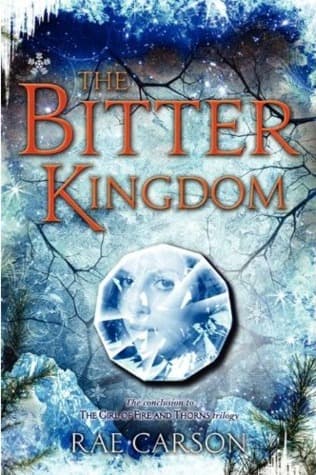
Rae Carson (2013)
Genre
Fantasy / Young Adult / Romance
Reading Time
433 min
Key Themes
See below
Sign in to track this book
Queen Elisa, on the edge of civil war and hunted by her own people, must go through a land of ice and brutal magic to save her love, reclaim her throne, and become the champion the world needs.
Queen Elisa, now a fugitive after the coup by her sister Alodia and the Inquisition, escapes Joya d'Oro with her loyal companions: Father Alejandro, the spy Mara, and her guard Captain Storm. They are chased by the Inquisition's soldiers, led by Commander Cosme. Elisa is upset by the capture of Hector, her husband, who sacrificed himself to buy them time. They head towards the northern border, hoping to find safety and plan their next move, knowing that Alodia has called Elisa a traitor and ordered her death. Elisa struggles with guilt for leaving Hector and the pressure of her crown.
Elisa and her small group travel through the harsh desert, facing extreme heat, low supplies, and the constant threat of being found. Their journey is dangerous, including encounters with hostile desert tribes who are wary of outsiders. Elisa, despite her growing power from the Godstone, is tested physically and emotionally. She uses her Godstone abilities carefully, aware that it draws attention and can be dangerous. The group's endurance is pushed to its limits as they ration food and water, all while knowing that Cosme and his forces are chasing them, determined to capture or kill the deposed queen.
After weeks of difficult travel, Elisa and her companions finally cross into the icy, mountainous land of the Thracians, her mother's people. This land is very different from Invierne, known for its brutal cold and fierce, independent clans. Elisa hopes to find safety and allies among her estranged royal relatives, especially her aunt, Queen Malen. However, she knows her welcome will be uncertain, as her mother's marriage to the King of Invierne was controversial. The Thracians are a proud and warlike people, and Elisa must prove her worth and show her connection to their heritage to gain their trust and support.
Upon reaching the Thracian stronghold, Elisa is brought before Queen Malen, her aunt. Malen is at first cold and doubtful, seeing Elisa as a pampered Invierne queen rather than a true Thracian heir. She questions Elisa's right to ask for help, demanding proof of her strength and leadership. Elisa must navigate Thracian customs and show her growing command of the Godstone, as well as her strategic thinking. She tells of the coup and her plan to rescue Hector and reclaim her throne. Malen, though still cautious, begins to see the potential in her niece, but demands a significant test of loyalty and ability.
To earn Queen Malen's full support and the loyalty of the Thracian people, Elisa goes through a series of difficult physical and mental trials. These trials push her to her limits, testing her endurance, combat skills, and strategic mind in the harsh northern environment. She faces challenges like climbing icy peaks, surviving in the wilderness, and showing her skill with a sword, all while battling the doubts of the Thracian warriors. Elisa's Godstone power helps her, but she learns to rely on her own strength and cleverness. Through these trials, she proves herself and begins to embrace her Thracian heritage, earning the respect of her new allies.
Having secured Queen Malen's alliance and a group of Thracian warriors, Elisa focuses on rescuing Hector from his captivity in Joya d'Oro. They create a plan to enter the heavily guarded capital, using the Thracians' stealth and knowledge of the terrain, as well as Mara's spy network. Elisa is determined to free Hector, not just as her husband, but as a key part of her plan to reclaim her throne and stabilize Invierne. The mission is very dangerous, and Elisa knows that failure means Hector's death and the end of her hopes for her kingdom.
Elisa, Storm, Mara, and a small group of Thracian warriors successfully enter Joya d'Oro, using secret passages and their combined skills to move through the city. They learn that Hector is held in the deepest dungeons of the Inquisition's fortress. During their secret operations, Elisa discovers a truth: the Godstone is not just a source of power, but a living entity, an ancient consciousness that has guided its bearers for generations. This changes her understanding of her own abilities and the destiny she thought she was fulfilling, adding urgency and complexity to her mission.
Elisa and her team find Hector, but their rescue attempt leads to a direct fight with Alodia, who has fully taken on her role as queen, and the relentless Commander Cosme. A fierce battle breaks out within the fortress. Alodia, using her political power and the Inquisition's backing, tries to capture Elisa. Cosme, driven by fanaticism and a personal vendetta, is a strong opponent. Elisa must use her full Godstone power and combat training to protect Hector and her companions, leading to a dramatic clash that determines the immediate fate of the captured king and the stability of Invierne.
Elisa, with her companions' help, frees Hector from his cell. However, Hector is weakened and injured from his captivity. The escape is difficult, as they are chased by Alodia's forces and the Inquisition. Elisa uses her Godstone to create diversions and protect their retreat, showing great power and control. They get Hector out of the city, but their victory is mixed. Hector's condition is critical, and they must find a safe place to heal him, knowing that their fight for Invierne is not over and that Alodia will not rest until Elisa is dead.
While Hector recovers, Elisa works to understand the Godstone's full truth. Guided by old texts and the Godstone's own consciousness, she learns that it is an artifact of great power, connected to the fabric of existence, created by an ancient, kind race to protect the world from a destructive force. She discovers that her destiny is not just to rule Invierne, but to be the champion who uses the Godstone to prevent a disaster. This strengthens her resolve, changing her from a hesitant queen into a true leader, ready to embrace her purpose.
With Hector slowly recovering and her understanding of the Godstone complete, Elisa begins to gather support for her cause. She uses her charm, her growing power, and her vision for Invierne to unite various groups: loyal nobles, disillusioned soldiers, and the Thracian warriors who have pledged their support. She also works to win over common people who have suffered under Alodia's rule. This requires careful negotiations and planning, as she builds an army capable of challenging Alodia's control over the capital and the Inquisition's hold on the kingdom.
Elisa leads her combined forces in an attack on Joya d'Oro. The battle is fierce, with loyalists fighting against Alodia's regime and the fanatical Inquisition soldiers. Elisa, in the front, uses the Godstone's power with skill, inspiring her troops and changing the battle's course. She faces Commander Cosme in a brutal duel, defeating him. The conflict ends in a direct confrontation with Alodia, who is desperate to keep her power. Elisa must not only defeat her sister but also dismantle the Inquisition's corruption and restore order to her fractured kingdom.
In the final confrontation, Elisa faces Alodia. Alodia, consumed by ambition, refuses to give up. Elisa, now fully embracing her role as champion, shows the Godstone's true power, not just for destruction, but for creation and healing. She offers Alodia a choice: reconciliation and a chance to rebuild Invierne together, or continued conflict. Elisa also learns that she has a choice about the Godstone itself – whether to keep its power for herself, or to release it, allowing its consciousness to spread and empower others, changing the world forever. This decision will define her reign and her legacy.
After the battle, Elisa secures her throne. She chooses to release the Godstone's essence, allowing its kind influence to spread throughout the land, promoting balance and growth rather than concentrating power in one person. This act marks a new era for Invierne, one of healing and progress. She works to reconcile the warring groups, rebuild the kingdom, and establish a fairer society. With Hector by her side, she begins her reign as a wise and compassionate monarch, changed by her journey from a hesitant princess to a powerful queen and the world's champion, ready to face the future.
The Protagonist
From a hesitant, self-doubting queen, Elisa transforms into a powerful, confident leader who fully embraces her destiny and the responsibilities of the Godstone.
The Supporting
Endures brutal captivity and recovers, remaining a steadfast source of love and support for Elisa.
The Antagonist
Becomes increasingly ruthless and power-hungry, ultimately being defeated by Elisa's compassion and strength.
The Antagonist
Remains a zealous and unyielding foe until his final defeat.
The Supporting
Continues to serve Elisa faithfully, providing crucial intelligence and support.
The Supporting
Remains Elisa's steadfast protector, his loyalty never wavering.
The Supporting
Continues to guide Elisa spiritually and intellectually, helping her understand her destiny.
The Supporting
Transitions from a skeptical observer to a loyal and powerful ally to Elisa.
Elisa's journey is about her struggle to accept and master her role as queen and the bearer of the Godstone. From a hesitant ruler fleeing her kingdom, she is forced to make hard decisions, lead her people, and ultimately embrace a destiny greater than just her throne. This theme is clear in her initial guilt over leaving Hector, her difficult trials among the Thracians, and her final decision about the Godstone's fate. She learns that true leadership requires wisdom, compassion, and sacrifice, not just power.
““A champion must not waver. A champion must not fear. The gate of darkness closes.””
The novel explores family dynamics, especially through the broken relationship between Elisa and her sister, Alodia. Alodia's betrayal and taking of the throne drive much of the conflict, forcing Elisa to confront the pain of sibling rivalry and the devastating results of ambition. While Elisa fights to reclaim her throne, the story also hints at the chance for understanding, if not full forgiveness, as Elisa offers Alodia a choice in their final confrontation, showing her growth beyond just revenge.
““Some betrayals cut deeper than any blade.””
The Godstone represents great power, and the novel explores its true nature, showing it as a kind, ancient consciousness rather than just a magical object. Elisa learns that true power is not about control, but about understanding, responsibility, and the willingness to share or even release it for the greater good. Hector's initial sacrifice to save Elisa, and Elisa's final decision to spread the Godstone's essence, show that big change often requires personal sacrifice.
““Power is not to be hoarded, but to be wielded for the good of all.””
Elisa's journey takes her to her mother's people, the Thracians, making her confront and embrace a part of her heritage she had previously ignored. Her trials among them are not just tests of strength but also a process of self-discovery, where she learns to combine her Invierne royal upbringing with the fierce, independent spirit of the Thracians. This blending of identities strengthens her, making her a more complete and capable ruler, connecting two different cultures.
““You are of the ice and the sun, Queen. You are both.””
Throughout her ordeal, Elisa's love for Hector and the loyalty of her companions—Mara, Captain Storm, and Father Alejandro—are her strongest sources of strength and motivation. Her determination to rescue Hector is a driving force, reminding her of what she is fighting for beyond just a crown. The trust and camaraderie among her small group show how personal bonds and shared purpose can overcome great odds, proving that emotional connections are as important as magical power or military strength.
““I will not leave him. Not again. Not ever.””
A magical artifact that grants immense power and knowledge to its bearer.
The Godstone is the central magical artifact, embedded in Elisa's hand. It provides her with extraordinary powers, including healing, foresight, and elemental control. In this book, its true nature is revealed: it is not merely a stone but an ancient, conscious entity designed to protect the world. It serves as both a source of Elisa's strength and a guide for her destiny, pushing her towards becoming a champion. Its revelation adds a layer of cosmic significance to Elisa's personal struggles, transforming her from a political figure into a world-saver.
Elisa's perilous escape and travel through hostile lands.
The fugitive journey is a classic plot device that isolates the protagonist from their usual resources and forces them to rely on their inner strength and a small, loyal group. For Elisa, fleeing Joya d'Oro and traversing the desert and northern wastes strips her of her royal comforts and forces her to adapt, grow, and prove her mettle. This device allows for character development, introduces new environments and cultures (like the Thracians), and heightens the stakes as she is constantly pursued by enemies, emphasizing her vulnerability and resilience.
A series of challenges Elisa must undergo to prove her worth.
The Thracian trials serve as a rite of passage and a test of character for Elisa. By subjecting her to physical, mental, and spiritual challenges in the harsh northern environment, they force her to confront her weaknesses, embrace her Thracian heritage, and demonstrate her capabilities as a leader and warrior. This device allows for significant character growth, showcasing Elisa's transformation from a queen accustomed to luxury to a hardened champion, and earning her the respect and loyalty of her formidable Thracian relatives and warriors.
A preordained destiny that guides Elisa's actions.
While not a literal oracle, the overarching prophecy hinted at in previous books and fully revealed in 'The Bitter Kingdom' dictates Elisa's ultimate destiny as 'the champion.' This device frames Elisa's personal struggles within a larger, cosmic narrative, suggesting that her actions have far-reaching consequences beyond just her kingdom. It provides a sense of purpose and urgency to her quest, compelling her to understand and fulfill her role in preventing a global catastrophe, thus elevating the stakes beyond mere political intrigue.
“The gods give us powers, but we are the ones who choose what to do with them.”
— Elisa reflecting on her abilities and agency.
“Some things are worth fighting for, even if you know you might lose.”
— Elisa contemplating the risks of war.
“Love isn't about finding someone perfect. It's about finding someone who is perfect for you.”
— Elisa's internal thoughts on her romantic relationships.
“A queen must protect her people, no matter the cost to herself.”
— Elisa accepting her responsibilities as a monarch.
“There are always choices, even when it feels like there are none.”
— Elisa's determination in a difficult situation.
“It's not enough to have a cause; you have to have the will to fight for it.”
— Elisa considering the resolve needed for war.
“Sometimes the greatest strength is knowing when to ask for help.”
— Elisa realizing she doesn't have to face everything alone.
“Fear can be a powerful motivator, but so can love.”
— Elisa comparing different emotional drivers.
“The future is not written. We write it ourselves, with every choice we make.”
— Elisa's belief in free will and agency.
“True leadership isn't about giving orders; it's about inspiring others to follow.”
— Elisa's evolving understanding of her role as a leader.
“Even in the darkest times, there is always a flicker of hope, if you look for it.”
— Elisa finding resolve amidst despair.
“The greatest battles are often fought within ourselves.”
— Elisa grappling with her inner conflicts.
“Forgiveness is a gift you give yourself, not just the other person.”
— Elisa reflecting on past hurts and moving forward.
Ready to see how well you understood this book? Take our interactive quiz with 10 questions.

Biography coming soon.







