“I am the Beetle! I am the Beetle! I am the Beetle!”
— The mysterious antagonist's chilling declaration of identity, repeated to instill fear.

Sign in to track this book
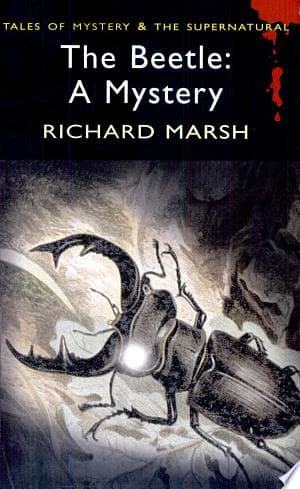
An ancient, shape-shifting beetle-creature from Egypt seeks supernatural revenge in Victorian London, terrifying its targets and leaving questions in its wake.
Robert Holt, a clerk, is locked out of his lodgings and finds shelter in an empty Bloomsbury Square house. There, he meets a veiled figure who calls herself 'The Beetle'. This being has unsettling features and can change her appearance. She hypnotizes Holt and makes him write letters that involve important people in a strange, old cult. Holt is scared but also drawn to her. He sees her monstrous changes. He escapes, deeply troubled, but the experience connects him to an old Egyptian revenge plot.
Lady Arabella, a wealthy society woman, gets a disturbing letter from 'The Beetle'. It threatens her life and shows the creature knows about her past. Arabella was on an expedition to Egypt years ago. During that trip, a sacred ritual was disrespected, and a priestess of an ancient cult was wronged. Paul Lessingham, a Member of Parliament, was also on this expedition. Arabella lives in fear. She realizes the 'Beetle' wants revenge for the cult's mistreatment and fears for her reputation and life as the creature closes in.
Dolly Maude, a young woman engaged to Paul Lessingham, disappears from her home. Her disappearance is linked to 'The Beetle', making the events even stranger. Augustus Champnell, a detective, is hired to investigate. Champnell is at first skeptical of supernatural claims. He starts to connect Holt's story, Lady Arabella's fears, and Dolly's disappearance to one source: the shapeshifting 'Beetle' and its quest for revenge.
Still bothered by his first encounter, Robert Holt feels drawn back to the empty Bloomsbury Square house. He meets 'The Beetle' again, who continues to torment him and makes him her unwilling helper. During these meetings, Holt learns more about the creature's reasons: a strong desire for revenge against those who violated her Egyptian cult's sacred rites. He sees more of her grotesque transformations, confirming she is supernatural. Holt's mind is pushed to its limits as he tries to understand his horrifying situation and the rational world he knew. He becomes more involved in the Beetle's plans.
With the threats growing and Dolly gone, Paul Lessingham finally tells Champnell the full story of the Egyptian expedition. He admits he and Arabella disrespected a sacred tomb and a priestess. This started the Beetle's centuries-long revenge. Meanwhile, Lady Arabella, desperate from fear and the Beetle's presence, tries to leave London. However, 'The Beetle' is always there, appearing wherever Arabella goes, a constant reminder of coming danger. Arabella's mental state worsens as she sees her efforts are useless.
Lady Arabella is cornered, and 'The Beetle' focuses on Paul Lessingham. The creature uses its shapeshifting to enter Lessingham's life, appearing in different forms to torment him and remind him of his past actions. Lessingham becomes more paranoid. His public life falls apart under the mental attack. The Beetle's methods are subtle but terrifying, playing on his fears and loneliness. He struggles to convince others of the supernatural threat. The Beetle's actions often look like a clever human's work, making it hard for Champnell to understand the true enemy.
It is revealed that Dolly Maude is held captive by 'The Beetle' in a hidden room within the empty Bloomsbury house. The Beetle plans to use Dolly in its revenge, perhaps to sacrifice her or to torment Lessingham further. Robert Holt, despite his fear, feels a growing sense of responsibility for Dolly. Along with Augustus Champnell and Lessingham, a plan is made to rescue Dolly. This involves going into the house and facing the creature. The rescue attempt is dangerous, as the Beetle's powers and unpredictable nature make it a difficult opponent.
The main characters, led by Champnell and Lessingham, with Holt's help, confront 'The Beetle' in the hidden rooms of the empty Bloomsbury house. The Beetle tells more about its old origins and its deep hatred, explaining it is an avenging spirit of the Egyptian cult. During the fight, the Beetle shows its full shapeshifting abilities, changing into monstrous forms, including a giant beetle, to scare and overpower its enemies. Dolly Maude is found, but the fight for her freedom and their lives is intense. The Beetle's supernatural strength and cleverness make it almost impossible to defeat.
In a final fight, 'The Beetle' is defeated. The ancient creature, having gotten some revenge, collapses, its power seemingly gone. Dolly Maude is rescued but is deeply traumatized. Paul Lessingham and Lady Arabella deal with the mental effects of their past actions and the terrible results. Robert Holt, forced to be part of the supernatural events, is changed forever. His life is altered by his close encounters with the monstrous 'Beetle'. The experience leaves them all scarred, showing the power of old curses and how fragile the rational world is.
The Antagonist
The Beetle remains a consistent force of vengeance throughout, its character arc focusing on the escalation and execution of its long-held revenge.
The Protagonist/Witness
Holt transforms from a passive victim into a more active, albeit reluctant, participant in the fight against the Beetle, driven by fear and a nascent sense of courage.
The Protagonist/Target
Lessingham's arc involves a descent from respected public figure to a paranoid man, forced to confront his past and fight for his life and the woman he loves.
The Supporting/Target
Arabella's arc is one of increasing fear, paranoia, and desperation as she is relentlessly pursued by the Beetle, leading to a mental and physical breakdown.
The Supporting/Victim
Dolly's arc is primarily one of victimization and survival, serving as a catalyst for others' actions and highlighting the Beetle's cruelty.
The Supporting
Champnell's arc shows a transformation from a rational detective to someone who must accept the existence of supernatural forces to solve the case.
The Mentioned
Sydney's role is static; he primarily serves as a plot device to initiate Robert Holt's encounter with the Beetle.
The main theme of 'The Beetle' is revenge, specifically the ancient Egyptian creature's quest for payback for disrespect shown to its cult. The Beetle's actions are driven by this desire. It seeks to punish Paul Lessingham and Lady Arabella over centuries. This theme suggests that some wrongs, especially against sacred powers, must be paid for, and that consequences will eventually arrive. The Beetle's persistence shows the unforgiving nature of old curses and the unavoidable results of past actions, no matter how much time passes. The story often reinforces that the past always catches up.
“'Born of neither God nor man, it could change its shape at will, and it was bent on revenge for a crime committed against the devotees of an ancient religion.'”
The novel shows the conflict between Victorian society's growing belief in reason and the terrifying arrival of the supernatural. Characters like Augustus Champnell first think the strange events are delusions or tricks, relying on logical explanations. However, the 'Beetle's' impossible actions force them to face a reality beyond science. This theme reflects late-19th-century worries about the limits of human knowledge and the return of ancient, mystical forces in a supposedly modern age. The horror comes not just from the Beetle, but from the shattering of the characters' understanding of the world.
“'It was a thing beyond human experience, a nightmare made flesh, and yet I knew it to be real.'”
The theme of identity is explored through 'The Beetle's' shapeshifting and how it challenges the human characters' fixed identities. The Beetle can appear as male or female, monstrous or beautiful, blurring what is real and what is seen. This unsettling fluidity reflects the disruption of the protagonists' own identities as they face a reality they cannot understand. Robert Holt, especially, changes from an ordinary clerk to someone marked by supernatural horror, his sense of self changed by his encounters with the changeable creature. The novel questions how stable identity is when facing the unknown.
“'I saw him take a different shape before my eyes. His loose draperies fell about him...and there issued out of them a monstrous creature of the beetle tribe.'”
The novel reflects late-19th-century anxieties, especially fears of 'outsiders,' ancient cultures, and the era's perceived decay. The Egyptian setting and the 'Beetle's' foreign origins use contemporary fascinations and fears of colonialism and the unknown. The characters, like Lady Arabella and Paul Lessingham, represent upper society whose respectable lives hide past wrongs and moral failures. The Beetle's appearance from ancient Egypt and its targeting of these figures can be seen as a criticism of imperial overreach and the moral decay beneath a civilized surface, reflecting a society dealing with its own hidden problems.
“'A creature of horror, 'born of neither God nor man', which can change its form at will. It is bent on revenge for a crime committed against the devotees of an ancient religion.'”
The Beetle's ability to change its form, creating terror and ambiguity.
The most prominent plot device is 'The Beetle's' ability to shapeshift, transforming between a beautiful, seductive woman, a monstrous insect, and other forms. This device serves multiple functions: it creates profound terror by making the antagonist unpredictable and unidentifiable; it allows the Beetle to infiltrate various social settings undetected; and it blurs the lines between reality and nightmare for the characters and the reader. The shifting forms also symbolize the instability of identity and the pervasive, insidious nature of the ancient curse, making the threat feel omnipresent and inescapable.
Used by the Beetle to manipulate victims and gather information.
The Beetle frequently uses hypnosis or some form of mind control to manipulate its victims, most notably Robert Holt. This device allows the entity to force characters into acting against their will, compelling them to write letters, reveal secrets, or perform other tasks that further its vengeful agenda. It highlights the Beetle's supernatural power over human will and adds to the characters' sense of helplessness and violation. The use of hypnosis also creates ambiguity, as victims struggle to distinguish between their own actions and those forced upon them, blurring the lines of culpability and sanity.
A central, liminal setting for the supernatural encounters.
The empty house in Bloomsbury Square serves as a crucial plot device and symbolic setting. It is the initial site of Robert Holt's encounter with the Beetle and becomes a recurring location for the entity's activities and the imprisonment of Dolly Maude. As a derelict, unoccupied space in the heart of London, it symbolizes a liminal zone where the mundane world gives way to the supernatural. Its emptiness and forgotten nature reflect the ancient, forgotten cult from which the Beetle originates, creating an eerie contrast with the bustling Victorian city outside and serving as a hidden nexus for the unfolding horror.
The foundational motivation for the Beetle's actions.
The entire plot is driven by an ancient Egyptian curse or prophecy, activated by the desecration of a sacred tomb and priestess by Paul Lessingham and Lady Arabella. This plot device provides the Beetle's motivation and justifies its seemingly supernatural powers and centuries-long quest for revenge. It establishes a sense of inescapable destiny and highlights the idea that actions in the distant past can have terrifying, far-reaching consequences in the present. The curse serves as a powerful, immutable force that transcends modern understanding, making the Beetle's vengeance feel both inevitable and profoundly terrifying.
“I am the Beetle! I am the Beetle! I am the Beetle!”
— The mysterious antagonist's chilling declaration of identity, repeated to instill fear.
“There are things in this world which are not to be explained by any known laws.”
— A character reflecting on the inexplicable and supernatural events unfolding.
“I have seen the Beetle, and I know that it is not of this earth.”
— A witness describing the otherworldly nature of the creature.
“The power of the Beetle is the power of the unknown.”
— Commentary on the antagonist's ability to manipulate through mystery and fear.
“In the darkness, the Beetle moves unseen, and in the light, it is but a shadow.”
— Description of the creature's elusive and terrifying presence.
“To look upon the Beetle is to look upon madness.”
— Warning about the psychological impact of encountering the creature.
“The Beetle does not kill; it consumes the soul.”
— Explanation of the antagonist's more insidious, spiritual threat.
“There is no escape from the Beetle, for it is everywhere and nowhere.”
— A character's realization of the inescapable nature of the threat.
“The Beetle is a curse upon this house, and upon all who dwell within.”
— Statement linking the creature to a specific location and its inhabitants.
“In the silence of the night, the Beetle whispers secrets that drive men to despair.”
— Description of the psychological torment inflicted by the creature.
“The Beetle is not a beast, but a force of nature, wild and untamed.”
— Philosophical reflection on the antagonist's essence beyond mere monstrosity.
“To understand the Beetle is to understand the darkness within us all.”
— A deeper insight into the creature as a metaphor for human fears.
“The Beetle's gaze is like a poison, seeping into the mind and corrupting all thought.”
— Description of the creature's hypnotic and corrupting influence.
“In the end, the Beetle is but a reflection of our own deepest terrors.”
— Final reflection on the antagonist as a manifestation of internal fears.
Ready to see how well you understood this book? Take our interactive quiz with 10 questions.
Biography coming soon.







