“The beast must die. But I must kill it. And I must kill it myself.”
— Frank Cairnes' opening declaration of his intent to murder the man who killed his son.

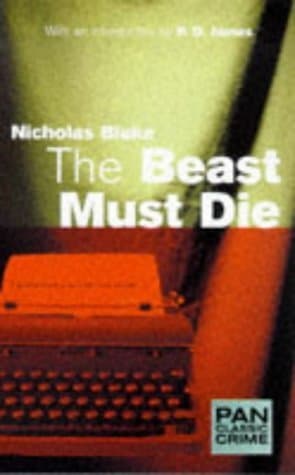
Nicholas Blake (1958)
Genre
Thriller / Mystery
Reading Time
260 min
Key Themes
See below
Sign in to track this book
A grieving father, a celebrated mystery author, trades his pen for a pistol in a relentless, real-life quest to avenge his son's hit-and-run death, blurring the lines between justice and his own dark obsession.
Frank Cairnes, a successful thriller writer, is shattered by the hit-and-run death of his only son, six-year-old Martin. The police investigation has stalled, leaving Frank with a strong desire for vengeance. He writes a 'murder plan' in his notebook, detailing his intention to find and kill the driver responsible. His investigation starts with the only clue: a silver cigarette case found at the accident scene. He visits various garages and shops, determined to trace the owner, believing this object will identify the person who killed his child. His grief is so deep that it warps his view, making his quest a singular, obsessive goal.
Frank's search for the distinctive silver cigarette case leads him to a small seaside town called Seaford. His inquiries show that a man named George Rattery, a wealthy, arrogant, and disliked boat-builder, bought the case. Frank quietly enters the local community, befriending people who know Rattery, all while hiding his true identity and intentions. He learns that Rattery owns a powerful sports car matching the description of the hit-and-run vehicle. The confirmation of Rattery's identity strengthens Frank's resolve, confirming his belief that he has found his target.
Frank, using the name 'Frank Cairns' and pretending to be a writer seeking quiet inspiration, befriends George Rattery's young son, Martie. Martie looks like Frank's deceased son and becomes an unwitting part of Frank's revenge plan. Through Martie, Frank meets the Rattery household, including George's timid wife, Lena, and his sister-in-law, Frances. Frank watches Rattery closely, noticing his quick temper, his cruel treatment of his family, and his general unpleasantness. This reinforces Frank's belief that he has found the right man. He begins to plan Rattery's death.
As a friendly acquaintance, Frank continues to get closer to the Rattery family. He learns about George's temper, his cheating, and his money problems. Frank also discovers that Lena Rattery is unhappy and afraid of her husband, while Frances protects her sister. Frank subtly creates suspicion and unhappiness, intending to isolate George and create chances for his plan. He practices shooting and studies the local area, mapping out how he will kill Rattery and escape detection, all while keeping up his act as a harmless writer.
Frank puts his plan into action. He arranges a fishing trip with George Rattery, luring him to a secluded cove. During the outing, Frank, using an alibi and a planned sequence of events, shoots Rattery. He then stages the scene to look like an accidental drowning, disposing of the weapon and ensuring his escape. The murder is carried out with precision and coldness, the result of his weeks of planning and obsessive hatred. Frank feels a grim satisfaction, believing he has avenged his son's death and brought justice to the 'beast'.
After George Rattery's body is found, Detective Superintendent Blount investigates. Blount, a shrewd and experienced detective, quickly senses that something is wrong. He finds the circumstances of Rattery's death suspicious and questions those connected to the deceased, including Frank Cairnes. Frank, confident in his alibi and the carefulness of his plan, maintains his innocent appearance, acting as a shocked acquaintance. However, Blount's observations and persistent questioning begin to break down the carefully constructed story, making Frank uneasy.
As Blount looks deeper, he finds inconsistencies in the accounts of Rattery's last movements and Frank's alibi. He learns about the animosity George Rattery created, but also notes Frank's intense interest in the Rattery family and his strange behavior. Blount's investigation leads him to discover the silver cigarette case and its connection to the hit-and-run death of Frank Cairnes' son, Martin. This discovery gives Blount a motive and puts Frank Cairnes at the top of his suspect list. The hunter is now becoming the hunted, as Blount starts to close in.
Cornered by Blount's questioning and evidence, Frank Cairnes confesses to the murder of George Rattery, detailing his motive of vengeance for his son's death. He describes how he planned and carried out the killing. However, just as Frank believes he has achieved his dark justice, Blount delivers a shocking revelation: George Rattery was not the driver who killed Martin. Another person, Lena Rattery, had confessed to the hit-and-run, stating she was driving Rattery's car that day.
Lena Rattery, driven by guilt and fear of her husband, finally confesses to Blount that she was driving the car when it hit Martin Cairnes. She explains that George, fearing scandal and the loss of his driving license, made her stay silent and covered up her involvement. This confession shatters Frank's world, showing the tragic irony of his actions. His carefully planned vengeance was misplaced, and he has murdered an innocent man, though a cruel one, while the real killer, Lena, was still alive. Frank is left to deal with the moral implications of his terrible mistake.
Frank Cairnes is arrested for the murder of George Rattery. The novel ends with Frank facing the reality of his situation. He set out to avenge his son's death but instead became a murderer himself, killing the wrong person. Lena Rattery, though responsible for the hit-and-run, is now a widow and may face legal consequences for her part in the accident and cover-up. The story shows the destructive nature of unchecked vengeance and the complex, often unpredictable, paths that justice can take. Frank's journey from grieving father to killer ends in deep regret and the realization of a colossal, tragic error.
The Protagonist
From a grieving father plotting revenge, he transforms into a calculated killer, only to discover his vengeance was misplaced, leading to profound regret and the loss of his own freedom.
The Antagonist/Victim
He remains a static character, a cruel man whose death is the central event, revealing the tragic irony of Frank's vengeance.
The Supporting/True Culprit
From a fearful, silent accomplice, she eventually confesses her guilt, bringing a shocking twist to the narrative.
The Supporting/Investigator
He begins as an impartial investigator and systematically uncovers the truth of both Rattery's murder and the initial hit-and-run.
The Supporting
She remains a static character, representing the family's general dislike for George and providing a counterpoint to Lena's timidity.
The Supporting
He remains an innocent, static character, serving as a poignant symbol of Frank's loss and misguided revenge.
The Mentioned
His death is the inciting incident, and his memory fuels Frank's actions throughout the novel.
The novel explores the destructive nature of personal vengeance compared to the impartial pursuit of justice. Frank Cairnes wants vengeance, believing he is bringing justice for his son. However, his actions are driven by emotion and lead him to murder an innocent man. This shows the mistakes and moral corruption in taking the law into one's own hands. Superintendent Blount, in contrast, represents true justice, methodically uncovering the truth without personal bias. He reveals the tragic irony of Frank's misguided quest. The story argues that vengeance, while emotionally strong, often misses its mark and causes more suffering.
“''The beast must die.'”
Frank Cairnes's character arc shows how extreme grief can turn into dangerous obsession. The loss of his son, Martin, shatters him, turning him from a successful writer into a single-minded avenger. His grief distorts his view, making him blind to other possibilities and strengthening his belief that George Rattery is the 'beast.' His careful planning and cold execution of the murder demonstrate the terrifying power of an obsession fueled by unbearable sorrow. This illustrates how grief, when unchecked, can lead to self-destruction and moral compromise.
“''I had to kill him. I had no choice. For Martin.'”
The book plays with the ideas of guilt and innocence. George Rattery, though a morally bad character, did not commit the hit-and-run, yet he is murdered. Lena Rattery committed the hit-and-run but first appears as an innocent victim of her husband's abuse. Frank Cairnes did not commit the hit-and-run but becomes guilty of murder. This complex situation makes the reader question whether moral fault (Rattery's cruelty) equals legal guilt. It also makes us wonder how hidden truths can completely change who is 'innocent' or 'guilty.' The final twist shows the devastating consequences of misjudging these differences.
“''I killed him, Blount. I killed the beast.'”
Deception is a main theme, appearing in many ways. Frank Cairnes uses a false name and creates a fake identity to enter the Rattery household, successfully deceiving everyone about his true intentions. George Rattery, despite his arrogance, actively deceives authorities and his community by covering up Lena's involvement in the accident. Lena herself maintains an appearance of timid innocence while hiding a terrible secret. The novel constantly reminds the reader that appearances can be misleading, and that characters often show a carefully constructed version of themselves, making it hard to find the truth until the final revelations.
“''He was a writer. He could invent alibis, motives, characters. He could invent a new self.'”
Frank Cairnes's internal monologue guides the initial narrative, colored by his grief and bias.
While not strictly a first-person narrative, much of the reader's early understanding of events and characters is filtered through Frank Cairnes's highly subjective and grief-stricken perspective. His 'murder plan' notebook and internal monologues reveal his obsessive focus and his certainty about Rattery's guilt. This creates a sense of dramatic irony as the reader is led to believe Rattery is the killer, only for the truth to be revealed later. The narrative doesn't explicitly state unreliability but subtly builds it through Frank's intense emotional state and the subsequent twist, showing how his perception distorts reality.
A key physical clue that drives Frank's initial investigation.
The silver cigarette case is the only tangible piece of evidence left at the scene of Martin Cairnes's hit-and-run. It serves as Frank's initial, singular clue, a tangible object that he obsessively traces to its owner. This device is crucial for propelling the plot, as its unique design allows Frank to track it directly to George Rattery, thereby setting his revenge plot in motion. It's a classic mystery trope, a seemingly innocuous item that connects the victim to the perpetrator, or in this case, the perceived perpetrator.
A chilling record of Frank's meticulous planning and descent into vengeance.
Frank's notebook, where he meticulously details his 'murder plan,' serves as a chilling insight into his deteriorating mental state and his methodical approach to vengeance. It's a literary device that allows the reader direct access to his darkest thoughts and plans, emphasizing his transformation from writer to killer. The notebook highlights his intellectual capacity for crafting intricate plots, now applied to real-life murder. It underscores the theme of calculated revenge and foreshadows the careful execution of his crime.
The audience believes Frank is targeting the true killer, only for a shocking revelation.
This is the core plot device driving the novel's suspense and its ultimate impact. From the outset, both Frank and the reader are led to believe that George Rattery is the 'beast' responsible for Martin's death. The entire narrative builds on Frank's relentless pursuit and eventual murder of Rattery under this assumption. The dramatic irony is revealed when Lena Rattery confesses, exposing that Frank has murdered the wrong person. This twist completely recontextualizes Frank's actions and forces the reader to reconsider the entire story, highlighting the tragic consequences of misplaced vengeance.
“The beast must die. But I must kill it. And I must kill it myself.”
— Frank Cairnes' opening declaration of his intent to murder the man who killed his son.
“I have planned this murder as carefully as a mathematician plans a problem.”
— Cairnes describing his meticulous preparation for the revenge killing.
“There is no such thing as a perfect crime, only imperfect detection.”
— Reflection on the nature of crime and investigation in the story.
“Grief is a kind of madness, and it drives men to do terrible things.”
— Observation on how Cairnes' loss transforms him.
“The truth is often a mirror that shows us what we do not wish to see.”
— Commentary on the uncomfortable revelations during the investigation.
“In the end, we are all beasts, some just wear better masks.”
— A character reflecting on human nature and hidden savagery.
“Justice is not a blind goddess; she is a vengeful one.”
— Critique of traditional notions of justice in the context of the plot.
“A life taken cannot be restored, but a life avenged can bring a bitter peace.”
— Cairnes' justification for his quest for revenge.
“The detective's mind must be a trap, ready to spring on the smallest clue.”
— Description of the investigative process in the mystery.
“Fear is the shadow that follows every secret.”
— Observation on how hidden truths create anxiety among characters.
“To kill a man is to become a part of him forever.”
— Philosophical musing on the lasting impact of murder.
“The line between hunter and hunted is thinner than a razor's edge.”
— Comment on how Cairnes' role shifts during his pursuit.
“In darkness, even the most ordinary man can become a monster.”
— Reflection on how circumstances reveal hidden darkness.
“A mystery is not a puzzle to be solved, but a truth to be uncovered.”
— View on the deeper purpose of investigation beyond mere solution.
Ready to see how well you understood this book? Take our interactive quiz with 10 questions.

Biography coming soon.







