“I believe in a long, prolonged, derangement of the senses in order to obtain the unknown.”
— Richard reflects on his desire for extreme experiences and escape from ordinary life.

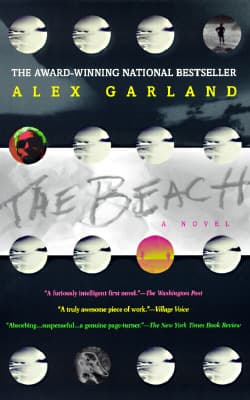
Alex Garland (1996)
Genre
Thriller / Lifestyle
Reading Time
9-11 hours
Key Themes
See below
Sign in to track this book
On a secluded Thai island, an adventurous backpacker's discovery of a utopian beach community quickly devolves into a struggle for survival as human nature's darker side erodes paradise.
Richard, a young British backpacker, arrives in Bangkok, Thailand, looking for an experience beyond typical tourist spots. He checks into a cheap guesthouse where he meets Daffy, a strange, quiet Scotsman who talks about a perfect, untouched beach. Daffy, clearly troubled, later dies by suicide, leaving a hand-drawn map to this mythical island paradise. Richard, curious and wanting to escape the ordinary, decides to investigate. He shares the map with a French couple, Françoise and Étienne, whom he befriended. Together, they plan their trip to find the beach, despite the dangers and Daffy's warnings about its inhabitants.
Following Daffy's map, Richard, Françoise, and Étienne travel south to the Thai coast. The map shows the beach on an island in a national marine park, which is closed to tourists. To avoid being seen, they swim across a dangerous stretch of ocean, just missing a patrol boat, then walk through thick jungle. Their journey is risky, with waterfalls and steep cliffs. They find a secret cannabis farm guarded by armed Thai farmers. This discovery suggests the island's reality is not idyllic and shows the dangers of their path. They manage to get past the guards and keep looking for the beach.
After getting past the cannabis growers, Richard, Françoise, and Étienne find the legendary beach. It is a beautiful, secluded cove, home to a small, international community of backpackers who have created a utopian life. Sal, the leader, and her American boyfriend, Bugs, greet them. The community lives by unwritten rules, sharing resources and tasks, aiming for a life free from modern society's limits. Richard feels he belongs, drawn to the beauty and the seemingly peaceful way of life, though he soon notices an underlying tension and strict adherence to their isolated existence.
Richard quickly adjusts to life on the beach, helping with fishing, cooking, and group activities. He becomes close with Françoise, leading to a romance that causes some tension with Étienne. As he settles in, Richard notices the community's rigid structure and the unspoken fear of outsiders. The 'utopia' is kept going by strict rules and a shared commitment to secrecy. He also learns about the previous group that tried to live on the beach, whose tragic end is a warning. Richard's early idealism starts to fade as he sees the group's isolation and the subtle power dynamics, especially Sal's influence over decisions and some members' growing unhappiness.
During a fishing trip, Christo, a community member, is badly attacked by a shark, losing an arm and suffering severe injuries. This event breaks the illusion of their perfect life and shows the community has no medical help and cannot handle a serious crisis. Sal decides to let Christo die rather than risk showing the beach by seeking outside medical help. This decision deeply upsets Richard and others, creating a big split in the group. The incident shows the harsh truth of their self-imposed isolation and the moral choices they must make to keep their secret paradise.
After Christo's death, Richard becomes more troubled by Sal's strict rule and the community's involvement. He volunteers for the dangerous and lonely job of guarding the cannabis farm from the farmers, a role Daffy used to have. This isolation, with his guilt over Christo and his growing disappointment with the beach, starts to harm his mental state. He begins to hallucinate, seeing Daffy and having vivid, unsettling visions. His behavior becomes wild and paranoid, like Daffy's earlier decline, as he tries to make sense of the beach's beauty with its harsh realities and the compromises made to keep it going.
While guarding the farm, Richard sees a group of American tourists trying to reach the beach, using a map like his. Fearing exposure, he breaks their raft and leaves them stranded, hoping they will give up. But the tourists keep going, and Richard, driven by a twisted sense of duty to protect the beach, starts to follow them, seeing them as a threat. The cannabis farmers, already suspicious of the beach community, see his actions. This increases tension, as the farmers, fearing their operation will be found out, give a strong warning to the beach inhabitants.
The cannabis farmers, having seen Richard's wild behavior and the American tourists' continued presence, give Sal an ultimatum. They demand that the beach community get rid of the tourists, threatening to kill everyone if they do not. This puts Sal and the others in an impossible spot, forcing them to face the brutal results of their secret life. Richard, still mentally fragile, decides to 'handle' the tourists, falling further into a morally unclear role, believing he is protecting the beach, even if it means doing terrible things.
Richard, in a final act of desperation and delusion, creates a cruel 'game' to deal with the American tourists. He manipulates the situation to ensure their deaths, believing it is the only way to save the beach. The community, frozen by fear, watches as the farmers kill the tourists. This is a result of Richard's actions and Sal's desperate attempts to keep things as they are. This horrific event completely destroys the community's remaining ideas of utopia. The group's moral structure falls apart, and the members are left struggling with the lasting trauma and guilt of what they saw and allowed.
After the horrific deaths of the tourists, the beach community is completely broken. The once-perfect paradise is now stained by violence, fear, and deep guilt. Members start to leave, unable to handle the moral compromises and the loss of their utopian dream. Sal, overwhelmed by the collapse, also leaves. Richard, Françoise, and Étienne decide to leave together; their relationships are strained and changed forever by their experiences. They return to civilization, always marked by the beautiful, but ultimately destructive, secret they shared. Richard thinks about the illusion of paradise and the flaws in human nature that ultimately destroy any attempt at a perfect society.
The Protagonist
He transforms from an adventurous idealist to a paranoid, morally compromised individual, ultimately realizing the impossibility of a perfect human society.
The Supporting
She begins as an adventurous traveler, falls in love, and becomes disillusioned by the community's dark turn, eventually choosing to escape its corruption.
The Supporting
He begins as a loyal and quiet partner, endures betrayal and trauma, and leaves the beach a more somber, reflective individual.
The Supporting
She transforms from an idealistic leader into a hardened, morally compromised individual, ultimately unable to sustain her vision of paradise.
The Mentioned
Already mentally broken when introduced, his story serves as a tragic precedent for the dangers of the beach.
The Supporting
He remains loyal to Sal and the beach's rules, becoming increasingly complicit in its darker aspects, but ultimately leaves when it collapses.
The Supporting
His tragic injury and death expose the fragility and moral bankruptcy of the beach community.
The Supporting
She consistently questions the community's moral compromises, becoming a voice of dissent.
The Antagonists
They remain a constant, looming threat, eventually becoming direct antagonists who force the community's collapse.
The novel explores how impossible it is to create a perfect society, especially when it needs strict isolation and secrecy. The beach first looks like an untouched paradise, a escape from modern life's artificiality. But to keep its 'purity' and hidden status, the community makes increasingly brutal moral compromises, like abandoning Christo and sacrificing the American tourists. The act of protecting their secret paradise ruins it, turning the dream into a nightmare as fear and paranoia destroy their early ideals. The beach shows how humans tend to destroy what they try to save with misguided intentions.
“For the first time it occurred to me that maybe Daffy hadn't been mad at all. Maybe he'd just been there too long.”
Garland looks at how human behavior worsens without outside societal rules and moral accountability. On the beach, away from civilization's rules, the community's idealism quickly turns into tribalism, paranoia, and cruelty. Richard's change from an adventurous backpacker to a manipulative, unstable person shows this decline. The isolation, while freeing at first, creates an environment where fear, suspicion, and a desperate need for control override empathy and ethics. The novel suggests that the 'wild' part of human nature, when unchecked, can be more destructive than any outside force.
“We were not colonials, we were refugees. We were not building a new society, we were escaping an old one.”
Richard's journey is driven by a wish to find something 'real' and authentic, beyond typical tourism. The beach promises this authenticity. However, the novel questions if his search is truly for authenticity or just an elaborate escape. The community on the beach, trying to create an 'authentic' life, ends up building a very artificial and unsustainable one, defined by strict rules and a constant show of their ideal. Richard's early idealism turns into a desperate clinging to a flawed reality, suggesting that true authenticity cannot be found by running from society, but must be faced within oneself.
“I was back in the world. I was back in the real world. And the real world was fine. But it wasn't the Beach.”
The novel examines how leadership works and how power corrupts within a small, isolated community. Sal, as the leader, first represents the group's vision, but as problems arise, she becomes more authoritarian, making difficult and often morally questionable decisions to keep control and protect the beach's secret. Her choices, especially about Christo and the American tourists, show the heavy burden of leadership and how easily ideals can be given up for perceived survival. Richard's own attempts to take control and his eventual decline into a Daffy-like state further explore the dangers of unchecked power and the compromises made to get it.
“The problem with paradise, I thought, was that it was a prison.”
Richard's narration itself is a plot device, as he tells the events from a future point, allowing for reflection and some unreliability. The story is seen through his memory, which is affected by trauma and disappointment. The novel also touches on how stories and myths (like the beach legend) are made and kept alive, and how they can shape how people see things and act. Daffy's map and diaries are central to this, acting as both a guide and a warning, passed down and reinterpreted. The community itself creates a story of utopia, which is ultimately broken by the harsh realities they face, showing how fragile made-up stories are.
“And the map wasn't just a map. It was a story. A story that had to be told, and a story that had to be finished.”
A literal and symbolic guide to a hidden paradise and a descent into madness.
Daffy's hand-drawn map serves as the central inciting incident, a tangible object that sets Richard's quest in motion. Beyond its literal function as a guide to the beach, it acts as a powerful symbol of the allure of the unknown, the promise of escape, and the potential for danger. It represents the collective human desire for an untouched, perfect place. As the story progresses, the map's significance evolves, becoming a symbol of a false promise and the path to moral corruption, mirroring Daffy's own tragic journey.
Provides an intimate, yet potentially unreliable, perspective on the events.
The story is told entirely from Richard's perspective, giving readers direct access to his thoughts, observations, and emotional state. This allows for a deep dive into his psychological journey and descent into paranoia. However, it also introduces an element of unreliability, as his perceptions are colored by his increasing mental instability and the trauma he experiences. This narrative choice immerses the reader in Richard's subjective reality, making the unraveling of the 'paradise' more personal and impactful, while also inviting questions about the truth of his account.
A secluded environment that reflects broader societal issues and human nature.
The isolated beach community functions as a microcosm, a small-scale representation of larger societal structures and human tendencies. Freed from external laws and norms, the community quickly develops its own rules, hierarchies, and conflicts. It demonstrates how easily idealism can give way to pragmatism, how a desire for peace can lead to violence, and how secrecy can breed paranoia. The beach becomes a controlled experiment to examine the inherent flaws in human nature and the challenges of sustaining any form of utopia.
Daffy's madness and suicide prefigure Richard's own psychological decline.
Daffy's character and his tragic end serve as a powerful instance of foreshadowing. His ramblings about the beach, his mental instability, and his eventual suicide hint at the dark side of the 'paradise' and the psychological toll it can take. Richard's gradual descent into paranoia and his increasingly erratic, Daffy-like behavior directly mirror his predecessor's fate, creating a chilling sense of inevitability. This device builds suspense and underscores the novel's thematic exploration of the corrupting influence of isolation and the illusion of utopia.
A constant external threat and a symbol of the world the community seeks to escape.
The hidden cannabis plantation, guarded by armed farmers, serves as a persistent external threat to the beach community's existence. It represents the 'real world' they are trying to escape – a world of illicit activities, danger, and the need for secrecy. The farmers' presence forces the community to remain hidden and ultimately becomes the catalyst for their most horrific moral compromises. It grounds the utopian dream in a harsh reality, reminding the characters and the reader that their paradise is always precarious and intertwined with external dangers.
“I believe in a long, prolonged, derangement of the senses in order to obtain the unknown.”
— Richard reflects on his desire for extreme experiences and escape from ordinary life.
“The only person who gets hurt on the beach is the one who doesn't respect it.”
— A warning from Sal, the leader of the beach community, about the dangers of their paradise.
“We had finally found the beach, and it was perfect. And then, of course, it wasn't.”
— Richard describes the initial idealism and subsequent disillusionment with the hidden beach.
“Traveling is a brutality. It forces you to trust strangers and to lose sight of all that familiar comfort of home and friends.”
— Richard muses on the harsh realities of backpacking and seeking adventure.
“The beach is a state of mind.”
— A phrase used by characters to describe their secluded paradise as more than just a physical location.
“I wanted to be a part of something, even if it was something that didn't really exist.”
— Richard admits his longing for belonging, even in a fabricated community.
“In Thailand, you can disappear. You can become someone else.”
— Reflecting on the allure of Southeast Asia for Western travelers seeking reinvention.
“We were all running away from something, but we didn't know what we were running to.”
— Richard observes the shared motivations of the beach's inhabitants.
“Paradise comes with a price, and we were all willing to pay it.”
— Acknowledging the compromises and sacrifices made to maintain their utopian lifestyle.
“The map is not the territory.”
— A philosophical remark about the difference between perception and reality, especially regarding their quest.
“We thought we were pioneers, but we were just tourists with a better view.”
— Richard's realization about the superficiality of their adventure and isolation.
“In the end, the beach was just a mirror, and we didn't like what we saw.”
— Reflecting on how the community's paradise revealed their own flaws and conflicts.
“You can't escape yourself, no matter how far you travel.”
— A lesson Richard learns as personal issues follow him to the secluded beach.
“The thrill of discovery was gone, replaced by the fear of losing what we had.”
— Describing the shift from excitement to paranoia as the beach's perfection unravels.
Ready to see how well you understood this book? Take our interactive quiz with 10 questions.

Alex Garland is a British novelist and screenwriter, best known for his debut novel 'The Beach,' which was adapted into a major film. His work often explores themes of existentialism, technology, and the human condition. Garland has also penned screenplays for acclaimed films such as '28 Days Later' and 'Ex Machina'.







