“People are more difficult to work with than machines. And when you break a person, he can't be fixed.”
— Hephaestus warns Percy about the dangers of underestimating human complexity.

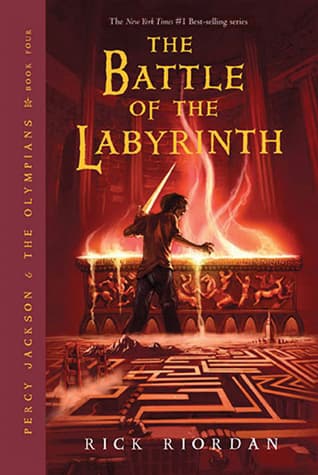
Rick Riordan (2008)
Genre
Fantasy / Children's / Young Adult
Reading Time
360 min
Key Themes
See below
Sign in to track this book
Percy Jackson navigates a dangerous, monster-filled labyrinth that changes with its creator's thoughts to stop Kronos's army from invading Camp Half-Blood and releasing an ancient evil.
Percy Jackson attends freshman orientation at Goode High School, hoping for a normal start, but his peace is broken when he meets Rachel Elizabeth Dare, a mortal who can see through the Mist. They are soon attacked by two empousai, Kelli and Tammi, disguised as cheerleaders, who are loyal to Luke and Kronos. Rachel helps Percy escape the fiery attack, showing her ability to see mythical creatures. After the fight, Percy leaves, his hopes for a normal school year gone, as he realizes monster attacks are increasing and threatening his life, even in the mortal world. He knows the war with Kronos is getting closer.
Percy returns to Camp Half-Blood, where he sees Annabeth, Grover, and Tyson again. During a sword-fighting lesson with Quintus, a new mysterious instructor, Percy and Annabeth accidentally find an entrance to the Labyrinth. They realize that Luke and Kronos's army could use this old, large maze to get around the camp's magic defenses and invade from inside. The camp is on high alert, and the demigods understand the need to stop this threat. Chiron confirms their fears, explaining the danger the Labyrinth presents.
During a meeting with the gods, it is revealed that the Labyrinth is growing and changing, making it an even more unpredictable and dangerous passage. Annabeth Chase, wanting to prove herself, is chosen to lead the quest into the Labyrinth to find Daedalus's workshop and stop Luke from getting the Ariadne's string, which would let him navigate the maze easily. The Oracle of Delphi gives a prophecy, hinting at betrayal, a hard choice, and a 'ghost's last breath.' Percy, Grover, and Tyson are chosen to go with Annabeth on this mission, which surprises her.
Annabeth, Percy, Grover, and Tyson enter the Labyrinth through the Camp Half-Blood entrance. The maze immediately confuses and endangers them, with shifting walls and illusions. They soon meet the ghost of King Minos, who says he is their guide. Minos, an old enemy of Daedalus, tries to manipulate Annabeth, causing distrust in the group. His presence adds psychological tension, as he constantly reminds Annabeth of the dangers and possible betrayals in the Labyrinth. The team quickly learns that the Labyrinth is alive, always changing and testing them.
As they go through the Labyrinth, the team faces many challenges. They meet the Sphinx, solving riddles that have become easy because of modern 'fact' changes. They also fight dracaenae and other creatures loyal to Kronos. Grover, still wanting to find the lost god Pan, feels a strong connection to nature in the Labyrinth and thinks he is getting closer to his goal. His journey adds a story about environmentalism and the fading of old wild places, making him temporarily split from the main group with Tyson to follow a strong lead, leaving Percy and Annabeth to continue alone for a time.
Percy and Annabeth eventually meet up with Grover and Tyson. The quest leads them to Geryon's ranch, where the three-bodied monster runs a business but is involved in illegal monster trafficking. They seek help from Nico di Angelo, who is at the ranch trying to summon his dead sister, Bianca. Nico, still sad and angry at Percy, is manipulated by Minos and Geryon. Percy fights Geryon, defeating him, and afterward, tries to get Nico to join their side, but Nico remains undecided and focused on his own quest to bring back Bianca.
The demigods travel to Hephaestus's forge, deep in the Labyrinth, to ask for his help. Hephaestus, the god of blacksmiths, gives them a dangerous task: to find out what is messing with his forges and tell him. They discover that Luke's forces are using Hephaestus's workshop to make weapons for Kronos's army and are trying to corrupt the god's automatons. This meeting confirms that Luke is trying to find Daedalus and get the Ariadne's string to lead his army through the Labyrinth directly to Camp Half-Blood, making their quest more urgent.
During their mission for Hephaestus, Percy is caught in an explosion and taken to Ogygia, the island of the nymph Calypso. He is healed and tempted to stay forever, but his loyalty to Annabeth and his quest makes him leave, a hard choice that fulfills part of the prophecy. When he returns, the team discovers that Quintus, the new sword instructor at Camp Half-Blood, is Daedalus himself, having put his mind into an automaton body. This is a big shock, as Daedalus has been subtly guiding and watching them.
The quest team reaches Daedalus's workshop, an amazing piece of old technology. They find Daedalus, still in his Quintus form, along with his hellhound, Mrs. O'Leary, who has been with Percy during parts of the quest. Daedalus explains his reasons and his wish to protect his inventions, including the Labyrinth itself. However, Luke and his army, led by the monster Antaeus, soon arrive, having followed them. A battle starts in the workshop, with the demigods fighting to stop Luke from taking control of the Labyrinth's master control panel, the Ariadne's string.
During the battle in Daedalus's workshop, Nico di Angelo, guided by Bianca's spirit, arrives and makes a choice, siding with the demigods and using his powers over the dead to change the fight. He helps them defeat Antaeus. Realizing that the Labyrinth will be a threat as long as he is alive, Daedalus makes a sacrifice. He dies, ending his life force and destroying the Labyrinth, cutting off Luke's invasion route to Camp Half-Blood. This fulfills the 'ghost's last breath' part of the prophecy, and the Labyrinth collapses.
Even with Daedalus's sacrifice and the Labyrinth's collapse, Kronos's forces, having found a different, less direct, route, attack Camp Half-Blood. The remaining members of Luke's army, including the empousa Kelli, storm the camp. A battle happens on Half-Blood Hill. The demigods, led by Percy, Annabeth, and Clarisse, fight to defend their home. They are helped by the wild nature spirits summoned by Grover, who, having accepted his failure to find Pan, takes on his role as a protector of the wild, and by Tyson, who shows his strength in combat.
The demigods, with help from the wild nature spirits and Clarisse's cleverness, repel Kronos's invasion, though with losses and damage to the camp. Kelli is defeated, and the immediate threat is gone. However, the victory is not completely happy. Luke escapes, and the knowledge that Kronos is getting stronger and closer to fully possessing Luke's body creates a dark feeling. The war is not over, and the demigods realize that the final fight is coming. Nico, now more allied with Percy, decides to explore his powers, hinting at future roles.
The Protagonist
Percy matures significantly, making difficult choices and accepting greater responsibility in the face of impending war.
The Protagonist/Quest Leader
Annabeth embraces her leadership potential, gaining confidence and confronting her fears while navigating complex emotions.
The Supporting
Grover faces the reality of Pan's disappearance and finds a new, more active role in protecting the wild.
The Supporting
Tyson grows in confidence and demonstrates his valuable contributions to the team, both physically and emotionally.
The Supporting
Nico begins to overcome his grief and anger, choosing to use his powers for good and aligning himself with the forces of Olympus.
The Supporting/Antagonist
Daedalus, driven by fear and regret, ultimately finds redemption through self-sacrifice to protect the demigods and destroy his own creation.
The Antagonist
Luke becomes increasingly consumed by Kronos, losing more of his original self as the Titan Lord gains power.
The Supporting
Rachel embraces her unique ability and becomes a key ally to Percy, demonstrating courage and a growing understanding of the demigod world.
The Antagonist
Kronos continues to gain power and influence, drawing closer to his full resurrection and the final war against the gods.
Identity is a main theme, especially for Annabeth, Nico, and Grover. Annabeth tries to prove herself as a leader and make her own path beyond her mother's influence. Nico deals with his identity as a son of Hades and his grief, eventually choosing his loyalty. Grover, facing the truth about Pan, must find a new purpose. Even Daedalus's multiple identities show a search for meaning beyond his original form. Each character's journey involves understanding who they are and what they stand for under pressure.
“"The world was a scary place. Even if you were a demigod, you never knew what was around the next corner. You could be happy one minute, and then a monster could eat you the next. Or your best friend could betray you. Or you could find out your new sword instructor was the legendary inventor Daedalus, who had built the Labyrinth that was about to destroy your camp."”
Loyalty is a main theme, tested throughout the quest. Percy's strong loyalty to his friends, especially Annabeth, drives the story. The prophecy warns of betrayal, which appears in different ways: Luke's continued treachery, Minos's manipulation of Nico, and the initial distrust of Daedalus/Quintus. Nico's internal struggle between loyalty to his dead sister and his growing bond with Percy shows this theme, ending in his choice to fight with the demigods. The constant threat of betrayal highlights how important trust is in a dangerous world.
“"You promised to protect me. You promised to protect Bianca. You broke your promises!"”
The book looks at immortality and the legacy someone leaves. Daedalus's long life, achieved by moving his mind into automaton bodies, shows the burden of living too long and the regrets that build up. His desire to protect his inventions, even at others' expense, shows a mistaken idea of legacy. Pan's disappearance also relates to this, showing that even gods can fade if their domains are forgotten or destroyed. The demigods, in contrast, try to create a good legacy through their actions, despite their mortal lives.
“"My life... it has been long and full of regret. I have lived too long. I have seen too much. And I have done too much wrong."”
Grover's quest for Pan directly addresses environmentalism and the fading of wild places. Pan's last message says that nature needs protection, not a leader, and that the wild god lives in all nature spirits and mortals who care for the environment. The Labyrinth itself, as a living, growing thing, can be seen as a symbol for the wild, unpredictable parts of nature. The damage by Kronos's forces and the impact on the natural world emphasize the importance of preserving the environment, a message that strongly affects Grover.
“"Pan is dead. The wild god is no more. But the wild lives on. It lives in you. It lives in all of us. Protect it. Cherish it. Let it grow."”
Free will and destiny are repeated ideas. The prophecy given to Annabeth outlines a path, but the characters' choices determine how it happens. Nico's decision to get over his anger and join the fight, Percy's choice to leave Calypso's island, and Daedalus's sacrifice are examples of characters shaping their own destinies rather than just accepting fate. This theme suggests that while prophecies may hint at the future, individual courage and moral choices define a hero.
“"To storm the maze, or be devoured by its maker... The choice is yours, demigod."”
A magical, shifting maze used as a portal and a central setting.
The Labyrinth is the primary plot device, serving as both the setting for the quest and the main threat. It's a vast, sentient, and constantly shifting underground maze designed by Daedalus, capable of connecting to almost any location. It represents unpredictability and danger, forcing the characters to rely on their wits and each other. Its existence allows Kronos's army a direct, hidden route to Camp Half-Blood, making its navigation and eventual destruction crucial to the story. Its magical properties, like illusions and shifting walls, create constant challenges and suspense.
Daedalus's master control panel for navigating the Labyrinth.
The Ariadne's String is a metaphorical device, not a literal string, but rather a master control panel or a mental blueprint that allows its user to navigate the Labyrinth without getting lost. It is the object of the quest, as whoever possesses it can easily lead an army through the maze. Its pursuit drives the plot, creating urgency and conflict. Luke's desire for it highlights its strategic importance, while Annabeth's quest to find it first underscores her intelligence and leadership in preventing the invasion.
A supernatural veil obscuring the mythical world from mortals.
The Mist is a magical veil that prevents mortals from perceiving the true nature of gods, monsters, and demigods, often replacing them with mundane explanations. It's a recurring device in the series, but it's particularly highlighted in this book through Rachel Elizabeth Dare, a mortal who can see through it. Her unique ability allows her to interact with Percy's world without being fooled, making her a valuable and unconventional ally. The Mist's presence constantly reminds the reader of the hidden reality coexisting with the mortal world.
A cryptic foretelling guiding the quest and foreshadowing events.
The prophecy delivered by the Oracle of Delphi serves as a guiding framework for Annabeth's quest. Its cryptic nature creates suspense and forces the characters to interpret its meaning as events unfold. It foreshadows key plot points, such as betrayal, an impossible choice (Percy on Ogygia), and Daedalus's sacrifice ('a ghost's last breath'). The prophecy builds anticipation and highlights the theme of destiny versus free will, as characters make choices that either fulfill or defy its predictions.
A loyal hellhound, a symbol of unexpected companionship.
Mrs. O'Leary, Daedalus's pet hellhound, is a symbolic plot device representing that even creatures traditionally seen as evil can be loyal and good. She defies the monstrous stereotype of hellhounds and provides companionship and aid to Percy throughout the quest, even assisting in battles. Her presence, often appearing through shadow travel, provides an element of surprise and lightens tense moments. She symbolizes that appearances can be deceiving and that loyalty can be found in unexpected places, especially within the magical world.
“People are more difficult to work with than machines. And when you break a person, he can't be fixed.”
— Hephaestus warns Percy about the dangers of underestimating human complexity.
“Even strength must bow to wisdom sometimes.”
— Annabeth reflects on the importance of strategy over brute force.
“The real story of the hero is one of failure.”
— Quintus discusses the nature of heroism with Percy.
“Families are messy. Immortal families are eternally messy.”
— Percy muses on the dysfunctional relationships among the gods.
“Knowing too much of your future is never a good thing.”
— Rachel Elizabeth Dare warns Percy about the Oracle's prophecies.
“A half-blood of the eldest gods shall reach sixteen against all odds.”
— The Great Prophecy that drives much of the series' tension.
“The world was collapsing, and the only thing that really mattered to me was that she was alive.”
— Percy's thoughts as he reunites with Annabeth in a dangerous moment.
“You deal with mythological stuff for a few years, you learn that paradises are usually places where you get killed.”
— Percy's cynical observation about seemingly idyllic locations.
“Sometimes mortals can be more horrible than monsters.”
— Percy reflects on human cruelty after encountering dangerous situations.
“I'd rather fight a hundred monsters than a single Sphinx.”
— Percy complains about the Sphinx's riddle game during the quest.
“That's the thing about being a hero: sometimes you have to die to win.”
— Percy contemplates the sacrifices required in their mission.
“The labyrinth is alive. It's a living thing.”
— Annabeth explains the nature of the ever-changing maze.
“You can't choose your parentage. But you can choose your legacy.”
— Percy encourages a fellow demigod about their destiny.
“Hope is a powerful weapon. Maybe the most powerful weapon of all.”
— Percy rallies his friends during a bleak moment in the labyrinth.
Ready to see how well you understood this book? Take our interactive quiz with 10 questions.
Biography coming soon.







