“The most important thing in life is not to be happy, but to be sure that you are happy.”
— Michael asks Turnbull about the meaning of life.

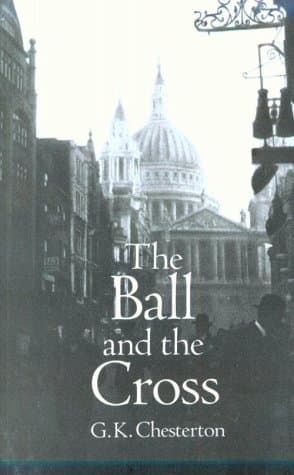
G.K. Chesterton (1909)
Genre
Fantasy / Spirituality / Philosophy
Reading Time
280 min
Key Themes
See below
Sign in to track this book
A devout Catholic and a zealous atheist, both comically naive, spark a duel and a whirlwind of allegorical adventures across England, all to settle the eternal debate between faith and reason.
The story begins when Professor Lucifer, a fervent atheist, meets Michael, a devout Catholic. Michael had publicly defended a blasphemous statement made by a shopkeeper's assistant named Turnbull. Lucifer, initially amused, becomes increasingly angered by Michael's unwavering faith and the perceived irrationality of his beliefs. Their verbal sparring quickly escalates, fueled by their mutual, opposing dogmatism. Michael, offended by Lucifer's atheistic pronouncements and a perceived slight against the Virgin Mary, challenges Lucifer to a duel to defend his faith. Lucifer, despite his modern sensibilities, accepts the challenge, seeing it as a chance to expose the absurdity of religious zealotry.
Michael and Lucifer, armed with pistols, set out to find a secluded spot for their duel, but their attempts are comically frustrated. They try a quiet park, but a policeman interrupts them. They then attempt a remote field, only to be discovered by picnickers. Each potential location is unsuitable due to modern law and the public's lack of understanding, who view their intentions as barbaric or insane. This repeated failure highlights the clash between their old code of honor and the realities of contemporary life, where such disputes are no longer settled by personal combat.
Unable to find a suitable dueling ground on land, Michael and Lucifer are unexpectedly rescued by an enormous airship. This fantastical vessel belongs to Lucifer's uncle, Turnbull, a brilliant but eccentric inventor and a staunch rationalist who created this marvel of technology. Seeing their plight, Turnbull offers them refuge on his airship, believing its isolated nature will provide the perfect, unobserved arena for their duel. This offers a temporary solution to their dilemma, lifting them above society's constraints, but also introducing them to the peculiar world of Turnbull's scientific idealism.
Aboard the airship, the duel is continually delayed, not by external forces, but by Turnbull's unique environment. The airship is populated by a diverse and often bizarre crew, including a 'madman' who believes he is a king, and a young woman named Lady Andromeda, Turnbull's ward and a symbol of his attempt to raise a child purely on reason. Turnbull, obsessed with scientific progress and social engineering, uses the airship as a laboratory for his philosophical experiments, including an attempt to create a perfect, rational society. Michael and Lucifer find themselves drawn into these strange dynamics, their duel momentarily forgotten amidst the airship's eccentricities.
Growing uncomfortable with Turnbull's rationalist experiments and the delay of their duel, Lady Andromeda, who is surprisingly resourceful, helps Michael and Lucifer escape the airship. They descend to earth in a small, experimental flying machine, landing in an English village. Their escape triggers a widespread pursuit by Turnbull and his airship crew, who are determined to recapture them and continue their 'experiments.' This starts a series of farcical chases and close calls across England, with the duo constantly on the run from Turnbull's technologically superior forces.
To throw Turnbull's pursuers off their scent, Michael and Lucifer use various elaborate disguises, often leading to humorous misunderstandings. They pose as a clergyman and his assistant, then as tramps, and even as actors, each new identity adding to the comic absurdity of their situation. Their journey takes them through numerous English inns, which serve as temporary havens and stages for their ongoing philosophical debates. These inns, with their colorful landlords and patrons, become microcosms of everyday life, contrasting sharply with the abstract intellectualism of Michael and Lucifer's quarrel and the technological detachment of Turnbull's airship.
In a desperate attempt to find a truly secluded and sacred space for their duel, Michael and Lucifer seek refuge in a remote monastery. The monks, initially confused by the two men's strange request, offer them hospitality. For a brief period, the monastery provides peace and contemplation, allowing for deeper discussions between the duellists. However, their sanctuary is short-lived. Turnbull's relentless pursuit eventually leads his airship to the monastery, disrupting the quiet and again preventing the duel, showing that even the most ancient institutions are not immune to the intrusions of the modern world.
Their increasingly bizarre behavior, coupled with their persistent desire for a duel over abstract principles, leads to Michael and Lucifer being apprehended and committed to a lunatic asylum. Here, the irony of their situation is clear. In a society that values rationality above all else, their fervent commitment to their beliefs, and their willingness to fight for them, is deemed a sign of madness. Inside the asylum, they encounter a diverse group of inmates, some genuinely disturbed, others perhaps just non-conformist, further blurring the lines between sanity and insanity in the eyes of society and highlighting the arbitrary nature of 'normalcy.'
With the help of some sympathetic inmates and their own ingenuity, Michael and Lucifer orchestrate a dramatic escape from the asylum. Renewed in their determination, they again find themselves in a direct confrontation with Turnbull and his formidable airship. This scene is a chaotic blend of action and philosophical debate, as the two duellists, now more united by their shared experiences, challenge Turnbull's detached rationalism. The airship itself becomes a symbol of the scientific arrogance and cold logic that they both, in their different ways, oppose. The confrontation is a culmination of their journey, pitting human passion against technological might.
Following the confrontation, the airship is damaged, and Michael and Lucifer are shipwrecked on a small, deserted island. With no external forces to interrupt them, they are finally able to prepare for their long-delayed duel. However, the isolation and shared ordeal have subtly changed them. As they face each other, pistols drawn, a deeper understanding of each other's convictions, and perhaps the futility of their initial animosity, begins to emerge. The duel, which was once an act of aggression, becomes a symbolic gesture, leading to a profound, if unspoken, resolution.
Eventually, Michael and Lucifer are rescued from the island by a passing ship. Their return to civilization is marked by a quiet transformation. While their fundamental beliefs remain, their experiences have broadened their perspectives and softened their initial fanaticism. They have learned to see the humanity in their opponent, and the limitations of their own dogmatism. The physical journey is over, but the philosophical journey has led them to a more nuanced understanding of faith, reason, and the complexities of the human spirit. They re-enter the world not as adversaries, but as individuals who have shared a unique and enlightening odyssey.
The Protagonist
Michael begins as a zealous defender of his faith, willing to duel for it, but through his trials, he learns to appreciate the common humanity shared with his adversary.
The Protagonist/Antagonist
Lucifer starts as an unwavering advocate for atheism, but his adventure forces him to confront the limits of pure reason and the complexities of human belief.
The Supporting
Turnbull remains largely static, serving as an exaggerated representation of scientific rationalism, whose plans are ultimately thwarted by human unpredictability.
The Supporting
Andromeda begins as a product of pure reason but gradually asserts her own emotional and spiritual independence, becoming an agent of change.
The Mentioned
The policemen remain a consistent, impersonal force of societal interruption.
The Supporting
The Madman's role is primarily symbolic, offering a static but potent commentary on sanity and perception.
The Mentioned
The landlords are static figures who provide temporary settings and represent societal normalcy.
The main theme of the novel is the conflict and eventual reconciliation between fervent religious faith (Michael) and zealous scientific reason (Lucifer). Chesterton explores the limitations and dogmatism inherent in both extremes when held without nuance. The characters' relentless pursuit of their duel, despite societal obstacles, shows the human need to believe in something, whether it be God or pure logic. Through their journey, both Michael and Lucifer must confront the humanity and sincerity of their opponent's convictions, suggesting that neither absolute faith nor absolute reason provides a complete understanding of the world. The asylum scene particularly highlights how society struggles to categorize profound conviction, often labeling it as madness.
“The great difficulty of the duel was not in fighting, but in finding a place to fight.”
Chesterton satirizes various aspects of modern society, especially its obsession with scientific progress, its bureaucratic laws, and its inability to comprehend profound, non-material conflicts. The repeated frustration of the duelists by policemen, picnickers, and the legal system underscores the mundane and often illogical constraints of the 'rational' modern world. Turnbull's airship, a marvel of technology, becomes a symbol of scientific arrogance and the potential dehumanization that can accompany a purely rationalist worldview. The commitment of Michael and Lucifer to an asylum for their 'mad' belief in a duel further mocks a society that cannot tolerate passionate conviction outside its prescribed norms.
“The modern world is so mad that it cannot even understand the sanity of a duel.”
Beneath the farcical plot is a serious inquiry into the human quest for ultimate meaning. Both Michael and Lucifer, in their opposed beliefs, are driven by a deep desire to understand the universe and their place within it. Their willingness to fight to the death for their convictions, no matter how absurd it appears to others, signifies the deep-seated human need for truth and purpose. The journey itself, rather than the duel's outcome, becomes the true path to understanding, as they must confront their own limitations and the complexities of human experience beyond their initial dogmas. The deserted island provides the ultimate setting for this internal search.
“A man's belief is his life; and if you take it from him, you kill him.”
The novel constantly plays with the idea of freedom and the various constraints placed upon it. Michael and Lucifer seek the ultimate freedom to settle their dispute according to their own code of honor, but they are consistently constrained by the laws of society, the limitations of technology, and even the eccentricities of others. Turnbull's airship, while offering physical freedom from the ground, becomes a different kind of prison, enforcing a rationalist ideology. The asylum represents the ultimate loss of freedom, yet ironically, it is within this confinement that the protagonists gain a new perspective on their own 'sanity.' The paradox is that true freedom is found not in the absence of constraint, but in understanding and accepting one's convictions amidst them.
“We are free to choose, but we are not free to choose not to choose.”
A fantastical technological marvel that serves as both refuge and prison.
Turnbull's giant airship is a prominent plot device. Initially, it offers Michael and Lucifer an escape from the societal constraints preventing their duel, symbolizing a literal elevation above earthly problems. However, it quickly transforms into a metaphorical prison, representing the detached, sterile, and potentially dehumanizing world of pure scientific rationalism. Its advanced technology allows for the continuation of the chase, but also isolates the characters, forcing them into close proximity and prolonged philosophical debate. It is both a product of human ingenuity and a symbol of its potential hubris.
The central, never-fought conflict that drives the entire narrative.
The proposed duel between Michael and Lucifer is the primary plot device, acting as the inciting incident and the constant motivation for their adventures. Paradoxically, the duel is never actually fought in the conventional sense. Its repeated postponement by external forces (police, public, technology) and internal changes (growing understanding between the men) highlights the futility of such a physical confrontation for philosophical differences. The duel becomes a symbol of their initial, narrow-minded dogmatism, and its ultimate non-occurrence (or transformation) signifies their growth and a more profound resolution.
A series of farcical pursuits that propel the characters through diverse settings.
The extended chase sequence, with Michael and Lucifer constantly on the run from Turnbull's airship and other societal forces, is a key plot device. It provides the narrative structure, moving the characters through various English landscapes and social situations (inns, monasteries, asylum). This constant movement prevents the duel from occurring while forcing the protagonists into close, prolonged interaction, deepening their understanding of each other. The farcical nature of the chase also injects humor, preventing the philosophical debates from becoming overly dry and emphasizing the absurdity of their situation within a 'normal' world.
Various assumed identities used to evade capture, leading to comic misunderstandings.
The use of disguises by Michael and Lucifer is a recurring plot device that adds to the novel's comedic and allegorical layers. By adopting different identities (clergymen, tramps, actors), they highlight the fluidity of social roles and the superficiality of outward appearances. These disguises often lead to humorous misunderstandings with the general public, further emphasizing the chasm between the duelists' abstract concerns and everyday life. Allegorically, the disguises can be seen as representing the different 'masks' people wear, and how their true convictions remain despite external presentations.
“The most important thing in life is not to be happy, but to be sure that you are happy.”
— Michael asks Turnbull about the meaning of life.
“The madman is not the man who has lost his reason. The madman is the man who has lost everything but his reason.”
— Turnbull explains the nature of madness to Michael.
“You can never be just to a man if you do not understand him. And you can never understand him if you do not love him.”
— Michael reflects on his relationship with Turnbull.
“The object of opening the mind, as of opening the mouth, is to shut it again on something solid.”
— Turnbull argues against endless skepticism.
“It is always the man who is not quite sure of his God who is quite sure of his virtues.”
— The two men discuss the relationship between faith and morality.
“The world is not a problem to be solved; it is a mystery to be experienced.”
— Michael grapples with the complexities of the world.
“The greatest crimes are not committed for money, but for a philosophy.”
— Turnbull comments on the motivations behind human actions.
“There are no uninteresting things, only uninterested people.”
— Michael tries to find wonder in everyday life.
“The only way to get rid of a temptation is to yield to it. Resist it, and your soul grows sick with longing for the things it has forbidden to itself.”
— A discussion on the nature of temptation.
“A man is not a man until he is in trouble.”
— Turnbull observes Michael's transformation through adversity.
“The true soldier fights not because he hates what is in front of him, but because he loves what is behind him.”
— The characters discuss the reasons for fighting.
“Logic and truth are not the same thing. Logic is the beginning of wisdom, not the end.”
— Turnbull challenges Michael's purely rational approach.
“The only way to enjoy a thing is to be afraid of losing it.”
— Michael considers the value of precious things.
“It is easy to be a rebel; it is much harder to be a saint.”
— The characters discuss different forms of defiance and virtue.
“To be clever enough to get all that money, one must be stupid enough to want it.”
— A critique of materialism and ambition.
Ready to see how well you understood this book? Take our interactive quiz with 10 questions.

Biography coming soon.







