“If you are interested in stories with happy endings, you would be better off reading some other book.”
— The narrator's opening warning to readers.

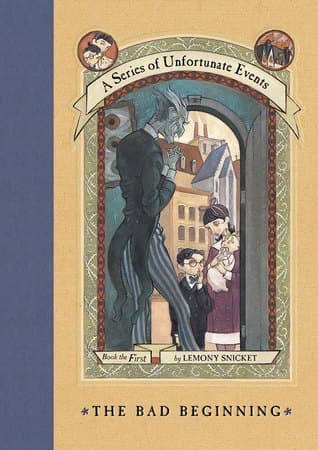
Lemony Snicket (1999)
Genre
Fantasy / Children's / Mystery / Young Adult
Reading Time
120 min
Key Themes
See below
Sign in to track this book
Three intelligent but unlucky orphans must outsmart a greedy, master-of-disguise villain who relentlessly pursues their inheritance through a series of bizarre and miserable events.
Violet, Klaus, and Sunny Baudelaire are enjoying a gloomy day at Briny Beach when Mr. Poe, a banker and family friend, arrives with bad news. Their parents have died in a fire that also destroyed their mansion, leaving only ashes and a charred safe. The children are now orphans. Mr. Poe explains they must live with a guardian until Violet, the eldest, turns eighteen. Despite their shock and sadness, the children must leave their familiar life for an uncertain future. Mr. Poe manages their affairs and their large, but currently unavailable, inheritance.
Mr. Poe takes the Baudelaire orphans to their new guardian, Count Olaf, a distant relative they have never met. Olaf's house is a run-down, dirty mansion in a grimy part of the city. When they arrive, Olaf shows himself to be a tall, thin man with an unpleasant unibrow and an eye tattoo on his ankle, which the children find disturbing. He immediately treats them poorly, making them share a single, cramped bedroom with one bed and demanding they do all household chores. The children quickly realize Olaf only cares about their inherited money, not their well-being.
Life with Count Olaf is bad. He forces Violet, Klaus, and Sunny to do hard chores like chopping wood, weeding his garden, and cooking his meals. He gives them little, unappetizing food like cold porridge. He never takes them out or offers any comfort. When Klaus complains about the lack of food, Olaf backhands him across the face. The children try to tell Mr. Poe about Olaf's cruelty, but Mr. Poe dismisses them. He is too focused on rules and does not see the danger the children are in, believing Olaf is just eccentric.
Count Olaf announces that he and his theater group will perform a play called 'The Marvelous Marriage.' He insists that all three Baudelaire orphans must take part. Violet plays the bride, Sunny is a silent baby, and Klaus is a minor character. The children are uneasy about the play, especially when Olaf says the marriage ceremony in the play will be legally binding. Klaus, using his love for reading, finds a book on marriage law. He learns that if a real justice of the peace performs the marriage and Violet says 'I do' in front of witnesses, it will be legitimate.
Klaus, after hours in the library, finds the legal loophole Count Olaf plans to use. The play's script, written by Olaf, includes a line where Violet, as the bride, must say 'I do' and sign a legal document. With a real justice of the peace officiating and witnesses present, the marriage would be legal, giving Olaf control of the Baudelaire fortune. When Klaus confronts Olaf, the count gets angry and dangles Sunny from the top of his tower, threatening to drop her if Violet refuses the ceremony. The children are trapped and must obey to save their baby sister.
The night of the play arrives. Violet wears a scratchy white gown, Klaus is dressed as a notary, and Sunny is in a cage. Justice Strauss, Olaf's kind neighbor and a real justice of the peace, is made to officiate, thinking it is just part of the show. Violet, under duress and fearing for Sunny's life, says 'I do' and signs the marriage document with her left hand, though she is right-handed. Olaf brags, thinking he has secured the Baudelaire fortune. The audience, including Mr. Poe, does not realize the sinister reality happening on stage.
After the curtain call, Count Olaf tells the audience his real intentions, declaring himself married to Violet and the rightful heir to the Baudelaire fortune. Mr. Poe, finally understanding the situation, is horrified. However, Violet, clever and resourceful, calmly reveals that the marriage is not legally binding. She explains that she signed the document with her left hand, despite being right-handed, making her signature invalid under the law. Justice Strauss confirms this technicality, stopping Olaf's elaborate plan.
Angry at Violet's cleverness and his plan's failure, Count Olaf tries to run away. He tells his henchman, the Hook-Handed Man, to turn off the lights, making the theater dark. In the confusion, Olaf and his entire theater group escape. Mr. Poe, flustered and ineffective, apologizes to the children. Justice Strauss offers to take them in, but Mr. Poe says she is not a relative according to the parents' will. The Baudelaire orphans are again without a guardian, facing an uncertain future, but now fully aware of the ongoing threat from the escaped Count Olaf.
The Protagonist
Violet transforms from a grieving orphan to a cunning protector, using her inventive mind to save her siblings from Count Olaf's schemes.
The Protagonist
Klaus evolves from a bookish boy to a vital investigator, using his intellect to expose villainous plots.
The Protagonist
Sunny remains a constant source of innocence and surprising strength, unknowingly being a catalyst for her siblings' actions.
The Antagonist
Count Olaf's arc is one of escalating villainy and cunning, constantly pursuing the Baudelaire fortune with ruthless determination.
The Supporting
Mr. Poe remains largely static, consistently failing to grasp the severity of the orphans' situation despite repeated evidence.
The Supporting
Justice Strauss's arc is one of unwitting involvement in a villainous plot, followed by genuine sympathy and an attempt to help the orphans.
The Supporting
He remains a loyal, menacing henchman, a constant physical threat to the children.
A main theme in the book is the complete incompetence and unawareness of the adults meant to protect the Baudelaire orphans. Mr. Poe, despite his good intentions, repeatedly fails to see through Count Olaf's obvious disguises and bad plots, dismissing the children's real concerns. His focus on rules prevents him from seeing real danger. This theme shows the children's isolation and forces them to rely only on their own intelligence to survive, as the adult world constantly fails them.
““I am afraid that your parents have, in fact, perished in a terrible fire,” Mr. Poe said, and then coughed into his handkerchief.”
Despite great sadness, neglect, and direct threats, the Baudelaire orphans show great resilience and resourcefulness. Violet uses her inventing skills, Klaus uses his knowledge from books, and even baby Sunny helps with her biting. They always work together to solve problems and escape danger, often outsmarting the adults around them. Their ability to think and act well when facing trouble is their strongest weapon against Count Olaf's plans, showing their inner strength and refusal to give up.
““If only we had some way of getting up there,” Violet said, thinking aloud. “We could climb the side of the tower.””
Count Olaf is pure evil and greed. His only goal is to get the Baudelaire fortune, and he will neglect, abuse, and even try fraudulent marriage to get it. He shows no empathy or regret, finding entertainment in the children's suffering. This theme explores how greed can corrupt people and lead them to do bad things, and how evil can be sneaky, often hiding in plain sight or seeming legitimate. Olaf's acting also suggests how evil can put on a convincing show.
““You see, orphans, I am now your legal father, and you are my children. The Baudelaire fortune is mine!””
The entire story is about loss and grief. The children start the story having just lost their parents and their home in a terrible fire. This initial trauma sets the mood for their later misfortunes. Their parents' absence creates a gap no new guardian can fill, and their inherited money, meant to secure their future, becomes the very thing that brings danger. The book subtly explores how children deal with great loss and how it shapes how they see the world, making them cautious and often cynical about others' intentions.
“The Baudelaire orphans were not, of course, very happy. They were thinking of their parents, and of their home, and of their whole lives, which had been turned upside down.”
A distinctive, melancholic, and meta-fictional voice.
Lemony Snicket serves as both the author and the in-story narrator, directly addressing the 'Dear Reader' with warnings and philosophical asides. His voice is characterized by a dry, morbid wit, a vast vocabulary, and a constant foreboding tone. He frequently defines complex words and offers cynical observations about the world and human nature. This meta-fictional device creates a unique reading experience, distancing the reader slightly from the immediate horror while simultaneously drawing them into the grim reality of the Baudelaire's lives, emphasizing the tragic nature of their story.
The reader and orphans are aware of danger, while adults remain oblivious.
Dramatic irony is a key device, particularly in the interactions between the Baudelaire orphans, Count Olaf, and Mr. Poe. The reader and the children are acutely aware of Olaf's villainy and his sinister intentions, while Mr. Poe and other adults remain utterly oblivious. For instance, Mr. Poe fails to recognize Olaf's obvious 'disguises' or the true nature of the 'play.' This creates tension and frustration for the reader, highlighting the children's isolation and the adults' incompetence, making the children's plight even more agonizing.
A recurring symbol representing observation, secrets, and Olaf's pervasive influence.
The symbol of the eye appears repeatedly throughout the book. It is most prominently featured as a tattoo on Count Olaf's ankle and is present in the decor of his dilapidated house. The eye symbolizes constant observation, secrets, and the pervasive, watchful influence of Count Olaf and potentially a larger, mysterious organization. It implies that the children are always being watched, and that there are hidden depths to the tragedy that are yet to be revealed. It creates an unsettling atmosphere of being perpetually under surveillance and danger.
A macguffin driving the plot and symbolizing their lost security.
The Baudelaire fortune acts as a central macguffin, the object that drives the entire plot. It is the reason Count Olaf pursues the orphans, and its inaccessibility until Violet comes of age creates the legal loophole Olaf attempts to exploit. While it represents the children's lost security and their parents' legacy, it also becomes a source of immense danger, attracting villainy rather than providing comfort. The fortune serves as a tangible representation of what the children have lost and what they constantly fight to protect.
“If you are interested in stories with happy endings, you would be better off reading some other book.”
— The narrator's opening warning to readers.
“It is a curious thing, the death of a parent. You never get over it, but you learn to live with it.”
— Reflecting on the Baudelaire children's loss.
“Fate is like a strange, unpopular restaurant filled with odd little waiters who bring you things you never asked for and don't always like.”
— Describing the children's unfortunate circumstances.
“The way sadness works is one of the strange riddles of the world.”
— Observing the children's emotional state.
“It is very useful, when one is young, to learn the difference between 'literally' and 'figuratively'.”
— Explaining a situation with Count Olaf.
“A library is like an island in the middle of a vast sea of ignorance, particularly if the library is very tall and the surrounding area has been flooded.”
— Describing the importance of books and knowledge.
“Sometimes, just saying that you hate something, and having someone agree with you, can make you feel better about a terrible situation.”
— The children bonding over their dislike of Count Olaf.
“Wicked people never have time for reading. It's one of the reasons for their wickedness.”
— Commenting on Count Olaf's lack of interest in books.
“It is a terrible thing to have to say, but sometimes it is better to be alone than to be in bad company.”
— Advising the children about their guardians.
“The world is quiet here.”
— The motto of V.F.D., mentioned cryptically.
“There are many things in this world that are not what they seem.”
— Warning about deceptive appearances.
“It is a sad truth that the world is full of people who are eager to believe the worst about others.”
— Reflecting on the children's struggles with adults.
“A good library will never be too neat, or too dusty, because somebody will always be in it, taking books off the shelves and staying up late reading them.”
— Describing the ideal state of a library.
“Misfortune, like a cockroach, is very difficult to get rid of once it has infested your home.”
— Comparing the Baudelaires' persistent troubles.
Ready to see how well you understood this book? Take our interactive quiz with 10 questions.
Biography coming soon.







