“He knew that the only way to truly defeat evil was to expose it, to refuse to let it hide in the shadows.”
— Miroslav's growing resolve to bear witness to the atrocities.

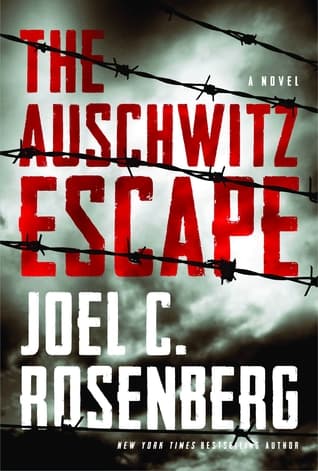
Joel C. Rosenberg (2014)
Genre
Thriller / Historical Fiction
Reading Time
10-12 hours
Key Themes
See below
Sign in to track this book
A young Jewish man, after escaping Nazi Germany and joining the resistance, must find a way to break out of the horrific Auschwitz death camp and expose the Holocaust to a world on the brink of collapse.
In 1938 Berlin, Jacob Weisz, a young Jewish man, lives with his family during growing Nazi persecution. 'Kristallnacht' erupts, a night of organized violence against Jews. The Weisz family apartment is ransacked, their synagogue burned, and Jacob's father, Mendel, is beaten and taken away. Jacob's sister, Sarah, is also targeted. Jacob escapes the immediate danger, but he is separated from his family and becomes a fugitive. He is traumatized by the violence and loss, vowing to fight back against the Nazi regime.
After fleeing his home, Jacob Weisz, adrift and seeking purpose, contacts an underground resistance cell in Berlin. This group, made of Jews and sympathetic non-Jews, works to sabotage Nazi operations and aid those persecuted. Jacob, initially driven by revenge and a desire to find his family, quickly adapts to the clandestine life. He learns their methods, codes, and the immense risks, becoming a valuable, though young, member of their network, using his wits and courage in dangerous situations.
Jacob Weisz takes part in a resistance mission to disrupt Nazi supply lines or gather intelligence, but the operation is compromised. During the chaos and firefight with Gestapo agents, several members of the cell are killed or captured. Jacob, despite his efforts, is cornered and apprehended. He endures brutal interrogations but reveals nothing about the resistance network. Deemed a political prisoner and a Jew, he is then deported, loaded onto a crowded, unsanitary train bound for an unknown destination.
Jacob Weisz's train journey ends at Auschwitz-Birkenau. Upon arrival, he faces the brutal reality of the death camp. The air is thick with the smell of burning flesh, and the screams of new arrivals and barking dogs fill the air. He sees the selection process, where SS officers condemn individuals to immediate death in the gas chambers or to forced labor. Jacob is stripped of his belongings, clothes, and identity, receiving a tattooed number on his arm. The scale of the atrocity shatters his remaining illusions.
Inside Auschwitz, Jacob Weisz suffers greatly. He is forced into backbreaking labor, often pointless and designed to break the spirit, with minimal food and water. The constant threat of violence from SS guards and kapos, disease, and starvation are daily realities. Jacob sees countless deaths and acts of cruelty. He quickly learns to navigate the camp's brutal hierarchy, forming alliances and using his wits to avoid drawing attention. His will to survive is fueled by the faint hope of escape and exposing the Nazi atrocities, though despair is a constant companion.
Amidst the despair of Auschwitz, Jacob Weisz discovers a small, covert group of prisoners planning an escape. These individuals, including a former Polish military officer and a Jewish doctor, recognize Jacob's intelligence and resilience. They see him as a potential asset to their perilous endeavor. The plan is not just about personal freedom, but about alerting the world to the systematic killing happening in the camp. Jacob, though skeptical and terrified, understands the immense stakes and agrees to join, fueled by a renewed sense of purpose and the memory of his lost family.
The escape group, with Jacob Weisz now a key member, begins the painstaking and dangerous process of gathering information and resources. They observe guard rotations, camp layouts, and security weaknesses. Jacob uses his memory and observation skills to map out escape routes. They secretly acquire tools, maps, and even a uniform, often through risky trades or by exploiting the camp's chaotic environment. Each piece of information or item is crucial, and discovery would mean immediate execution for everyone involved, adding immense pressure to their every move.
On a predetermined night, Jacob Weisz and his fellow conspirators put their escape into action. Under the cover of darkness and a diversion created by other prisoners, they navigate the treacherous camp perimeter. They face immediate obstacles: watchtowers, electrified fences, and patrolling SS guards with dogs. The escape is full of tension and near-misses. Not all members of the group survive the initial breakout; some are caught, others are shot. Jacob must rely on his training, courage, and a stroke of luck to get past the final barriers, pushing through exhaustion and fear.
Having breached the camp's defenses, Jacob Weisz, along with one or two other survivors from the escape group, finds himself in the hostile territory of occupied Poland. They are hunted by SS patrols and must navigate unfamiliar and dangerous landscapes, avoiding towns and relying on their wits to find food and shelter. They encounter both suspicious locals and, occasionally, sympathetic individuals who risk their lives to offer aid. The journey is physically grueling and psychologically taxing, as the trauma of Auschwitz combines with the constant fear of recapture or betrayal, but the mission drives them forward.
After an arduous journey through occupied territory, Jacob Weisz, against all odds, contacts Allied forces or resistance networks that can connect him to them. He is initially met with skepticism due to the unbelievable nature of his story, but his detailed testimony, the tattooed number on his arm, and any physical evidence he might carry, eventually convince the authorities. Jacob recounts the horrors of Auschwitz, providing proof of the systematic killing of Jews. His mission to alert the world, born out of unimaginable suffering, is finally fulfilled.
Jacob Weisz's testimony from Auschwitz shocks Allied intelligence and political circles. The information he provides, detailing the gas chambers, crematoria, and the scale of the Nazi's 'Final Solution,' is credible and vital. While the world knew of atrocities, Jacob's firsthand account provides undeniable, specific evidence that encourages efforts. It contributes to increased Allied pressure on Germany, though the full extent of the response is limited by the ongoing war. His story helps to solidify the understanding of the Holocaust as a unique crime against humanity.
Following his escape and testimony, Jacob Weisz is forever changed. While he achieved his goal of alerting the world, the trauma of Auschwitz continues to haunt him. He struggles with survivor's guilt, the loss of his family, and the images of the camp. His story is a reminder of human resilience and the atrocities committed. He dedicates his life to ensuring that the world never forgets, becoming a voice for the voiceless. His journey from an ordinary young man to a courageous witness leaves an enduring legacy of truth and remembrance.
The Protagonist
Jacob evolves from a traumatized refugee into a cunning resistance operative, then a resilient Auschwitz survivor, and finally, a courageous witness who alerts the world to the Holocaust.
The Supporting
Mendel's arc is tragically cut short, serving as a symbol of the initial, devastating impact of Nazi persecution on ordinary Jewish families.
The Supporting
Sarah's arc is incomplete within the narrative, her unknown fate serving as a constant motivator for Jacob's actions and a symbol of the unresolved suffering.
The Antagonist
These characters remain static, embodying the unwavering evil of the Nazi regime throughout the narrative.
The Supporting
This character's arc is largely in their role as a mentor and guide for Jacob, shaping his early resistance efforts.
The Supporting
This character serves as a catalyst and collaborator in Jacob's escape, embodying the collective spirit of resistance within the camp.
The Supporting
This character's arc involves moving from skepticism to belief, facilitating the global revelation of the Holocaust.
Despite unimaginable suffering and dehumanization in Auschwitz, Jacob Weisz and his fellow prisoners show incredible resilience, courage, and a will to survive. This theme is clear in Jacob's decision to join the resistance after his family's devastation, his resourcefulness in the camp, and his commitment to escape and expose the truth. Even when faced with starvation, brutality, and death, the characters find ways to maintain hope, solidarity, and purpose, often through small acts of defiance or the grand ambition of the escape.
“Even in the darkest of places, the human heart finds a flicker of defiance, a desperate need for meaning.”
A central theme is the moral need to bear witness to atrocities and expose the truth. Jacob's entire escape mission is not just for personal freedom but to alert the world to the systematic killing happening in Auschwitz. His firsthand testimony, despite initial skepticism, becomes proof of the Holocaust. The novel emphasizes that silence and ignorance allow evil to flourish, and that speaking truth, even at immense personal risk, is a powerful form of resistance and a cornerstone of justice. This is clear when Jacob finally reaches the Allies and recounts his story.
“To escape was not enough; the world had to know what was happening behind those barbed wires.”
The novel clearly shows the Nazi regime's systematic efforts to strip Jews and other prisoners of their humanity and identity. From the moment Jacob Weisz arrives at Auschwitz, he is stripped of his clothes, his name (replaced by a number), and his dignity. The camp system is designed to reduce individuals to cogs in a death machine, erasing their past, culture, and personal worth. The theme explores how Jacob struggles to retain his sense of self and purpose in the face of such dehumanization, finding strength in his memories and his mission.
“They took our names, our clothes, our hair, but they could not take our spirit, not entirely.”
Jacob Weisz, initially from a devout Jewish family, struggles with his faith as he sees the evil of the Holocaust. The question of how God could allow such suffering is a constant internal struggle. While he is not sure if he believes, he often finds himself praying or reflecting on his father's teachings. This theme explores the spiritual crisis caused by genocide, and how individuals either lose their faith, find new meaning in it, or cling to a desperate hope in a higher power as a means of survival and moral guidance. His ultimate mission becomes a form of spiritual defiance.
“Where was God in this place? Was He here, or had He abandoned us entirely?”
Jacob's incredible story is met with initial skepticism.
This device is used to highlight the sheer, almost unbelievable nature of the Holocaust. When Jacob Weisz finally escapes and attempts to tell his story to Allied forces, he is initially met with skepticism and disbelief. His account of systematic extermination on an industrial scale is so horrific and unprecedented that it challenges the comprehension of those who haven't witnessed it. This device underscores the difficulty of conveying the full horror of the camps and emphasizes the importance of irrefutable evidence and multiple testimonies in breaking through the world's incredulity.
The number on Jacob's arm represents his lost identity and his proof.
The tattooed number on Jacob Weisz's arm serves as a powerful symbol. Initially, it represents the Nazi regime's success in stripping him of his identity and reducing him to a mere statistic, a dehumanizing mark of enslavement. However, it later transforms into a crucial piece of evidence. It becomes irrefutable proof of his time in Auschwitz, lending credibility to his testimony when he reaches the Allies. This dual symbolism highlights both the profound loss inflicted by the Holocaust and the enduring power of physical evidence in demanding recognition and justice.
The hidden information about Auschwitz's true purpose.
While not a traditional MacGuffin in the sense of a physical object, the 'truth' about the systematic extermination at Auschwitz functions as a central driving force. Jacob Weisz's entire escape is predicated on the idea that if the world truly knew the extent of the atrocities, it would act. This 'truth' is the ultimate prize, the knowledge that motivates Jacob and his fellow escapees. The urgency of revealing it propels the plot, creating tension and purpose, even though the 'truth' itself is an abstract concept rather than a tangible item.
The relentless progression of the 'Final Solution'.
The 'Final Solution' serves as a pervasive ticking clock throughout the narrative. From the initial persecutions to the systematic extermination in Auschwitz, the Nazi regime's relentless progression toward its genocidal goals creates an immense sense of urgency for Jacob Weisz's mission. Every day that passes means more lives are lost, increasing the stakes of his escape and the vital importance of alerting the world. This device heightens tension and emphasizes the catastrophic consequences of delay, making Jacob's efforts a race against time and an escalating evil.
“He knew that the only way to truly defeat evil was to expose it, to refuse to let it hide in the shadows.”
— Miroslav's growing resolve to bear witness to the atrocities.
“Hope was a dangerous thing in Auschwitz, a flicker that could be snuffed out by the slightest gust of reality.”
— The internal struggle of prisoners to maintain any semblance of hope.
“The world had to know. They had to know what was happening here, in this place built for death.”
— Miroslav's driving motivation to escape and inform the Allies.
“Every breath was a victory. Every beat of his heart a defiance.”
— Reflecting on the sheer will to live amidst unimaginable suffering.
“Silence was complicity. To stay silent was to allow the monster to grow.”
— The moral imperative felt by those who learned of the Holocaust.
“The greatest weapon against tyranny was not always a bullet, but a story, a truth shouted from the rooftops.”
— The power of testimony and information in fighting the Nazi regime.
“He carried the weight of millions on his shoulders, the silent screams of those who could not speak for themselves.”
— Miroslav's burden as an eyewitness and messenger.
“Even in the darkest abyss, a single spark of courage could ignite a revolution.”
— The inspiration for the escape plan and the bravery of those involved.
“The barbed wire was not just around the camp; it was around their minds, trying to strangle their will.”
— The psychological impact of imprisonment and dehumanization.
“To forget was to allow them to win. To remember was to fight back.”
— The importance of historical memory in the face of atrocity.
“He wasn't just escaping a camp; he was escaping oblivion, a world that refused to see.”
— The broader mission of the escape beyond personal freedom.
“The chilling efficiency of evil was its most terrifying aspect.”
— Reflecting on the systematic nature of the Nazi extermination machine.
“Every step away from Auschwitz was a step towards humanity, a reclamation of what was lost.”
— Miroslav's journey after escaping the camp.
Ready to see how well you understood this book? Take our interactive quiz with 10 questions.

Biography coming soon.







