“Know, O my brother, that I have not been able to sleep since I left you, for my heart is troubled about you.”
— Spoken by theharvester and his wife to the fisherman.

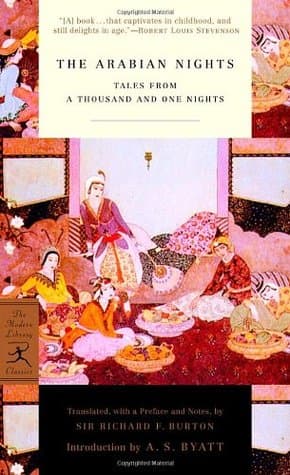
Anonymous (2015)
Genre
Fantasy / Children's
Reading Time
2500 min
Key Themes
See below
Sign in to track this book
To survive, Shahrazad tells King Shahriyar a thousand and one enchanting tales of genies, sorcerers, and clever lovers, creating a picture of medieval Islamic life and imagination.
King Shahriyar, heartbroken by his first wife's infidelity, and further betrayed by his brother's wife, decides to marry a new virgin each night and execute her the next morning to prevent future dishonor. This practice devastates his kingdom until the Vizier's clever and brave daughter, Shahrazad, volunteers to marry the King. Despite her father's warnings, Shahrazad plans. On her wedding night, she starts to tell the King a captivating story, stopping at a suspenseful moment just before dawn. Her younger sister, Dinarzad, whom Shahrazad has instructed to wake her, helps create the impression of an eager audience, ensuring the King's curiosity is strong enough to spare Shahrazad for one more night, eager to hear the story's end.
A wealthy merchant, traveling through a desert, stops to rest and eats dates. Carelessly, he throws the date pits, one of which accidentally hits and kills the invisible son of a powerful Jinni. The Jinni, furious, appears before the terrified merchant and vows to kill him in return. The merchant pleads, explaining it was an accident, but the Jinni is firm. He gives the merchant one year to return home, settle his affairs, and say goodbye to his family, promising to meet him at the same spot for his execution. The merchant, heartbroken, returns home, makes his will, and says farewell to his loved ones before returning to face his fate.
As the merchant waits for his execution by the Jinni, an old man approaches with a gazelle. He sits down, and after learning of the merchant's situation, offers to tell his own story. He recounts how his wife, a sorceress, turned his first wife and children into animals out of jealousy. He later discovered her infidelity with a slave, whom she also turned into a bull. The old man, seeking justice, eventually outsmarted the sorceress, saving his family and turning her into the gazelle he now holds. The Jinni, interested by the tale, agrees to spare one-third of the merchant's life if the old man's story is amazing enough.
A second old man arrives with two black hounds. He tells his story of being a wealthy merchant with two envious brothers. They repeatedly tricked him, stealing his fortune and leaving him to die. Each time, he miraculously recovered and rebuilt his wealth. Finally, he discovered that his brothers had been turned into the black hounds by a sorceress, his cousin, whom he had married and who had helped him get his fortune back. He now travels with them, bound by an oath to neither harm nor reveal their true identities for ten years. The Jinni, further impressed by this story of resilience and magic, agrees to spare another third of the merchant's life.
A third old man approaches with a mule. He shares his story of discovering his wife's affair with a slave. Instead of confronting them immediately, he pretended to be ill. His wife, a sorceress, tried to poison him. He tricked her into drinking the poison herself, which she survived due to her magic. In anger, she turned him into a dog. He eventually found a kind butcher's daughter who recognized him and, with her magical knowledge, turned him back into a man. In return, he had his wife turned into the mule he now leads. This final tale convinces the Jinni to fully pardon the merchant, who is then free to return home.
A poor fisherman, after several unsuccessful attempts, casts his net for the fourth time and pulls up a sealed copper bottle. Upon opening it, a massive, terrifying Jinni emerges. The Jinni, imprisoned for centuries, declares he will grant the fisherman's wish to choose his method of death. The fisherman, terrified but clever, asks the Jinni how such a large being could have fit into such a small bottle, expressing disbelief. The Jinni, his pride challenged, demonstrates by shrinking himself back into the bottle. The fisherman quickly seals it, threatening to throw it back into the sea and warn others of the treacherous Jinni within. The Jinni, humbled, promises wealth and help if released.
Aladdin, a lazy youth, is recruited by an African sorcerer posing as his uncle. The sorcerer tricks Aladdin into retrieving an old lamp from a magical cave, but tries to trap him there. Aladdin, accidentally rubbing a magic ring given by the sorcerer, summons a lesser Jinni who helps him escape. Later, rubbing the lamp, he summons a powerful Jinni of the Lamp, who grants his every wish. Aladdin uses the lamp to gain immense wealth, build a magnificent palace, and marry Princess Badroulbadour, the Sultan's daughter. The sorcerer returns, tricks the Princess into exchanging the old lamp for a new one, and transports the palace and Princess to Africa. Aladdin, using the ring's Jinni, travels to Africa to rescue her and recover the lamp, ultimately defeating the sorcerer and his brother.
Ali Baba, a poor woodcutter, secretly watches a band of forty thieves use the magic words 'Open Sesame' to enter a hidden cave filled with treasure. After they leave, Ali Baba enters the cave, taking some gold. His rich, greedy brother, Cassim, learns of the cave and goes there, but forgets the magic words and is trapped and killed by the returning thieves. Ali Baba, with the help of his clever slave-girl Morgiana, retrieves Cassim's body and buries it. The thieves, realizing their secret is compromised, relentlessly pursue Ali Baba. Morgiana repeatedly stops their attempts to find and kill Ali Baba, culminating in her identifying and killing their leader, who had infiltrated Ali Baba's house disguised as a merchant. Ali Baba and his family then inherit the thieves' treasure.
Sindbad, a wealthy merchant from Baghdad, tells of his seven fantastic voyages across the seas. Each voyage sees him shipwrecked or stranded in exotic, dangerous lands. He encounters giant birds (Roc), monstrous fish, cannibals, serpents, magical islands, and powerful rulers. Through resourcefulness, luck, and divine help, Sindbad repeatedly escapes death and returns home with great riches. His tales are filled with descriptions of strange creatures, precious jewels, and perilous adventures, often beginning with him losing his fortune and then regaining it through extraordinary means. He shares his stories with a poor porter named Hindbad, showing the rewards of perseverance and the wonders of the world.
A tailor, his wife, a Jewish doctor, a Christian broker, and a Muslim steward are all involved in the accidental death of a hunchback, whom they each believe they have killed. The tailor's wife chokes him with food, the doctor throws him down stairs thinking he's dead, the broker accidentally knocks him down with a stone, and the steward, thinking he's a thief, beats him. Each character, trying to dispose of the body secretly, passes it along to the next, leading to a series of escalating accusations and misunderstandings. The story unfolds as a comedic series of confessions before the Sultan, who, finding the whole affair amusing, ultimately pardons them all after hearing the full, complex truth and seeing their genuine remorse and terror.
A beautiful young woman, secretly entertaining five different lovers in her house, finds herself in a difficult situation when they all arrive at once. Through quick thinking and cunning, she manages to hide each lover from the others. She uses various excuses and disguises, moving them from room to room, under beds, and even in chests. Each time a new lover arrives, she convinces the previous one to hide, sometimes even tricking them into believing they are helping her hide from a fictional threat. Her elaborate scheme shows her intelligence and resourcefulness in navigating a complex and potentially embarrassing social situation, allowing her to escape detection and keep her secrets.
After 1001 nights of captivating storytelling, Shahrazad tells King Shahriyar that she has run out of tales. By this point, she has borne him three sons. More importantly, the King has been greatly changed by her stories. The bitterness and rage that drove his murderous decree have gone, replaced by admiration, love, and a renewed sense of humanity. He acknowledges her wisdom, courage, and the impact her narratives have had on him. He revokes his cruel vow, declares his love for her, and makes her his queen permanently. Shahrazad's intelligence and artistry not only saved her own life but also healed a broken king and brought peace back to his kingdom, ensuring a long and prosperous reign for them both.
The Protagonist
Shahrazad transforms from a courageous volunteer into a revered queen, whose wisdom and storytelling heal a broken king and restore harmony to the kingdom.
The Antagonist/Recipient of Transformation
Shahriyar transforms from a tyrannical, woman-hating king to a loving, just ruler, his heart softened and his mind enlightened by Shahrazad's tales.
The Supporting
Dinarzad remains a steadfast and supportive sister, witnessing and aiding Shahrazad's transformative journey.
The Protagonist
Aladdin transforms from an idle youth into a courageous prince and a wise ruler, proving his worth through trials and tribulations.
The Protagonist
Ali Baba rises from poverty to wealth, not through his own cunning, but by being a beneficiary of good fortune and the exceptional loyalty of his servant.
The Supporting
Morgiana transitions from a clever slave to a free woman, marrying Ali Baba's son and becoming a respected member of the family.
The Protagonist
Sindbad's character remains largely consistent as a resilient adventurer, continually facing and overcoming extraordinary challenges, growing in wealth and experience.
The Antagonist/Supporting
The Jinni transforms from a vengeful, arrogant entity into a grateful, benevolent helper after being outsmarted and released by the fisherman.
The Antagonist
The Sorcerer remains a consistently evil and ambitious antagonist, ultimately meeting his demise due to his own treachery.
The entire collection is framed by Shahrazad's use of storytelling to save her life and ultimately transform King Shahriyar. Her narratives are not just entertainment; they are a means of education, therapy, and social commentary. The stories themselves, such as Aladdin's adventures or Sindbad's voyages, show the boundless human imagination, taking listeners to worlds of magic, jinni, and incredible feats. This theme highlights how stories can shape perceptions, teach moral lessons, provide comfort, and even mend broken hearts, as Shahrazad's tales gradually reduce the King's bitterness and cruelty. The act of listening to and engaging with narrative becomes a transformative experience.
“And Shahrazad perceived the dawn of day and ceased to say her permitted say.”
Many tales explore ideas of justice, often delivered by fate or divine intervention rather than human law. Characters like the merchant in 'The Merchant and the Jinni' face seemingly inescapable doom, only to be saved by a series of unexpected encounters and stories. Similarly, Ali Baba's discovery of the thieves' cave seems fated, and Morgiana's repeated successes against the thieves often seem like miraculous timing. Even the Jinni in 'The Fisherman and the Jinni' is initially a force of arbitrary vengeance, but ultimately becomes an agent of fortune. This theme suggests that while human actions have consequences, an overarching cosmic order or divine will often plays a decisive role in outcomes, ensuring that good is eventually rewarded and evil punished, though not always predictably.
“Verily, this is a marvellous thing! What then is the cause of thine weeping?”
This is a fundamental theme, seen in countless narratives. From Shahrazad's actions against King Shahriyar's tyranny to Aladdin's fight against the wicked sorcerer, and Ali Baba's struggle against the ruthless forty thieves, the tales consistently pit good characters against evil forces. Evil often appears as greed, jealousy, or vengeful cruelty, while good is characterized by courage, cleverness, loyalty, and compassion. Even supernatural beings like Jinni can embody both extremes. The stories often serve as moral allegories, showing that while evil may win temporarily, good, supported by wit and righteousness, ultimately prevails.
“O thou Jinni, since thou didst promise to me, if I should tell thee a story, that thou wouldst release me a third part of this merchant's blood, I will tell thee the story of myself and this gazelle.”
Beyond entertainment, the tales offer sharp observations on society, human nature, and moral conduct. The 'Tale of the Hunchback' satirizes human flaws and the absurdity of circumstantial evidence, while stories of infidelity and betrayal (like those that fuel Shahriyar's rage or the origins of the three old men's companions) serve as cautionary tales. The narratives often praise virtues like generosity, loyalty (Morgiana), and perseverance (Sindbad), while condemning vices like greed (Cassim), envy, and cruelty. They provide a rich picture of medieval Islamic society, reflecting its customs, values, and ethical dilemmas, often subtly guiding the audience towards virtuous behavior through the consequences faced by characters.
“O King, I have found no pleasure in life since I killed the hunchback.”
Central to the frame story, Shahriyar's transformation from a vengeful tyrant to a just and loving king is the ultimate example of redemption. This idea is echoed in many other tales, where characters undergo significant changes, often as a result of magical intervention or profound experiences. The Jinni in 'The Fisherman and the Jinni' shifts from malevolence to benevolence. Characters who commit wrongs, like the sorceress wives, are often turned into animals as punishment, showing a physical manifestation of moral change. This theme suggests that individuals are capable of great personal growth and change, and that even the most hardened hearts can be softened by compassion and understanding.
“And the King said, 'I have forgiven thee, O Shahrazad, and grant thee thy life, for I have been changed by thy stories and have learned wisdom.'”
A narrative structure where a main story encloses a series of smaller, independent tales.
The entire collection is contained within the frame story of Shahrazad telling tales to King Shahriyar. This device provides a compelling reason for the existence of the myriad stories and creates a continuous thread that binds them together. The frame story establishes the stakes (Shahrazad's life and the King's redemption) and gives context to the diverse narratives. It allows for a vast array of genres, characters, and settings to be explored while maintaining a central purpose: the transformation of the King through the power of storytelling. Each night's cliffhanger also serves as a mini-frame within the larger one.
A narrative technique where a story ends abruptly at a moment of high tension or suspense, leaving the audience eager for the resolution.
Shahrazad masterfully employs the cliffhanger at the end of each night's storytelling. Just as dawn breaks, she stops her narrative at a crucial, suspenseful moment, ensuring King Shahriyar's intense curiosity. This technique is vital to her survival, as it compels the King to spare her life for another day so he can hear the story's conclusion. It builds dramatic tension not only within the individual tales but also within the overarching frame story, demonstrating Shahrazad's narrative skill and her understanding of human psychology.
The pervasive presence of supernatural elements, including jinni, sorcerers, magical objects, and transformations.
Magic is a fundamental and ubiquitous plot device throughout 'The Arabian Nights.' Jinni, both benevolent and malevolent, frequently appear to grant wishes, imprison, or punish. Sorcerers and witches wield powerful spells to transform people into animals (as seen with the old men's companions or in Aladdin's story), create illusions, or manipulate events. Magical objects, such as Aladdin's lamp and ring or the flying carpet, serve as catalysts for adventure and solutions to seemingly impossible predicaments. This device enables characters to overcome extraordinary obstacles and creates a sense of wonder and possibility, enriching the fantastical settings.
Characters employing trickery, false identities, or hidden appearances to achieve their goals or escape danger.
Deception is a recurring element, often used by both protagonists and antagonists. Shahrazad's entire strategy is a form of benevolent deception. The African sorcerer uses a false identity as Aladdin's uncle to manipulate him. Morgiana repeatedly uses disguises and cunning ploys to outwit the forty thieves, such as marking houses or hiding in oil jars. Characters feign illness, pretend to be merchants, or hide their true intentions. This device highlights the intelligence and resourcefulness of characters, often serving as a means for the weak to overcome the strong, or for justice to be served through indirect means.
“Know, O my brother, that I have not been able to sleep since I left you, for my heart is troubled about you.”
— Spoken by theharvester and his wife to the fisherman.
“Indeed, the world is a bridge; pass over it, but build no house upon it.”
— A proverb often repeated or referenced within various tales.
“Many a small thing has been made large by the telling of it.”
— Reflecting on the power of storytelling itself.
“He who has no need of patience has no need of life.”
— A general maxim found in several narratives.
“There is no might and no power save in Allah, the High, the Great!”
— A common exclamation of faith and resignation throughout the stories.
“Be kind, for everyone you meet is fighting a harder battle.”
— A sentiment expressed in various forms across different tales.
“The greatest wealth is contentment with little.”
— A recurring theme, particularly in stories of humble characters.
“The first thing in love is the last thing in wisdom.”
— A reflection on the often irrational nature of love.
“He who digs a pit for his brother falls into it himself.”
— A proverb illustrating the consequences of malicious actions.
“The world is but a moment; spend it in obedience.”
— A religious and moralistic piece of advice.
“The pen is the tongue of the mind.”
— A saying emphasizing the power of written words.
“Trust in God, but tie your camel.”
— A proverb advocating for both faith and practical caution.
“Sleep is the brother of death.”
— A philosophical observation on the nature of sleep and mortality.
“A man's worth is not in his gold, but in his good deeds.”
— A moral lesson often highlighted in the tales of rich and poor.
Ready to see how well you understood this book? Take our interactive quiz with 10 questions.

Anonymous may refer to:Anonymity, the state of an individual's identity, or personally identifiable information, being publicly unknown Anonymous work, a work of art or literature that has an unnamed or unknown creator or author Anonymity, a property of a voting rule, saying that it does not discriminate apriori between voters







