“A boy can be two things, a Jew or a nobody.”
— Spoken by Duddy's grandfather, encouraging him to make something of himself.

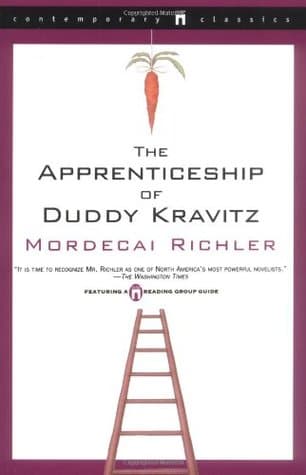
Mordecai Richler (1959)
Genre
Literary Fiction / Historical Fiction
Reading Time
450 min
Key Themes
See below
Sign in to track this book
In a boisterous quest to "be somebody," the amoral and hilariously scheming Duddy Kravitz hustles his way through 1940s Montreal, leaving a trail of comedic chaos and hard-won lessons in his wake.
Duddy Kravitz is a restless, ambitious, and often unscrupulous teenager growing up in the Jewish quarter of Montreal. He attends Fletcher's Field High School, where he constantly causes trouble for his teachers, especially Mr. MacPherson. Duddy's father, Max, is a small-time pimp and taxi driver, more interested in his own escapades than his sons. Duddy's older brother, Lenny, is the family's hope, destined for medical school. Duddy, however, wants to 'be somebody' and acquire land, a dream instilled in him by his beloved Zayda (grandfather), who often laments the plight of Jews without land. This ambition fuels Duddy's early schemes, including a short-lived film production company.
After being expelled from school, Duddy takes on various jobs, including working as a waiter at a resort in Ste. Agathe during the summer. While there, he starts a small business making films of Bar Mitzvah ceremonies and other events for wealthy Jewish families. He enlists the help of an older, alcoholic filmmaker named Friar, who does the actual shooting and editing. It is during this period that Duddy meets Yvette, a quiet, observant French-Canadian girl who works as a switchboard operator at the resort. Yvette is initially wary of Duddy's aggressive demeanor but is slowly drawn to his energy and ambition, becoming his assistant and eventually his lover and confidante. She often helps him out of his financial predicaments.
While driving a wealthy American tourist, Mr. Calvin, around the Laurentians, Duddy finds a beautiful, undeveloped piece of land surrounding a small lake. He immediately recognizes its potential for development and sees it as the realization of his Zayda's dream. This discovery becomes Duddy's obsession. He begins to research the ownership of the various parcels of land around the lake. He realizes they belong to different, often elderly or financially struggling, local farmers. He enlists Yvette to help him navigate property ownership and secure options to buy, often using deceptive tactics and exploiting the landowners' naivety or desperation.
Duddy's ambition to acquire the lakefront property leads him to increasingly unethical actions. He continues to exploit Friar's talent and alcoholism, paying him little while profiting significantly from their film business. When Friar becomes a liability due to his drinking and a car accident, Duddy callously cuts him off, leaving him destitute. He also takes advantage of Yvette's loyalty and financial stability, borrowing money from her repeatedly without much intention of repayment. His schemes become more elaborate, including a brief, disastrous foray into the black market, which nearly lands him in serious trouble and further strains his relationship with Yvette.
Duddy encounters Virgil Rose, a kind-hearted, epileptic American who had been working for a Montreal-based film distributor. Duddy, seeing an opportunity, befriends Virgil and convinces him to invest in his film business, promising him a share in the profits and a future in filmmaking. Virgil, desperate for purpose and friendship, trusts Duddy. However, Duddy's reckless driving and disregard for Virgil's condition lead to a severe epileptic seizure during a delivery run, causing a serious accident that leaves Virgil paralyzed from the waist down. Despite this tragedy, Duddy continues to exploit Virgil's insurance settlement and disability payments to fund his land purchases, promising to make things right.
Duddy's wealthy and respected Uncle Benjy, who has always criticized Duddy's character, becomes terminally ill. Benjy tries to give Duddy some moral guidance, urging him to consider the consequences of his actions and to be a better person. Duddy, however, remains largely focused solely on his land. Meanwhile, his brother Lenny, once the family's golden boy, succumbs to the pressures of medical school and his own moral failings. He becomes involved in a drug-smuggling scheme, leading to his expulsion from medical school and public humiliation, shattering his father Max's hopes and further showing the moral decay within the family.
With almost all the lakeside parcels secured, Duddy faces a final hurdle: a piece of land owned by a reluctant farmer. Desperate to complete his acquisition, Duddy needs a significant sum of money quickly. He realizes that Virgil's insurance settlement, which he has been managing, is the key. In a climactic act of betrayal, Duddy forges Virgil's signature on a document, stealing the remainder of Virgil's money to purchase the last parcel of land. This act shows Duddy's ruthless ambition, as he sacrifices his friendship and Virgil's future for his own gain, believing the ends justify the means.
Yvette, who has been a loyal supporter and lover, is increasingly disturbed by Duddy's callous treatment of Virgil and his relentless pursuit of the land. When she discovers evidence of Duddy's forgery, she is heartbroken and disgusted by his actions. The betrayal of Virgil, a man she also cares for, is the final straw. Yvette confronts Duddy, leading to a bitter and painful breakup. Despite having achieved his dream of owning the land, Duddy finds himself emotionally isolated, having alienated the one person who truly cared for him and saw beyond his ambition, leaving him with a hollow victory.
Having acquired all the land around the lake, Duddy proudly takes his beloved Zayda to see his achievement. He expects his grandfather to be overjoyed, to finally see his dream of land ownership realized through Duddy. However, Zayda, who had always emphasized the importance of being a 'mensch' (a good person), is horrified when he learns the full extent of Duddy's unethical methods, particularly the betrayal of Virgil. Zayda's reaction is not one of pride but of deep disappointment and sorrow. He refuses to acknowledge Duddy's achievement as a moral victory, leaving Duddy's triumph feeling utterly hollow and exposing the true cost of his ruthless ambition.
Duddy Kravitz has achieved his lifelong ambition: he owns all the land around the lake, poised for lucrative development. He has 'become somebody' in the material sense, accumulating wealth and property. However, his journey has come at a tremendous personal cost. He has lost Yvette, his most loyal companion and the only person who truly understood him. He has alienated Virgil, leaving him permanently injured and financially ruined. Most devastatingly, he has earned the disapproval of his cherished Zayda, who sees him as a success but not a 'mensch.' Duddy is left with his land, his money, and his ambition, but without the love, respect, or moral integrity he unknowingly sacrificed along the way, hinting at an unfulfilled future.
The Protagonist
Duddy transforms from a mischievous boy to a ruthless businessman, achieving his material goals but sacrificing his moral compass and personal relationships in the process.
The Supporting
Yvette moves from being Duddy's devoted supporter to his disillusioned moral judge, ultimately choosing her integrity over her love for him.
The Supporting
Zayda remains a steadfast moral anchor, his wisdom and disappointment serving as a final judgment on Duddy's actions.
The Supporting
Max's hopes are shattered by Lenny's downfall, but he remains largely unchanged in his own character.
The Supporting
Lenny's arc is one of decline, from respected medical student to disgraced drug smuggler, revealing the fragility of outward respectability.
The Supporting
Virgil's arc is one of hope and trust leading to profound physical and financial ruin due to Duddy's exploitation.
The Supporting
Uncle Benjy's arc involves a final attempt to guide Duddy morally, ending in his death and lingering disappointment.
The Supporting
Mr. MacPherson's role is largely static, representing the authority Duddy constantly defies.
The Supporting
Friar's arc is one of exploitation and abandonment, serving as a victim of Duddy's early ruthlessness.
The novel examines the relentless pursuit of success, particularly the 'American Dream' (or in this case, the 'Canadian Dream' of material wealth and land ownership). Duddy's ambition to 'be somebody' and acquire land is at the heart of the narrative. The book questions the moral cost of such ambition, as Duddy's success is built on exploitation, betrayal, and a disregard for ethical conduct. His material triumph is a moral failure, suggesting that success achieved without integrity is hollow. The theme challenges the notion that wealth automatically equates to happiness or respect.
“"A man without land is nobody." ”
Duddy's quest to 'be somebody' is tied to his sense of identity and belonging as a young Jewish man in post-war Montreal. His Zayda's lament about Jews being a 'people without land' fuels Duddy's drive to establish roots and secure a place. However, Duddy struggles with what it means to be a 'mensch' (a good person) versus merely a 'success'. His identity is shaped by his environment and his choices, leading him to question whether his material gains truly define who he is or if he has lost himself in the process. The novel explores the tension between individual ambition and communal values.
“"You're a bright boy, Duddel, but you're not a mensch. A mensch is a human being, a good man." ”
The novel is steeped in moral ambiguity, as Duddy consistently operates in a grey area, blurring the lines between shrewd business and unethical behavior. Characters like Max Kravitz also show a casual amorality. Richler portrays a society where corruption is subtle and pervasive, often disguised as ambition or necessity. Duddy's journey shows how easily individuals can rationalize their questionable actions in the pursuit of a greater goal. The story makes readers confront the slippery slope of ethical compromise and the destructive power of unchecked self-interest, showing how Duddy's small deceits escalate into major betrayals.
“"He was going to be a somebody. He would show them all. He would make his mark, no matter what." ”
The complex and often dysfunctional family dynamics are central to Duddy's development. His strained relationship with his father, Max, who openly favors Lenny, fuels Duddy's desire to prove himself. The influence of his Zayda, who is his moral compass, contrasts sharply with Max's more pragmatic and less ethical approach to life. The rivalry between Duddy and Lenny, and Lenny's eventual downfall, further complicate these dynamics. The novel explores how parental expectations, perceived favoritism, and the legacy of immigrant struggles shape the aspirations and moral choices of the next generation.
“"Max thought of Lenny, the doctor, the hope of the family, and then he thought of Duddy, and sighed." ”
The narrative traces Duddy's journey from a mischievous but relatively innocent teenager to a hardened, cynical, and morally compromised businessman. His 'apprenticeship' is not one of moral growth but of increasing disillusionment with ethical constraints. Characters like Yvette and Virgil experience their own loss of innocence as they are drawn into Duddy's world and eventually betrayed. The novel presents a world where idealism is often crushed by ruthless ambition, and where even the most cherished dreams can be corrupted by the means used to achieve them. Duddy's final, hollow victory shows this pervasive disillusionment.
“"He felt empty, a little sick, but he had the land. He had achieved his dream. Why didn't it feel like a victory?" ”
Characters who highlight Duddy's traits through contrast.
Several characters serve as foils to Duddy, emphasizing his unique qualities and moral failings. Yvette, with her quiet integrity and genuine affection, contrasts sharply with Duddy's amorality and transactional view of relationships. Virgil Rose, the trusting and vulnerable epileptic, highlights Duddy's exploitative nature and lack of empathy. Zayda, the wise and moral patriarch, acts as Duddy's conscience, his disappointment serving as the ultimate judgment on Duddy's actions. Even Lenny, the 'golden boy' brother, initially appears to be Duddy's opposite, only to reveal his own moral weaknesses later on, showing that corruption isn't exclusive to Duddy.
Land represents security, identity, and the fulfillment of a dream for the Jewish people.
The land around the lake is the central symbolic element in the novel. For Zayda, it represents security, belonging, and a historical aspiration for a people often without a homeland. For Duddy, it initially embodies his grandfather's dream, but quickly transforms into a symbol of material success, power, and his desperate need to 'be somebody.' The acquisition of the land becomes a physical manifestation of his ambition. However, the tainted means by which he acquires it ultimately corrupts its symbolic meaning, turning his 'promised land' into a monument to his moral failures rather than a source of true fulfillment.
Situational and dramatic irony underscore the gap between Duddy's perception and reality.
Irony is prevalent throughout the novel, particularly situational and dramatic irony. Duddy's relentless pursuit of his Zayda's dream of land ownership, expecting his grandfather's pride, results in Zayda's profound disappointment, creating a bitter situational irony. Duddy's belief that acquiring wealth and property will make him 'somebody' is ironically undercut by his loss of relationships and moral standing, leading to a hollow victory. The dramatic irony often arises from the reader's awareness of Duddy's manipulative tactics and their consequences, while Duddy remains self-assured of his righteousness, highlighting his flawed perception of success.
The title itself acts as a metaphor for Duddy's moral education, or lack thereof.
The title, 'The Apprenticeship of Duddy Kravitz,' acts as a central metaphor. An apprenticeship typically implies a period of learning and moral growth under guidance. However, Duddy's 'apprenticeship' is one where he learns to be increasingly ruthless, amoral, and exploitative. He becomes a master of manipulation and self-interest rather than a 'mensch.' The metaphor is ironic, suggesting that the lessons Duddy learns are not those of conventional morality but of cutthroat capitalism and survival at any cost. His 'education' is a journey into moral darkness, leaving him with material gain but profound spiritual emptiness.
“A boy can be two things, a Jew or a nobody.”
— Spoken by Duddy's grandfather, encouraging him to make something of himself.
“You'll be a big man, Duddy. A big man.”
— Duddy's grandfather's repeated encouragement and vision for his future.
“A man without land is nobody.”
— Duddy's guiding principle, driving his relentless pursuit of property.
“He was a boy who could make things happen.”
— A description of Duddy's energetic and often disruptive nature.
“Money isn't everything, but it's a long way ahead of whatever is in second place.”
— A pragmatic view on the importance of wealth, reflecting Duddy's values.
“The world was full of people who had something to sell and Duddy had something to buy, and the something was land.”
— Duddy's perspective on his place in the world and his primary goal.
“He didn't want to be liked. He wanted to be important.”
— A key insight into Duddy's motivations, prioritizing status over affection.
“Honesty is the best policy. Unless you're in business, then it's a luxury.”
— A cynical view on ethics in the pursuit of success, reflecting Duddy's methods.
“He knew that if he ever stopped running, he'd be nothing.”
— Duddy's internal drive and fear of stagnation.
“What did it matter if you made a few enemies if you made a lot of money?”
— Duddy's justification for his ruthless tactics.
“He had a conscience, all right, but it was like a muscle he hadn't used much.”
— A description of Duddy's underdeveloped moral compass.
“You can't buy respect, Duddy. You earn it.”
— Spoken by Yvette, trying to instill a different value system in Duddy.
“The trouble with Duddy Kravitz was that he was always running, but he didn't know where to.”
— A critical observation about Duddy's relentless but sometimes aimless ambition.
“He was a hustler, a schemer, a dreamer, and a boy who knew how to make things happen.”
— A summary of Duddy's multifaceted and driven personality.
Ready to see how well you understood this book? Take our interactive quiz with 10 questions.

Biography coming soon.







