
Biography coming soon.

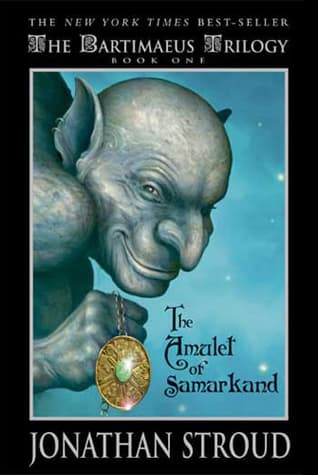
Jonathan Stroud (2003)
Genre
Fantasy / Children's / Young Adult
Reading Time
12 Minutes
Key Themes
See below
Sign in to track this book
A young magician's quest for revenge against a cruel rival unleashes an ancient, sarcastic djinn, drawing him into a dangerous world of political intrigue and forbidden magic.
Nathaniel, a ten-year-old magician's apprentice, attends a reception at the Ministry of Internal Affairs with his master, Arthur Underwood. There, the ambitious magician Simon Lovelace publicly humiliates Nathaniel. He makes Nathaniel fall and spill drinks, then mocks his lack of magical ability. Underwood, afraid of Lovelace, fails to defend his apprentice. This further crushes Nathaniel and fuels his resentment. The incident ignites Nathaniel's desire for revenge against Lovelace and his master's cowardice. He secretly dedicates himself to advanced magical studies, driven to prove his worth and get even.
Nathaniel, consumed by revenge, secretly studies forbidden magical texts. He pushes his magical abilities beyond what his master teaches. He learns the rituals needed to summon powerful spirits. In an act of defiance, he summons Bartimaeus, a sarcastic and ancient djinni, to his chamber. Nathaniel immediately asserts his authority over the djinni, binding him to his will. He commands Bartimaeus to steal the Amulet of Samarkand from Simon Lovelace. Bartimaeus, annoyed by the boy's arrogance, is forced to obey due to the magical geas.
Bartimaeus, under Nathaniel's command, goes to Lovelace's heavily guarded home to steal the Amulet of Samarkand. He quickly finds that Lovelace's defenses are stronger than Nathaniel expected, with many powerful imps and protective wards. Bartimaeus fights several magical battles, taking injuries and facing great difficulty. He cannot get the amulet during his first attempts. He reports back to Nathaniel with frustration and a grudging respect for Lovelace's security. This failure makes Nathaniel rethink the dangers and his enemy's true power.
The attempted theft of the Amulet of Samarkand from Simon Lovelace's home immediately gets the attention of the Ministry of Internal Affairs. High-ranking magicians, including Nathaniel's master Arthur Underwood, investigate the incident. Unknown to them, the culprit is right nearby. The investigation causes tension and paranoia within the magical government. The Amulet is a very powerful relic, and its potential theft suggests a serious threat. Nathaniel is in a difficult position, needing to appear innocent while secretly directing the dangerous operation.
After several more dangerous attempts and planning with Nathaniel, Bartimaeus finally gets into Lovelace's inner sanctum and steals the Amulet of Samarkand. When he gets it, Bartimaeus finds that the amulet is not just a powerful artifact; it also contains a bound spirit, which keeps spirits like himself from touching it without great pain. He brings the amulet back to Nathaniel, who is thrilled. However, the amulet's unique properties, especially its resistance to spiritual manipulation, suggest a deeper, more complex magical design than either Nathaniel or Bartimaeus first understood.
Nathaniel's continued use of Bartimaeus and his increasingly suspicious behavior eventually get the attention of his master and other Ministry officials. Lovelace, suspecting a younger magician is behind the theft, sets a trap. Bartimaeus is ambushed by Lovelace's powerful servants, including the Golem. He is severely weakened and captured. Nathaniel is left in a desperate situation; his plan is falling apart, and his djinni is now his enemy's prisoner. He realizes the true danger he has created and the power Lovelace commands.
Simon Lovelace, now with the Amulet and Bartimaeus, starts the next part of his plan. He plans a coup against the British government and the ruling magicians, whom he sees as corrupt. He intends to use the Amulet's power, combined with a summoning ritual, to unleash a devastating force on London. Lovelace's goal is not just to steal an artifact, but to reshape the magical world with himself in charge. His ruthlessness and the scale of his treachery become clear.
Realizing how catastrophic Lovelace's plan is, Nathaniel knows he must act. Despite his initial dislike for Bartimaeus, he sees the djinni is key to stopping Lovelace. He begins a daring rescue mission, infiltrating Lovelace's stronghold. This requires him to put aside his pride and work with Bartimaeus, forming a fragile, reluctant alliance. Nathaniel uses his wits and what magic he can to navigate the dangerous defenses, driven by the threat to London and the knowledge that his own actions started this disaster.
The climax is at the Tower of London, where Lovelace performs a massive summoning ritual to unleash a demon on the city. Nathaniel and Bartimaeus, having escaped, arrive to stop the ritual. A chaotic battle follows, involving Lovelace, his powerful djinni, the Golem, and Nathaniel and Bartimaeus. London's fate hangs in the balance as the summoned entity begins to appear, threatening to destroy everything. Nathaniel must make difficult decisions and push his magical abilities to their limit.
Nathaniel's quick thinking, Bartimaeus's power, and an unexpected twist with the Amulet's true purpose disrupt Simon Lovelace's ritual, and he is defeated. The summoned entity is banished, and London is saved. Nathaniel is hailed as a hero, taking credit for stopping Lovelace's plot, while Bartimaeus is secretly dismissed and returns to the Other Place. Nathaniel's master, Arthur Underwood, dies in the chaos, allowing Nathaniel to rise quickly through the Ministry. The boy magician has achieved his revenge and gained power, but at a personal cost and with the weight of his deception.
The Protagonist
Nathaniel transforms from a humiliated, vengeful apprentice into a seemingly heroic, yet deeply deceptive, young magician who gains power but loses some of his innocence. He learns the hard way about the true dangers of magic and the cost of his ambition.
The Supporting
Initially a reluctant servant, Bartimaeus develops a grudging respect and a complex, almost paternal, relationship with Nathaniel, despite their constant bickering, ultimately playing a key role in saving London.
The Antagonist
Lovelace's arc is one of escalating ambition and malevolence, culminating in his attempted coup and ultimate defeat, serving as a cautionary tale of unchecked power.
The Supporting
Underwood remains largely static in his self-serving nature, ultimately becoming a victim of Lovelace's coup, highlighting the vulnerability of the established order.
The Supporting
Martha's role is primarily to provide emotional grounding and a sense of humanity for Nathaniel, serving as a moral compass that he often ignores in his pursuit of power.
The Supporting
Kitty's initial appearance sets up her future role as a more prominent character in the series, establishing her as an intelligent and defiant commoner who will challenge the magical establishment.
The Supporting
Jakob's arc is tied to Kitty's, serving to highlight the perils faced by commoners in a world ruled by magicians.
The Antagonist
The Golem serves as a persistent, formidable obstacle for Bartimaeus and Nathaniel, showcasing Lovelace's power until its eventual defeat alongside its master.
The novel shows how seeking power and ambition can corrupt people. Nathaniel's desire for revenge quickly turns into a thirst for recognition and authority, leading him to morally questionable acts and deceptions. Simon Lovelace shows this theme, as his power and ambition drive him to try a violent government overthrow. The magicians are generally shown as a ruling class more concerned with keeping their status than with the common people's well-being, showing how power can lead to complacency and corruption.
“Power corrupts, and absolute power corrupts absolutely. It's a cliché, I know, but sometimes clichés are true.”
Nathaniel's entire journey starts with his desire for revenge against Simon Lovelace and his master, Arthur Underwood. While he achieves his initial goal, revenge leads him into greater dangers and forces him to compromise his morals. The novel shows that revenge, even when seemingly justified, can have unforeseen and catastrophic results, not only for the target but also for the one seeking it. Nathaniel's actions, born of vengeance, ultimately endanger all of London.
“Revenge is a dish best served cold, or, in my case, with a healthy dose of sarcasm and a side order of unnecessary destruction.”
The novel portrays a society divided by class, with powerful magicians at the top, ruling over commoners who are largely powerless. Nathaniel, as an apprentice, is still part of the privileged magical class, while characters like Kitty and Jakob represent the commoners who suffer under the magicians' rule. The magicians' disregard for ordinary people's lives and concerns is a recurring idea, showing the vast social inequality and injustice of a system where power belongs to a few.
“The commoners were just so many ants, to be trodden on if they got in the way of a magician's progress.”
This theme is primarily shown through Bartimaeus, a powerful being bound against his will to serve humans. His constant comments on the indignity of servitude, his longing for freedom, and his sarcastic remarks about Nathaniel's mastery highlight the complexities of power dynamics. Even Nathaniel, as an apprentice, experiences a form of servitude to his master, mirroring Bartimaeus's situation. The novel questions the morality of binding sentient beings and explores the psychological effect it has on both master and servant, suggesting that true freedom is valuable and often hard to get.
“Oh, to be free! To soar through the aether, unburdened by the whims of a sniveling human boy!”
Provides a unique, cynical, and humorous perspective.
A significant portion of the novel is told from Bartimaeus's first-person perspective, offering a sarcastic, ancient, and often humorous commentary on the events, humans, and magic. This device allows for exposition about the magical world, historical context through Bartimaeus's past experiences, and a counterpoint to Nathaniel's more earnest perspective. It also provides comic relief and deepens the reader's understanding of the djinni's personality and motivations, making him a highly engaging character despite his servitude.
Focuses on Nathaniel's internal struggles and actions.
The narrative alternates between Bartimaeus's first-person and a third-person limited perspective focusing on Nathaniel. This allows the reader to delve into Nathaniel's thoughts, his growing ambition, his fear, and his moral dilemmas without the filter of Bartimaeus's cynicism. It provides direct insight into his development, his secret plans, and his interactions with the human world, creating a contrast with Bartimaeus's supernatural viewpoint and allowing for a more traditional character arc for the protagonist.
The central MacGuffin and source of conflict.
The Amulet of Samarkand serves as the primary MacGuffin of the plot, the object that drives the initial conflict. It is a powerful magical artifact that Nathaniel commands Bartimaeus to steal, setting off a chain of dangerous events. Its true nature and purpose are gradually revealed, proving to be more significant than just a stolen item. The amulet's properties, particularly its ability to repel spirits, are crucial to the climax and Lovelace's ultimate plan, making it not just a goal but a key element in the magical mechanics of the story.
Hints at future dangers and character developments.
The novel employs subtle and overt foreshadowing to build suspense and hint at future plot points. Bartimaeus's historical anecdotes often allude to the dangers of powerful artifacts or the downfall of ambitious magicians. Nathaniel's intense drive for revenge and his secret magical studies foreshadow the perilous situation he will create. The casual cruelty of magicians towards commoners and their internal rivalries foreshadow the larger societal conflict and Lovelace's coup, preparing the reader for the escalating stakes.
Ready to see how well you understood this book? Take our interactive quiz with 10 questions.
Biography coming soon.







