“Every man has a compass in his heart, and that compass always points north, but it is up to him to decide what direction north is.”
— Early in the story, Josef Kavalier reflects on his escape and the choices he faces.

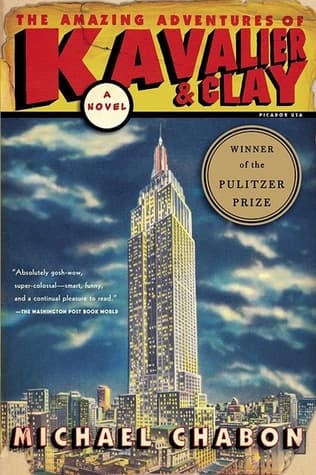
Michael Chabon (2000)
Genre
Literary Fiction / Historical Fiction
Reading Time
1278 min
Key Themes
See below
Sign in to track this book
In 1940s New York, two Jewish cousins, one an escape artist refugee and the other a Brooklyn writer, create comic book heroes, confronting real-world problems and finding love during America's golden age.
In October 1939, Josef Kavalier, a nineteen-year-old Jewish magician and artist, is smuggled out of Nazi-occupied Prague in a coffin and arrives in New York City. His aunt and uncle in Brooklyn take him in, where he meets his younger cousin, Sammy Clay (born Klayman), a writer with big plans in the new comic book industry. Sammy works for the Empire Novelty Company, run by Sheldon Anapolis. He sees Joe's artistic talent and knowledge of escapology and magic as a good match for his own storytelling. They decide to work together, driven by Joe's wish for a hero who can fight real evil and Sammy's skill with pulp fiction. Their first ideas create the foundation for their most famous character.
Joe and Sammy create their main character, the Escapist, a masked crime-fighter whose powers come from illusion and the ability to escape any trap. The Escapist becomes a sign of hope against oppression, showing Joe's experiences in Europe and his wish for revenge against the Nazis. They also create other characters, like Luna Moth and the Monitor. Sheldon Anapolis sees the potential and gives them their own imprint, Empire Comics. The Escapist's first appearance in 'Amazing Midget Radio Comics' is a hit, quickly leading to his own comic title. Their work together succeeds, mixing Joe's dramatic art with Sammy's clever stories, making them important figures in the Golden Age of comics.
As the Escapist gets popular, Joe and Sammy move into an apartment in Greenwich Village, joining the artistic and intellectual community there. They meet Rosa Saks, a beautiful and smart young woman who wants to be an artist and becomes Joe's art student. Rosa quickly inspires both cousins, influencing the character of Luna Moth and their work. Joe is very attracted to her, and she to him, leading to a passionate relationship. Sammy, who is secretly gay and struggles with his identity in a restrictive time, also has strong feelings for Rosa, though she does not acknowledge his complex emotions.
Joe and Rosa's relationship grows, and they marry. Meanwhile, Sammy struggles with his developing gay identity, finding comfort in the underground queer scene but staying closeted to most people. Joe, increasingly desperate to save his younger brother, Thomas, from Nazi-occupied Czechoslovakia, becomes focused on the legend of the Golem. He thinks he can bring a clay Golem to life to smuggle Thomas out of Europe. He builds a large clay figure in his studio, putting his desperate hope into it. The cousins' personal lives become more and more connected with their creative work, as their worries and desires fuel the Escapist's stories.
As World War II gets worse, the Escapist becomes a strong symbol against fascism, fighting characters like Nazis in the comics. This shows Joe's personal pain and wish for revenge. Joe and Sammy, with Rosa, go to a big party at Salvador Dalí's home, a surreal event that shows their involvement in the artistic avant-garde. However, a telegram brings bad news: Joe's brother, Thomas, has been killed in the Holocaust. This news breaks Joe, leading him into a deep sadness and making him want to act directly against the Nazis, feeling his comic book heroism is not enough.
Overwhelmed by sadness and feeling helpless, Joe quickly joins the Navy after Pearl Harbor, leaving behind a pregnant Rosa and a shocked Sammy. He goes absent without leave during basic training, trying to steal a battleship to sail to Europe and fight the Nazis directly, but he is caught and sent to an isolated base in Alaska. Back in New York, Rosa gives birth to a son, Thomas Kavalier, named after Joe's dead brother. Sammy feels a strong responsibility and deep love for Rosa and the baby, stepping in as a father, raising Thomas as his own and keeping Joe's desertion a secret from the child. He continues to run Empire Comics, making sure they have money.
For years, Joe Kavalier lives alone on a remote naval base in Alaska, working as a radio operator. He continues to draw, creating his own dark, personal comics that show his inner struggles and grief. He carefully plans his escape, wanting to return to his family. Meanwhile, Sammy and Rosa raise Thomas in New York, keeping up the appearance of a normal family. Sammy becomes a successful, if somewhat unhappy, comic book writer and executive, while Rosa becomes a successful photographer. They sometimes receive unclear postcards from Joe, hinting at his location but never saying when he will return, leaving them always wanting and unsure.
In the mid-1950s, the comic book industry faces strong public criticism and moral panic, led by figures like Dr. Fredric Wertham, who blames comics for juvenile delinquency. Empire Comics, like others, must follow the strict Comics Code Authority. During this time, Joe Kavalier finally returns to New York, having successfully escaped his military post in Alaska. He is a changed man, toughened by his experiences but still having his artistic passion. His unexpected return immediately creates tension and problems in the carefully built lives of Sammy, Rosa, and their son, Thomas, who has grown up believing Sammy is his biological father.
Joe's return makes them confront the past. He struggles to reconnect with Rosa and to understand his son, Thomas, who sees him as a stranger. The truth of Thomas's parentage, kept secret by Sammy and Rosa for years, slowly starts to come out. Sammy, very attached to Thomas, faces the painful chance of losing the boy he has raised. The reunion is full of unspoken resentments, complicated feelings, and the lasting shadow of Joe's disappearance. Despite the difficulties, they make a tentative attempt to rebuild their broken family, centered on their shared history and the Escapist's legacy.
As the comic book industry changes, Joe and Sammy decide to work together on one last, big Escapist story, a graphic novel that finishes their creative partnership and shows their personal journeys. This project allows them to work through their unsolved problems, finding some understanding and forgiveness. Joe finally accepts Sammy's role in raising Thomas, and Sammy acknowledges Joe's lasting connection to Rosa and their son. The story ends with a bittersweet resolution, as the Kavalier and Clay story, both personal and professional, reaches a moving end, suggesting new beginnings and the lasting power of their shared creations.
The Protagonist
Joe begins as a determined refugee seeking revenge through art, then becomes a man broken by loss and war, eventually finding a fragile peace and reconnection with his family.
The Protagonist
Sammy evolves from an ambitious young writer into a responsible, loving father figure, coming to terms with his identity while navigating complex family dynamics.
The Supporting
Rosa transforms from a bohemian artist and muse into a strong, independent woman and mother, navigating profound loss and complex family relationships.
The Supporting
Thomas grows up unaware of his true parentage, eventually discovering and grappling with his complex family history.
The Supporting
Sheldon remains a consistent, self-serving figure, representing the commercial side of the comic industry.
The Supporting
Tracy helps Sammy explore his identity and find personal freedom, though their relationship is ultimately challenged by societal pressures.
The Supporting
George consistently provides professional and personal support to Joe and Sammy throughout their careers.
The Supporting
Longman serves as a consistent peer and friend within the comic book industry.
The Mentioned
Wertham represents the external forces of societal judgment and censorship that impact the comic industry.
The novel looks at how characters create and understand who they are, both personally and creatively. Joe deals with his Jewish background, his past as a refugee, and his role as an artist and avenger. Sammy struggles deeply with his hidden homosexuality and his desire for a normal life, leading him to create a new identity as Thomas's father. Rosa also looks for her identity as an artist and a woman managing unusual relationships. Making the Escapist itself is a way of finding oneself, letting Joe and Sammy put their inner selves onto a hero.
“For the superhero was, by his nature, an outlaw. An outlaw with a badge, a cop who worked outside the system, but an outlaw nonetheless.”
Escape is a main idea in the novel, both literally and figuratively. Joe's escape from Prague starts the story, and his training as an escape artist shapes his character and the creation of the Escapist. The Escapist shows the wish for freedom from oppression, whether from Nazi rule or everyday limits. Sammy seeks escape from social expectations about his sexuality. The characters constantly try to escape their pasts, their sadness, and the limits placed on them, finding comfort and freedom in their art and, sometimes, in each other.
“The secret to escaping any trap, Joe Kavalier had explained, was to make the trap part of you.”
The novel shows how art and storytelling, especially comic books, can change things. For Joe and Sammy, creating the Escapist is not just a job; it is a way to deal with trauma, fight injustice, and express their deepest desires and fears. Their comics offer a form of wish fulfillment and a voice for those without one. The Escapist becomes a cultural phenomenon, bringing hope and showing resistance during wartime. The act of creation also connects the cousins, giving them a shared purpose and a legacy that goes beyond their personal struggles.
“He drew his heroes with an almost painful exactitude, as if by giving them definition, by giving them flesh and bone and muscle and costume, he could, by force of will, make them real.”
Family, in different forms, is a main idea. The novel looks at the complex bonds between cousins Joe and Sammy, their adoptive family with Rosa and Thomas, and the sad loss of Joe's original family in the Holocaust. The idea of legacy is explored through names (Thomas Kavalier), the lasting impact of the Escapist, and the connections between generations made through love and sacrifice. The characters deal with what it means to be a family, often changing traditional roles and finding strength in unusual arrangements.
“He loved the boy with the ferocity of a father, and with the desperate, guilty devotion of a man who had stolen a child from his true father.”
The novel looks at the immigrant experience and the pursuit of the American Dream in the mid-20th century. Joe, a Jewish refugee, comes to America looking for safety and opportunity, finding both in the new comic book industry. He and Sammy, both from immigrant backgrounds, achieve great success, creating an iconic American superhero. However, the dream is complicated by the prejudices of the time, the pressures of fitting in, and the lasting effects of the European war. The story shows the promise and the difficulties of building a new life and identity in a new country.
“He knew that in America, a man could be anything, even a superhero. Especially a superhero.”
A fictional superhero who embodies themes of freedom, justice, and personal struggle.
The Escapist is the central creation of Joe and Sammy, a masked magician-hero whose powers are rooted in escape and illusion. He serves as a powerful symbol throughout the novel, reflecting Joe's desire for revenge against the Nazis and Sammy's yearning for freedom. The Escapist's adventures parallel the real-world struggles of the characters, acting as a wish-fulfillment fantasy and a means for them to process their trauma and desires. He also represents the creative legacy that binds the cousins together and influences their lives long after his initial creation.
A mystical clay figure from Jewish folklore, representing Joe's desperate hope and grief.
The Golem is a figure from Jewish mysticism, a clay automaton brought to life to protect the Jewish people. Joe becomes obsessed with the legend, believing he can animate a Golem to rescue his brother from Nazi Europe. He constructs a large clay figure in his studio, pouring his grief and desperate hope into it. The Golem symbolizes Joe's helplessness and his yearning for a magical solution to real-world horrors. It also connects him to his Jewish heritage and the ancient power of his people, even as it ultimately fails to fulfill its intended purpose, underscoring the limits of magical thinking against the brutality of war.
A recurring motif that blurs the lines between reality and fantasy, reflecting characters' desires and the nature of comics.
Magic, particularly stage magic and escapology, is a significant motif. Joe's background as an escape artist and his fascination with Houdini directly influence the Escapist. This motif extends beyond the literal, permeating the characters' lives as they use illusion to cope with reality – Sammy's closeted life, the illusion of a traditional family, and the fantasy worlds they create in their comics. Magic represents both the power of imagination to transform and the ways in which people construct elaborate deceptions, for themselves and others, to navigate difficult truths. It highlights the blurred boundary between the mundane and the extraordinary, much like the comics themselves.
The historical backdrop and a dynamic force shaping the characters' lives and the narrative.
The burgeoning comic book industry of the Golden Age and its subsequent decline and transformation serves as both the setting and a major plot device. It provides the opportunity for Joe and Sammy to achieve success, but also subjects them to its commercial pressures, censorship (via Dr. Wertham and the Comics Code Authority), and evolving trends. The industry's history parallels the characters' personal trajectories, reflecting periods of optimism, struggle, and adaptation. It grounds the fantastical elements of the story in a specific historical and cultural context, showing how art forms emerge and evolve in response to societal forces.
“Every man has a compass in his heart, and that compass always points north, but it is up to him to decide what direction north is.”
— Early in the story, Josef Kavalier reflects on his escape and the choices he faces.
“The world was a puzzle, and it was up to him to put the pieces together, and if he couldn't find the right pieces, he would make them.”
— Josef's determination to succeed in America and create a new life for himself and his family.
“There were two kinds of people in the world, those who were afraid of the dark, and those who were afraid of the light.”
— A philosophical observation about human nature and fear, often attributed to one of the characters.
“He understood then that the truest magic was not in the illusion, but in the belief.”
— Josef's realization about the power of storytelling and the suspension of disbelief in comics and magic.
“The greatest trick the devil ever pulled was convincing the world he didn't exist. The greatest trick the superhero ever pulled was convincing the world he did.”
— A meta-commentary on the nature of superheroes and their impact on popular culture, often from Sammy Clay's perspective.
“What are the two most important things in life? Love and magic. Without magic, there is no love. Without love, there is no magic.”
— A recurring theme or sentiment expressed by characters who believe in the intertwined nature of these forces.
“He had always believed that the world was a kind of story, and that if you paid close enough attention, you could hear its plot unfolding.”
— A reflection on the narrative structure of life and the observant nature of one of the protagonists.
“That's the thing about escape. It only works if you have somewhere to go.”
— Josef's struggle with his past and the limitations of simply running away without a clear destination or purpose.
“Every secret is a kind of magic, a way of bending the rules of the world.”
— The characters often deal with secrets, both personal and professional, and the power they hold.
“He knew then that the only way to truly escape was to create something new, something that had never existed before.”
— Josef's realization that his art and creations are his ultimate form of liberation.
“The past is a foreign country; they do things differently there.”
— A classic literary allusion used to describe the profound distance and difference between the characters' past experiences and their present.
“You can't save the world, but you can save a piece of it.”
— A sentiment reflecting the more grounded aspirations and limitations of the characters in the face of grand global conflicts.
“There are some things you can only learn in the dark.”
— A reflection on the lessons learned through hardship, struggle, and difficult times.
“The thing about stories, the thing about art, is that it's a way of making sense of the chaos.”
— The novel's overarching theme about the role of art and storytelling in understanding and coping with life's complexities.
Ready to see how well you understood this book? Take our interactive quiz with 10 questions.

Michael Chabon is an American novelist, screenwriter, columnist, and short story writer. Born in Washington, D.C., he spent a year studying at Carnegie Mellon University before transferring to the University of Pittsburgh, graduating in 1984. He subsequently received a Master of Fine Arts in creative writing from the University of California, Irvine.







