“The gin was a great comfort.”
— Charlie Allnutt frequently relies on gin to cope with his circumstances.

Genre
Historical Fiction / Romance
Reading Time
250 min
Key Themes
See below
Sign in to track this book
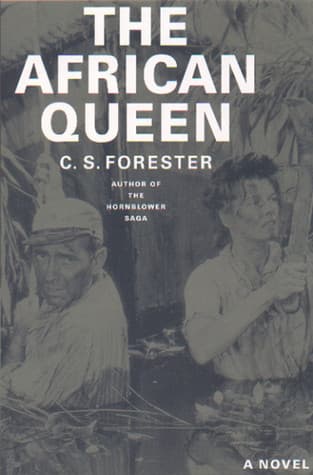
Stranded in the WWI African jungle, a missionary and a steamboat captain fall in love and plan to sink an enemy warship, battling nature and their own differences.
In German East Africa at the start of World War I, the English missionary Rose Sayer lives with her brother, Samuel, at their remote mission. Their peaceful life ends when German colonial forces invade the area. The Germans burn the mission, drive away the natives, and hurt the Sayers, causing Samuel to have a breakdown. Samuel dies shortly after the Germans leave, leaving Rose alone. As she considers her situation, the Canadian mechanic, Charlie Allnutt, arrives in his steamboat, the *African Queen*, having supplied the mission. He finds Rose in shock among the ruins.
Charlie Allnutt, surprised by Rose's calm reaction to the tragedy, offers her passage on the *African Queen* to escape the war. Rose, having lived a strict Victorian life, is put off by Charlie's crude manners and drinking. Despite their differences, they form an alliance out of necessity. They begin their journey down the Ulanga River, a dangerous and mostly uncharted waterway. Rose, still grieving her brother's death and the loss of her life's work, struggles to adapt to the harsh escape and Charlie's rough lifestyle.
As they go down the river, Rose, driven by patriotism and a desire for revenge against the Germans, comes up with a plan. She suggests converting the *African Queen* into a torpedo boat to sink the German gunboat, the *Königin Luise*, which patrols the larger lake at the river's mouth. Charlie first dismisses the idea as absurd and suicidal. He points out the challenges: the *African Queen* is small and slow, they have no torpedoes, and the river has dangerous rapids. However, Rose's strong belief and arguments start to convince Charlie, appealing to his sense of adventure and a growing admiration for her spirit.
The first big challenge is navigating a series of dangerous rapids. Charlie, an experienced riverman, steers the *African Queen* skillfully through the churning water. Rose, at first terrified, has to trust him completely. The boat is tossed around and almost capsizes many times, and they barely avoid hitting rocks. During this ordeal, Rose sees Charlie's competence and bravery, starting to change her initial negative view of him. The shared danger and successful passage through the rapids create a stronger bond between them, breaking down some of their social barriers.
After surviving the rapids, the *African Queen* is damaged. Charlie needs to make extensive repairs, including patching a leaking boiler. This forces them to stop for a long time in a swampy, mosquito-infested area. The insects bother them constantly, making sleep and work hard, and adding to the oppressive heat and humidity. During this time, the small boat and shared hardship continue to reduce their inhibitions. Rose, despite her discomfort, helps Charlie where she can, further solidifying their partnership. The repairs are difficult, testing Charlie's cleverness and strength, but he eventually makes the boat ready to sail again.
As they continue, food and fresh water run low, leading to a period of severe hardship. The constant exposure and poor diet take their toll, especially on Charlie. He gets a bad case of malaria, falling into a feverish state. Rose is left to care for him, despite her limited medical knowledge and her own weakening condition. She nurses him tirelessly, getting water, applying cool compresses, and enduring his confused talk. This period of Charlie's extreme vulnerability, and Rose's selfless care, marks a turning point in their relationship, deepening their emotional connection as she sees past his rough exterior.
With Charlie slowly recovering from malaria, they face one last natural obstacle: a long stretch of very shallow, reedy river. The *African Queen* gets stuck repeatedly in the mud and thick plants, threatening to strand them. Charlie, still weak but determined, has to get into the water to push and pull the boat through the muck. Rose, showing her growing toughness and practical skills, helps him, pulling ropes and clearing the way. Their combined efforts, driven by sheer will, eventually get them through this seemingly impassable section, bringing them close to the great lake.
After weeks of struggle, the *African Queen* finally leaves the river and enters the vast lake. However, the boat is in bad shape. The hull is severely damaged by rocks and strain, taking on water. The propeller shaft is bent, and the engine barely works. They are adrift in the middle of the large lake, with their plan to sink the *Königin Luise* seeming impossible given their vessel's condition. The sight of the endless water is both a victory and a new, huge challenge, showing how fragile their survival is.
Despite the *African Queen*'s bad condition, Rose refuses to give up. They decide to change their plan. With Charlie's cleverness, they make two torpedoes using oxygen and hydrogen cylinders, attaching them to the front of the *African Queen*. Their new strategy is to ram the *Königin Luise*, hoping the impact will set off their makeshift explosives. This is an even more desperate and dangerous plan than the original, as it means their own boat will be destroyed and they will likely die. The plan shows their shared determination and the strong bond between them.
As they prepare for their mission, a violent storm brews on the lake. The *African Queen*, barely afloat, is tossed by the waves. Amidst the storm, they spot the *Königin Luise*. Charlie, with great skill and courage, steers the damaged steamboat towards the German gunboat, aiming for a collision. The storm adds to the chaos and reduces visibility, making the approach even more dangerous. Both are fully committed to their desperate plan, facing death together with a shared purpose and a deep, unspoken love.
Just as the *African Queen* is about to hit the *Königin Luise*, the storm capsizes their small vessel, throwing Charlie and Rose into the water. Germans from the *Königin Luise* rescue them, surprised to find a European man and woman in such a remote place. They are immediately questioned and, after their intentions and makeshift torpedoes are discovered, they are tried as spies and saboteurs. A German officer sentences them to death by hanging. Facing execution, Charlie proposes marriage to Rose, and she accepts, cementing their love as they face death.
Miraculously, as Charlie and Rose are about to be executed on the deck of the *Königin Luise*, a British gunboat unexpectedly attacks the German vessel. In the chaos, the *Königin Luise* is hit and sinks. Charlie and Rose, still tied but free from their executioners, escape the sinking ship in the confusion. The British pick them up, astonished by their story. Their daring plan, though not carried out as intended, indirectly led to their rescue and the German gunboat's destruction. They are seen as heroes, and their marriage is officially recognized.
The Protagonist
Rose transforms from a sheltered, prim missionary into a resilient, adventurous woman, shedding her inhibitions and embracing love and action.
The Protagonist
Charlie evolves from a cynical, self-preserving individual to a courageous and devoted partner, inspired by Rose's conviction and love.
The Supporting
Samuel's arc is brief and tragic; he represents the collapse of the missionary ideal in the face of brutal reality.
The Antagonist (as an object/force)
The *Königin Luise* remains a constant, imposing threat until its unexpected demise, freeing the protagonists.
The Mentioned
The German soldiers serve as a catalyst for the plot and a recurring threat, their individual fates are not explored.
The novel shows how Rose and Charlie change as they adapt to survival in the African wilderness during wartime. Rose, a prim missionary, lets go of her rigid ways, learning to navigate rapids, endure hardship, and even plan a military attack. Charlie, a rough mechanic, finds a heroic and tender side, driven by his growing love for Rose. Their journey forces them to shed old identities and take on new roles, showing how extreme situations can build unexpected resilience and change. For example, Rose calmly takes the tiller during dangerous rapids (Chapter 6), and Charlie nurses her through fever (Chapter 10).
“She looked at him with new eyes, seeing not the uncouth mechanic, but the man who had faced death for her.”
At its core, "The African Queen" is a love story that grows in challenging and unlikely circumstances. Rose and Charlie, from different social classes and with different personalities, are brought together by fate and must rely on each other. Their shared struggle against nature, the Germans, and their own limitations slowly erases their initial dislike and prejudice. Their love is not romanticized but built through shared danger, respect for each other's strengths, and mutual vulnerability. This culminates in Charlie's proposal and Rose's acceptance as they face execution (Chapter 11). Their bond proves stronger than the war itself.
“And in that moment, facing death, they knew a love that was as real and as strong as the river that had brought them together.”
The novel is set during World War I in German East Africa, showing how European colonial conflicts disrupt remote regions. The war, an abstract concept to the mission until the German invasion, shatters the peaceful lives of the Sayers and local natives. The Germans' burning of the mission and the hunt for a British gunboat illustrate how imperial rivalries affect distant lands, bringing violence and chaos. The *African Queen*'s journey is a direct result of this conflict, forcing the characters to navigate a world made dangerous and unpredictable by forces beyond their control, as shown by the mission's destruction in the opening chapter.
“The war, which had seemed so far away, had come to their very doorstep, burning it down.”
A repeated theme is human cleverness and determination in the face of impossible odds. Charlie Allnutt, a skilled mechanic, constantly improvises repairs to the old *African Queen*, keeping it afloat against everything, from patching boilers to rigging the propeller. Rose Sayer, despite her lack of practical experience, plans the daring idea to torpedo the German gunboat and shows strong resolve even when facing death. Their combined efforts, from navigating rapids to pushing the boat through thick reeds, show the strength of the human spirit when pushed to its limits. This demonstrates that willpower and cleverness can overcome large technological and environmental challenges.
“There was always a way, if one only had the wit and the will to find it.”
The dilapidated steamboat that serves as both vehicle and symbol of their journey.
The *African Queen* is more than just a mode of transport; it is a central character and a potent symbol. Its decrepit state mirrors the initial fragility of Charlie and Rose's alliance and the precariousness of their survival. As Charlie constantly repairs and maintains it, the boat becomes a testament to human ingenuity and perseverance. Its journey down the river, through rapids and swamps, parallels the protagonists' emotional and physical transformation, carrying them from their old lives into a new, shared destiny. Its eventual near-destruction and miraculous survival underscore the themes of resilience and chance.
The treacherous river that acts as a dynamic obstacle and catalyst for character development.
The Ulanga River is a powerful environmental antagonist, constantly presenting new challenges that force Charlie and Rose to adapt and bond. Its rapids test Charlie's skill and Rose's courage, while its shallow, reedy sections demand immense physical exertion and cooperation. The river symbolizes the unknown and the unpredictable nature of their journey, pushing them beyond their limits and stripping away their societal facades. It acts as a crucible, forging their relationship and revealing their true characters as they overcome its numerous obstacles, each section of the river marking a new stage in their development.
The distant, formidable enemy that serves as the ultimate goal and source of motivation.
The *Königin Luise* serves as the primary external antagonist and the driving objective of Rose's audacious plan. It represents the larger, impersonal forces of war and colonialism that have disrupted their lives. As a symbol, it is formidable and seemingly invincible, making their mission to sink it appear utterly suicidal. Its very existence forces Charlie and Rose into a shared purpose, overcoming their differences. The gunboat's eventual, accidental sinking provides a deus ex machina resolution, highlighting the role of fate and chance in their survival and the unexpected ways in which their determination ultimately leads to victory.
A severe illness that incapacitates Charlie and deepens Rose's care for him.
Malaria serves as a critical internal conflict and a plot device that forces a significant shift in the relationship between Charlie and Rose. When Charlie succumbs to the fever, he is rendered vulnerable and dependent, allowing Rose to step into a nurturing role. Her selfless care for him, despite her own weakened state, breaks down the last of her inhibitions and prejudices, solidifying her affection and respect for him. It underscores the harsh realities of their environment and highlights the deep bond that has formed between them, moving their relationship beyond mere partnership to genuine love and devotion.
“The gin was a great comfort.”
— Charlie Allnutt frequently relies on gin to cope with his circumstances.
“I suppose you think I'm a silly old maid.”
— Rose Sayer says this to Charlie, reflecting on her prim nature.
“It was impossible to make any headway against the current.”
— Describing their struggle to pilot the African Queen upstream.
“There was a certain exhilaration in their very desperation.”
— As Charlie and Rose face seemingly insurmountable challenges.
“He looked at her and suddenly saw her not as a missionary, but as a woman.”
— Charlie's evolving perception of Rose as their journey progresses.
“We've got to blow up that German gunboat.”
— Rose's determined declaration of their mission.
“She was a woman of iron will, disguised as a fluttery bird.”
— A description of Rose's inner strength despite her outward appearance.
“The river was their enemy and their only friend.”
— Reflecting on the dual nature of the Ulanga River.
“One day we shall look back on this and laugh.”
— Charlie's attempt to lighten the mood during a difficult moment.
“They were two utterly different people, bound together by a common purpose.”
— Describing the unlikely partnership of Charlie and Rose.
“He had never known such a woman.”
— Charlie's internal thought about Rose's unique qualities.
“The African Queen, battered and bruised, but still afloat.”
— A description of their resilient boat, mirroring their own journey.
“It was a mad enterprise, but it was theirs.”
— Reflecting on the audacious and personal nature of their mission.
“Death was a constant companion on the river.”
— Highlighting the ever-present danger they face.
Ready to see how well you understood this book? Take our interactive quiz with 10 questions.

Cecil Louis Troughton Smith, known by his pen name Cecil Scott "C. S." Forester, was an English novelist known for writing tales of naval warfare, such as the 12-book Horatio Hornblower series depicting a Royal Navy officer during the Napoleonic Wars. The Hornblower novels A Ship of the Line and Flying Colours were jointly awarded the James Tait Black Memorial Prize for fiction in 1938. His other works include The African Queen and The Good Shepherd.







