“I beg that you will not interrupt me. Have you any idea how difficult it is to get a man to talk about a thing that he would rather forget?”
— Holmes speaking to Watson about the delicate nature of interviewing a reluctant client.


Genre
Historical Fiction / Mystery
Reading Time
45 min
Key Themes
See below
Sign in to track this book
When a prestigious bank is rocked by the theft of a priceless beryl coronet, only Sherlock Holmes can untangle the web of familial betrayal and public scandal threatening to shatter a prominent gentleman's reputation.
Alexander Holder, a senior partner in the banking firm Holder & Stevenson, arrives at 221B Baker Street in distress, carrying a beryl coronet with three missing beryls. He explains he was entrusted with the coronet, a national treasure, as collateral for a loan of fifty thousand pounds to a prominent, unnamed client. Fearing theft, Holder brought the coronet home, locking it in his personal desk. That night, he was woken by a noise and found his son, Arthur, in his study, holding the damaged coronet. Arthur refused to explain himself, leading to his immediate arrest. Holder, though convinced of Arthur's guilt, seeks Sherlock Holmes's help to recover the missing jewels and understand the motive.
Holmes and Dr. Watson accompany Mr. Holder back to his house in Streatham. Holmes meticulously examines the study, the window, the snow outside, and Arthur's room. He notes the lack of footprints in the fresh snow leading to Arthur's window, but finds evidence of a struggle outside the study window, including a woman's footprint and a man's larger footprint. Holmes interviews the household staff, including the maid, Lucy Parr, and Holder's niece, Mary Harrison. Mary is beautiful but reserved, and Arthur is deeply in love with her. Holmes observes the strained relationships and emotional turmoil in the household, beginning to suspect Arthur's arrest might be a convenient, but incorrect, conclusion.
Despite his father's pleas and the seriousness of the situation, Arthur Holder refuses to explain his presence in the study with the damaged coronet. His silence further implicates him in his father's eyes. Meanwhile, Mary Harrison, who had seemed distant, shows signs of distress. Holmes observes her furtive movements and her unusual interest in the investigation. He notices her looking out the window towards the street with a worried expression and later sees her in deep conversation with a young man, seemingly a stranger, near the house. These observations lead Holmes to believe that Mary, despite her reserved manner, holds a key piece of the puzzle.
Holmes returns to the study window, which Mr. Holder had claimed was securely fastened. He re-examines the snow outside, noting that while there are no clear footprints directly beneath Arthur's window, there are distinct impressions beneath the study window. He deduces that the window, though seemingly closed, had been forced open from the outside. The snow, falling after the initial entry, had partially obscured the evidence. Holmes also finds a small, peculiar indentation in the snow, consistent with the heel of a woman's shoe, distinct from Lucy Parr's. This discovery, combined with the lack of a clear escape path for Arthur, strengthens Holmes's conviction that the story of Arthur's sole guilt is flawed.
Holmes's investigation into Mary Harrison's movements leads him to follow her. He observes her meeting secretly with a man known to him as Sir George Burnwell, a notorious gambler and dissolute character with a reputation for blackmail and shady dealings. This secret meeting, along with Mary's earlier distress and her interest in the coronet, immediately raises Holmes's suspicions about her involvement. He realizes that Mary is likely being manipulated or is complicit in the theft. The connection to Burnwell, a man capable of such a crime, provides a strong lead, suggesting a more complex conspiracy than Mr. Holder initially imagined.
Holmes confronts Mary Harrison, presenting the evidence he has gathered about her secret meetings with Sir George Burnwell. Faced with Holmes's deductions, Mary breaks down and confesses. She admits that Burnwell, with whom she had a past connection, blackmailed her into helping him steal the coronet. She opened the study window for him, and Burnwell attempted to remove the jewels. However, Arthur, hearing the noise, intervened. In the struggle, Burnwell broke off three beryls and escaped, leaving Arthur to be discovered by his father with the damaged coronet. Mary's confession clears Arthur's name but reveals Burnwell's villainy and her own tragic complicity.
Mary's confession finally explains Arthur's puzzling silence. He had seen Mary and Burnwell at the window and had intervened to stop the theft. When his father discovered him, Arthur, realizing Mary's involvement and fearing the ruin of her reputation and his father's distress, chose to remain silent. His love for Mary was so strong that he was willing to bear the accusation of theft and disgrace rather than expose her. This sacrifice highlights Arthur's character and his deep affection for his cousin, making his earlier arrest and his father's condemnation even more tragic.
With Mary's confession, Holmes knows his target is Sir George Burnwell. He immediately sets out to track the villain down. Holmes locates Burnwell and, through cunning and intimidation, recovers two of the three missing beryls. Burnwell, a desperate man, had already sold the third beryl to a fence. Holmes, recognizing the urgency and importance of the coronet, pays Burnwell a thousand pounds of his own money to secure the return of the two remaining jewels. Burnwell, having secured some money, escapes, while Holmes focuses on the immediate task of restoring the coronet to Mr. Holder.
Holmes returns to Mr. Holder's house, presenting him with the mostly restored coronet and explaining the true sequence of events. Arthur is immediately freed and cleared of all charges, his reputation restored. Mr. Holder is overcome with relief and remorse for misjudging his son. While two beryls are recovered, the third remains lost, a permanent reminder of the night's events and Burnwell's escape. Mary Harrison, her complicity revealed, leaves the household in disgrace. The family is left to grapple with the emotional fallout, but the truth has been revealed, and Arthur's honor is salvaged, thanks to Holmes's brilliant deductions.
The Protagonist
Holmes's arc in this story is to solve the complex mystery, clear an innocent man, and restore the beryl coronet, reaffirming his role as a brilliant problem-solver.
The Supporting
Watson's arc is to document Holmes's brilliance and the resolution of the case, showcasing his role as the Boswell to Holmes's Johnson.
The Client/Victim
Holder's arc involves moving from initial despair and misjudgment of his son to profound relief and remorse upon learning the truth, undergoing a significant emotional shift.
The Victim/Protagonist's Client's Son
Arthur's arc is one of unjust accusation and silent suffering, culminating in his exoneration and the revelation of his noble character.
The Supporting/Complicit
Mary's arc involves being manipulated into complicity, suffering extreme distress, and ultimately confessing her involvement, leading to her departure from the household.
The Antagonist
Burnwell's arc is one of villainous action and a partial escape from justice, demonstrating his cunning and amorality.
The Mentioned
N/A
The story shows how easily appearances can deceive and lead to serious misjudgments. Alexander Holder immediately condemns his son, Arthur, based on circumstantial evidence, unable to see past the surface. Arthur's noble silence, meant to protect Mary, is mistaken for an admission of guilt. Conversely, Mary Harrison's quiet demeanor hides a secret past and current complicity due to blackmail. Holmes's genius is his ability to see through these facades, showing that truth often lies beneath layers of misconception and emotional bias, as seen when he examines the footprints in the snow, revealing a different story than Holder believes.
“"The lowest and vilest alleys in London do not present a more dreadful record of sin than does the smiling and beautiful countryside."”
A central theme is Arthur Holder's selfless love and sacrifice. His deep affection for Mary Harrison leads him to endure public disgrace and his father's condemnation rather than expose her involvement with Sir George Burnwell. This act of silent suffering highlights his character and the powerful, sometimes destructive, nature of love. His sacrifice not only protects Mary's reputation, however briefly, but also underscores the emotional turmoil within the family. His willingness to take the blame shows that love can sometimes compel individuals to make difficult choices.
“"My son, Arthur, was arrested. He would say nothing. Oh, for God's sake, sir, do something!"”
Sir George Burnwell embodies the corrupting influence of vice, especially gambling and a dissolute lifestyle. His desperate need for money drives him to blackmail Mary Harrison and attempt to steal a national treasure. His actions show how unchecked greed and moral decay can lead individuals to commit crimes, disregarding the devastating impact on others. Burnwell's escape, though with only one beryl, also suggests the pervasive nature of such corruption and the challenges in fully eradicating it, leaving a lingering sense of injustice despite the recovery of most of the coronet.
“"He is a man of evil reputation, a notorious gambler and a dissolute, worthless fellow."”
While Holmes solves the mystery, recovers most of the coronet, and clears Arthur's name, the story also touches on the imperfection of justice. Sir George Burnwell, the main antagonist, escapes with one of the beryls, never fully facing legal repercussions for his crime. Mary Harrison, though remorseful, is also implicated and leaves in disgrace, her future uncertain. This outcome suggests that even with the most brilliant detective, complete justice is not always achievable, and some wounds, like the missing beryl, may remain unhealed, serving as a permanent reminder of the crime.
“"Two of the beryls I have recovered. The third, alas, is gone forever."”
Arthur Holder's apparent guilt distracts from the true culprit.
Arthur Holder's presence with the damaged coronet, his bloodied hand, and his subsequent silence serve as a classic red herring. This misdirection immediately leads Mr. Holder and initially the police to believe Arthur is the thief, diverting attention from the true circumstances and the actual perpetrator, Sir George Burnwell. Holmes must meticulously peel back these layers of assumption and circumstantial evidence to reveal Arthur's noble motive for silence and the real villain's involvement. This device effectively heightens the mystery and underscores the theme of misjudgment.
Mr. Holder's emotional state and bias cloud his perception of events.
Alexander Holder, as the initial narrator of the events to Holmes, is an emotionally compromised and unreliable witness. His profound distress, his immediate conviction of his son's guilt, and his inability to see beyond the surface facts lead him to present a biased and incomplete account of the crime. This device allows Holmes to demonstrate his superior observational and deductive skills by identifying the gaps and inconsistencies in Holder's narrative, forcing him to look beyond the obvious and reconstruct the true sequence of events. It highlights the subjective nature of perception when under duress.
Footprints in the snow provide crucial evidence of external involvement.
The footprints in the fresh snow outside the study window are a pivotal plot device. The absence of clear footprints leading to Arthur's window, combined with the presence of a woman's and a man's larger footprint beneath the study window, directly contradicts Mr. Holder's initial assumptions. Holmes's meticulous examination and interpretation of these impressions provide irrefutable physical evidence that another party, specifically Sir George Burnwell and Mary Harrison, was involved in the crime, thus clearing Arthur and pointing towards the true culprits. It's a classic example of Holmes's scientific approach to detection.
“I beg that you will not interrupt me. Have you any idea how difficult it is to get a man to talk about a thing that he would rather forget?”
— Holmes speaking to Watson about the delicate nature of interviewing a reluctant client.
“Data! Data! Data! I can't make bricks without clay.”
— Holmes expressing his need for more information from Mr. Holder to begin his deductions.
“As a rule, the more bizarre a thing is the less mysterious it proves to be. It is your commonplace, featureless crimes which are really puzzling, just as a plain face is more difficult to identify than a striking one.”
— Holmes's observation on the nature of unusual cases vs. seemingly simple ones.
“The lowest and vilest alleys of London do not present a more dreadful record of sin than does the smiling and beautiful countryside.”
— Holmes reflecting on the universality of crime, not confined to urban squalor.
“It is a capital mistake to theorize before one has data. Insensibly one begins to twist facts to suit theories, instead of theories to suit facts.”
— Holmes admonishing Watson (and implicitly himself) about premature theorizing.
“A client is a client, and it is my business to play the game according to the rules.”
— Holmes explaining his commitment to his clients, even when the case is unusual.
“There is nothing more deceptive than an obvious fact.”
— Holmes's insight into how seemingly simple truths can mislead.
“My dear Watson, you are the fixed point in a changing age.”
— Holmes's affectionate and appreciative remark to Watson.
“It is of the first importance not to allow your judgment to be biased by personal qualities. A client is to me a mere unit, a factor in a problem.”
— Holmes explaining his detached approach to clients to maintain objectivity.
“What is the meaning of it all, Watson? What object is served by this circle of misery and violence and fear? It must tend to some end, or else our universe is ruled by chance, which is unthinkable.”
— Holmes pondering the deeper philosophical implications of the crimes he investigates.
“He has, I am sure, a most complete and detailed knowledge of the history of crime. He is, in fact, a walking criminal encyclopaedia.”
— Watson describing Holmes's vast knowledge of criminal history.
“Depend upon it, there is nothing so unnatural as the commonplace when you approach it from the right angle.”
— Holmes suggesting that even ordinary events can hold profound secrets when examined closely.
“I can see that you are an honest man, Mr. Holder. I can also see that you are a man with a great deal of trouble.”
— Holmes's initial assessment of Mr. Holder's character and predicament.
“Mediocrity knows nothing higher than itself; but talent instantly recognizes genius.”
— A general observation on the recognition of intellectual superiority.
Ready to see how well you understood this book? Take our interactive quiz with 10 questions.
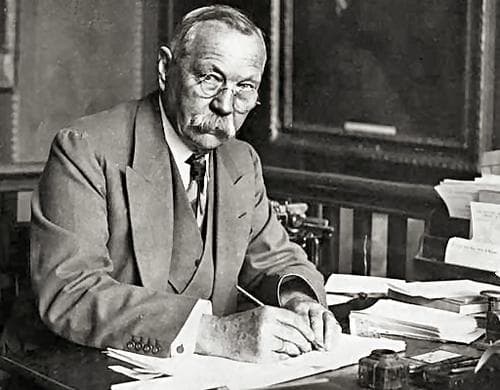
Sir Arthur Ignatius Conan Doyle was a British writer and physician. He created the character Sherlock Holmes in 1887 for A Study in Scarlet, the first of four novels and fifty-six short stories about Holmes and Dr. Watson. The Sherlock Holmes stories are milestones in the field of crime fiction.







