“I think the world is a series of broken dams and floods, and my cartoons are tiny little lifeboats.”
— Junior describes his drawings as an escape from the hardships of life on the reservation.

Sherman Alexie (2007)
Genre
Young Adult
Reading Time
270 min
Key Themes
See below
Sign in to track this book
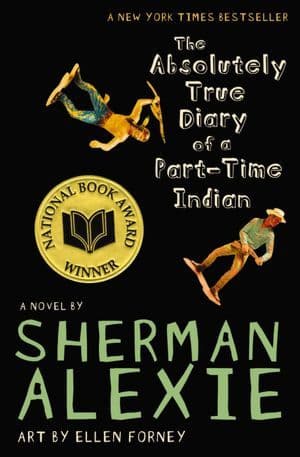
Armed with a sketchbook and a sharp wit, a Spokane Indian boy navigates the hilarious and heartbreaking tightrope between his impoverished reservation and an all-white farm town high school, determined to redraw the boundaries of his own destiny.
Arnold Spirit Jr., known as Junior, describes his life on the Spokane Indian Reservation, detailing the widespread poverty, alcoholism, and hopelessness there. He calls himself 'hydrocephalic' with various physical problems, making him an easy target for bullies, including his best friend, Rowdy. Junior finds comfort and a way to express himself by drawing cartoons. During a geometry class, his teacher, Mr. P, throws a textbook at him, frustrated with the old, neglected resources at the reservation school. Mr. P then tells Junior to leave the reservation to find hope and a better future, saying that if he stays, he will die, both literally and figuratively. This meeting gives Junior a new idea: to transfer to the all-white Reardan High School.
Junior decides to transfer to Reardan High School, a choice that makes almost everyone on the Spokane Reservation turn against him, especially Rowdy, who feels betrayed. Junior's first day at Reardan is humiliating; he is the only Native American student besides the school mascot, feels out of place, and is mocked. He punches a racist bully named Roger, surprisingly earning respect from the white students rather than punishment. He struggles with the commute, often hitchhiking or walking twenty-two miles when his father is too drunk or lacks gas money. Despite the initial problems, he starts to make connections, particularly with Penelope, a popular white girl, and Gordy, the school's smartest student.
Junior lives a double life, a 'part-time Indian.' At Reardan, he is 'Arnold,' the smart Native American kid who plays basketball. On the reservation, he is 'Junior,' seen as a traitor for leaving his community. He becomes friends with Penelope, who has bulimia, and they pretend to date, eventually developing real affection. He also connects with Gordy over their shared interest in learning. He experiences racism, both obvious and subtle, from students and teachers at Reardan, but also finds unexpected allies. His family, though at first supportive, struggles with his choice, and his connection to the reservation becomes more strained, especially with Rowdy, who refuses to speak to him.
Junior tries out for the Reardan basketball team and, despite his small size, makes the varsity squad. During a game against his old school, Wellpinit, Junior is heavily booed and physically attacked by Rowdy during play. Reardan loses the first game. However, in a later, important rematch, Junior plays very well, outsmarting Rowdy and leading Reardan to an upset victory against Wellpinit, a moment of mixed triumph. This success is overshadowed by several terrible losses: his grandmother is hit by a drunk driver and dies, his father's best friend, Eugene, is shot and killed by a friend over a dispute about the last drink, and his older sister, Mary, dies in a trailer fire on the reservation, likely due to an accidental fire while she was drunk. Each death makes Junior and his family feel deeper grief and despair.
Overwhelmed by the tragedies, Junior almost gives up on Reardan. His classmates show him unexpected support, going to his grandmother's funeral and offering condolences. He realizes that while he is a part-time Indian, he is also a part-time Reardan student, belonging to both worlds in a unique way. He accepts the complex nature of his identity and grief. Eventually, Rowdy, still distant, starts to communicate with Junior again, first through a cartoon that Junior's mother passes on. In the final scene, Rowdy visits Junior, and they play one-on-one basketball, not keeping score, showing a tentative reconciliation and the lasting bond of their friendship. Junior thinks about his future, realizing he doesn't have to choose just one identity but can embrace who he is in many ways.
The Protagonist
Junior transforms from a bullied, isolated boy on the reservation to a confident individual who embraces his complex identity, finding belonging in multiple communities.
The Supporting
Rowdy initially rejects Junior's decision, but eventually, through shared grief and unspoken understanding, begins to mend their friendship.
The Supporting
Penelope moves from a superficial relationship with Junior to a genuine, supportive friendship, revealing her vulnerabilities and aspirations.
The Supporting
Gordy develops a friendship with Junior, becoming a source of academic and intellectual support.
The Supporting
Mr. P acts as an initial mentor, pushing Junior towards a path of self-improvement and escape from the reservation's limitations.
The Supporting
Mary finds a brief period of happiness and escape from the reservation before her tragic death, mirroring the fragility of hope.
The Supporting
Grandma Spirit serves as a moral compass and source of unconditional love for Junior until her tragic death, which profoundly impacts him.
The Supporting
Junior's father remains trapped by his alcoholism but consistently shows love and support for his son's aspirations.
The Supporting
Junior's mother remains a constant, loving presence, providing stability and encouragement amidst family tragedies.
The novel explores Junior's struggle to define his identity as he lives between the Spokane Reservation and the mostly white Reardan High School. He feels like a 'part-time Indian,' not fully belonging to either world. This theme is clear in his thoughts and cartoons, showing his confusion and eventual acceptance of his many-sided self. His relationships with Rowdy (representing his reservation identity) and Penelope/Gordy (representing his Reardan identity) further show this tension. He comes to understand that identity is complex and not limited to one place or group.
“I was half Indian in one place and half white in the other. It was like being a magician, like I was trying to make myself disappear. And, in a way, I was. I was trying to make my Indian half disappear.”
Poverty is a constant presence on the reservation, affecting every part of Junior's life, from a lack of school resources to his family's struggle for basic needs. The book clearly shows the despair, alcoholism, and lack of opportunity that often come with this poverty. Junior's decision to leave the reservation is an act of hope, a desperate attempt to break the cycle. The difference between poor Wellpinit and wealthy Reardan highlights the sharp contrasts in opportunity. Despite the overwhelming problems, Junior's journey shows the lasting power of hope and individual choice.
“I was going to be the first one to leave the rez and go to a white school. I was going to be a pioneer. And I was going to bring hope to the reservation.”
The novel addresses both obvious and subtle forms of racism and prejudice. Junior experiences direct racist comments and stereotypes from students at Reardan, and his family faces systemic discrimination. The 'us vs. them' way of thinking between the reservation and Reardan is always present. However, the book also challenges these expectations, showing that prejudice can exist on both sides (e.g., Rowdy's initial rejection of Junior) and that unexpected allies can appear (e.g., Roger, Penelope). It looks at the complexities of racial identity and the problems of overcoming deep-seated biases.
“I realized that I was an Indian who was trying to be an Indian in a white world. And that was a really bad idea.”
Junior experiences several devastating losses, including his grandmother, his father's best friend Eugene, and his sister Mary. These tragedies, often linked to the widespread alcoholism and despair on the reservation, highlight the deep grief and trauma in Native American communities. Despite these huge setbacks, Junior shows great resilience. He finds ways to cope, drawing strength from his family, his new friends, and his art. The book emphasizes that while grief is hard, the human spirit's ability to be resilient and find meaning can continue.
“I realized that, sure, I was a Spokane Indian. I belonged to that tribe. But I also belonged to the tribe of basketball players. And I belonged to the tribe of cartoonists. And I belonged to the tribe of chronic masturbators. And I belonged to the tribe of guys who wanted to date pretty white girls. And I belonged to the tribe of poor people. And I belonged to the tribe of people who knew what it was like to be hungry and to have their parents be hungry and their grandparents be hungry. And I belonged to the tribe of people who had lost people they loved.”
The main relationship between Junior and Rowdy explores friendship, loyalty, and betrayal. Their bond is at first strong, built on shared experiences and Rowdy's protection of Junior. However, Junior's choice to leave the reservation feels like a deep betrayal to Rowdy, leading to a bitter split. The novel examines the pain of this separation and the slow, difficult path to making up. It also shows how new friendships form at Reardan, demonstrating how different kinds of bonds can offer support and challenge personal growth.
“I knew that Rowdy was going to hate me forever. I knew that I was going to be lonely forever. But I also knew that I was going to be okay. I was going to be okay because I was going to be a part-time Indian.”
Provides direct access to Junior's thoughts and emotions through text and visual art.
The story is told entirely from Junior's perspective, offering an intimate and often humorous insight into his mind. His voice is distinct, engaging, and reflective of a teenage boy. Crucially, the narrative is interspersed with Junior's own drawings and cartoons. These visuals are not mere illustrations; they are an integral part of the storytelling, functioning as Junior's primary mode of expression, communication, and coping mechanism. They often convey emotions, social commentary, or plot points that words alone might not capture, making the reader feel directly connected to Junior's inner world and artistic talent.
Symbolizes Junior's divided identity and the struggle to belong.
The phrase 'part-time Indian' is a central metaphor that Junior uses to describe his experience of straddling two distinct cultures: his Spokane Reservation heritage and the white world of Reardan High School. This device encapsulates his feeling of not fully belonging to either, being 'too Indian' for Reardan and 'too white' for the rez. It highlights the internal conflict and external pressures he faces, constantly code-switching and adapting. The metaphor evolves throughout the book, ultimately representing his acceptance that identity is fluid and can encompass multiple affiliations, rather than being a binary choice.
Serve as a microcosm for the conflict between the reservation and Reardan.
The two basketball games between Wellpinit (Junior's old school) and Reardan (his new school) are powerful plot devices. They physically manifest the cultural and personal conflict Junior experiences. The first game, where Junior is booed and injured, represents his initial rejection by his community. The second game, where Reardan triumphs due to Junior's play, symbolizes his growing confidence and ability to succeed in the white world, but also the bittersweet nature of his separation. These games are high-stakes emotional battlegrounds that reflect the larger socio-economic disparities and the personal betrayals and reconciliations between Junior and Rowdy.
Emphasize the pervasive despair and impact of alcoholism on the reservation.
The recurring motif of tragic deaths (Grandma Spirit, Eugene, Mary Spirit) serves as a stark reminder of the harsh realities and cyclical despair on the Spokane Reservation. These events, often linked to alcoholism, are not just personal losses for Junior but also commentary on systemic issues. They highlight the fragility of life and the deep-seated trauma within the community. While devastating, these tragedies also serve to deepen Junior's resolve, strengthen his family bonds, and ultimately lead to moments of unexpected empathy and support from his Reardan peers, underscoring the universal nature of grief.
“I think the world is a series of broken dams and floods, and my cartoons are tiny little lifeboats.”
— Junior describes his drawings as an escape from the hardships of life on the reservation.
“If you let people into your life a little bit, they can be pretty damn amazing.”
— Junior reflects on his experiences at Reardan High School after initially feeling like an outsider.
“Life is a constant struggle between being an individual and being a member of the community.”
— Junior grapples with his identity as he moves between the Spokane reservation and the white school.
“I was a zero on the rez. If I stayed, I would always be a zero.”
— Junior explains his decision to leave the reservation school for better opportunities.
“We all have to find our own ways to say goodbye.”
— Junior deals with the deaths of his grandmother, Eugene, and his sister Mary.
“The only thing more pathetic than Indians on TV is Indians watching Indians on TV.”
— Junior criticizes the stereotypical portrayal of Native Americans in media.
“I used to think the world was broken down by tribes. By Black and White. By Indian and White. But I know that isn't true. The world is only broken into two tribes: the people who are assholes and the people who are not.”
— Junior shares a realization about human nature after facing bullying and finding unexpected allies.
“I draw because words are too unpredictable. I draw because words are too limited.”
— Junior explains why he relies on cartoons to express himself beyond verbal communication.
“Poverty doesn't give you strength or teach you lessons about perseverance. No, poverty only teaches you how to be poor.”
— Junior reflects on the harsh realities of growing up in poverty on the reservation.
“I was crying because I knew I was never going to drink and because I was never going to kill myself and because I was going to have a better life out in the white world.”
— Junior cries after a basketball game, overwhelmed by his conflicting emotions about his future.
“You have to dream big to get big.”
— Junior's father encourages him to pursue his ambitions beyond the reservation.
“I realized that I might be a lonely Indian boy, but I was not alone in my loneliness.”
— Junior finds connection with others who feel isolated, like his friend Gordy.
“We lived on a combination of irregular paychecks, hope, fear, and government surplus food.”
— Junior describes the economic instability of his family on the reservation.
“I was a boy who wanted to be a boy, but the rez wanted me to be a warrior.”
— Junior feels pressure from reservation expectations while navigating his personal identity.
Ready to see how well you understood this book? Take our interactive quiz with 10 questions.
Biography coming soon.