“Things are what they are, and whatever will be will be.”
— Allan Karlsson's life philosophy, often repeated throughout his adventures.

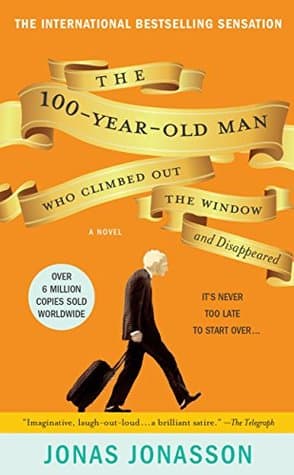
Jonas Jonasson (2012)
Genre
Historical Fiction
Reading Time
360 min
Key Themes
See below
Sign in to track this book
A 100-year-old man escapes his birthday party, steals a suitcase of cash, and goes on a road trip that reveals how he accidentally shaped the 20th century.
On his 100th birthday, Allan Karlsson, a resident of the Elderly Care Home in Malmköping, decides he has had enough of the planned celebrations and the rules about his alcohol. Slipping out his window in his slippers, he goes to the bus station. There, a young, aggressive man called 'The Young Man' asks Allan to watch a large suitcase for a moment. When the bus arrives, Allan takes the suitcase and gets on the bus to Byringe, leaving The Young Man behind. Allan does not know the suitcase holds 50 million Swedish kronor belonging to a criminal gang called 'Never Again'.
In Byringe, Allan meets Julius Jonsson, an unemployed and eccentric former hot dog vendor and ex-convict. Allan tells Julius about the suitcase and his accidental theft. Soon, The Young Man finds them at Julius's old house. During a fight, Julius accidentally locks The Young Man in a freezer, where he freezes to death. Realizing what happened, Allan and Julius decide to get rid of the body by feeding it to a badger, then dumping the rest into a lake. This event starts their unexpected partnership and draws the attention of the 'Never Again' gang, who are now looking for their money and their missing member.
Allan and Julius continue their journey with the suitcase of money and pick up more unusual companions. They meet Gunilla Björklund, an independent woman living in the countryside with her elephant, Sonya. Gunilla, at first suspicious, joins them after they help her get Sonya back from a truck where she was being taken for slaughter. The group, now Allan, Julius, Gunilla, and Sonya, becomes a unique traveling party. They are chased by the remaining members of the 'Never Again' gang, led by Buster, who want their money back and revenge for The Young Man.
The 'Never Again' gang, Buster and 'The Scar,' searches harder. They find Allan and his companions in a small town. During a chaotic chase with Sonya the elephant, another gang member, 'The Scar,' dies accidentally when he falls from a moving truck and is run over. The remaining gang leader, Buster, becomes even angrier and more determined. Allan and his group escape and find shelter with Allan's old friend, Benny Ljungberg, a former railway station master and eternal student. Benny has been married many times and knows many random facts. Benny, interested in their story and the money, quickly joins their eccentric group.
The story mixes Allan's current adventures with long flashbacks to his unusual past. Born in 1905, Allan becomes fascinated with explosives early on, a skill he learns from his father, who was involved in the Russian Revolution. After his parents die, Allan's talent for demolition becomes clear. He accidentally blows up a local railway station, which leads to him being put in a psychiatric institution. This part of his life sets the stage for his future involvement in major global events, showing his natural ability to cause significant, often accidental, disruption with a cheerful lack of concern for the results.
After escaping the psychiatric institution, Allan travels to Spain, where he accidentally helps Francisco Franco's Nationalist forces during the Spanish Civil War by blowing up a bridge. His reputation for explosives grows. He later goes to the United States, where he works on the Manhattan Project, becoming an unlikely friend to J. Robert Oppenheimer. Allan's simple, yet effective, way of solving problems, along with his lack of political beliefs, allows him to navigate complex historical events with a unique view, often influencing their outcomes without fully understanding the political implications.
Allan's journey continues through World War II and the Cold War. He meets President Harry S. Truman, accidentally giving him advice on the atomic bomb, and later gets involved with Chinese Communist leaders, including Mao Zedong, during the Chinese Civil War. He also meets Kim Il-sung in North Korea. His knack for being in the right place at the right time, combined with his lack of interest in political ideas, allows him to cross political lines and talk with opposing world leaders, often leaving a lasting, though subtle, impact on their decisions. He becomes a valuable, though often unwitting, asset to various intelligence agencies.
During the Cold War, the CIA recruits Allan to spy on Soviet nuclear activities. His mission takes him to Moscow, where he gets involved with the KGB. He escapes Lavrentiy Beria, the head of the NKVD, but is eventually caught and sent to a Gulag in Siberia. Even in the harsh Gulag, Allan stays optimistic and resourceful. He becomes friends with Albert Einstein's fictional, simple-minded brother, Herbert Einstein, and together they plan their escape, showing Allan's lasting ability to find companionship and opportunity in the worst situations.
Allan and Herbert Einstein successfully escape the Gulag using Allan's explosive skills, blowing a hole in the prison wall. Their escape shows Allan's lasting cleverness and Herbert's surprising, accidental help. They travel across Asia and Europe, eventually returning to the West. Their adventures together further establish Allan's reputation as a man who can survive anything and whose life is a continuous, accidental journey through the most important events of the 20th century, always landing on his feet, often with a drink in hand.
Back in the present, Allan, Julius, Gunilla, Benny, and Sonya the elephant are still running from Buster, the last member of the 'Never Again' gang. They arrange a meeting with Buster to talk. However, Buster's attempt to get his money back goes wrong when he is accidentally trapped in a container and shipped to Estonia, never to be seen again. With the threat gone, the group decides to use the 50 million kronor to start a new life. They move to Bali, where they live a luxurious and peaceful life, enjoying their new wealth and the company of their unusual family, with Allan still enjoying his vodka and good food.
The Protagonist
Allan begins as a man escaping the mundane end of his life and ends up creating a new, adventurous beginning, proving that age is just a number. He finds a new 'family' in his later years.
The Supporting
From a solitary ex-con, Julius finds companionship and purpose through his adventures with Allan, becoming a loyal friend and an integral part of their new 'family'.
The Supporting
Gunilla transitions from a solitary existence to finding a new community and adventure with Allan's group, embracing an unexpected life.
The Supporting
Benny, an intellectual wanderer, finds a stable, albeit unconventional, 'family' and a thrilling new purpose in life with Allan's group.
The Supporting
Sonya's 'arc' is one of companionship and survival, embodying the unusual nature of the group she joins.
The Antagonist
His arc is brief and tragic, serving as the initial spark for the plot and a demonstration of the gang's ruthlessness.
The Antagonist
Buster starts as a powerful criminal leader and ends up accidentally exiled, losing his money and his gang due to Allan's unpredictable nature.
The Supporting
Herbert, initially a simple Gulag prisoner, finds freedom and a global adventure through his friendship with Allan.
The Mentioned
His interaction with Allan is a brief but significant part of Allan's past, showing Allan's unexpected influence.
The novel shows how random life can be and how chance meetings and coincidences can greatly change one's path. Allan Karlsson's life shows this, as he stumbles into important historical events and meets world leaders not because he wants to, but by chance and his simple wish for a drink or an adventure. His escapes and the deaths of his pursuers often happen because of absurd, unforeseen events, showing that life often unfolds in unpredictable and funny ways, not through careful plans. The ease with which he handles global politics despite his lack of interest highlights this theme.
“Things are what they are, and what will be, will be.”
Allan Karlsson's main trait is his complete lack of interest in political beliefs. He sees all systems, whether communism, capitalism, or fascism, with equal indifference, focusing instead on practical things like food, drink, and explosions. This apolitical stance lets him easily cross international borders and talk with leaders from opposing groups (from Franco to Mao to Truman) without bias. The book often makes fun of the strict beliefs of political figures by comparing them with Allan's simple, practical way, suggesting that ideology often makes human affairs more complicated, not clearer. This theme is clear when world leaders take Allan's advice seriously, even though he does not care about their political goals.
“Politics didn't interest him. There were always far more interesting things to do.”
Despite Allan's often solitary and wandering life, the story strongly emphasizes how important companionship is. In his old age, Allan quickly forms a new 'family' with Julius, Gunilla, Benny, and even Sonya the elephant. These relationships form through shared experiences, helping each other, and a common bond against outside threats. Similarly, his past includes important friendships, like with Herbert Einstein and J. Robert Oppenheimer. These bonds give Allan comfort, support, and a sense of belonging, showing that even a wandering centenarian needs connections. The ending, with the group settling in Bali, reinforces this theme of chosen family.
“Life would be so much easier if you only had to worry about yourself, but it was so much more fun if you had to worry about others.”
The novel challenges the usual idea of old age as a time of decline and quiet thought. Allan, at 100, refuses to act as expected, literally climbing out a window to leave his nursing home. His current adventure is as active and dangerous as any of his past experiences, proving that the desire for excitement and new experiences is not limited by age. His resourcefulness, wit, and physical strength show that old age can be a time for new beginnings, rejecting the idea that life's adventures must end at a certain point. His youthful spirit remains, no matter his age.
“It's never too late to stop being stupid.”
Alternates between Allan's present-day escape and his historical flashbacks.
The novel employs a dual timeline structure, alternating chapters between Allan's current adventure and extensive flashbacks to his extraordinary life throughout the 20th century. This device allows the reader to understand Allan's character and skills in the present by revealing his past experiences. The flashbacks provide context for his casual approach to danger and his surprising resourcefulness, while also adding historical depth and satirical commentary on major world events. The interweaving keeps both narratives engaging and builds a complete picture of Allan's eccentric life.
Hints at future events or Allan's past skills without giving away details.
While not heavy-handed, the narrative often subtly foreshadows events or Allan's capabilities. For instance, early mentions of Allan's past with explosives prepare the reader for later instances of him using this skill. The casual way he handles the suitcase hints at his indifference to consequences, which is a major driver of his historical escapades. The ironic foreshadowing comes from the reader's awareness of Allan's extraordinary past, which makes the present-day events, no matter how absurd, seem almost plausible for him.
Allan's actions, often accidental, drive the plot and influence historical events.
Allan Karlsson is the quintessential accidental hero. His actions, both in the present and the past, are rarely premeditated or driven by grand ambition. He 'climbs out the window' simply to avoid a birthday party, 'steals' a suitcase by mistake, and 'helps' various world powers through sheer happenstance and his practical skills. This device highlights the theme of serendipity and the absurdity of life, suggesting that significant events can be triggered by the most mundane or unintentional actions of an ordinary man with an extraordinary knack for explosives.
Uses humor to comment on historical events, politics, and human nature.
The novel heavily relies on satire and black humor to comment on serious historical events, political ideologies, and human foibles. Allan's nonchalant attitude towards death, global conflicts, and powerful figures creates a comedic contrast with the gravity of the situations. The absurd ways in which characters die or are disposed of (e.g., fed to a badger, shipped to Estonia) are examples of black humor. This device allows the author to critique political systems and historical figures in a lighthearted yet pointed manner, making profound observations through an entertaining lens.
“Things are what they are, and whatever will be will be.”
— Allan Karlsson's life philosophy, often repeated throughout his adventures.
“Most people worry about things that never happen. It's a terrible waste of time.”
— Allan reflecting on his long life and the futility of anxiety.
“The world is full of idiots, but they are not dangerous until they start to think.”
— Allan's observation after encountering various historical figures.
“You should always be nice to people on the way up because you might meet them again on the way down.”
— Advice Allan gives based on his experiences with powerful figures.
“It's easier to fool people than to convince them they've been fooled.”
— Allan's pragmatic view after witnessing political manipulations.
“A person who has nothing to lose is the most dangerous person of all.”
— Reflection on his own situation when he escapes the nursing home.
“History is a strange thing. Sometimes it's written by the victors, sometimes by the survivors.”
— Allan's thought after influencing major 20th-century events.
“The problem with the world is that everyone is a few drinks behind.”
— Allan's humorous take on global conflicts and human behavior.
“It's not the crime that's the problem, it's the cover-up.”
— Allan's observation after witnessing political scandals.
“Life is a journey, not a destination. And sometimes you have to climb out a window to start it.”
— Summarizing his decision to escape the nursing home at age 100.
“The secret to a long life is to keep breathing and avoid dying.”
— Allan's simple, humorous answer when asked about longevity.
“When you're old, people stop expecting things from you. That's when you can finally have some fun.”
— Allan explaining why he embarks on his unexpected journey.
“Money is like a sixth sense - you can't make use of the other five without it.”
— Allan's practical observation after various financial adventures.
“Sometimes the best way to solve a problem is to pretend it doesn't exist.”
— Allan's approach to dealing with difficult situations throughout his life.
Ready to see how well you understood this book? Take our interactive quiz with 10 questions.

Biography coming soon.







