“It was a messy, ugly business, and she was damn good at it.”
— Eve reflects on her job as a homicide detective, acknowledging the grim nature of her work.

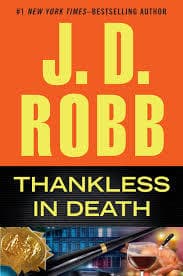
J.D. Robb (2013)
Genre
Thriller / Mystery / Science Fiction / Romance
Reading Time
240 min
Key Themes
See below
Sign in to track this book
As Thanksgiving approaches in 2060 New York, Lieutenant Eve Dallas hunts a disgruntled son who brutally murdered his parents and plans to unleash his new love for violence upon the city, proving that some family ties are best severed by a blade.
The novel opens with Lieutenant Eve Dallas and her husband, Roarke, preparing for a large Thanksgiving celebration at their luxurious New York City penthouse, hosting Roarke's extensive Irish family. Their domestic peace is shattered when Eve receives a call about a double homicide. She and Detective Delia Peabody respond to a gruesome scene in a suburban home: Arnette and Richard Reinhold have been stabbed and bludgeoned to death. Initial evidence, including a bloody note and the son's missing vehicle, points immediately to their estranged son, Jerry Reinhold, as the main suspect. Eve's team begins processing the crime scene and gathering information about the victims and their son.
As Eve, Peabody, and Detective Ian McNab investigate, they quickly create a profile for Jerry Reinhold. He is a twenty-six-year-old man with a history of underachievement, frequent job changes, and failed relationships. Interviews with former employers, a previous girlfriend (Lisa), and neighbors describe a man full of resentment, entitlement, and deep anger towards anyone he felt slighted him. His parents, Arnette and Richard, had recently cut him off financially, likely causing his violent outburst. The team learns Jerry stole a significant amount of money from his parents after the murders, indicating a clear motive and an escape plan.
Eve's investigation quickly determines that Jerry is not just fleeing; he is actively seeking revenge against those he feels wronged him. His first target after his parents is his ex-girlfriend, Lisa, who had recently broken up with him. Jerry tracks her down and brutally murders her in her apartment. This act confirms Eve's understanding of Jerry's increasing pathology: he is a spree killer, driven by a twisted sense of grievance and a growing enjoyment of violence. The discovery of Lisa's body intensifies the manhunt, as Eve realizes Jerry will continue to kill until he is stopped.
With Jerry now a confirmed multiple murderer, Eve and her team, including technicians like Morris and patrol officers, work tirelessly to track his movements. They use traffic camera footage, financial records from the stolen money, and witness interviews to piece together his itinerary. Jerry, fueled by paranoia and a desire to 'settle scores,' is proving unpredictable but also following a pattern of targeting individuals he believes have wronged him. Eve recognizes the urgency of anticipating his next victim before he can strike again, feeling the pressure increase with each passing hour.
Despite the horrific case, Eve is committed to her personal life and the Thanksgiving celebration at her home. Roarke's boisterous and loving family fills their penthouse, providing a sharp contrast to the darkness Eve faces professionally. While she tries to be present for the festivities, her mind is constantly on the investigation. Roarke, always supportive, understands her dedication and helps manage the family while also offering his own resources and insights to aid her. This balance shows Eve's growth and her increasing ability to integrate her personal and professional worlds, even under extreme pressure.
Jerry continues his murderous spree, next targeting Mr. Henderson, a former employer who had fired him. Henderson is found dead, a victim of Jerry's escalating violence. This murder further confirms Jerry's method: he is systematically eliminating anyone he sees as having contributed to his failures. The team now has a clearer understanding of the types of individuals Jerry is likely to target next, allowing them to issue warnings and deploy resources to protect potential victims. The pressure on Eve to apprehend Jerry before he claims more lives increases.
Through diligent investigation and psychological profiling, Eve and Dr. Mira deduce that Jerry's next target is likely his former therapist, Dr. Joyce Miller. Jerry had attended therapy sessions, but he could not take responsibility for his actions, instead blaming others. Eve realizes that Miller represents another figure of authority or perceived judgment in Jerry's mind. The team races against time to locate Dr. Miller and protect her, understanding that Jerry's mental state is rapidly declining, making him even more dangerous and unpredictable.
Eve, Peabody, and other officers arrive at Dr. Miller's office just as Jerry is preparing to attack her. A tense standoff occurs, with Jerry holding Dr. Miller hostage. Eve attempts to negotiate with him, trying to understand his motivations and de-escalate the situation. Jerry, however, is deeply convinced he has been wronged and shows no remorse. He sees himself as a victim, enacting justice. Eve's strategic thinking and quick reactions are essential in managing the volatile situation, ensuring the hostage's safety while trying to apprehend the increasingly desperate killer.
The confrontation ends in a dramatic sequence where Eve, using her tactical skills, manages to disarm and apprehend Jerry Reinhold. She acts decisively, preventing him from harming Dr. Miller and ending his violent spree. The capture shows Eve's persistence, her ability to think under pressure, and her entire team's coordinated efforts. With Jerry in custody, the immediate threat is neutralized, and the surviving potential victims are safe. The aftermath involves securing the scene, processing evidence, and preparing Jerry for interrogation and eventual prosecution.
After Jerry Reinhold's capture, Eve and her team begin the extensive paperwork and legal procedures for his prosecution. Eve reflects on the case, the chilling nature of Jerry's entitlement, and the deep resentment that drove him to murder. The contrast between the horrific violence she witnessed and the warmth of her own Thanksgiving celebration with Roarke and his family is stark. The case reinforces Eve's understanding of the darkness that can exist within people, but also deepens her appreciation for the love and stability she has found in her life, a powerful antidote to her own traumatic past.
The Protagonist
Eve continues to grow in her capacity for emotional vulnerability and deepens her appreciation for her personal relationships, even as she confronts the darkest aspects of human nature.
The Supporting
Roarke continues to provide unwavering support and unconditional love to Eve, demonstrating his commitment to their shared life and his role as her emotional bedrock.
The Antagonist
Jerry's arc is one of rapid descent into escalating violence and delusion, culminating in his capture.
The Supporting
Peabody continues to develop her detective skills and confidence, proving to be an indispensable asset to Eve.
The Supporting
Dr. Mira consistently provides her expert psychological insights, guiding Eve in understanding the criminal mind.
The Supporting
McNab continues to provide vital technical support and remains a stable, loving partner to Peabody.
The Supporting
Whitney continues to be a steady and supportive superior, trusting Eve's abilities while ensuring protocol.
The Supporting
Morris consistently provides accurate and timely forensic analysis, crucial for Eve's investigations.
This theme is central to understanding Jerry Reinhold's motivations. Jerry embodies the destructive power of entitlement, believing the world owes him success and happiness without effort. When reality fails to meet his deluded expectations, his entitlement turns into bitter resentment, which he projects onto everyone around him. His parents cutting him off, an ex-girlfriend leaving him, or a boss firing him are not seen as consequences of his own actions, but as personal attacks, fueling his violent revenge spree. The novel contrasts this with Eve's own self-made success despite a truly horrific past.
“He didn't want to take responsibility, he wanted to blame. And when he couldn't blame, he wanted to hurt.”
The novel explores various forms of family—blood, chosen, and found—and the importance of gratitude. Eve, who grew up without a loving family, finds immense joy and stability in her chosen family: Roarke, Peabody, Summerset, and even the larger circle of friends and colleagues. The Thanksgiving setting emphasizes this theme, contrasting Eve's newfound warmth with the Reinholds' toxic family dynamic that led to murder. Jerry's inability to appreciate anything given to him, and his belief that his parents owed him, highlights the destructive absence of gratitude.
“She had so much to be grateful for. A home, a husband, a family that was hers by choice, not by blood. And a job that mattered.”
The narrative tracks Jerry Reinhold's psychological decline and the increasing brutality of his crimes. He starts with a brutal but perhaps unplanned murder of his parents, fueled by immediate anger. However, with each subsequent victim—his ex-girlfriend, his former boss—his violence becomes more deliberate, more sadistic, and almost ritualistic. This escalation shows how unchecked rage and a lack of empathy can lead an individual down a path of increasing depravity, finding a perverse satisfaction in killing. Eve's ability to recognize this pattern is key to predicting his next move.
“He wasn't just killing; he was making a statement, a bloody, violent one, to everyone he felt had ever slighted him.”
The conflict between justice, as sought by Eve, and revenge, as enacted by Jerry, is a core theme. Eve represents the institutional pursuit of justice, ensuring that criminals are held accountable within the bounds of law and order. Jerry, on the other hand, believes he is enacting his own form of 'justice'—a twisted, personal vendetta against those he perceives as having wronged him. His actions are driven by a desire for retribution and to inflict pain, rather than to right any actual wrongs. The novel highlights the profound difference between these two concepts and the societal need for a system of impartial justice.
“He called it justice. She called it murder.”
The initial, obvious suspect provides a starting point but not the full picture.
While Jerry Reinhold is immediately identified as the killer of his parents, the 'red herring' aspect comes from the initial assumption that this might be a one-off, albeit horrific, act of familial violence. The real 'mystery' then shifts from 'who' to 'where will he strike next?' and 'how do we stop him?', making the initial clarity a setup for a more complex manhunt rather than a simple resolution.
The urgency of preventing further murders drives the narrative pace.
The ticking clock device is central to the plot's tension. Once Eve realizes Jerry is a spree killer targeting specific individuals, the narrative becomes a race against time. Each victim's death intensifies the pressure to identify and protect the next potential target, creating a palpable sense of urgency for Eve and her team to apprehend Jerry before he can claim more lives. This device constantly heightens the stakes and quickens the pace of the investigation.
Dr. Mira's expertise helps predict the killer's motives and next moves.
Dr. Mira's psychological profiling is a crucial plot device. By analyzing Jerry Reinhold's background, his past interactions, and the nature of his crimes, Mira helps Eve understand his distorted mindset. This allows the team to anticipate his pattern of targeting those he felt wronged him, narrowing down the pool of potential victims and providing critical intelligence that guides the investigation and leads to his eventual capture.
The contrast between Eve's warm Thanksgiving and the cold murders.
The novel frequently uses juxtaposition, particularly by setting the brutal murders and intense manhunt against the backdrop of Eve's personal Thanksgiving celebration. This contrast highlights Eve's growth and her ability to find solace and love amidst the darkness of her work. It also emphasizes the theme of gratitude and chosen family, making the horror of Jerry's actions even more stark when compared to the warmth and connection Eve experiences at home.
“It was a messy, ugly business, and she was damn good at it.”
— Eve reflects on her job as a homicide detective, acknowledging the grim nature of her work.
“The dead don't lie, but they sure as hell can be misinterpreted.”
— Eve considers the complexities of forensic evidence and the potential for human error or bias.
“Sometimes, the monster isn't under the bed. Sometimes, he's in the mirror.”
— A philosophical thought on the nature of evil and how it can reside within seemingly normal individuals.
“Roarke had a way of looking at her that made her feel like the only woman in the universe, and sometimes, the only person.”
— Eve contemplates her deep connection with Roarke, highlighting the intensity and exclusivity of their bond.
“Justice wasn't about revenge, not really. It was about balance. Putting things right.”
— Eve's internal monologue on her motivation for pursuing justice, separating it from mere vengeance.
“The city never slept, and neither did its demons.”
— A general observation about the constant presence of crime and darkness in the futuristic New York City setting.
“Trust was a fragile thing, easily broken, hell to rebuild.”
— Eve considers the aftermath of betrayal and the difficulty of restoring faith in others.
“She had a job to do, and feelings, while inconvenient, didn't get in the way of it.”
— Eve's professional mindset, prioritizing her duties over personal emotions during an investigation.
“Money didn't buy happiness, but it sure as hell bought comfort, and a lot of very nice toys.”
— A somewhat cynical, yet practical, observation about wealth from Roarke's perspective.
“Every victim had a story, and it was her job to hear it, even if they couldn't speak.”
— Eve's dedication to giving a voice to the deceased and understanding their final moments.
“There was a fine line between obsession and dedication, and sometimes, she walked it like a tightrope.”
— Eve reflects on her intense focus on cases and the potential for it to consume her.
“He was her anchor, her calm in the storm, and sometimes, the storm itself.”
— Eve's complex feelings about Roarke, acknowledging his multifaceted role in her life.
“The future was always coming, whether you were ready for it or not.”
— A general reflection on the relentless march of time and change in the futuristic setting.
“Sometimes the greatest evil wore the most charming smile.”
— A cautionary thought about appearances and the deceptive nature of some criminals.
Ready to see how well you understood this book? Take our interactive quiz with 10 questions.

Biography coming soon.







