“The secret, he knew, was not to think about it. Not to dwell on the impossible odds, the certain death that awaited them. Just to do it.”
— Main characters facing an overwhelming challenge in the temple.

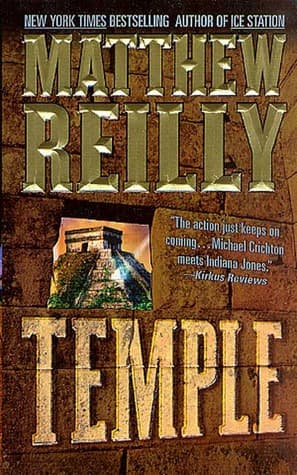
Matthew Reilly (1999)
Genre
Thriller / Fantasy / Historical Fiction / Mystery / Science Fiction
Reading Time
523 min
Key Themes
See below
Sign in to track this book
An American linguist races a shadowy group and ancient Incan guardians to find a hidden, alien idol in the Peruvian jungle—an artifact with the power to save or destroy humanity.
In the remote Peruvian jungle, a US Army Special Forces team, led by Captain Sarah Bell, finds an ancient Incan temple. Inside, they see strange carvings and a unique stone idol that gives off unusual energy. In Washington D.C., William Race, a smart but disgraced linguist, is recruited by General Schofield of the US Army. Schofield reveals that the idol, called the 'Huaca,' is believed to be from space and has immense, possibly destructive power. Race's knowledge of ancient languages is needed to decipher clues to its location and purpose, as the US military wants to secure it before it falls into the wrong hands.
Race is flown to Peru and meets his military escort and the realities of jungle operations. He meets Captain Bell, who is at first unsure about his academic background but respects his knowledge. The team, including Sergeant 'Gunny' Gus, a cynical soldier, begins their trek through the Amazon rainforest, following Schofield's initial coordinates. Race struggles with the physical demands and constant threats of the jungle, but his drive to understand the Huaca's secrets keeps him going. They face natural obstacles and signs of others in the area, increasing the tension.
As Race's team gets closer to the temple, they find signs of hostile forces: a German mercenary group led by Colonel Horst Richter. Richter is also looking for the Huaca, working for an unknown powerful entity. A firefight breaks out, causing casualties on both sides. Race, new to combat, is forced to fight, relying on the soldiers for protection. They also find ancient Incan booby traps and defenses designed to protect the temple, showing the Incans knew of the Huaca's danger and actively hid it.
Under constant threat, Race works to decipher the Incan hieroglyphs and pictograms on stone tablets and temple walls. He discovers that the Huaca is not just an idol but a device of immense power, able to control fundamental forces. The Incans, according to the texts, were its guardians, tasked with preventing its activation. The writings describe a prophecy of global destruction if the Huaca is misused, making their mission even more urgent. Race realizes the 'treasure' is not power, but preventing disaster.
Following Race's interpretations, the team finds the lost city of Paititi, a wonder of ancient engineering hidden in the jungle. The city is a maze of temples, plazas, and sophisticated traps, more advanced than anything they've seen. As they move towards the central temple where the Huaca is believed to be, they face deadly pressure plates, poisoned darts, collapsing floors, and automated defenses. The German mercenaries are close behind, forcing the US team to move quickly while also dealing with the city's guardians.
Within Paititi, Race's team meets a small, isolated tribe, the last descendants of the Incans who guarded the Huaca. Led by a wise elder, they are at first hostile, seeing all outsiders as threats. Race, using his language skills and knowledge of their history, communicates with them, explaining their shared goal of preventing the Huaca's misuse. He earns their trust by showing respect for their traditions and understanding of the prophecies. The tribe, though small, knows the temple's layout and defenses, offering help against the mercenaries.
The US team, now helped by the indigenous guardians, and Richter's mercenaries meet at the central chamber where the Huaca is. A brutal battle breaks out inside the ancient temple. The indigenous warriors, using their knowledge of the terrain and traditional weapons, fight alongside the US soldiers against the mercenaries. Captain Bell shows strong combat leadership, while Race, an academic, uses his wit and understanding of the temple's mechanics to help his allies. Casualties increase on all sides as the fight for the prize intensifies.
Colonel Richter, despite heavy losses, reaches the Huaca. It is revealed that he works for a global organization, not just for himself, and their goal is to use the Huaca as a weapon. Richter tries to activate the idol, following instructions. As he does, the Huaca begins to hum with ominous energy, causing seismic tremors and strange atmospheric phenomena in the temple. Race realizes Richter is causing a catastrophic event, and the ancient Incan prophecies of planetary destruction begin to appear, threatening to tear reality apart.
With the Huaca humming with destructive energy, Race understands that simply taking it is not enough; it must be deactivated or stabilized. Using all his linguistic and mythological knowledge, combined with his observations of the Huaca's unique properties, he attempts a desperate, complex sequence of actions to disarm it. This involves manipulating ancient mechanisms and chanting forgotten words, all while the temple crumbles around him and Richter's remaining forces try to stop him. Race faces the immense strain of the Huaca's power, risking his life to prevent a global disaster.
Race deactivates the Huaca, but at a cost to himself and the temple. The destructive energy fades, leaving the chamber devastated but the world safe. Richter is either killed or captured, and his organization's plans are stopped. The remaining US soldiers and indigenous guardians secure the area. General Schofield arrives to oversee the cleanup. Race insists that the Huaca's secrets must be re-buried and protected, arguing that humanity is not ready for such power. The US Army, recognizing the danger, agrees to hide the Huaca's existence and location again, ensuring it remains a buried secret.
The Protagonist
From a reluctant academic thrust into danger, Race evolves into a heroic figure who uses his intellect to prevent global destruction, ultimately accepting the burden of guarding ancient secrets.
The Supporting
Bell learns to trust and value intellect over pure force, broadening her perspective on what constitutes strength and leadership.
The Antagonist
Richter remains consistently villainous, serving as the primary human obstacle to the protagonists' mission, ultimately meeting a violent end.
The Supporting
Gus maintains his cynical but loyal nature, providing steadfast support and a grounded perspective throughout the perilous journey.
The Supporting
Schofield moves from a distant, commanding figure to someone who acknowledges the profound and dangerous nature of the Huaca, ultimately agreeing to its re-burial.
The Supporting
The Elder moves from suspicion to alliance, sharing ancient knowledge to protect his people's legacy and the world.
The Antagonist
The organization's presence remains largely unseen but serves as the ultimate antagonist, representing a persistent threat to global safety.
The novel explores the idea that some ancient artifacts have power beyond human understanding. The Huaca, an alien device, is not a treasure to be desired, but a planet-killer the Incans rightly tried to bury. This theme appears when Race deciphers the Incan warnings, revealing prophecies of global destruction if the Huaca is misused, and ends with Richter trying to activate it, causing seismic events and threatening to unravel reality.
“Some treasures are meant to stay buried.”
The story first contrasts the military's practical, scientific approach with ancient cultures' beliefs. Race, a linguist, bridges this gap, translating ancient 'mythology' into warnings about real, destructive technology. The Incans' 'gods' and 'prophecies' are shown to be their scientific understanding and historical accounts of the Huaca's true, catastrophic potential. This connection is key when Race uses both ancient rituals and scientific understanding to disarm the Huaca, showing that advanced ancient knowledge can seem like 'magic' to modern science.
“What they called magic, we would call physics.”
Human greed and ambition are a central theme, shown by Colonel Richter and the organization he serves. Their relentless search for the Huaca, despite its clear danger, highlights humanity's tendency to seek power at any cost. Richter's willingness to sacrifice lives and risk global disaster for an unknown agenda shows the corrupting influence of unchecked ambition. This sharply contrasts with the selfless duty of the Incans and Race's team to protect the world, rather than exploit it.
“Man's desire for power will always outweigh his fear of consequences.”
Race, the linguist, carries the heavy burden of understanding the Huaca's true nature and the catastrophic results if it is unleashed. His knowledge, initially academic, becomes a deep responsibility for the world's fate. The indigenous guardians also carry this burden, having protected the Huaca for centuries. The theme explores the moral problem of having dangerous knowledge and the need to act responsibly, even at great personal cost, to prevent its misuse. Ultimately, the decision to re-bury the Huaca means accepting this eternal responsibility.
“To know is to bear the weight of the world.”
A mysterious, powerful object that drives the plot.
The Huaca serves as the central MacGuffin of the story. It is an ancient, extraterrestrial idol with immense, destructive power that all factions are seeking. Its true nature and capabilities are gradually revealed throughout the narrative, driving the characters' motivations and the escalating conflict. While its specific powers are critical to the climax, the primary function of the Huaca as a plot device is to set the entire adventure in motion and provide a tangible goal for both the protagonists and antagonists, without necessarily being fully understood by the audience until later.
Pre-existing texts foretelling future events or dangers.
The ancient Incan texts and prophecies discovered by Race are a crucial plot device. They don't just provide clues to the Huaca's location but, more importantly, warn of its cataclysmic potential if activated. These prophecies elevate the stakes from a simple treasure hunt to a race against global destruction. They serve to deepen the mystery, provide exposition about the Huaca's history, and establish a sense of impending doom, guiding Race's actions and reinforcing the urgency of his mission to prevent the prophesied apocalypse.
A character placed in an unfamiliar and challenging environment.
William Race embodies the 'fish out of water' trope. As an academic linguist, he is completely unsuited for the harsh realities of jungle warfare and survival. His initial discomfort, physical ineptitude, and reliance on the soldiers for protection highlight the stark contrast between his intellectual world and the brutal physical demands of the mission. This device generates both humor and tension, emphasizing the extraordinary nature of his task and making his eventual contributions, based purely on intellect, all the more impactful and heroic.
A powerful, mysterious antagonist operating from the shadows.
The shadowy global organization that employs Colonel Richter acts as the unseen mastermind. This device creates a sense of a larger, more insidious threat beyond the immediate conflict, implying that the struggle for the Huaca is part of a grander, more dangerous scheme. By keeping the true leaders and their ultimate motivations obscured, the device fosters suspense and suggests that even after the immediate threat is dealt with, a deeper, more pervasive danger still lurks, potentially for future stories or as a lasting sense of unease.
“The secret, he knew, was not to think about it. Not to dwell on the impossible odds, the certain death that awaited them. Just to do it.”
— Main characters facing an overwhelming challenge in the temple.
“History, he had learned, was often written by the victors, and sometimes, the victors were very, very good at lying.”
— Professor Temple considering historical accounts of ancient civilizations.
“There were some things, he reflected, that even modern technology couldn't prepare you for. Like a screaming, six-ton gorilla.”
— A character encountering a formidable creature in the temple.
“Every legend, no matter how outlandish, had a kernel of truth at its heart. It was just a matter of digging deep enough to find it.”
— Professor Temple's approach to investigating ancient myths.
“The jungle didn't care about your plans, your maps, or your advanced training. It just wanted to consume you.”
— Characters struggling against the harsh environment of the Amazon jungle.
“Sometimes, the greatest treasures weren't gold or jewels, but knowledge. Knowledge that could change the world.”
— Professor Temple reflecting on the true value of the temple's secrets.
“Fear was a luxury they couldn't afford. Not now. Not ever.”
— Characters in a life-or-death situation, suppressing their fear.
“The past wasn't dead; it was just waiting. Waiting to be found, waiting to be understood.”
— Professor Temple's philosophy on archaeology and ancient civilizations.
“He understood then that true power wasn't about weapons or armies, but about controlling information.”
— A character realizing the strategic importance of the temple's secrets.
“The line between genius and madness was often blurry, especially when dealing with the truly ancient.”
— Professor Temple pondering the creators of the temple and their motives.
“To survive, sometimes you had to do things you never thought yourself capable of. Unspeakable things.”
— A character making difficult moral choices in a desperate situation.
“The greatest dangers were often the ones you couldn't see, the ones that lurked in the shadows of your own mind.”
— Characters dealing with psychological stress and unseen threats.
“He knew, with a chilling certainty, that some doors were meant to remain closed. And some secrets, buried forever.”
— Professor Temple contemplating the consequences of uncovering ancient truths.
“The world was a far stranger place than anyone truly understood, filled with wonders and horrors beyond imagination.”
— Professor Temple reflecting on the discoveries made within the temple.
Ready to see how well you understood this book? Take our interactive quiz with 10 questions.

Biography coming soon.







