“The only thing that makes life possible is that you can get over things. It’s a terrible and wonderful thing, to get over things.”
— Therru reflecting on her past trauma and the nature of healing.

Ursula K. Le Guin (1990)
Genre
Fantasy / Science Fiction / Young Adult
Reading Time
350 min
Key Themes
See below
Sign in to track this book
A former priestess and a broken wizard, united by a daring escape, must rekindle their magic and wisdom to shelter a scarred child from a world that fears her.
Tenar, once Arha of Atuan and later Ged's companion, now lives as Goha, a farmer's widow on Gont. She has built a simple, fulfilling life with her two grown children, Lebannen and Seserakh, and her adopted daughter, Therru. Therru is a young girl with a severely burned face and hand, a victim of abuse. Tenar found Therru abandoned and took her in, giving her the love and care she needed. Tenar's days are filled with farm life, tending to animals and garden, and raising Therru, who remains largely silent due to her trauma. The peace of their lives contrasts with Tenar's past as a priestess and her adventures with Ged.
One day, a ship arrives at the Gontish harbor, bringing news that Ged, the former Archmage of Roke, is on board. The Ged who disembarks is not the powerful wizard Tenar remembers; he is an old, frail man, his face scarred and his magic gone. He sacrificed his powers to mend the world's rupture caused by Cob's spell, saving Earthsea but leaving him broken. Tenar is saddened by his state, recognizing his great loss. She takes him into her home, offering him a place to recover and live in peace, treating him with the same gentle care she gives Therru. Ged struggles to adapt to a life without magic, feeling useless.
Under Tenar's patient care, Ged slowly begins to heal, both physically and emotionally. He finds comfort in the simple routines of farm life, learning to milk goats, tend the garden, and do other manual tasks. He shares stories with Tenar, recalling their past adventures and thinking about power and loss. Therru, initially wary of Ged, gradually finds quiet companionship with him. His presence brings a new dynamic to Tenar's household. The absence of his magic reminds them of his sacrifice, but he finds a new kind of strength and purpose in the everyday world.
As Ged settles into his new life, subtle disturbances begin to ripple through the quiet community. Animals behave strangely, shadows seem to lengthen, and an underlying unease fills the air. These are not the grand magical threats Ged once faced, but smaller, more insidious signs of imbalance. Tenar, with her connection to the land, senses these changes. Villagers speak of strange men passing through, and fear grows. It becomes clear that even without his powers, Ged's presence, and perhaps Therru's, attracts unwanted attention, hinting at a deeper threat to the world.
The subtle disturbances grow with the arrival of a group of ruthless men, led by Hand, a former wizard who uses dark practices. These men belong to a cult that seeks to control women, especially those with hidden powers. They are drawn to Gont's perceived weakness now that the Archmage is powerless. They threaten villagers, demanding tribute and asserting their dominance. Their presence creates fear over Tenar's farm, making her fear for Therru and Ged. Tenar, though a woman of peace, feels a fierce protective instinct, knowing she must defend her home and loved ones.
The conflict peaks when Hand and his men directly threaten Tenar's farm. In a moment of extreme danger, as Hand tries to seize Therru, the silent, scarred girl transforms. Her burned skin glows with an inner fire, and she speaks with immense power, revealing herself to be a dragon in human form, a creature of ancient magic. This sudden, awe-inspiring display frightens the raiders, driving them away. Tenar and Ged are stunned by this revelation, realizing that Therru is more than a traumatized child; she is a being of great importance to Earthsea, a living link to its primal forces.
After the confrontation, Therru, though still a child, understands her own nature more deeply. She explains, in her new voice, that she is a daughter of the dragons, a guardian of Earthsea's ancient balance. Ged and Tenar grapple with this revelation, recognizing the great responsibility and danger of protecting such a being. Ged, though without his own magic, understands the deep magic Therru embodies, a magic older and more fundamental than his wizardry. Her existence challenges their understanding of the world and their place in it, making them reconsider power and guardianship.
Throughout the story, Tenar reflects on the male-dominated structure of wizardry and society in Earthsea, where women's magic is often dismissed or feared, and their roles are largely domestic. She sees how men, like Hand, seek to control. This contrasts with the nurturing, life-giving power traditionally associated with women. The arrival of the raiders, who embody this oppressive masculinity, highlights the struggle for power and respect. Tenar, a woman who has chosen a life outside conventional expectations, asserts her strength and agency, challenging the assumptions of the male-dominated world. She recognizes the value and power in traditionally feminine roles and wisdom.
Ged, initially consumed by grief over the loss of his magic, gradually finds peace and acceptance. He learns to appreciate the simple joys of everyday life and human connection. He realizes that true power is not solely magic, but also compassion, wisdom, and the ability to care for others. His relationship with Tenar, built on mutual respect and shared history, helps him navigate this change. He becomes a mentor to Therru in a new way, offering guidance not through spells, but through quiet understanding and a deep connection to the living world. He finds a new identity as a wise elder, a friend, and a guardian.
With Therru's true nature revealed and the immediate threat gone, Tenar, Ged, and Therru look toward a future where their roles are intertwined. Tenar, the grounded woman, continues to provide stability and love. Ged, the former wizard, offers wisdom and a deep understanding of the world's balance, even without his magic. Therru, the dragon-child, bridges humanity and Earthsea's ancient forces. Their shared experiences create a strong bond, showing that strength comes in many forms. The future of Earthsea may depend on a blending of seemingly different powers: the everyday, the wise, and the ancient. They form a new kind of family, ready to face future challenges, united by love and a shared destiny.
The Protagonist
Tenar deepens her understanding of power, recognizing its diverse forms beyond magic, and fully embraces her identity as a strong, self-possessed woman and guardian.
The Co-Protagonist
Ged transforms from a powerful wizard to a wise elder, accepting his powerlessness and finding a new form of strength and purpose in compassion and connection.
The Central Figure
Therru transforms from a traumatized, silent victim into a powerful, self-aware being who embraces her true nature as a dragon-child.
The Antagonist
Hand remains a static character, serving as an embodiment of patriarchal corruption and ultimately being defeated by Therru's true power.
The Supporting
Lebannen remains a constant, supportive presence, representing the grounding force of family and the ordinary world.
The Supporting
Seserakh remains a constant, supportive presence, representing the grounding force of family and the ordinary world.
The novel redefines 'power.' Initially, power is Ged's wizardry, but his loss of magic forces a new understanding. Tenar's strength is her nurturing, practical wisdom, and connection to the Earth, showing a feminine power often undervalued. Therru's transformation reveals an ancient, primal power inherent in the world, beyond human magic. The story contrasts the destructive, controlling power sought by men like Hand with the life-affirming, protective power of Tenar and Therru, suggesting that true power resides in balance, connection, and self-knowledge, rather than domination.
“He had forgotten that there was a power in women too, not of the staff and the word, but of the flesh and the earth.”
Ged's journey is central to this theme. He struggles with the great loss of his magic, which he sees as his identity. His search for meaning in a life without power reflects the universal challenge of accepting change and limitations. Tenar, having also experienced loss and transformation, guides him. The story explores how one finds new purpose and peace not by regaining what was lost, but by embracing a new identity and appreciating what remains, especially human connection and life's simple joys. This theme is also in Therru's healing from trauma.
“What good is a wizard without his wizardry?”
The novel champions feminine strength, often overlooked in the male-dominated world of wizardry. Tenar, as a farmer's widow, embodies grounded wisdom, resilience, and a deep connection to life and the earth. Her care for Therru and Ged, and her ability to sustain life on her farm, are powerful acts. The patriarchal structures of Earthsea, where women's magic is often dismissed or feared, are critiqued. Therru, as the dragon-child, further symbolizes this, representing an ancient, untamed, and benevolent feminine power essential to the world's balance, challenging traditional, masculine views of power.
“I will not be a tool. I will not be a slave. I am a woman.”
Tehanu blurs the lines between the ordinary and the extraordinary. Tenar's farm life, with daily chores and nature's rhythms, has as much significance as Ged's past magical feats. The novel suggests that true magic is not always grand spells but can be found in everyday acts of love, care, and connection to the living world. Ged's adjustment to a non-magical life highlights the beauty and value of the mundane. Ultimately, Therru's revelation as a dragon-child, immense magic hidden within a seemingly ordinary, damaged child, signifies the deep connection of the two realms, suggesting that magic is inherent in existence, not just a separate force.
“There are powers in the world that are not of men, and not of the mind, and not of the will, but of the earth.”
Characters who have suffered profound loss or trauma become agents of healing for others.
Both Ged and Therru embody this device. Ged, having lost his magic and suffered greatly, is nursed back to health by Tenar, and in turn, his quiet presence and understanding help Therru to heal. Therru, scarred and traumatized, ultimately reveals a powerful, ancient healing force. Their shared vulnerability and journey of recovery highlight the idea that one's own wounds can foster empathy and the capacity to bring solace and strength to others. This device emphasizes that healing is often a reciprocal process, and that profound suffering can lead to profound wisdom and a unique ability to connect.
A powerful figure returns to a humble, familiar setting, forcing a re-evaluation of identity.
Ged's return to Gont, his childhood home, but as a powerless old man, serves as a powerful instance of this device. Having been the Archmage, the most renowned wizard in Earthsea, his retreat to Tenar's simple farm forces him to shed his public identity and confront who he is without his extraordinary abilities. This return to the familiar, yet changed, setting allows for introspection and the development of a new, more grounded self. It highlights the contrast between his past grandeur and his present humility, facilitating his acceptance of his new reality and the discovery of inner strength beyond magic.
An unassuming character possesses immense, undiscovered abilities that emerge in crisis.
Therru is the primary manifestation of this device. For much of the story, she is a silent, traumatized, and physically scarred child, seemingly vulnerable and powerless. However, in a moment of extreme danger, her true nature as a dragon-child, a being of immense, ancient power, is dramatically revealed. This device builds tension and delivers a powerful, unexpected climax, demonstrating that true strength can be hidden beneath the surface and that appearances can be deceiving. It also suggests that the most profound powers may not be those that are openly displayed or understood, but those that lie dormant, waiting for the right moment to emerge.
The everyday acts of home, care, and family are elevated to a profound, almost spiritual significance.
This device is central to Tenar's character and the overall message of the novel. Her life on the farm, her tending to animals, gardening, and nurturing of Therru and Ged, are presented not as mundane chores but as acts of profound importance. The stability, love, and healing found within her home are portrayed as essential forces, as vital to the world's balance as any wizardry. This device challenges the traditional fantasy emphasis on grand quests and magical battles, suggesting that the true strength and meaning of life, and indeed the world, can be found and preserved in the quiet, consistent acts of care within a domestic sphere. It elevates the 'feminine' realm to a position of sacred power.
“The only thing that makes life possible is that you can get over things. It’s a terrible and wonderful thing, to get over things.”
— Therru reflecting on her past trauma and the nature of healing.
“Power is a thing that lives in the mind. It’s a thing that can be given, and can be taken away. It’s a thing that can be used, for good or for ill.”
— Tenar discussing the nature of power with Lebannen.
“A woman’s power is not a man’s power. It is different. It is of the earth, and of the body, and of the heart.”
— Tenar contemplating the distinct forms of power held by women.
“To be whole, you must be broken. To be strong, you must be weak. To be wise, you must be foolish.”
— An old saying that Tenar recalls, reflecting on paradoxes of life.
“Sometimes a man needs a woman to be his friend, not his wife, not his mother, not his daughter. Just his friend.”
— Ged's thoughts on his relationship with Tenar.
“There are no easy answers. Only hard choices.”
— Tenar facing difficult decisions about her life and responsibilities.
“The earth is not a possession. It is a being. It is our mother. We are part of it, and it is part of us.”
— Tenar's deep connection to the land and her understanding of nature.
“To truly see, you must look with your heart, not just your eyes.”
— Tenar teaching Therru about deeper perception.
“Silence is not empty. It is full of answers.”
— Ged finding peace and understanding in quiet contemplation.
“Love is not a gift. It is a choice. And a choice must be made every day.”
— Tenar reflecting on the sustained effort required in loving relationships.
“The past is not dead. It is alive in us. It shapes us, and we shape it.”
— Characters grappling with the lasting effects of past events.
“Freedom is not the absence of chains, but the presence of choice.”
— Tenar considering the nature of true liberty for herself and others.
“Sometimes the greatest courage is not to fight, but to endure.”
— Therru's quiet strength in facing her difficult circumstances.
“A story is not just words. It is a living thing. It grows and changes with the telling.”
— The importance of narrative and oral tradition in Earthsea.
Ready to see how well you understood this book? Take our interactive quiz with 10 questions.
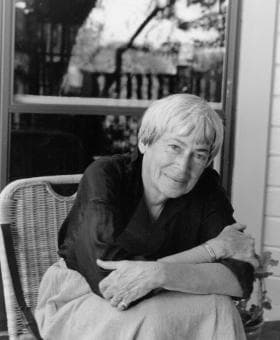
Ursula Kroeber Le Guin was an American author best known for her works of speculative fiction, including science fiction works set in her Hainish universe, and the Earthsea fantasy series. She was first published in 1959, and her literary career spanned nearly sixty years, producing more than twenty novels and over a hundred short stories, in addition to poetry, literary criticism, translations, and children's books. Frequently described as an author of science fiction, Le Guin has also been called a "major voice in American Letters". Le Guin said she would prefer to be known as an "American novelist".







